It’s completely normal to have butterflies before your Florida behind the wheel test. But trust me, walking in knowing exactly what’s going to happen is the best way to turn those nerves into pure confidence.
This isn’t some mystery exam designed to trip you up. It’s a practical, straightforward check of your driving skills. Think of it as your chance to show the examiner you can safely handle a car, follow the rules of the road, and react to whatever comes your way.
What to Expect on the Florida Driving Test
The day of your driving test should feel predictable. The whole process is standardized, so every new driver is measured against the same benchmarks. When you pull up, the examiner will walk you through everything, starting with a quick look at your vehicle and finishing with a review of how you did.
Your job is simple: drive safely and show you’re competent. The examiner isn’t there to catch you in a "gotcha" moment. They just want to confirm you can manage everyday driving situations with calm control. They'll be watching everything, from the moment you buckle up to how you scan for traffic at intersections.
The Grader's Perspective
It really helps to put yourself in the examiner’s shoes. They’re doing more than just checking off boxes. They're evaluating your overall awareness and how you make decisions on the fly. Every instruction is a new opportunity to prove you’re a safe, responsible driver.
Their entire assessment really boils down to three core things:
- Vehicle Control: How well do you handle the car? This means smooth acceleration and braking, precise steering, and nailing those parking maneuvers.
- Observation Skills: Are your eyes constantly moving? They need to see you checking your mirrors, looking over your shoulder for blind spots, and scanning the road ahead for any potential issues.
- Following Traffic Laws: This is a big one. It means obeying speed limits, coming to a complete stop at stop signs, and knowing when to yield the right-of-way.
Key Takeaway: The examiner is looking for a driver who is predictable, cautious, and in control. They want to see you prioritize safety over speed and that you’re actively aware of what's happening around you.
The Initial Vehicle Checklist
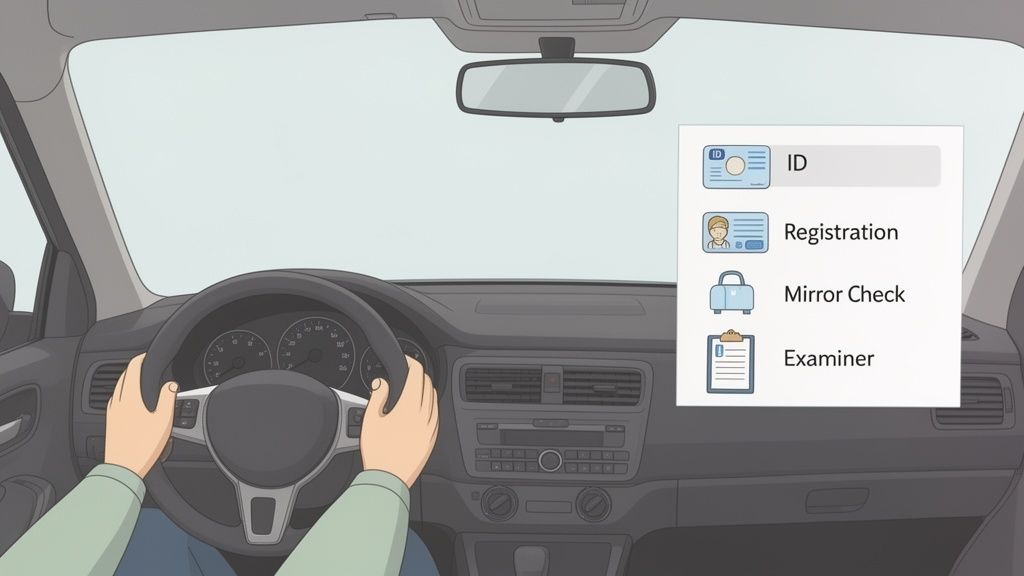
Before you even turn the key, the test begins with a pre-drive safety check of your vehicle. A lot of people don't realize this, but you can fail right here before you even leave the parking spot. You’ll need to show the examiner that all the essential equipment works.
Get ready to operate these on command:
- Headlights (both high and low beams)
- Turn signals (left and right)
- Brake lights
- Emergency flashers (your hazard lights)
- Windshield wipers
- The horn
Also, make sure your car is reasonably clean, has at least half a tank of gas, and, crucially, has no warning lights on the dashboard. Showing up in a car that isn't in safe condition is an automatic test disqualification. For a quick brush-up, the official Florida driver's handbook covers all of this in detail.
To make this even easier, here’s a quick-glance table to help you prepare.
Florida Driving Test Quick Checklist
| Requirement Category | What You Need | Why It Matters |
|---|---|---|
| Paperwork | Valid Learner's Permit, Proof of Insurance & Registration | You can't take the test without the right documents. No exceptions. |
| Vehicle Condition | Working signals, lights, horn, and wipers. No warning lights. | A vehicle that isn't road-safe is an automatic fail before you start. |
| Key Maneuvers | 3-Point Turn, Straight-In Parking, Backing Up | These are fundamental skills that demonstrate your control of the vehicle. |
| Road Skills | Stopping, turning, changing lanes, observing traffic | The examiner needs to see you can navigate real-world traffic safely. |
This checklist is your bare-bones guide to being ready. Get these things right, and you're already halfway to passing.
How the Test Is Scored
The Florida behind the wheel test uses a point system. You start out with a perfect score, and the examiner subtracts points for any mistakes you make. Little things, like turning a bit too wide or braking a little late, might cost you a few points.
But then there are the "critical errors." These are the deal-breakers that will cause you to fail on the spot.
A critical error is any action that’s illegal or immediately dangerous to you, the examiner, or anyone else on the road. Think running a red light, blowing through a stop sign, or forcing another driver to slam on their brakes to avoid hitting you. Knowing what not to do is just as important as mastering the maneuvers. We'll dig deeper into those specific skills and common pitfalls in the next sections.
Getting Your Paperwork and Requirements in Order
Believe it or not, the first part of passing your driving test happens before you even get in the car. Showing up with the wrong documents is one of the most common—and frustrating—reasons people get turned away from the DMV. A little bit of prep work here saves you a massive headache later.
The Florida Department of Highway Safety and Motor Vehicles (FLHSMV) needs to be certain about who you are and where you live. Think of it less like a chore and more like building a solid case for why you should be on the road.
What to Bring: Identity, Social Security, and Residency
First up, you need to prove your identity. The easiest way is with an original U.S. birth certificate or a valid U.S. passport. If you’re not a U.S. citizen, documents like a Permanent Resident Card (often called a Green Card) or specific immigration paperwork will be required. A critical point here: they will not accept photocopies. You need the real deal or a certified copy.
Next, you have to show proof of your Social Security number. The actual card is best, but if you can’t find it, a recent W-2 form or a pay stub that clearly shows your full name and SSN will work just fine.
Finally, you’ll need to prove you're a Florida resident with two different documents. This is where people sometimes get tripped up. Good options include:
- A recent utility bill (like power, water, or cable) with your name on it.
- A bank or credit card statement mailed to your home.
- Your current lease or rental agreement.
- A Florida voter registration card.
The key is that both documents must clearly show your name and your current physical address. If you're a minor living at home, your parent or guardian will likely need to sign a form to certify your address.
Extra Rules for Teen Drivers
If you’re under 18, Florida has a couple of extra hoops to jump through. You must have held your learner’s permit for a full 12 months without getting any traffic tickets. This isn't just a random waiting period; it's designed to make sure you get enough real-world practice before you go solo.
A Quick Note for Parents: You'll need to sign a Certification of Minor Driving Experience Form. This is your official word that your teen has completed at least 50 hours of supervised driving, and that 10 of those hours were at night. Take this seriously—it’s a legal document confirming their on-road experience.
For teens just starting this journey, our guide on how to get a driver's permit breaks down all the initial steps you'll need to take.
How to Schedule Your Test Appointment
You can’t just walk into the DMV anymore and hope to take your test. You absolutely have to schedule your behind the wheel test online using the FLHSMV appointment system. Slots can fill up incredibly fast—sometimes weeks or even months out—so don't wait until the last minute to book.
If your local office looks completely booked, don't give up. People cancel all the time, so check the portal frequently for newly opened slots. Here’s a pro tip: try looking at service centers in smaller, less-populated towns nearby. They often have much better availability. Make sure you have your learner's permit number handy when you book, and double-check that all your information is correct. Showing up on time with the right papers and a confirmed appointment starts the whole day off on the right foot.
Mastering the Core Driving Maneuvers
This is it—the part of the behind the wheel test where the rubber really meets the road. It’s not about what you know from a book; it’s about showing the examiner you have smooth, confident control over the vehicle. They need to see that you’ve built the muscle memory to handle common driving situations safely and without a second thought.
Think of each maneuver as its own little pop quiz, checking different parts of your driving skill set. A three-point turn tests your spatial awareness in tight quarters, while backing up in a straight line shows your precision with steering. Getting these right isn't just about passing a test; it's about building the foundation for a lifetime of safe driving.
As you’re gathering your paperwork, it’s the perfect time to start mapping out how you’ll practice these critical skills. The process starts with getting the administrative side handled first.
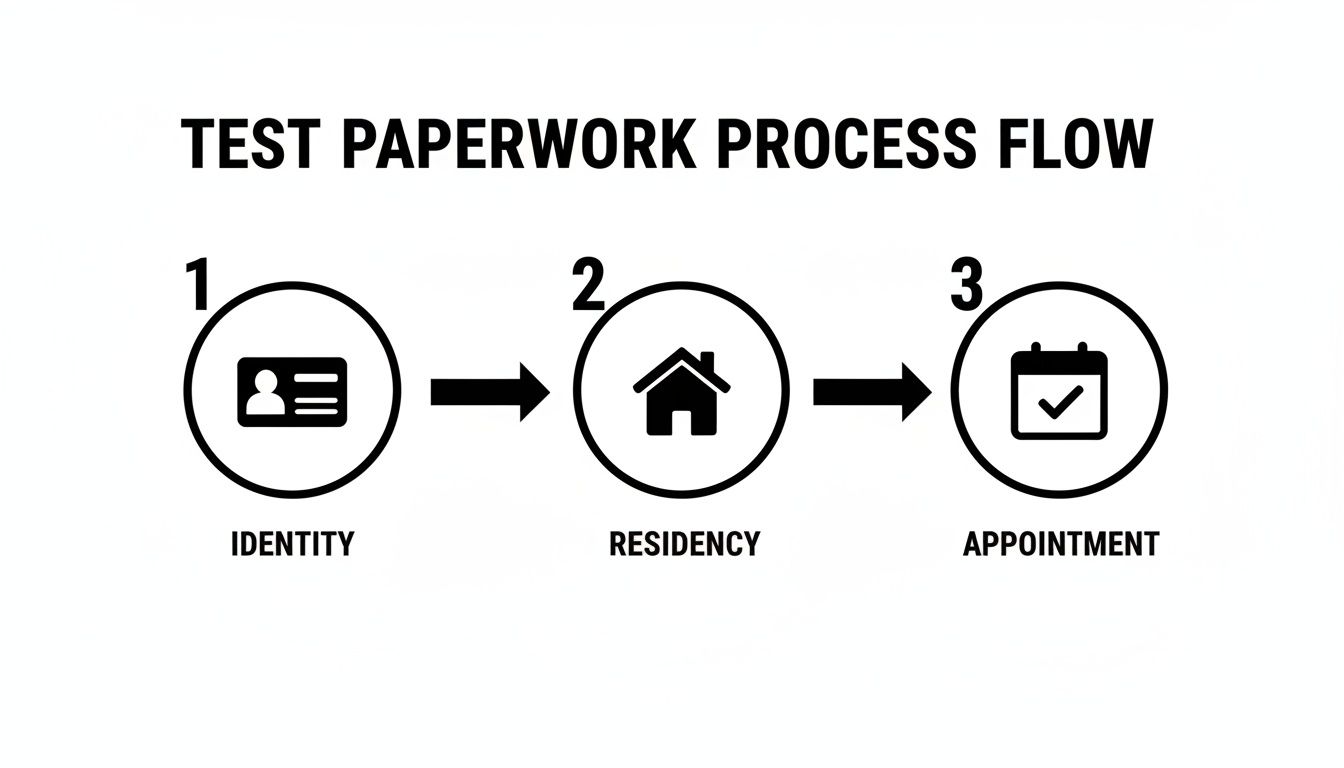
Getting your identity, residency, and appointment details locked in early frees you up mentally, so you can focus 100% on the driving drills ahead.
Drills for Flawless Parking and Backing
Let's tackle two maneuvers that tend to give new drivers the most trouble: parking and backing up. The secret to both is simple—go slow and never stop looking around. Examiners care far more about your control and awareness than they do about your speed.
For backing up, you'll need to reverse in a straight line for about 50 feet without looking like you’re weaving down the road. Find a big, empty parking lot and use the painted lines as your guide.
- Practice Drill: Line your car up parallel to a parking line. Put your right hand on the back of the passenger seat and look directly over your right shoulder out the rear window. Your left hand should rest at the top of the steering wheel (the 12 o'clock position). Start creeping backward, making only tiny adjustments to the wheel to stay straight. Your main view is out the back; only take quick glances at your mirrors.
When it comes to parking, you'll almost certainly be asked to do a straight-in park, pulling headfirst into a space. Precision is the name of the game here.
- Practice Drill: Approach the parking space, leaving yourself enough room to turn in cleanly. Flip on your signal. As your side mirror passes the first line of the space you're aiming for, start your turn. Try to land right in the center and straighten out just before you pull all the way in. Stop before your tires bump the curb or cross the line at the front. Make sure to practice this from both left and right approaches.
An Examiner's Perspective: A classic mistake is turning too early or too late, which forces you to awkwardly correct your path. What they want to see is a smooth, single-motion entry into the space. Always finish the maneuver by shifting to park and engaging the parking brake.
Executing the Perfect Three-Point Turn
The three-point turn, sometimes called a K-turn, is the ultimate test of your ability to handle a car in a confined space. It's a required maneuver in Florida for a reason—it shows the examiner how you manage a low-speed, high-precision situation.
Here's how to break it down:
- First Move: Signal right, pull over to the curb, and stop. Once the coast is clear, signal left. Crank the steering wheel all the way to the left before you even start moving, then creep across the road until your front tires are just shy of the opposite curb.
- Second Move: Shift into reverse and immediately turn the steering wheel all the way to the right. Look back over your right shoulder and slowly back up just enough to give yourself clearance to pull forward. Keep scanning for traffic the entire time.
- Third Move: Shift back into drive, turn the wheel to the left, and accelerate smoothly to straighten out in the proper lane.
Find a quiet residential street and practice this until the sequence feels completely natural. The most important part of this whole maneuver is constant observation. You need to be looking up and down the road before, during, and after every single movement.
Nailing the Quick Stop and Intersections
While most of the test focuses on smooth control, the quick stop is designed to see how you react in a pinch. The examiner will have you drive around 20 mph and then suddenly tell you to stop quickly and safely.
The idea is to stop firmly without skidding or locking up the brakes. You need to apply strong, steady pressure to the brake pedal. It shouldn’t be a jarring, violent slam, but it definitely needs to be harder and faster than a typical stop.
Finally, getting through intersections correctly is non-negotiable. Examiners will be watching you like a hawk for these things:
- Complete Stops: Your car has to come to a full, motionless stop behind the white line. No "California rolls" allowed.
- Scanning: They need to see your head physically turn—look left, then right, then left again—before you pull out.
- Yielding: You have to know who has the right-of-way and yield properly to other cars and pedestrians.
If parking is still a major source of stress, take a look at our detailed guide on how to master parallel parking step-by-step. Many of the same principles of slow speed and constant observation apply to all parking maneuvers.
Critical Errors That Lead to an Automatic Fail
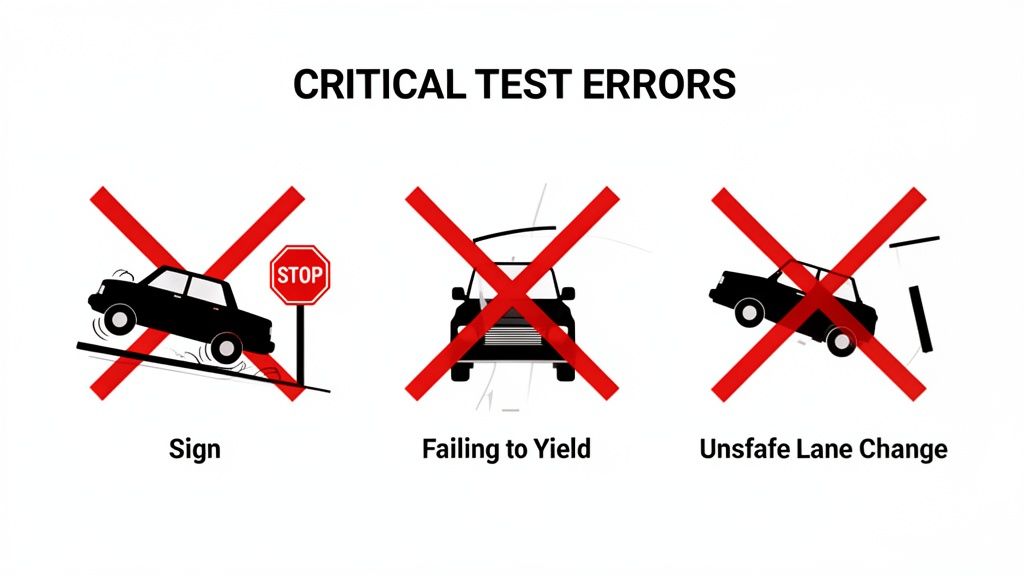
While you can lose a few points here and there for small mistakes, some actions will bring your behind the wheel test to an immediate halt. These are the "automatic fails"—the critical errors that signal to the examiner that you're just not ready for the responsibility of a driver's license.
Think of it this way: knowing what not to do is just as important as perfecting your three-point turn. The examiner's main job is to ensure you won't be a danger to yourself or others. Committing one of these errors shows them you're a potential risk, and that’s a non-starter.
Violating Traffic Controls and Signs
This one is about as straightforward as it gets. Stop signs, traffic lights, and yield signs are the fundamental rules of the road. Blatantly ignoring them is a massive red flag.
One of the most common ways people fail here is the "rolling stop." You might think you've stopped, but if the wheels never fully cease their motion behind that white line, the examiner will mark it as running the sign. The same goes for misreading a traffic light, like turning left on a solid green without yielding to oncoming cars.
Failing to Yield the Right-of-Way
Driving is a cooperative activity. A huge part of that is knowing when it's your turn to go and, more importantly, when it isn't. If you force another driver or a pedestrian to slam on their brakes or swerve to avoid you, your test is likely over.
Here are a few classic examples I've seen trip people up:
- At intersections: Simply pulling out in front of another car that clearly has the right-of-way.
- With pedestrians: Failing to give a pedestrian their space in a marked (or even unmarked) crosswalk.
- Changing lanes: Cutting someone off so aggressively they have to brake hard to avoid hitting you.
These situations show the examiner you can't properly judge speed and distance yet. When in doubt, just wait. It's always better to be a little too cautious than to cause a near-miss. For a full breakdown, check out our guide covering right-of-way rules at intersections.
Unsafe Actions and Lack of Vehicle Control
This category covers any action that just screams "unsafe." Even if you don't break a specific traffic law, if you show a fundamental lack of control over the car, you're going to fail. These are the mistakes that make an examiner's heart skip a beat.
Common test-enders include:
- Striking an object: Hitting a curb, a traffic cone, or anything else is a clear sign you don't have full control of the vehicle's dimensions.
- Driving too fast for conditions: Speeding is an obvious fail, but so is going the speed limit in heavy rain or a packed parking lot where a slower speed is clearly necessary.
- Examiner intervention: This is the big one. If the examiner has to grab the wheel or hit their brake pedal, the test is over, full stop. It's the ultimate proof that you were about to cause an accident.
Expert Insight: Remember, the examiner's #1 priority is safety. They would much rather fail a nervous driver who makes a few minor mistakes than pass a confident driver who takes unnecessary risks. If you make them feel unsafe, you're not going to pass.
This isn't just a Florida thing, either. Getting a license is getting tougher everywhere. For example, first-time pass rates for the practical driving test in the UK have fallen to just 45.7% for young drivers, largely because the tests have gotten more rigorous.
The takeaway here is simple: avoid these critical errors by being patient, observant, and putting safety first. Understand what the examiners are looking for, and you'll sidestep the mistakes that end a driving test before it really even begins.
Your Test Day Strategy for Success
How you handle the hours right before your behind-the-wheel test can be just as critical as all the practice you’ve put in. Think of it as a pre-game ritual—a smart strategy to walk into the FLHSMV office feeling calm, focused, and ready. It really starts the night before.
The Night Before: Setting the Stage
Your main goal is to wake up without a single thing to worry about except driving. Lay out your clothes. Get that folder with all your documents and put it right next to your car keys. This sounds simple, but it completely eliminates that morning scramble that sends your stress levels through the roof.
And please, get a good night's sleep. I can't tell you how many students think staying up late to "mentally review" is a good idea. It isn't. A tired brain is a slow brain, and you need to be sharp and reactive for the examiner.
The Morning of Your Driving Test
Give yourself plenty of time on test day; rushing is your enemy. Have a decent breakfast—nothing too heavy or greasy that will make you feel sleepy. A little bit of protein goes a long way. Also, be mindful of the caffeine. A little is fine, but too much can amplify your nerves into full-blown jitters.
Before heading out the door, do one last walkthrough of your vehicle. It takes less than two minutes.
- Tires: Just a quick glance to make sure nothing looks low.
- Lights & Signals: Hop in and flick on your turn signals and tap the brakes (use a reflection if you can) to ensure everything is working.
- Mirrors & Windows: A quick wipe-down for a clear view is always a good idea. Make sure they’re adjusted perfectly for you.
Try to get to the test center about 15-20 minutes before your appointment. This is the sweet spot. It gives you time to park, use the restroom, and check in without feeling frantic. Any earlier, and you’ll just sit in your car overthinking everything. Use those few extra minutes to take some slow, deep breaths.
Interacting with Your Examiner
First impressions matter, even here. When the examiner gets in the car, greet them politely. They aren't trying to trick you; they're professionals with a job to do, which is to make sure you're a safe driver.
Listen—really listen—to their instructions. If you're unsure about a direction, it is 100% okay to ask them to repeat it. Simply saying, "I'm sorry, could you please repeat that?" shows you're engaged and careful. It’s always better to clarify than to guess and make a mistake.
Resist the urge to fill the silence with small talk. The examiner needs to concentrate on observing your skills, and a chatty driver can be a distracted driver. Just be pleasant, respectful, and keep your focus where it belongs: on the road.
Final Thought: Your driving test is just a performance of skills you've already practiced over and over. You’re not learning anything new today. Trust your training, stay in the moment, and just drive safely like you’ve been taught. You're ready for this.
How Professional Training Builds Test Day Confidence
Getting enough practice on your own is absolutely critical, but there's no substitute for the focused guidance you get from a certified driving instructor. Professional training is so much more than just logging hours behind the wheel. It’s where raw practice gets molded into real skill, building the muscle memory and quick-thinking awareness you need to nail the behind the wheel test.
A good instructor doesn't just teach you how to perform a maneuver; they help you build the calm, decisive mindset that examiners are really looking for.
Think of it as creating a dress rehearsal for the real test. Certified instructors know the Florida exam like the back of their hand—from the common routes used at the local DMV to the little habits that catch an examiner's eye. The one-on-one, in-the-moment feedback they provide is something a parent or friend just can't replicate. They can take a wobbly three-point turn or a nervous lane change and help you smooth it into a confident, fluid action.
Tailoring Instruction to Every Learner
Great driver education isn't a one-size-fits-all program. Every student is different. You might be a teenager just starting out or an adult who’s learning to drive for the first time—either way, the teaching style has to fit you.
This is where a professional instructor really shines. They’re trained to spot exactly where you're struggling, whether it's anxiety at busy intersections or trouble judging distance while parking. By applying adult learning theory principles, they can design specific drills and offer the right encouragement to help you clear those personal hurdles and build genuine confidence.
The real goal isn't just to pass the test. It's to build lifelong defensive driving habits that will keep you safe on the road for years to come. That focus on long-term safety is what sets quality driver education apart.
Reinforcing Safe Habits for All Drivers
Professional training isn't just for new drivers, either. If you’ve had a traffic ticket, an FLHSMV-approved Basic Driver Improvement (BDI) course can be a game-changer. These programs are designed to refresh and reinforce the crucial defensive driving skills that might have gotten a little rusty over time.
A BDI course zeros in on the fundamentals:
- Consistently understanding and applying right-of-way rules.
- Mastering safe following distances in all kinds of traffic and weather.
- Sharpening your hazard perception to spot potential dangers before they happen.
Revisiting these core ideas in a structured class helps correct bad habits and sharpens your on-road decision-making. Not only does this satisfy court requirements, but it also helps make Florida's roads safer for everyone. In the end, professional training turns the anxiety of a driving test into a story of success and safe, responsible driving.
Got Questions About the Florida Driving Test? We've Got Answers.
Even after hours of practice, it's completely normal to have a few last-minute questions swirling around before your big test day. Getting these cleared up can be the final piece of the puzzle, giving you the confidence you need to walk in feeling prepared. Let's dive into some of the questions we hear most often.
First up, the car. A lot of students ask if they need to bring their own vehicle. The answer is yes, you'll be testing in your own car. This means it must be properly registered and insured, and—this is a big one—it has to be in safe, working order. The examiner will do a quick vehicle check before you even start driving, so make sure your brake lights, turn signals, horn, and everything else are good to go.
Can I Use My Backup Camera?
This is probably one of the most common questions we get. You are allowed to use your backup camera during the Florida driving test, but there's a catch. You can't only use the camera.
The examiner needs to see that you're a safe, aware driver, which means you have to demonstrate that you're checking your surroundings the old-fashioned way.
Think of your backup camera as an extra tool, not your primary one. Your examiner will be watching to make sure you are still physically turning your head, checking your mirrors, and looking over your shoulder. That's a non-negotiable part of the test.
What Happens if I Don't Pass?
Failing the driving test is a setback, for sure, but it’s definitely not the end of the road. If it happens, the examiner will give you specific feedback on the skills you need to work on and why you lost points. This is actually valuable information.
- You'll have to wait a bit. Typically, you must wait at least one business day before you can try again.
- There's another fee. You will have to pay the re-testing fee when you book your next appointment.
- It's a chance to improve. Take the examiner's feedback seriously. It’s a road map for exactly what you need to practice before you go back.
Knowing what to expect if things don't go perfectly can take a lot of the pressure off.
At BDISchool, our goal is to get you passed on the first try by building the real-world skills and confidence you need to be a safe driver for life. Our programs are approved by the FLHSMV and are designed to cover exactly what's on the Florida driving test. Enroll in a course today and get on the fast track to getting your license.