Facing the Florida learner's permit exam can feel pretty intimidating, but the best way to tackle it is actually simpler than you might think. Hands down, the most effective tool in your arsenal is a good DMV practice permit test for Florida. It mimics the real deal, helping you build the confidence you need to walk in and pass on your first attempt.
Why Practice Tests Are Your Secret Weapon
Staring down the Florida learner’s permit test can feel like a huge hurdle. Everyone tells you to "read the handbook," but let's be honest, just reading and trying to memorize everything isn't a great strategy for most people. What if there was one single thing you could do to dramatically boost your chances of passing? That thing is actively preparing with high-quality practice tests.
Taking a practice test does more than just quiz you. It puts you in the driver's seat, mentally speaking, simulating the pressure of the real exam and building your confidence. Instead of trying to cram every single line from the driver's manual, a solid practice test helps you grasp the why behind the rules with practical, scenario-based questions. Here at BDISchool.com, our goal is to help you build safe, lifelong driving habits, and that all starts with smart preparation.
Know What You're Walking Into
To prepare like a pro, you first need to know what you're up against. Let’s break down the official Florida Class E Knowledge Exam.
The test is straightforward in its structure: 50 multiple-choice questions. To pass, you need to score an 80% or higher, which means getting at least 40 of those questions right. You’ll have one hour to complete it.
Here’s a quick overview of what to expect on test day:
Florida Class E Knowledge Exam At a Glance
| Exam Feature | Details |
|---|---|
| Total Questions | 50 multiple-choice questions |
| Passing Score | 80% (40 out of 50 correct) |
| Topics Covered | Road signs, traffic laws, and safe driving rules |
| Time Limit | 60 minutes |
Knowing these specifics helps take the guesswork out of your prep, so you can focus your energy where it matters most.
The Power of "Active Recall"
So, why are practice tests so much better than just re-reading the handbook? It comes down to a concept called active recall.
When you read, you're passively absorbing information. But when you take a practice test, you force your brain to actively pull that information out of your memory, just like you'll have to do on the real exam. This is a much more powerful way to learn. For a deeper dive, it's worth understanding what a practice exam is and how it pinpoints exactly what you don't know yet.
By simulating exam conditions, you're not just studying—you're training your brain to perform under pressure. This approach turns abstract rules into concrete answers you can access instantly when it counts.
This kind of focused practice is the key to mastering the material. For more tips, check out our guide on https://bdischool.com/how-to-prepare-for-driving-test/.
How to Actually Study the Florida Driver Handbook
"Just read the Florida Driver Handbook." It's the first piece of advice everyone gives, and while it's well-intentioned, it’s not a real strategy. Let's be honest, that handbook is dense. Trying to memorize it from cover to cover is a surefire way to get overwhelmed and burn out.
A much better approach is to study smart. Think of it like a scavenger hunt—your mission is to find the specific information you need to pass the test, not to become a legal expert on Florida traffic law overnight. This means focusing your energy on the sections that are almost guaranteed to show up on the exam.
Zero In on the High-Value Chapters
Not all parts of the handbook are created equal when it comes to the permit test. Some chapters are practically a goldmine for test questions, while others are more for your general knowledge later on. To get the most out of your study time, really dig into these areas:
- Traffic Signals and Signs: This is a big one. You absolutely have to know what every sign shape, color, and symbol means. Expect a lot of questions to come directly from this section.
- Driving Rules and Regulations: This is the core of safe driving in Florida. Pay close attention to things like who has the right-of-way, speed limits for different zones (like school vs. highway), and specific parking rules. They love to ask about parking on hills.
- Impairment and Its Consequences: Florida's laws on driving under the influence (DUI) are strict for a reason. You'll definitely be tested on blood alcohol concentration (BAC) limits and the serious penalties that come with a DUI.
This infographic lays out the simple math behind passing the test. It's not as intimidating as you might think.

As you can see, the test has 50 questions. To pass, you need to get 40 correct, which is an 80% score. Knowing exactly what you're aiming for makes the goal feel much more achievable.
Pro Tip: Don't just read the rules—see them. When you study the section on four-way stops, actually picture yourself at an intersection. Who goes first? What do you do if two cars arrive at the same time? Connecting these abstract rules to real-life situations makes them stick in your brain so much better.
Turn Passive Reading into Active Learning
Running a highlighter over a page might feel productive, but it's one of the least effective ways to learn. To actually remember this stuff, you have to actively engage with it. I suggest breaking your study time into short, focused bursts. Try 25-minute sessions with a single topic.
For instance, dedicate one session just to road signs. Make some quick flashcards and quiz yourself. For the next session, tackle speed limits. Actually write down the different limits for school zones, neighborhoods, and highways. The physical act of writing helps lock it into your memory.
This method is way more effective than trying to cram dozens of pages in one sitting. To make sure you're working with the official material, you can find the most up-to-date Florida Driver Handbook here. Combining the official handbook with a smart study plan will give you the confidence you need to walk in and ace that test.
Your Interactive Florida Permit Practice Questions

Alright, you've hit the books. Now it's time to see what sticks. Reading the Florida Driver Handbook is one thing, but actually applying that knowledge under pressure is a totally different ballgame. That's where the real learning kicks in.
To help you get ready, I've put together some practice questions designed to feel just like the real deal you'll see on test day.
The key here isn't just to memorize the right letter. For every question, I’ll break down why the correct answer is right. This approach helps you genuinely understand the rules of the road, which is what really matters for both passing the test and being a safe driver.
Road Signs and Signals Practice Set
Let's start with the basics: the visual language of the road. Getting a sign or signal wrong can put you in a dangerous spot fast.
Question 1
You're driving and see a solid yellow line on your side of the road. What does that mean?
A) You may pass other vehicles with caution.
B) You may not pass other vehicles.
C) The road is ending ahead.
D) Passing is allowed only during daylight hours.
Answer & Explanation:
The correct answer is B. A solid yellow line on your side of the center line means it’s a no-passing zone. You’ll typically see these on hills, curves, or any area where you can't see far enough ahead to pass safely.
Question 2
What does a flashing red traffic light mean?
A) Stop and wait for it to turn green.
B) Slow down and proceed with caution.
C) Yield to all other traffic.
D) The same as a stop sign.
Answer & Explanation:
The correct answer is D. Treat a flashing red light exactly like a stop sign. You need to come to a complete stop, look for any cross-traffic or pedestrians, and only go when the coast is clear.
Question 3
You are approaching a railroad crossing with no warning devices and are unable to see 400 feet down the tracks in one direction. The speed limit is:
A) 15 mph
B) 25 mph
C) 30 mph
D) 45 mph
Answer & Explanation:
The correct answer is A. Florida law is very specific about this. If your view is obstructed at a railroad crossing, you absolutely must slow down to 15 mph. It’s a safety rule designed to give you enough time to stop if a train suddenly appears.
Traffic Laws and Right-of-Way Scenarios
Now let's get into some common situations you'll face at intersections and on the road. Knowing the law isn't just about avoiding tickets—it's about preventing collisions.
Question 4
When two cars arrive at a four-way stop at the same time, who has the right-of-way?
A) The car on the left.
B) The driver who is more assertive.
C) The car on the right.
D) The car that is turning.
Answer & Explanation:
The correct answer is C. This is a classic driving rule: when two vehicles get to a four-way stop simultaneously, the driver on the right gets to go first. Of course, if you get there first, you go first. Simple as that.
Question 5
Under Florida's implied consent law, what have you agreed to do by signing your driver's license application?
A) To always wear a seatbelt.
B) To submit to a test for alcohol or drugs.
C) To have your vehicle inspected annually.
D) To obey all traffic laws without question.
Answer & Explanation:
The correct answer is B. The term "implied consent" means that just by applying for a license, you automatically agree to take a blood, breath, or urine test if a police officer suspects you're driving under the influence. Refusing the test comes with its own heavy penalties, like an immediate license suspension.
Key Insight: The implied consent law is a hot topic on the permit test. Remember, this isn't a choice you make on the side of the road. The moment you apply for that license, you’ve already given your consent.
Safe Driving Practices and DUI Rules
This last set covers some of the most critical safety knowledge, from parking on a hill to understanding Florida's strict DUI laws for young drivers.
Question 6
When parking on a hill with a curb, facing downhill, in what direction should you turn your front wheels?
A) Straight ahead.
B) Towards the curb.
C) Away from the curb.
D) It does not matter.
Answer & Explanation:
The correct answer is B. When you're parked facing downhill, you want to turn your wheels towards the curb. Think about it: if your brakes were to fail, the front tire would hit the curb and stop the car from rolling into traffic. A good way to remember this is: "Down, Right, Toward."
Question 7
What is the legal Blood Alcohol Concentration (BAC) limit for drivers under the age of 21 in Florida?
A) 0.08%
B) 0.05%
C) 0.02%
D) 0.00%
Answer & Explanation:
The correct answer is C. Florida has a very strict "Zero Tolerance" policy for drivers under 21. If you're underage, a BAC of just 0.02% or higher can get you a DUI. That’s an incredibly small amount of alcohol, sending a clear message: if you're under 21, don't drink and drive. Period.
Keep running through questions like these to build your confidence. The more scenarios you work through now, the more automatic the right answers will become on test day.
If you want to really sharpen your skills, consider taking a more comprehensive driver's license practice test that covers an even wider range of topics.
Proven Strategies from Successful Test Takers
Knowing the material is one thing, but knowing how to take the test is a completely different ball game. I've seen countless students walk in prepared but walk out disappointed. The ones who succeed have a specific mindset: they don't just see a DMV practice permit test for Florida as a quiz. They see it as a training ground for the real deal.
One of the most powerful tools in your arsenal is the process of elimination. Don't hunt for the right answer right away. Instead, your first move should be to find and mentally discard the options that are clearly wrong. This little trick can instantly narrow your choices down to just two, massively boosting your odds when you're feeling stuck.
This approach is a lifesaver for those tricky scenario questions. You know the ones—parking on a hill, who goes first at a four-way stop—they're loaded with small details meant to throw you off. By knocking out the answers that just don't make sense, you can zero in on the options that actually could be right.
Avoid Common Mental Traps
The biggest trap I see people fall into? Overthinking. It’s so easy to know the right answer, then talk yourself right out of it. If you've put in the study time, trust your gut. Your first instinct is usually coming from all that knowledge you've worked so hard to build.
Time management is also huge. You get 50 questions in 60 minutes, which is a little over a minute for each one. That's plenty of time, so don't rush. But don't get stuck, either. If a question stumps you, flag it and move on. Knocking out the easier ones first will build your confidence and momentum for the tougher ones you come back to.
The Florida Permit Test is all multiple-choice, so it pays to master some proven techniques for multiple-choice exams that can really give your score a boost.
The goal isn't just to pass, but to pass with confidence. Practice tests are so effective because they train your brain to recognize patterns and recall information quickly under pressure, a skill that's invaluable on test day.
The sheer number of people using these tools tells you everything you need to know. One practice platform recently noted that its users took 625 practice tests in Florida in just one day. That’s how essential this method has become. You can discover more insights about Florida test preparation to see just how common this strategy is. It’s clear that consistent, smart practice is the not-so-secret secret for those who pass on their first try.
Your Test Day Game Plan

True confidence on test day isn't about frantic, last-minute cramming. It's about being so well-prepared that your only job is to answer the questions. All the little administrative details—the right paperwork, the correct fee, just knowing the procedure—can throw you off your game if you're not ready for them.
Let's make sure that doesn't happen.
I’ve seen it countless times: a teen knows the material inside and out but gets turned away at the door. Why? A missing document. It’s the single most common reason for a failed trip to the DMV, and it’s completely avoidable.
Gathering Your Essential Documents
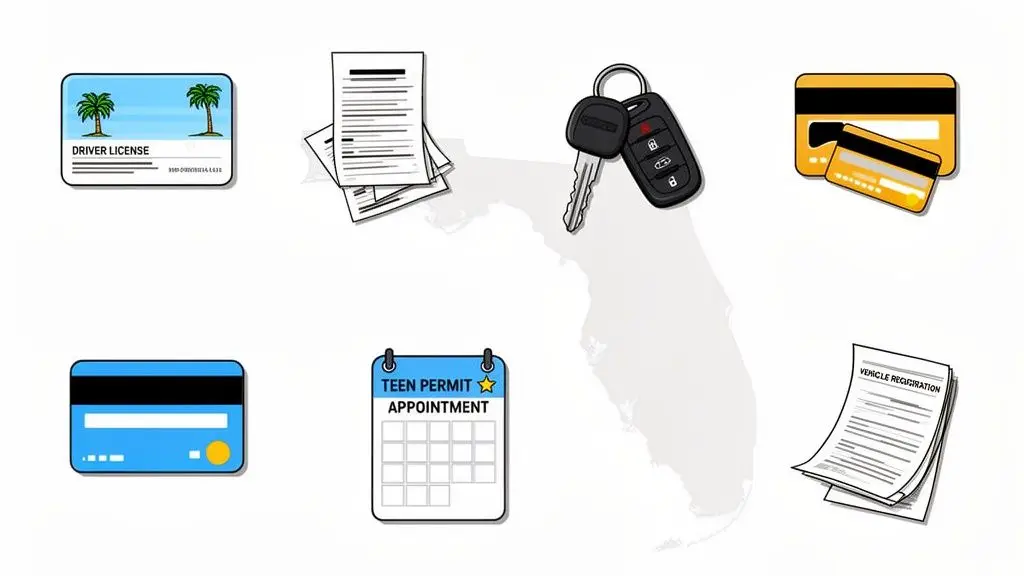
Before you even grab your keys, you need to have a folder with every single required document ready to go. Florida's REAL ID requirements are notoriously strict, so there's no room for error here.
Here's what you absolutely must have:
- Proof of Identity: An original U.S. birth certificate or a valid U.S. passport. No photocopies allowed.
- Proof of Social Security Number: Bring your original Social Security card.
- Proof of Residential Address: You'll need two separate documents that prove where you live. Think utility bills, bank statements, or school records.
For anyone under 18, there's one more crucial piece of paper: the Parental Consent Form. This form has to be signed in the presence of a notary public or right there in front of the driver's license examiner. Forgetting this is probably the most frequent—and frustrating—mistake I see families make.
For a super-detailed breakdown, our guide covers exactly what you need to get your permit.
What to Expect: Fees and The Process
With your paperwork sorted, let's talk money. You'll have a few fees to cover, including the initial exam, the issuance of the learner's license itself, and possibly a retake fee if things don't go perfectly the first time. It's always smart to bring a little extra cash, just in case. Most locations accept credit cards, cash, or checks.
Knowing the flow of the day helps, too. If you're testing in person, plan to arrive early. You'll check in and then complete quick vision and hearing screenings before you sit for the knowledge test. If you're under 18 and eligible to test online at home, a parent or guardian has to be there to proctor the exam and sign off on a supervision form.
The goal is to eliminate every unknown. Walking in with an organized folder and knowing the exact cost makes the whole day feel less like an ordeal and more like a simple transaction.
Your Florida Permit Test Day Checklist
To make this even easier, I've put everything into a simple checklist. Go through this the night before your appointment to make sure you’re ready to walk in and walk out with your permit.
| Category | Required Item/Action | Notes for Applicants |
|---|---|---|
| Identification | Original U.S. Birth Certificate or valid U.S. Passport | Critical: No photocopies will be accepted. Make sure it's the official document. |
| Social Security | Original Social Security Card | If you don't have the card, you may be able to use a W-2 form with your full SSN. |
| Residency | Two (2) proofs of address | Utility bills, bank statements, or official mail with your name and address. |
| Minor-Specific | Parental Consent Form (Form HSMV 71142) | Must be signed in front of a notary or a DMV examiner. Don't sign it beforehand! |
| Tests | Vision and Hearing Screening | These are done on-site right before the knowledge test. Bring your glasses if you need them. |
| Fees | Payment for exam and license issuance | Bring cash, check, or a credit/debit card. Have a little extra just in case. |
| Appointment | Confirmation of your scheduled time | Arrive at least 15 minutes early to avoid any last-minute rush. |
By tackling these logistical steps beforehand, you clear your head to focus on what really matters: acing that test. This preparation is the final piece of the puzzle, turning all your study time into a real-world success.
Your Top Florida Permit Test Questions, Answered
Even after hitting the books and taking practice tests, it’s natural to have a few questions rattling around. Let’s tackle some of the most common ones we hear from new drivers and their parents so you can walk into test day with total confidence.
What Happens if I Don’t Pass the First Time?
First off, don't panic. It happens, and it’s definitely not the end of the road. You can absolutely retake the test.
The catch is that you'll have to pay the testing fee again for each new attempt. Think of the time between attempts as a bonus study period. Really drill down on the sections that tripped you up. A solid DMV practice permit test for Florida is your best friend here—it's the perfect way to find and fix those weak spots before you go back for round two.
Can I Take the Florida Permit Test Online?
Yes, you can… but there's a big "if." In Florida, only drivers under the age of 18 are allowed to take the Class E Knowledge Exam online. This has to be done through an approved third-party provider.
If you're 18 or older, you'll need to schedule an appointment and take the test in person at a driver license or tax collector's office.
Pro Tip: Rules can and do change. Always give the official Florida Highway Safety and Motor Vehicles (FLHSMV) website a quick look to confirm the latest procedures before you schedule anything.
How Long Is the Florida Learner's Permit Good For?
Once you get your learner's permit, the clock starts ticking. It's valid for exactly one year from the date it was issued.
For drivers under 18, there are extra requirements. You must hold that permit for at least 12 months straight without any traffic tickets before you can even think about getting your driver's license. During that year, you also need to log 50 hours of supervised driving with a licensed adult, and 10 of those hours have to be at night.
Are the Practice Questions the Same as on the Real Test?
Not word-for-word, no. But a good practice test is the next best thing.
High-quality practice questions are built to mirror the real DMV exam as closely as possible. They pull from the exact same material in the Florida Driver Handbook, use the same multiple-choice format, and test you on the same critical rules and signs. The more you use them, the more familiar the real test will feel, which is a huge advantage for calming those test-day nerves.
At BDISchool, our goal is to help you become a safe, confident driver for life. Our state-approved courses are built to give you the skills you need to not just pass the test, but to be a responsible driver on the road. Explore our driver education programs today!