Let's get right to it. When you see double white lines on the road, they have one, crystal-clear meaning: do not change lanes.
Think of them as a painted-on concrete barrier. They are a definitive signal from traffic engineers telling you to stay put in your lane. In Florida, as in most places, this isn't a suggestion—it's the law.
What Double White Lines Really Mean for Drivers
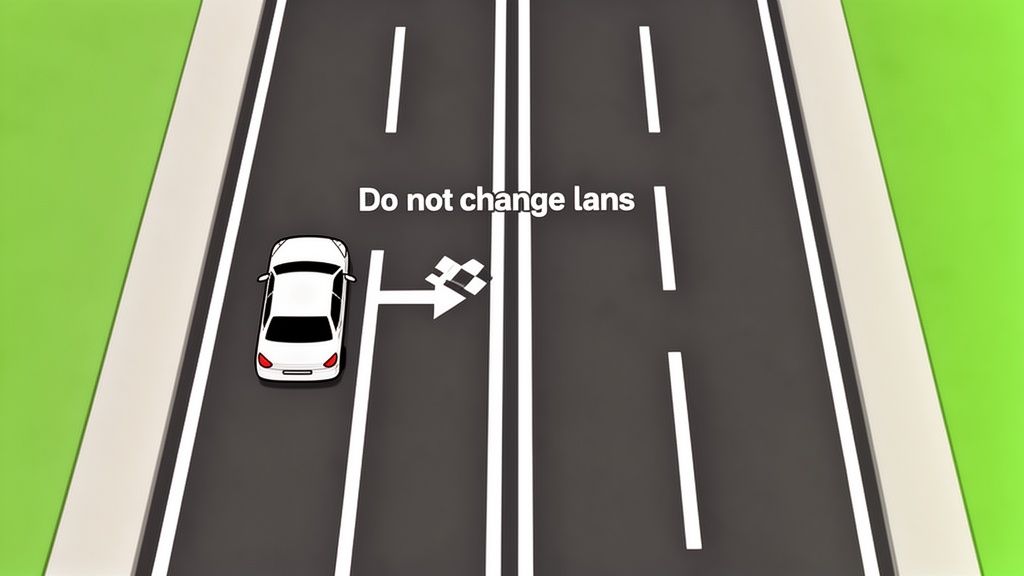
You’ve probably experienced this yourself. You're driving along, and the familiar broken white line separating your lane from the one next to you suddenly turns into two solid ones. That change isn't for decoration; it's a critical safety warning.
This visual cue means that conditions ahead have become too hazardous for lane-changing. These lines are placed with purpose in areas where the risk of an accident is much higher if drivers start weaving between lanes.
Where You'll Typically See Double White Lines
Knowing why these lines are used helps drive home their importance. They aren’t just random paint on the asphalt. They are a deliberate safety measure used in specific high-risk scenarios to keep traffic orderly and prevent collisions.
You can expect to find solid double white lines in several key locations:
- As you approach intersections, to stop drivers from making last-minute lane changes that could cause side-swipes.
- Inside tunnels and on bridges or overpasses, where lanes are often narrower and there’s no shoulder to escape to.
- In high-volume merge zones, like those near highway on-ramps, to create a more organized and predictable flow of traffic.
- On sharp curves or near the crest of a hill, where your line of sight is limited and you can’t see what’s coming.
The entire point of double white lines is to enforce predictability on the road. When every driver follows the simple "no crossing" rule, traffic becomes significantly safer and more efficient for everyone.
To put it all into context, here’s a quick breakdown of the different white lines you'll see on Florida roads and what each one means.
Florida White Line Markings at a Glance
This simple table can serve as a handy reference for what the paint on the road is telling you to do.
| Line Type | Meaning | Is Lane Changing Permitted? |
|---|---|---|
| Solid Double White Line | Separates traffic moving in the same direction. | No. Crossing is strictly prohibited. |
| Single Broken White Line | Separates traffic moving in the same direction. | Yes. You can change lanes when it's safe. |
| Single Solid White Line | Marks the edge of the roadway or discourages lane changes near hazards. | Discouraged, but may be legal in some situations. Always use extreme caution. |
Think of this as the basic language of the road. Understanding these simple markings is the first step to being a safer, more confident driver.
The Unspoken Rule of Solid Double White Lines
When you see a set of solid double white lines on the road, they're doing more than just separating traffic lanes heading in the same direction. Think of them as a physical wall painted on the pavement—a clear, non-negotiable warning from traffic engineers that says, "Changing lanes here is a seriously bad idea."
In Florida, these lines aren't just sprinkled randomly. You'll find them in high-risk zones where a sudden lane change could easily cause a catastrophic collision. They're strategically placed to take the guesswork out of tricky situations and keep traffic moving safely.
Why So Strict?
Picture yourself approaching a busy highway exit during peak rush hour. Or maybe you're navigating a sharp, blind curve on a multi-lane road. These are the exact spots where double white lines command you to hold your ground and stay in your lane.
They create a predictable path for everyone, which is crucial when visibility is poor or you have only a split second to react.
This strict rule is a direct response to common, and often tragic, accident scenarios like:
- Drivers making a last-second, desperate swerve to catch an exit they almost missed.
- Impatient drivers trying to weave through congested traffic.
- Cars drifting across lanes on a narrow bridge or inside a tunnel where there's no shoulder to escape to.
Once you understand their purpose, these lines stop feeling like a restriction and become a tool for smart, defensive driving. They're your guide for staying safe in areas that demand your undivided attention.
The presence of solid double white lines is a clear indicator of increased risk. Respecting them isn't just about avoiding a ticket—it's about recognizing a known danger zone and protecting yourself and the people around you.
The data backs this up. Those two bright white lines staring back at you in your headlights are there for a reason. While the very first center white line was painted way back in 1911, modern road studies have found that wider markings like these can reduce total crashes by 5.8%.
What's even more impressive is their impact at night. These lines have been shown to cut fatal and injury crashes after dark by a staggering 39.5%. If you're curious, you can learn more about how bright road markings make roads safer for everyone.
This research proves what double white lines mean for road safety: they are a simple, low-cost feature that delivers a huge return in saved lives. Their solid, unbroken form communicates an unwavering command—stay put. Ignoring that command isn't just breaking the law; it's disregarding a clear warning designed to prevent the worst from happening.
Decoding Florida's Road Markings: A Comparative Guide
To really get a handle on double white lines, it helps to think of them as just one piece of a larger language painted right onto our roads. Every line—whether it's solid, broken, white, or yellow—is a specific instruction for drivers. Once you learn this language, you stop just reacting to traffic and start proactively reading the road, anticipating what's ahead, and making safer choices.
Think of it this way: road markings are like a family of signs, and each one has its own personality. Those strict, unyielding double white lines? They're the protective older sibling, setting firm, non-negotiable boundaries. The broken white lines are more laid-back, allowing you to move around when it's safe to do so.
White Lines vs. Yellow Lines
The most fundamental rule of thumb comes down to color, and it's dead simple but absolutely critical to remember:
- White Lines: Separate lanes of traffic all heading in the same direction.
- Yellow Lines: Separate lanes of traffic moving in opposite directions.
Crossing a yellow line is inherently more dangerous because it means you’re pulling out into a lane where cars are coming straight at you. This basic color-coded system is the bedrock of traffic safety.
White Lines vs. Yellow Lines: What's the Difference?
Let's break down the common markings you'll see every day on Florida's roads, from I-4 to the Don Shula Expressway, and put their rules side-by-side for a clear comparison.
| Road Marking | Traffic Direction | Lane Changing Rules | Common Location |
|---|---|---|---|
| Solid Double White Line | Same Direction | Prohibited. Do not cross for any reason. | Approaching intersections, tunnels, high-risk areas. |
| Single Broken White Line | Same Direction | Permitted. You may change lanes when safe. | Standard on multi-lane highways and streets. |
| Single Solid White Line | Same Direction | Discouraged. Often marks the road edge or discourages changing lanes near hazards. | Edge of the roadway (fog line), separating bike lanes. |
| Solid Double Yellow Line | Opposite Directions | Prohibited. Do not cross to pass. | Centerline on two-way roads where passing is unsafe for both directions. |
This visual guide shows how double lines are a core part of keeping roads safe by managing traffic flow and preventing head-on collisions.
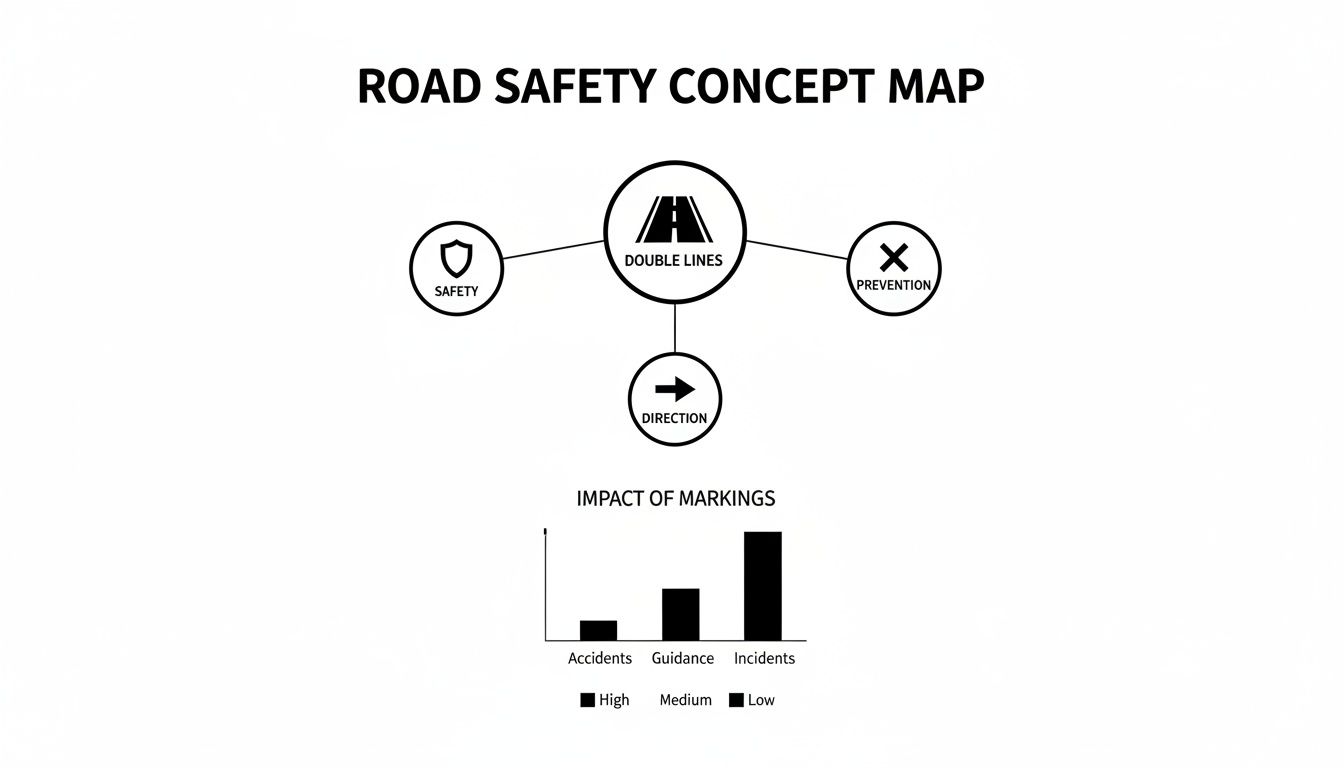
Ultimately, this whole system of painted lines is designed to create order and keep us safe by clearly defining where you can and, just as importantly, where you can't go.
Single vs. Double Solid White Lines
So, what's the real difference between a single solid white line and the double solid white lines we've been talking about? It's a great question, and it all comes down to the level of warning.
While both lines discourage you from crossing, the double line is a much stricter command. A single solid white line—like the "fog line" on the right shoulder of the highway—is a strong suggestion to stay put. Crossing it isn't always illegal, but it's often unsafe.
A double solid white line takes that suggestion and turns it into a legal prohibition. It tells you that changing lanes in that specific spot is exceptionally dangerous, and doing so is a clear traffic violation.
Of course, road rules go beyond just the painted lines. It's also about how different vehicles share the road. For example, understanding the current lane splitting laws for motorcycles is vital for everyone's safety. For a closer look at similar restrictions, check out our guide explaining the meaning behind the no-passing zone: https://bdischool.com/no-passing-zone-sign-meaning/
What Happens If You Cross Double White Lines in Florida?
Think of those solid double white lines as a clear "do not cross" sign painted right on the pavement. Ignoring them isn't just a bad idea—it's a traffic violation that comes with some real, and often expensive, consequences. In Florida, illegally crossing these lines is ticketed as an improper lane change, and it's a citation that can hit you in the wallet and on your driving record.
The penalties are no joke, and they're meant to get drivers to think twice before making such a dangerous move. While the exact fine can differ a bit from county to county, you're typically looking at a ticket somewhere between $160 and $200. But that initial sting is just the beginning.
Points on Your License
On top of the fine, an improper lane change ticket will add three points to your Florida driver's license. Three points might not sound like a catastrophe, but they add up faster than you think and can lead to serious trouble.
Florida's system is pretty strict. Here’s how quickly points can lead to a license suspension:
- 12 points in 12 months? That’s a 30-day suspension.
- 18 points in 18 months? You're looking at a 3-month suspension.
- 24 points in 36 months? Your license is suspended for a full year.
That one ticket for crossing double white lines gets you a quarter of the way to having your driving privileges taken away.
The Real Pain: Your Car Insurance Bill
For many drivers, this is where the mistake really hurts. After a ticket and points land on your record, your insurance company sees you as a bigger risk. When it's time to renew your policy, you can bet your premiums are going to jump.
This isn't just a one-time hike, either. That higher rate can stick with you for several years, meaning a single bad decision on the road could cost you hundreds, if not thousands, of dollars long after you've paid the ticket. It's a stark reminder that staying safe on the road also means protecting yourself financially with the right affordable car insurance in Florida.
The true cost of crossing double white lines isn't just the ticket. It's the lasting financial headache from points on your license and years of higher insurance premiums.
Luckily, Florida offers a way out. For many drivers, completing a state-approved Basic Driver Improvement (BDI) course can keep the points from ever going on your record. This is a game-changer. It not only keeps your license clean but also helps you dodge that painful spike in your insurance bill. You can dig deeper into how a BDI course works for an improper lane change ticket and see if it's the right move for you.
Navigating Tricky Real-World Driving Scenarios
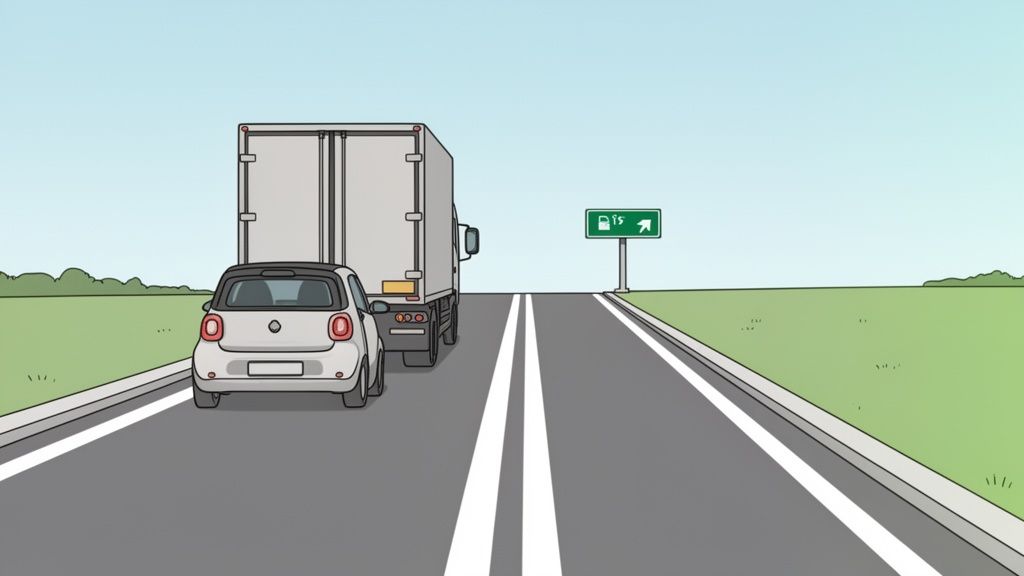
Knowing the textbook definition of double white lines is one thing. Applying that knowledge under pressure, with horns blaring and your exit flying by, is another story entirely. The real world is messy, and it’s these moments that separate a good driver from a great one. This is where a defensive mindset isn't just a concept—it's your best tool for staying safe.
Let's walk through a classic dilemma. You’re cruising along, but you get stuck behind a slow-moving truck just as your exit is coming up. The problem? You’re hemmed in by a pair of solid double white lines. The urge to just jump across them can be overwhelming, but it's a gamble that can easily end with a ticket or, far worse, a collision.
In this situation, the best move is to be patient, not aggressive. The only legal and safe option is to wait for the lines to break. A moment of panic can put you and everyone around you in danger.
Defensive Strategy: Stuck Behind a Slow Vehicle
Instead of letting frustration take over, switch to a proactive, defensive mindset. The trick is to see these problems coming before they’re right on top of you.
- Look Way Ahead: Don't just focus on the car in front of you. Scan the road far ahead. If you see a truck or slow traffic in your lane and know your exit is approaching, make your move early—long before those solid lines begin.
- Keep Your Distance: Tailgating is never a good idea, and it’s especially bad here. A safe following distance gives you a much better view of the road, helping you spot your chance to change lanes the moment the solid lines end.
- Accept the Detour: Sometimes, you just miss your window. If you can't change lanes legally and safely, the only correct move is to drive to the next exit and double back. It’s a minor inconvenience that could prevent a major accident.
This is exactly the kind of thinking we drill into students in our advanced driving courses, like the Intermediate Driver Improvement (IDI) 8-hour or Aggressive Driver programs. It’s all about using defensive techniques to keep cool and avoid road rage. Interestingly, the roads themselves can help. Studies show that well-maintained, clear road markings can boost driver confidence, actually leading to speed reductions of up to 8 mph. For a deeper dive, you can explore the findings on road marking effectiveness.
The Congested Merge Zone
Merging onto a busy highway is another classic stress test. You'll often see double white lines separating the on-ramp from the main lanes. They’re there for a reason: to prevent last-second, chaotic lane changes and create a more orderly flow.
In a merge zone, predictability is your best friend. Those double white lines are there to create order out of potential chaos. Your job is to hold a steady speed, be hyper-aware of the traffic around you, and get ready to merge smoothly once the lines break.
If you’re the one merging, use the entire length of the on-ramp to get up to the speed of traffic. Signal your intent early and look for a safe gap to slide into. If you're already on the highway, a little courtesy goes a long way. If it’s safe, adjust your speed to help create a space for others to enter. For a full refresher, check out our guide on how to change lanes properly, which breaks down the entire process.
Why Clear Road Markings Are a Lifesaver
Knowing what double white lines mean is critical, but that knowledge is only useful if you can actually see them. Faded, cracked, or barely-there road markings aren't just an eyesore; they're a genuine safety hazard.
Think about driving at night during one of Florida's famous torrential downpours. In those moments, clear lines become your lifeline, guiding you when visibility is near zero. When they vanish, chaos isn't far behind.
The link between well-maintained pavement markings and accident prevention is undeniable. In fact, these painted lines are one of the most cost-effective safety tools a state or city has at its disposal. They’re a silent, universal language that directs traffic flow and prevents dangerous, last-minute maneuvers.
The clarity of a road marking is directly tied to its ability to prevent accidents. When lines fade, the silent communication system of our roadways breaks down, increasing risk for everyone.
The Statistical Proof
The numbers don't lie. Study after study confirms that poorly maintained road markings are a contributing factor in far too many serious collisions.
Some research has linked marking failures to over 30% of roadway fatalities, a staggering figure that highlights just how vital this simple infrastructure is. For a real-world example, look at a UK initiative that repainted faded white lines on high-risk roads—the result was a dramatic and immediate drop in crashes. You can dive deeper into the data by reading the full research on roadway safety markings.
Bringing It Back to Florida
This is exactly why recognizing and respecting road markings is a fundamental part of defensive driving. Here in Florida, misinterpreting double white lines is a frequent mistake that our driver improvement courses, like the Mature Driver (6-hour) or the standard BDI program, are built to correct.
These programs don’t just recite the rules; they instill the crash-avoidance techniques and safe attitudes you need for any road condition. Learning to anticipate what other drivers might do when markings are poor is just as important as knowing the rules for perfect lines. It’s all about building a proactive mindset that keeps you safe on every single trip.
Your Questions About Double White Lines, Answered
Even when you know the rules, the real world throws curveballs. Let's clear up some of the most common questions drivers have when they encounter these tricky lines on the road.
What if I Need to Cross Double White Lines to Avoid an Obstacle?
This is a great question, and the answer is: yes, but with a huge asterisk. You are allowed to cross double white lines to get around something like a stalled car, a fallen tree branch, or major debris in your lane. Think of it as an emergency-only maneuver.
The key is that it must be an immediate hazard. This exception is designed to prevent a collision, not to help you zip around a slow-moving truck. Before you even think about crossing, you have to be 100% certain the next lane is clear and you can move over safely.
How Should I React to Emergency Vehicles?
When you see those flashing lights and hear the sirens, your instinct is to move out of the way. But with double white lines, you have to be smart about it. Your first duty is to pull over to the right and stop.
If you can't get to the right because of the lines, do not swerve left across them into another lane of traffic. The best and safest thing to do is slow down, stop right where you are, and let the ambulance or police car figure out the safest path around you.
The rule of thumb is always safety first. The ban on crossing double white lines is strict, but it doesn't mean you should cause an accident or block an emergency vehicle. Use common sense.
I Got a Ticket. How Does a BDI Course Help?
Getting a ticket for crossing double white lines can be frustrating. The good news is, in Florida, you have an option to keep points off your record by taking a Basic Driver Improvement (BDI) course.
Completing a state-approved BDI course means the points for that violation won't be added to your license. This is a huge deal—it helps you avoid a potential license suspension and, just as importantly, keeps your insurance company from jacking up your rates. You can find all the official details on this in the Florida Driver's Manual.
For a state-approved way to handle a traffic ticket and become a safer driver, trust BDISchool. Our online courses are designed to be convenient and effective, helping you protect your driving record with ease. Learn more at https://bdischool.com.