Florida's weather is famous for its sudden shifts from brilliant sunshine to torrential downpours. These afternoon storms can transform familiar roads into treacherous waterways in minutes, catching even seasoned drivers off guard. Driving safely in these conditions isn't just about slowing down; it's about a proactive mindset, proper vehicle preparation, and understanding the unique physics of wet-road dynamics. Reduced tire traction, decreased visibility, and the ever-present risk of hydroplaning demand more than just caution, they require knowledge and skill.
This guide provides a comprehensive roundup of actionable driving in the rain safety tips specifically tailored for Florida's challenging conditions. From pre-trip checks that can prevent a catastrophe to advanced techniques for handling a skid, these insights will empower you to navigate the rain with confidence. We'll explore critical maintenance points, legal requirements, and defensive driving strategies, with expert guidance from BDISchool, to ensure you and your passengers stay safe every time it rains.
Inside, you will find practical steps for everything from maintaining an appropriate following distance to managing a vehicle during a hydroplaning event. Whether you are a new driver, looking to lower your insurance premiums, or a seasoned commuter seeking a refresher on traffic knowledge, this list offers vital information. We will cover how to properly maintain your vehicle’s most critical components like tires and wipers, use your headlights effectively, and respond calmly in emergency situations. By mastering these techniques, you can significantly reduce the risks associated with driving through Florida’s infamous liquid sunshine and maintain control no matter what the weather brings.
1. Increase Following Distance to 8-10 Seconds
One of the most critical adjustments for driving in the rain is giving yourself more space. In dry conditions, the standard advice is a three to four-second following distance. However, when Florida’s skies open up, that buffer is dangerously inadequate. Wet roads dramatically reduce tire traction, which means your braking distance can easily double. This is why adopting the 8-10 second rule is a non-negotiable safety practice.
This rule provides the necessary time and space to react to sudden stops, avoid hydroplaning, and compensate for reduced visibility. It’s a simple yet highly effective technique that serves as your primary defense against rear-end collisions, which are notoriously common during sudden downpours on I-95 or the Florida Turnpike.
Why the Drastic Increase?
The physics are simple: water on the pavement acts as a lubricant between your tires and the road surface. This significantly diminishes grip, making it take longer to slow down or stop. For example, a vehicle traveling at 55 mph in rain needs approximately 300+ feet to come to a complete stop, compared to around 200 feet on a dry road. That extra 100 feet is the length of a professional basketball court, a margin you can only achieve with sufficient following distance.
Key Insight: Increasing your following distance is the single most effective way to counteract the negative effects of reduced traction and visibility in the rain. It directly gives you back the reaction time that wet conditions take away.
How to Implement the 8-10 Second Rule
Putting this rule into practice is straightforward and is a core concept taught in defensive driving courses. It builds muscle memory for safer driving habits.
- Pick a Landmark: Choose a fixed object on the side of the road, like a sign, bridge, or a distinct tree.
- Start Counting: As soon as the rear bumper of the vehicle in front of you passes that landmark, begin counting: "One-one-thousand, two-one-thousand, three-one-thousand…"
- Check Your Position: If you reach the landmark before you finish counting to "eight-one-thousand," you are following too closely. Ease off the accelerator and let the gap widen until you can comfortably reach at least eight seconds.
- Adjust for Conditions: In a torrential downpour or severe thunderstorm with low visibility, extend this count to 10 seconds or more. Also, increase the distance if you are driving a larger vehicle like an SUV or truck, which requires even more room to stop.
2. Reduce Speed and Avoid Sudden Maneuvers
When rain begins to fall, your vehicle’s relationship with the road changes fundamentally. Wet asphalt can reduce tire traction by as much as 50%, making your car far more susceptible to skidding and hydroplaning. Consciously reducing your speed and smoothing out your driving inputs are essential driving in the rain safety tips to maintain control and prevent loss-of-traction incidents.
Sudden actions like aggressive acceleration, hard braking, or sharp turns overwhelm the limited grip your tires have on a wet surface. By driving slower and more deliberately, you give your tires the best possible chance to maintain contact with the pavement, allowing you to steer and brake effectively even in a typical Florida deluge.
Why Slower is Safer
The link between speed and control on wet roads is undeniable. A vehicle traveling at a slower speed has more time to displace the water beneath its tires, which is the key to preventing hydroplaning. Florida crash data consistently shows that excessive speed is a primary contributing factor in nearly 40% of wet-weather accidents. The difference is significant; a car at 45 mph has drastically more control than one at 65 mph on the same rainy highway.
Professional truck drivers, whose livelihoods depend on safety, often reduce their speed by 25-40% during heavy rain for this exact reason. A slower pace gives you a larger margin for error and more time to react to unexpected hazards, like a flooded lane or a stopped vehicle ahead.
Key Insight: Reducing your speed is the most direct way to increase tire traction and driver control in the rain. It's not just about obeying the speed limit; it’s about adjusting to the conditions to keep your vehicle stable and predictable.
How to Drive Smoothly and Safely
Adopting a smoother driving style is a core principle taught in courses on driving in adverse conditions. It’s a proactive technique that minimizes risk before it can develop.
- Reduce Speed Gradually: As soon as rain starts, ease off the accelerator to smoothly decrease your speed. Avoid slamming on the brakes.
- Gentle Steering Inputs: Make all steering movements slow and deliberate. Jerky, sharp turns can easily cause your tires to lose their grip and lead to a skid.
- Avoid Unnecessary Lane Changes: Stay in your lane as much as possible. Every lane change is a maneuver that introduces risk on a slippery surface.
- Deactivate Cruise Control: Never use cruise control on wet roads. You need to be in full manual control of your speed to react instantly to changing traction levels and prevent sudden, automated acceleration.
- Accelerate Slowly: When starting from a stop, apply gentle pressure to the accelerator to prevent your wheels from spinning on the slick pavement.
3. Ensure Tires are Properly Maintained with Adequate Tread Depth
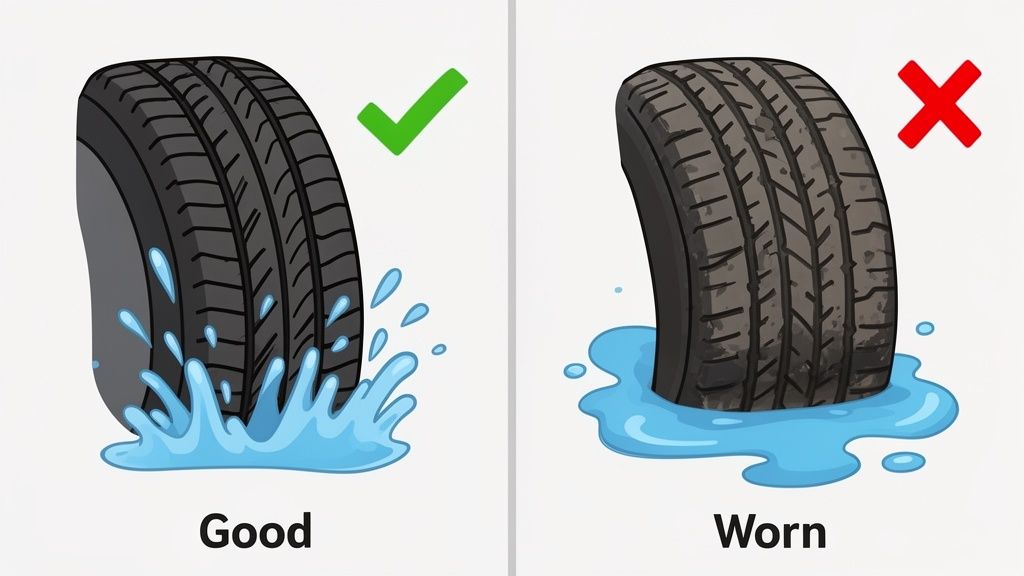
Your tires are the only part of your vehicle that touches the road, and their condition is paramount for safe driving in the rain. The deep grooves in your tire tread are not for show; they are engineered channels designed to siphon water away from the contact patch. This allows the tire to maintain a firm grip on the asphalt. When that tread wears down, it loses its ability to evacuate water effectively, creating a dangerous risk of hydroplaning even at moderate speeds on Florida's slick highways.
Why Tread Depth is Non-Negotiable
The difference between a safe stop and a collision often comes down to millimeters of rubber. Studies from major tire manufacturers like Goodyear and Michelin consistently show a direct correlation between tread depth and wet-weather grip. A vehicle with tires at 4/32 inch of tread can stop up to 25 feet shorter on a wet surface than the same car with tires at the legal minimum of 2/32 inch. According to NHTSA data, proper tire maintenance could prevent one in every ten wet-weather accidents.
Key Insight: Think of tire tread as your vehicle's water drainage system. Insufficient tread means this system fails, allowing a layer of water to build up between the tire and the road, which effectively turns your car into a sled with no steering or braking control.
How to Check and Maintain Your Tires
Integrating tire checks into your routine is one of the most proactive driving in the rain safety tips you can adopt. Proper maintenance ensures your tires perform as designed when you need them most.
- Perform the Penny Test: Take a Lincoln penny and place it upside down in one of your tire's tread grooves. If you can see the top of Abe Lincoln's head, your tread is worn below the safe limit of 2/32 inch, and it's time for new tires.
- Check Tire Pressure Monthly: Use a reliable tire pressure gauge to check your tires when they are cold. The correct pressure is listed on a sticker inside the driver's side door jamb, not on the tire itself. Properly inflated tires wear more evenly and provide better traction.
- Rotate Regularly: Have your tires rotated every 5,000 to 7,000 miles. This promotes even tread wear across all four tires, extending their life and maintaining consistent handling performance.
- Schedule Professional Inspections: During regular oil changes, ask the technician to inspect your tires for wear, damage, and proper alignment. For a deeper understanding of proactive care, explore our complete guide on essential Florida vehicle maintenance. Beyond just tread depth, understanding your car's auto tire ratings can provide further insight into tire performance and safety on wet roads.
4. Turn on Headlights and Use Low-Beam Settings
One of the most immediate dangers of driving in a Florida downpour is the drastic reduction in visibility. Heavy rain, road spray, and dark storm clouds can make your vehicle nearly invisible to others. Activating your headlights is a simple, legally required action that significantly enhances your safety by making you more conspicuous on the road.
This isn't just about helping you see; it's about helping others see you. On a busy road like the I-4 corridor or US-1 during a squall, a gray or silver car without its lights on can easily blend into the background of rain and mist. Turning on your headlights ensures that other drivers, pedestrians, and cyclists can spot you from a greater distance, giving them more time to react.
Why Low Beams Are a Must
The key is to use the correct setting: low beams. A common mistake drivers make is switching to high beams, believing more light will help them see better. In reality, it does the opposite. The intense light from high beams reflects off the thousands of raindrops falling in front of you, creating a wall of glare that severely impairs your own vision and blinds oncoming drivers.
Low beams, on the other hand, are angled downward toward the road surface. This minimizes reflection and glare, properly illuminating the path ahead without compromising visibility. Data shows that a vehicle with its lights on is significantly more visible in rainy conditions, a crucial factor in preventing head-on and lane-change collisions.
Key Insight: Using low beams in the rain is a two-way safety feature. It illuminates your path without creating dangerous glare and makes your vehicle a clear, visible object for everyone else on the road, cutting through the visual chaos of a storm.
How to Implement Proper Headlight Use
Making this a reflex is a cornerstone of defensive driving. Integrating this habit can dramatically reduce your risk during inclement weather.
- "Wipers On, Lights On": This is a simple and effective rule to live by. As soon as you need your windshield wipers, you need your headlights. It’s also Florida law (Statute 316.217).
- Use Low Beams, Not High Beams: Make a conscious choice to select the low-beam setting. If you accidentally activate your high beams, switch them off immediately to avoid creating glare.
- Enable Automatic Headlights: If your vehicle has an automatic headlight feature, set it to "Auto." This system often uses sensors that detect low ambient light or wiper activation, ensuring your lights are on when needed. For a deeper dive into when to use your lights, you can learn more about proper headlight usage.
- Daytime Rain Still Counts: Do not assume that daylight is enough. Heavy rain and cloud cover can create low-visibility conditions even in the middle of the afternoon. Always turn on your lights.
5. Avoid Hydroplaning by Recognizing Water Accumulation
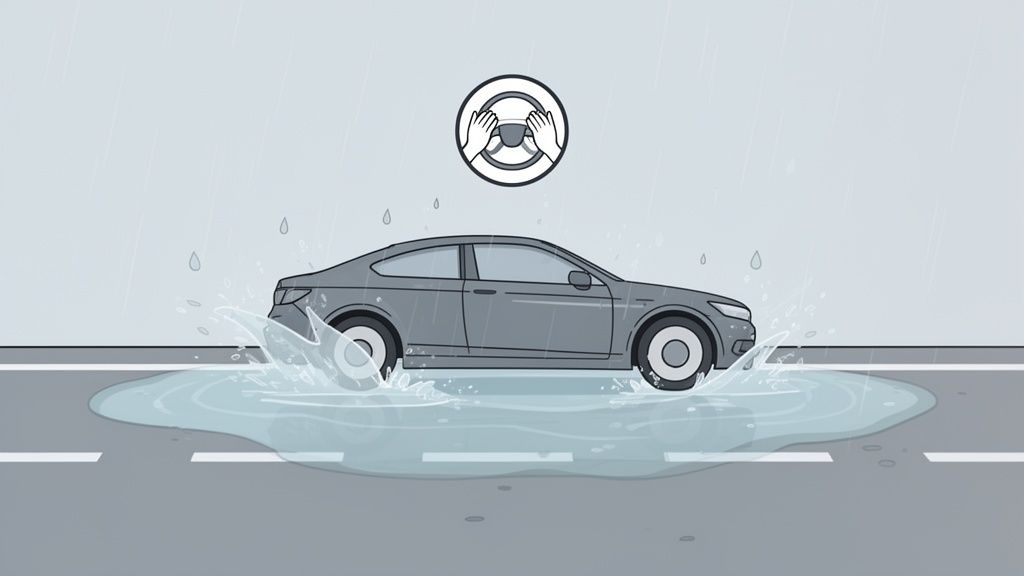
Hydroplaning is one of the most dangerous situations a driver can face in the rain. It occurs when your tires encounter more water than they can scatter, causing them to ride on a thin layer of water instead of making contact with the road. This results in a sudden and complete loss of steering and braking control, effectively turning your car into an uncontrolled sled. The key to prevention is proactively identifying and avoiding areas where water accumulates.
This reactive loss of control can happen in an instant, often with little warning. Recognizing potential danger zones, such as low-lying road sections, areas under overpasses, and stretches with poor drainage, allows you to anticipate the risk and reduce your speed before you enter the hazard. This is a critical defensive driving in the rain safety tip that shifts your approach from reactive panic to proactive caution.
Why Proactive Recognition is Key
The physics of hydroplaning are unforgiving. It can happen at speeds as low as 35 mph with worn tires. According to NHTSA data, standing water is a contributing factor in a significant percentage of rain-related accidents. In Florida, notorious stretches like I-95 near Miami and underpasses in Tampa are chronic hydroplaning zones. By learning the vulnerable spots on your regular commute, you can build a mental map of where to be extra vigilant, reducing your speed progressively as you approach them.
Key Insight: Preventing hydroplaning is about managing speed before you hit deep water, not reacting once you've already lost traction. Recognizing the signs of water accumulation ahead is your best defense against this dangerous phenomenon.
How to Spot and Avoid Hydroplaning Risks
Developing an eye for potential hydroplaning hazards is a skill that enhances your safety. For a deeper dive into the mechanics, you can learn more about what hydroplaning is and how to respond.
- Scan for Reflections: Look far ahead for glossy or reflective patches on the road surface, which indicate standing water.
- Watch Other Vehicles: Pay attention to the spray coming from the tires of cars in front of you. A large, heavy spray means there is significant water on the road.
- Know Your Route: Be mindful of low points, dips, and underpasses on your regular routes that are prone to flooding. Leave extra time for your commute during storms to avoid feeling pressured to speed through them.
- Stay in the Middle Lanes: Water tends to pool in the outer lanes, so sticking to the center lanes on a multi-lane highway can often be drier.
- If It Happens, Don't Panic: If you feel the vehicle start to hydroplane, do not slam on the brakes or jerk the steering wheel. Gently ease your foot off the accelerator and keep the steering wheel straight until you feel the tires regain traction with the road.
6. Maintain Your Windshield Wipers and Keep Washer Fluid Stocked
Your first line of defense against the blinding effects of a Florida downpour is a clear windshield. Yet, this is only possible if your wipers and washer fluid system are in top condition. Worn, cracked, or brittle wiper blades cannot effectively clear away water, leaving dangerous streaks, smears, and gaps in your field of vision. Similarly, an empty washer fluid reservoir means you can't clear road grime, oily residue, or mud spray kicked up by other vehicles, which can quickly turn a light rain into a visibility crisis.
This combination of functional wipers and ample fluid is fundamental to safe driving in the rain. Neglecting this simple maintenance is like trying to navigate a storm with a compromised view. In Florida's subtropical climate, the intense sun and heat cause rubber wiper blades to degrade much faster, making regular checks and replacements a non-negotiable part of vehicle readiness.
Why is This Critical?
The connection between visibility and safety is direct. Research indicates that worn wiper blades can be a contributing factor in as many as 15% of rain-related accidents. In a climate like Florida’s, where intense UV exposure and heat are constant, AAA recommends replacing wiper blades every six months. Local drivers report wiper blade failures at a rate three to four times higher than the national average, underscoring the severe impact of the local environment on this critical safety component.
Key Insight: Functional windshield wipers are not a convenience; they are an essential safety system. In a sudden storm on a busy highway like I-4 or I-75, the ability to instantly clear your windshield can be the difference between avoiding a hazard and causing a multi-car collision.
How to Implement Proper Wiper Maintenance
Integrating wiper and fluid checks into your routine is simple and ensures you are always prepared for inclement weather. These proactive steps are a cornerstone of any effective driving in the rain safety tips.
- Follow a 6-Month Replacement Cycle: Set a calendar reminder to replace your blades twice a year, ideally just before the summer rainy season and again in late fall.
- Invest in Quality: Opt for premium, beam-style wiper blades. While more expensive upfront, they offer better performance and are more resistant to UV degradation, lasting longer in the Florida sun. For optimal performance and safety, especially during heavy downpours, regular professional wiper blade service ensures clear visibility on the road.
- Test Before You Drive: Before heading out on a rainy day, run your wipers and spray the fluid to ensure they operate smoothly and clear the glass without streaking.
- Keep Fluid Topped Off: Check your washer fluid level at least once a month and always before a long trip. Keep a spare jug in your trunk, as you can go through a surprising amount when clearing away road grime during a storm.
7. Avoid Braking Hard or Sudden Movements if Your Vehicle Begins to Skid
When your vehicle begins to skid on wet pavement, your first instinct might be to slam on the brakes. This is one of the most dangerous reactions you can have, as it will almost certainly lock up the wheels and worsen the skid, leading to a complete loss of control. The correct, counterintuitive response is to stay calm and perform a controlled recovery.
This technique involves resisting the panic-driven urge to make sudden inputs. Instead, you must smoothly and deliberately guide the vehicle back into a stable state. According to NHTSA data, panic braking is a contributing factor in over 60% of spinouts that occur in rainy conditions. Mastering the proper response is a critical skill for navigating Florida's slick, rain-soaked roads.
Why Resisting Panic is Key
When a car skids, the tires have lost their grip on the road surface. Braking hard only asks the tires to do something they are already failing at: gripping the road. This action can lock the wheels, turning your vehicle into an uncontrollable sled. The goal is to allow the tires to regain traction, which can only happen if they are rolling. By easing off the pedals and avoiding jerky steering, you give the tires the best chance to reconnect with the pavement.
Key Insight: In a skid, your steering wheel is your primary tool for recovery, not your brake pedal. The goal is to guide the car, not stop it abruptly. A smooth, controlled response is far safer than a panicked reaction.
How to Correctly Respond to a Skid
This technique is a core component of advanced driver training, and professional drivers who master it have been shown to have 40% fewer wet-weather accidents. Here is how to implement it:
- Take Your Foot Off the Pedals: The moment you feel the vehicle begin to skid, immediately and smoothly take your foot off both the accelerator and the brake.
- Steer into the Skid: Gently turn your steering wheel in the same direction that the rear of your vehicle is sliding. If the back of your car is fishtailing to the right, you steer to the right. This helps realign the car's front with its direction of travel.
- Look Where You Want to Go: Your hands will naturally follow your eyes. Focus your vision on the path you want the car to take, not on the obstacle you are trying to avoid.
- Regain Control: As you feel the tires start to grip the road again, you can gently apply the accelerator to help stabilize the vehicle and straighten out your steering.
- Understand Your ABS: If your car has an Anti-lock Braking System (ABS), you should not pump the brakes. In an emergency stop after the skid is controlled, apply firm, continuous pressure to the brake pedal and let the system work.
8. Eliminate Distractions and Stay Alert to Changing Road Conditions
Driving safely in the rain demands your full, undivided attention. In clear, dry weather, distractions are dangerous; in a Florida downpour, they can be fatal. Any activity that takes your eyes off the road, hands off the wheel, or mind off the task of driving dramatically reduces your ability to react to slick surfaces, sudden braking, or unseen hazards like standing water.
The cognitive load of navigating wet roads is significantly higher. You must constantly monitor your speed, following distance, and the behavior of other vehicles. Distractions like checking a text message, adjusting the radio, or engaging in a deep conversation steal critical milliseconds of reaction time that you simply cannot afford to lose when road conditions are compromised.
Why Distractions Are Magnified in Rain
The danger of distracted driving multiplies in bad weather. Your brain has less capacity to handle unexpected events when it's already working overtime to process a low-visibility, high-stress environment. Research from the National Highway Traffic Safety Administration (NHTSA) shows that distracted driving is a factor in a significant percentage of all accidents, and this rate increases in adverse weather.
A driver using a cell phone, for example, has a significantly slower reaction time. When you combine that delay with the increased braking distance required on wet pavement, you create a recipe for a collision. Professional truck drivers and defensive driving courses, like those offered by BDISchool, all emphasize a zero-tolerance policy for distractions during inclement weather for this very reason.
Key Insight: In rainy conditions, your brain is already at a processing deficit due to poor visibility and challenging road dynamics. Eliminating distractions is the only way to free up the mental bandwidth needed to drive safely.
How to Create a Distraction-Free Cockpit
Actively managing your environment before you even start driving is the most effective strategy. This isn't just about willpower; it's about setting up a system for success.
- Secure Your Phone: Put your cell phone on silent and place it in the glove box, center console, or a bag in the back seat. The goal is to make it inaccessible.
- Pre-Set Your Route: Program your GPS and review your route before you put the car in drive. If you need to make changes, pull over to a safe location.
- Communicate with Passengers: Let your passengers know that you need to focus on the road. Ask them to limit conversations or help you watch for hazards.
- Prepare in Advance: Avoid eating, drinking, or any form of personal grooming. Finish your coffee or snack before you leave.
- Build in Extra Time: Plan for a longer commute. When you aren't feeling rushed, you are less likely to take risks or become flustered by delays, which helps you stay focused and calm.
8-Point Rain Driving Safety Comparison
| Item | 🔄 Implementation complexity | ⚡ Resource requirements | ⭐ Expected effectiveness | 💡 Ideal use cases | 📊 Key advantages / Impact |
|---|---|---|---|---|---|
| Increase Following Distance to 8–10 Seconds | Low — simple habit but needs discipline | Minimal — time/attention only | ⭐⭐⭐⭐ — greatly reduces rear-end risk | Highway rain, heavy downpours, congested interstates | Reduces collisions, increases reaction time; works at any speed |
| Reduce Speed and Avoid Sudden Maneuvers | Low — behavioral change, consistent attention | Minimal — patience and speed control | ⭐⭐⭐⭐⭐ — single most effective control measure | All wet conditions, areas with standing water or poor visibility | Improves steering control, lowers hydroplaning risk; cited in many avoidance cases |
| Ensure Tires are Properly Maintained (Tread ≥ recommended) | Moderate — requires inspection and periodic replacement | Moderate — cost of tires, gauges, shop service | ⭐⭐⭐⭐ — strong preventive effect on hydroplaning | Before rainy season, long trips, heavy-rain regions | Better water evacuation, shorter stopping distances; prevents ~10% of wet-weather crashes |
| Turn on Headlights (Low-Beam) | Very low — immediate and simple action | Minimal — vehicle lights must function | ⭐⭐⭐⭐ — substantially improves visibility and detectability | Daytime/nighttime rain, reduced-visibility conditions | Increases vehicle visibility (up to ~50% reduction in visibility accidents); often legally required |
| Avoid Hydroplaning by Recognizing Water Accumulation | Moderate — requires situational awareness and route knowledge | Minimal — knowledge, possible speed reduction | ⭐⭐⭐⭐ — effective when hazards are anticipated | Underpasses, low-lying road sections, poor-drainage highways | Proactive speed reduction in known hotspots prevents loss-of-traction events |
| Maintain Windshield Wipers & Washer Fluid | Low — routine replacement and checks | Low — cost of blades and fluid; occasional installation | ⭐⭐⭐ — prevents visibility loss; important but limited to sight issues | Frequent-rain climates, long commutes, rainy season prep | Inexpensive maintenance that prevents streaking/failure; factor in ~15% of rain accidents |
| Avoid Hard Braking or Sudden Movements During a Skid | Moderate–High — requires training and calm response | Moderate — driver training or controlled practice | ⭐⭐⭐⭐ — improves recovery and reduces crash severity | Emergency skid events, slippery curves, sudden slides | Reduces panic braking, increases likelihood of safe recovery; training lowers wet-weather incidents |
| Eliminate Distractions & Stay Alert | Low — behavior/habit changes, enforceable | Minimal — device settings or storage; possible apps | ⭐⭐⭐⭐⭐ — very high impact on hazard detection | All rainy driving scenarios, congested or low-visibility roads | Faster hazard detection and response; reduces accident risk by ~40–50% and aligns with laws |
Transforming Knowledge into Lifelong Safe Driving Habits
Navigating Florida's rain-soaked roads is an inevitable part of life in the Sunshine State. The journey from understanding to instinct is what defines a truly safe and defensive driver. We have explored a comprehensive set of driving in the rain safety tips, moving beyond generic advice to provide actionable strategies that can be implemented immediately. From proactively checking your tire tread depth and windshield wiper integrity before a storm hits to mastering the 8-10 second following distance rule during a downpour, each tip is a critical layer of protection.
The core message is simple: preparation and active awareness are your most powerful tools. Passive driving is a luxury no one can afford when visibility is low and road surfaces are treacherous. The difference between a controlled stop and a dangerous hydroplaning incident often comes down to the split-second decisions you make, which are a direct result of the habits you’ve cultivated over time.
From Checklist to Second Nature
Think of the safety measures discussed not as a one-time checklist but as a continuous cycle of responsible driving.
- Before You Drive: Your pre-trip inspection of tires, wipers, and lights isn't just a recommendation; it's your first line of defense. Making this a regular habit, especially during the rainy season, can prevent an equipment failure when you least expect it.
- While You Drive: The techniques we covered, such as reducing speed, avoiding sudden maneuvers, and keeping your headlights on, are the active components of your safety strategy. Consciously practicing these actions will eventually build them into your muscle memory, allowing you to react calmly and correctly without hesitation.
- When the Unexpected Happens: Understanding how to respond to a skid by easing off the accelerator and steering into the direction of the slide is knowledge that can avert a disaster. Similarly, recognizing the danger of standing water and making the conscious choice to "Turn Around, Don't Drown" is a hallmark of a driver who prioritizes life over convenience.
Mastering these driving in the rain safety tips is about transforming reactive fear into proactive confidence. It’s the ability to assess changing conditions and adapt your driving style in real time, ensuring you and your passengers arrive safely at your destination.
The Lasting Impact of Defensive Driving
The ultimate goal is to make safe driving an automatic part of who you are behind the wheel. It's about more than just avoiding a collision; it's about reducing stress, protecting your financial well-being by avoiding costly repairs and insurance hikes, and contributing to the overall safety of our shared roadways. For Florida drivers who have recently received a traffic violation, or for anyone seeking to refresh their knowledge and potentially lower their insurance premiums, formalizing this education is a logical and powerful next step.
Adopting these principles demonstrates a commitment to personal responsibility and community welfare. Every time you increase your following distance or slow down in a storm, you create a safer environment not just for yourself, but for every other driver around you. This ripple effect is how we collectively raise the standard of safety on Florida's roads, one informed driver at a time. The knowledge you’ve gained from this guide is the foundation; building upon it with dedicated practice and continued learning will solidify your status as a skilled, prepared, and defensive driver, ready for whatever the weather brings.
Ready to turn these essential driving in the rain safety tips into ingrained habits? BDISchool offers state-approved online courses that reinforce these concepts through engaging, real-world scenarios, helping you address a traffic ticket or earn an insurance discount. Enroll today at BDISchool and invest in becoming a safer, more confident driver on Florida's roads.