Florida's sudden downpours can transform a routine drive into a high-stakes challenge, turning familiar roads into slick, unpredictable surfaces. Reduced visibility, compromised tire grip, and the ever-present risk of hydroplaning demand more than just caution; they require a specific set of skills and a proactive mindset. Many drivers underestimate how dramatically rain alters vehicle dynamics, leading to preventable accidents and costly traffic citations. For anyone who has received a moving violation or is looking to enhance their road safety knowledge through a BDI course, mastering wet-weather driving is non-negotiable.
This comprehensive guide moves beyond the obvious advice, providing a detailed breakdown of actionable driving in the rain tips designed to empower you with the knowledge needed to navigate wet conditions with confidence. We will cover critical strategies from essential vehicle preparation, like optimizing tire pressure and wiper blade function, to advanced defensive driving techniques for maintaining control on saturated asphalt.
You will learn how to properly manage your speed and following distance, how to identify and react to hydroplaning threats, and the correct way to use your vehicle's lighting systems for maximum visibility without impairing other drivers. These insights are crucial for protecting yourself, your passengers, and your driving record. As experts in Florida driver education, we've compiled these essential tips to help every driver master the art of safe driving, no matter how severe the storm. This isn't just about staying dry; it's about staying safe and in control.
1. Reduce Speed and Increase Following Distance
The single most impactful adjustment you can make when driving in the rain is to slow down and create more space between you and the car ahead. Wet roads drastically reduce the friction your tires need to grip the pavement, which significantly increases the time and distance required to stop. Ignoring this physical reality is a leading cause of wet-weather collisions.
This principle is so fundamental that it's a core focus of safety campaigns by agencies like the Florida Department of Highway Safety and Motor Vehicles (FLHSMV) and the National Highway Traffic Safety Administration (NHTSA). It’s not just about avoiding a ticket; it's about giving yourself the time to react to unexpected hazards, from a sudden stop to a pedestrian dashing into the street.
The 8-10 Second Rule
In dry conditions, the standard advice is a 3-second following distance. In the rain, this is dangerously insufficient. The FLHSMV recommends expanding this buffer to a minimum of 8 to 10 seconds.
This extra time compensates for reduced tire traction and poor visibility, providing a crucial safety cushion. A larger gap gives you more time to perceive a hazard, react, and bring your vehicle to a safe stop without skidding. The physics of momentum and friction are unforgiving, so understanding how to calculate stopping distance can provide a powerful visual for why this extra space is so critical. For a deeper look, you can learn more about how speed and road conditions affect your vehicle's stopping capabilities on bdischool.com.
Actionable Tips for Implementation
Here are practical ways to apply this life-saving driving in the rain tip:
- Gradual Deceleration: Instead of hitting the brakes, start by simply easing your foot off the accelerator to slow down smoothly. This signals your intention to drivers behind you and prevents jarring movements that could lead to a loss of control.
- Use the "Mississippi" Count: To check your following distance, watch the vehicle ahead of you pass a fixed object like a sign or an overpass. Then, begin counting, "One-Mississippi, two-Mississippi…" until your front bumper reaches the same object. If you don't reach at least "eight-Mississippi," you're too close.
- Plan for More Time: If rain is in the forecast, build extra time into your travel schedule. Rushing in bad weather is a recipe for disaster. Knowing you have a buffer reduces the pressure to speed.
2. Ensure Your Tires Are in Optimal Condition
Your tires are the only part of your vehicle that directly contacts the road, making their condition absolutely critical for safe driving in the rain. Wet surfaces demand adequate tread to channel water away and maintain grip. Worn or bald tires cannot effectively displace this water, creating a high risk of hydroplaning-a dangerous scenario where the tire loses contact with the pavement and skids uncontrollably.
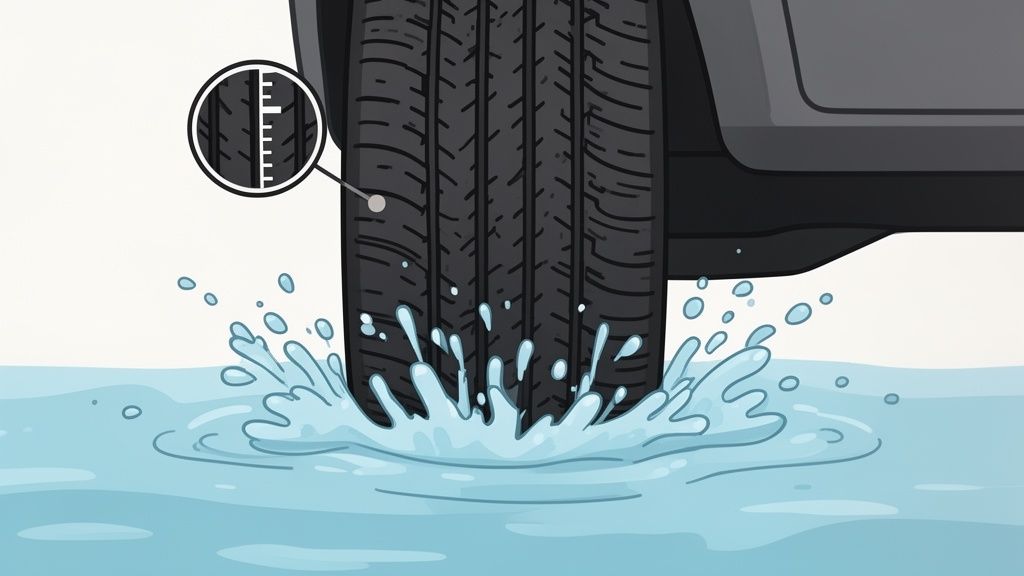
This fundamental principle of vehicle safety is championed by automotive authorities like AAA and the NHTSA. While the legal minimum tread depth in Florida is 2/32 of an inch, safety experts and tire manufacturers such as Michelin and Goodyear strongly recommend replacement at 4/32 of an inch. This extra depth provides a significantly better margin of safety for channeling water and preventing loss of control in downpours.
The Critical Role of Tread Depth
Tire tread consists of deep grooves designed specifically to act like water channels. As the tire rolls over a wet road, these grooves funnel water out from underneath the tire's contact patch, allowing the rubber to maintain its grip on the pavement. When tread depth is low, these channels are too shallow to handle the volume of water, especially at higher speeds.
The result is hydroplaning. This is why having sufficient tread is one of the most proactive driving in the rain tips you can follow. A simple check, like the "penny test" recommended by AAA, can immediately tell you if your tires are safe for wet conditions. Overall, maintaining vehicle health is crucial, as properly cared-for tires are part of a larger system that ensures your car responds predictably when you need it most.
Actionable Tips for Implementation
Here are practical steps to ensure your tires are ready for rainy weather:
- Check Tread Depth Monthly: Use the penny test. Insert a penny with Lincoln's head upside-down into several tread grooves. If you can see all of Lincoln's head, your tread depth is below 2/32 of an inch and it's time for new tires.
- Maintain Correct Tire Pressure: Check your tire pressure regularly when the tires are cold. Use the pressure recommended on the sticker inside your driver's side door jamb, not the maximum pressure listed on the tire's sidewall.
- Rotate Tires Regularly: To ensure even wear and maximize their lifespan, rotate your tires every 5,000 to 7,000 miles. This helps maintain balanced handling and traction on all four corners of the vehicle.
- Perform Visual Inspections: Look for any cracks, bulges, or uneven wear patterns on your tires. These can be signs of alignment issues or internal damage that could lead to a failure in adverse conditions.
3. Use Headlights and Visibility Features Properly
Visibility is one of the first casualties of a rainstorm. The combination of falling rain, spray from other vehicles, and reduced ambient light creates a hazardous environment where seeing and being seen are paramount. Properly using your vehicle's headlights is not just a suggestion; it's a critical safety measure and a legal requirement in many places, including Florida.

This rule is a cornerstone of defensive driving, emphasized by safety authorities like the NHTSA and enforced by state agencies. Studies by AAA have shown that using headlights during daytime precipitation can significantly increase other drivers' ability to detect your vehicle. It’s a simple action that dramatically cuts through the visual noise of a downpour, making you more visible to everyone on the road.
See and Be Seen: The Law and The Logic
In Florida, the law is unambiguous: if your windshield wipers are in continuous use, your headlights must be on. This isn't about illuminating the road ahead in broad daylight; it's about ensuring your vehicle stands out against a grey, muted, and wet backdrop. Daytime running lights are often not bright enough and do not activate your rear taillights, making you nearly invisible from behind.
Activating your low-beam headlights ensures both the front and rear of your vehicle are illuminated, providing a complete visual profile for other drivers. It's a key component of avoiding collisions and is a simple habit to adopt among other essential driving in the rain tips. Misusing lights, such as using high beams in rain or fog, can be counterproductive as the light reflects off water droplets, creating glare that impairs your own vision and blinds oncoming traffic.
Actionable Tips for Implementation
Here are practical steps to ensure you are using your vehicle's lighting systems effectively in the rain:
- Manual Activation: While automatic headlight settings are convenient, they may not activate in daytime rain. Manually turn your headlights to the 'ON' position to guarantee they are active whenever your wipers are on.
- Low Beams Only: Use your low-beam headlights. High beams will reflect off the rain, sleet, or fog, creating a wall of glare that severely reduces your visibility. It's also critical to avoid the dangerous practice of outrunning your headlight beam at night; you can explore this concept further by understanding what it means to overdrive your headlights on bdischool.com.
- Conduct a Light Check: Before rainy weather hits, walk around your vehicle and ensure all lights are clean and functional, including headlights, taillights, brake lights, and turn signals. Properly aligned headlights are crucial for maximum effectiveness.
4. Avoid Hydroplaning by Understanding Road Hazards
Hydroplaning is one of the most frightening and dangerous situations a driver can face in wet conditions. It occurs when a layer of water builds up between your tires and the road surface, causing them to lose contact and traction. This results in a complete loss of steering, braking, and acceleration control, essentially turning your vehicle into an uncontrolled sled. It can happen at speeds as low as 35 mph, especially with worn tires or significant standing water.
Include this internal link in a natural way in English language:
Link URL: https://bdischool.com/what-is-hydroplaning/
Link topic: Avoid Hydroplaning by Understanding Road Hazards
Create appropriate link text in English language (like "Learn more about [topic]…" or similar appropriate text)
Make sure the link looks like that in Markdown format: Learn more about topic on domain.com, where the link text should be in English language
Write in English language
Use a Informative tone
Target audience: Florida drivers with recent moving violations, Busy professionals seeking flexible online courses, Non-English speakers needing Spanish or Portuguese instruction, Vehicle owners aiming to reduce insurance premiums, First-time or returning drivers refreshing traffic knowledge, bdi course, florida online traffic school reviews
Be detailed and specific
CONTENT FORMATTING GUIDELINES:
- Keep paragraphs SHORT (2-3 sentences maximum)
- Use bullet points and numbered lists to break up information
- Use H3 headings to organize content sections
- Avoid wall-of-text paragraphs – break information into digestible chunks
- Use formatting elements like bold for emphasis
FORMATTING REQUIREMENTS:
- Do not use em dashes ("—") anywhere in the content
- Use regular hyphens (-) or commas for punctuation instead
Return the content in Markdown format.## 4. Avoid Hydroplaning by Understanding Road Hazards
Hydroplaning is one of the most frightening and dangerous situations a driver can face in wet conditions. It occurs when a layer of water builds up between your tires and the road surface, causing them to lose contact and traction. This results in a complete loss of steering, braking, and acceleration control, essentially turning your vehicle into an uncontrolled sled. It can happen at speeds as low as 35 mph, especially with worn tires or significant standing water.
Understanding the physics of this phenomenon is crucial. Tire treads are designed to channel water away, but they can be overwhelmed by high speeds or deep water. This is why agencies like the NHTSA and professional driving schools emphasize proactive awareness as the best defense. Florida's flat terrain and frequent downpours make its highways, such as I-75 and I-95, common sites for hydroplaning-related incidents.
How to Respond When Hydroplaning
If you feel the vehicle begin to hydroplane-often characterized by a light or loose feeling in the steering wheel-your immediate reaction is critical. The instinctive response to slam on the brakes or jerk the wheel is the worst thing you can do. Instead, the correct technique involves calm, deliberate actions to regain control.
The key is to avoid any sudden inputs. Your goal is to allow the tires to slow down naturally and re-establish contact with the pavement. Professional drivers are trained to handle these moments with precision, proving that with the right knowledge, a potential disaster can be managed. To better understand the science, you can find a complete guide about what hydroplaning is on bdischool.com.
Actionable Tips for Implementation
Here are practical driving in the rain tips to help you avoid and manage a hydroplaning event:
- Ease Off the Accelerator: Immediately and smoothly take your foot off the gas pedal. Do not use the brakes or make sharp turns, as this can send the vehicle into a spin.
- Steer Gently: Keep the steering wheel pointed in the direction you want the car to go. If the car starts to skid sideways, make small, gentle steering corrections to keep it straight.
- Scan for Hazards: Look for open space and be aware of your surroundings. Anticipating where the car might go if it continues to slide can help you steer toward a safer area.
- Wait for Traction: You will feel the tires reconnect with the road surface as the vehicle slows. Once you feel this grip return, you can gently apply the brakes or accelerator as needed.
5. Brake Gently and Avoid Sudden Stopping
Wet roads are notoriously slick, and your brakes become your first line of defense against losing control. The layer of water between your tires and the pavement acts as a lubricant, severely reducing friction and extending the distance needed to come to a stop. Slamming on the brakes in these conditions can easily lock up your wheels, leading to an uncontrollable skid.
This is why professional driving instructors and vehicle manufacturers emphasize smooth, deliberate braking as a core tenet of wet-weather safety. Anti-lock Braking Systems (ABS) are designed to prevent wheel lockup, but they are most effective when the driver applies steady, firm pressure. Understanding how to properly engage your brakes is a fundamental defensive driving skill that can prevent collisions.
The Art of Gradual Deceleration
The key to safe braking in the rain is to anticipate your stops far earlier than you would on a dry day. This proactive approach gives you and the drivers behind you more time to react, preventing rear-end collisions and maintaining vehicle stability. Gentle braking keeps the tire tread in contact with the road, maximizing whatever grip is available.
Insurance companies often incorporate this principle into their defensive driving programs because it’s a proven method for reducing claims. It’s not just about stopping; it’s about controlling your deceleration to maintain traction and composure. Learning to brake smoothly is one of the most effective driving in the rain tips for avoiding panic situations.
Actionable Tips for Implementation
Here are specific techniques for braking safely on wet surfaces:
- Anticipate and Act Early: Look far ahead for traffic lights, stop signs, or slowing traffic. Begin to ease off the accelerator and apply the brakes much sooner than you normally would.
- Apply Steady, Moderate Pressure: Avoid jabbing or stomping on the brake pedal. Instead, apply firm but gradual pressure, allowing the brakes to do their work without overwhelming the tires' limited grip.
- Know Your Braking System: If your vehicle has ABS, press firmly and hold the pressure. You may feel a pulsing or vibrating in the pedal; this is normal and means the system is working. Do not pump the brakes.
- For Non-ABS Vehicles: If you drive an older car without ABS, use a gentle pumping technique (threshold braking) if you feel the wheels start to skid. Apply pressure until just before the wheels lock, then release and repeat.
6. Increase Windshield Wipers and Visibility
Your ability to see the road and potential hazards is severely compromised during a storm, making visibility one of the most critical aspects of safe rain driving. Relying on your windshield wipers is a given, but maximizing their effectiveness requires a proactive approach that goes beyond simply turning them on. Optimal visibility is a combination of functional equipment, proper maintenance, and smart use of your vehicle's climate controls.
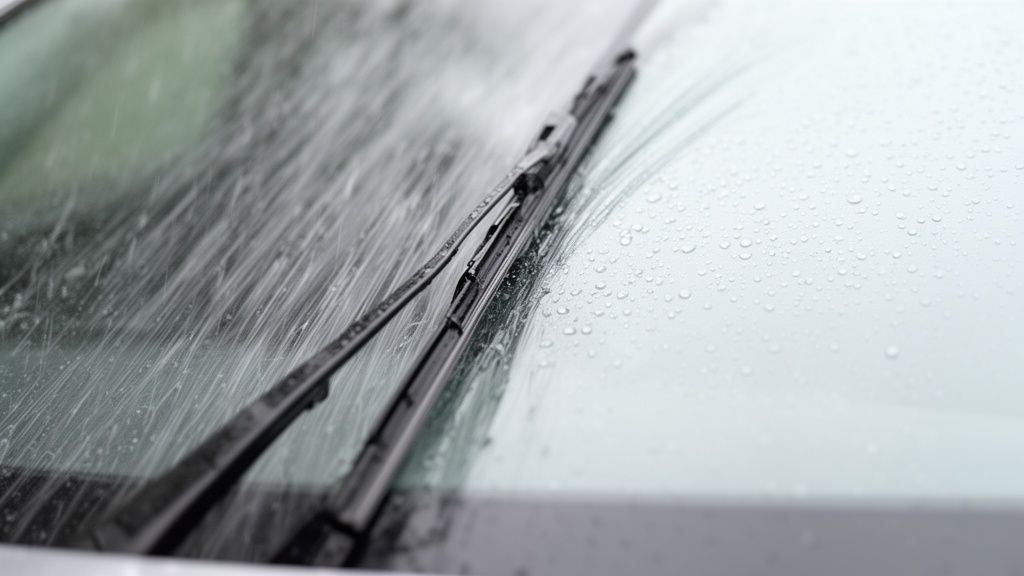
Automotive maintenance experts and professional driving schools consistently emphasize that clear sightlines are non-negotiable for driver safety. Modern vehicles often feature automatic rain-sensing wipers that adjust speed to match the rainfall's intensity, but manual control is just as important. In a heavy downpour, using the highest setting is necessary to keep your view clear, though you must remain aware that even the best wipers can be overwhelmed by torrential rain.
Maximizing Your Line of Sight
Effective visibility management involves three key areas: your wipers, your glass, and your cabin's atmosphere. High-quality wiper blades from manufacturers like Bosch and TRICO are designed with specific rubber compounds and geometries to maintain firm contact with the windshield, preventing streaking and clearing water efficiently.
Beyond ensuring your wipers are in top condition, consider applying a high-quality rain repellant ceramic coating. These treatments create a hydrophobic surface that causes water to bead up and roll off the windshield, significantly improving visibility, especially at higher speeds. They work in tandem with your wipers to provide an exceptionally clear view.
Actionable Tips for Implementation
Here are practical ways to ensure your visibility is never compromised during a storm:
- Routine Wiper Replacement: Replace your wiper blades every 6 to 12 months or as soon as you notice streaking, chattering, or skipping. Degraded rubber is ineffective and dangerous in heavy rain.
- Keep Washer Fluid Full: Always maintain a full reservoir of high-quality windshield washer fluid. Some formulas contain rain-repellent additives that supplement treatments like Rain-X.
- Clean Your Glass Inside and Out: A clean windshield is crucial. Dirt and grime on the outside can cause smearing, while a film on the inside from off-gassing vinyl can increase fogging.
- Use Your Defroster: Combat interior condensation by turning on your air conditioning and directing the airflow to the windshield using the defrost setting. The A/C acts as a dehumidifier, quickly clearing fog.
7. Stay Alert and Avoid Distractions
Driving in the rain demands your full, undivided attention. Reduced visibility from spray and fog, combined with slippery roads and unpredictable actions from other drivers, shrinks your margin for error to nearly zero. Any distraction, no matter how brief, can have catastrophic consequences when you have less time to perceive and react to a developing hazard.
This concept is a cornerstone of defensive driving, emphasized by safety organizations like the National Highway Traffic Safety Administration (NHTSA). Their data consistently shows the dangers of inattention, with distracted driving claiming thousands of lives annually. In perfect weather, a distraction is risky; in a downpour, it’s a gamble you cannot afford to take, making this one of the most critical driving in the rain tips to master.
The Amplified Risk of Inattention
In dry, clear conditions, your brain has more time to process information. However, rain adds layers of complexity: you must constantly monitor your speed, watch for standing water, track obscured vehicles, and anticipate sudden braking. Every second your attention is diverted to a phone, the radio, or a conversation, you're missing crucial updates from your environment.
This heightened need for focus is why many aggressive driver courses and traffic school programs heavily feature modules on attentive driving. The risk of an accident doesn't just double in the rain; it can increase exponentially when combined with a distraction. For a deeper understanding, you can learn more about the severe consequences of inattention on bdischool.com.
Actionable Tips for Implementation
Here are practical strategies to maintain laser focus when driving in wet conditions:
- Create a No-Phone Zone: Before you start the engine, put your phone on "Do Not Disturb" mode. Better yet, place it in the glove compartment or a bag in the back seat where you won't be tempted to reach for it.
- Prepare Before You Go: Adjust your mirrors, set your navigation, and choose your audio before putting the car in drive. Avoid tasks like eating, drinking, or grooming while the vehicle is in motion.
- Manage Passengers: Politely inform passengers that you need to concentrate fully on the road due to the weather. Ask them to assist with navigation or to keep conversations to a minimum if you feel overwhelmed.
- Actively Scan Your Surroundings: Force yourself to stay mentally engaged. Constantly check your mirrors, scan the road far ahead for potential hazards, and monitor the vehicles around you. This active process keeps your mind from wandering.
8. Understand Road Conditions and Adjust Route/Timing
Smart driving in the rain begins before you even turn the key. Proactively understanding the specific challenges of your route and having the flexibility to alter your plans based on real-time conditions is a hallmark of a mature, defensive driver. Not all roads react to rainfall the same way; factors like surface material, elevation, and even shade can create unpredictable hazards that require forethought and adaptation.
This proactive approach is championed by professional drivers and local traffic authorities who know that avoiding danger is always better than reacting to it. In an age of instant information, leveraging technology to make informed decisions about your travel is one of the most effective driving in the rain tips you can adopt. It's about shifting from a reactive mindset to a strategic one, prioritizing safety over schedule.
Leveraging Real-Time Information
Modern technology has made it easier than ever to assess your route before departure. Weather and navigation apps are no longer just for directions; they are critical safety tools. Applications like Waze and Google Maps integrate real-time traffic data, often showing slowdowns caused by heavy downpours or accidents.
Similarly, dedicated weather apps like Weather Underground provide hyper-local precipitation forecasts and radar maps. This allows you to see the intensity and movement of a storm, helping you decide whether to delay your trip by 20-30 minutes to avoid the heaviest rainfall. For instance, knowing that Florida’s I-75 through the Everglades is prone to water accumulation can help you choose an alternate route or time your travel to avoid peak storm conditions.
Actionable Tips for Implementation
Here are practical ways to apply this forward-thinking driving in the rain tip:
- Pre-Drive Weather Check: Before you leave, check a reliable weather radar. This gives you a clear picture of the storm's intensity and duration, allowing you to make an informed decision about whether to wait it out or proceed with caution.
- Identify High-Risk Zones: Use your navigation app to scout your route for potential hazards. Pay special attention to bridges, which can freeze faster in cold rain, low-lying areas prone to flooding, and heavily shaded roads that stay wet longer.
- Build in a Time Buffer: The most common mistake drivers make is not allowing enough time. If rain is in the forecast, add significant extra time to your travel schedule. The stress of being late can lead to poor decisions like speeding or tailgating, which are magnified in wet conditions.
- Be Willing to Postpone: The safest choice is sometimes not to drive at all. If the weather is severe, with warnings for flash floods or extremely low visibility, postponing your trip is the wisest and safest option. Arriving late is always better than not arriving at all.
8-Point Driving-in-Rain Safety Comparison
| Safety Measure | Implementation Complexity 🔄 | Resource Requirements ⚡ | Expected Effectiveness ⭐ | Key Advantages 📊 | Ideal Use Cases & Tips 💡 |
|---|---|---|---|---|---|
| Reduce Speed and Increase Following Distance | Low — behavioral change; requires discipline | Minimal — time, attention; optional cruise control | Very high ⭐⭐⭐⭐ | Increases stopping margin; lowers collision severity | High-speed roads & heavy rain — follow 8–10 second rule |
| Ensure Your Tires Are in Optimal Condition | Moderate — inspections and replacements needed | Moderate–High — cost for quality tires and maintenance | Very high ⭐⭐⭐⭐⭐ | Dramatically reduces hydroplaning & braking distance | Frequent rain driving — replace at ~4/32" and check monthly |
| Use Headlights and Visibility Features Properly | Low — simple to activate; requires judgment on beams | Low — minor energy and maintenance | High ⭐⭐⭐⭐ | Improves mutual visibility; legal compliance | Rain with wipers on, low light — use low-beams, keep lenses clean |
| Avoid Hydroplaning by Understanding Road Hazards | Moderate — requires knowledge and situational scanning | Low — awareness and speed adjustment | High ⭐⭐⭐⭐ | Prevents loss of steering/braking control | Standing water, curves, dips — avoid puddles; ease off accelerator if sliding |
| Brake Gently and Avoid Sudden Stopping | Low — habit/technique change; practice required | Low — planning and anticipation time | High ⭐⭐⭐⭐ | Maintains stability and ABS effectiveness; reduces skids | Urban traffic & following situations — brake early and apply steady pressure |
| Increase Windshield Wipers and Visibility | Low — replace blades, use settings and defrost | Low–Moderate — blade/washer fluid cost | High ⭐⭐⭐⭐ | Maintains clear sightlines; earlier hazard detection | Heavy downpours or old blades — replace every 6–12 months; use defrost |
| Stay Alert and Avoid Distractions | Moderate — behavioral discipline and habit changes | Minimal — phone settings (DND) and self-control | Very high ⭐⭐⭐⭐⭐ | Faster hazard detection; fewer reaction errors | All rain driving — silence phone, scan mirrors every 2–3 seconds |
| Understand Road Conditions and Adjust Route/Timing | Moderate — planning and judgment; app use | Low–Moderate — navigation apps, extra time | High ⭐⭐⭐⭐ | Reduces exposure to known hazards; enables safer choices | Long commutes or severe storms — check radar, delay or reroute when needed |
Drive Smarter, Not Harder: Your Next Step to Road Safety
Navigating a rain-soaked roadway is a test of preparation, patience, and perception. This guide has provided a comprehensive toolkit of driving in the rain tips, moving beyond generic advice to offer actionable strategies for real-world scenarios. We have explored the foundational importance of vehicle maintenance, from ensuring your tires have adequate tread depth to verifying your windshield wipers can effectively clear your view. These are not passive checks; they are your first line of defense against the elements.
The journey to becoming a safer driver continues behind the wheel, where proactive adjustments become critical. Remember the core principles we covered: significantly reducing your speed and doubling your following distance to at least six seconds. This simple change gives you the invaluable gift of time, time to react, to brake gently, and to avoid the sudden maneuvers that can lead to a loss of control on slick surfaces. By consciously choosing to drive with headlights on, even in light rain, you transform your vehicle from a gray shape into a clearly visible presence, protecting both yourself and others.
From Knowledge to Action: Mastering the Road
True mastery over challenging conditions like heavy rain comes from internalizing these techniques until they become second nature. It is about understanding the physics of hydroplaning not just as a concept, but as a tangible threat that you can actively mitigate by avoiding standing water and easing off the accelerator if you feel the vehicle float. It is about committing to a distraction-free environment, recognizing that a wet road demands 100% of your cognitive focus.
The most crucial takeaway is this: Safe driving is an active, ongoing skill. It is not a certificate you earn once, but a commitment you renew every time you start your engine. Each of these driving in the rain tips is a building block in the foundation of defensive driving. The ultimate goal is not just to survive a storm but to command your vehicle with confidence and precision, regardless of the weather. This proactive mindset protects your life, the lives of your passengers, and everyone else who shares the road.
Your Commitment to Safer Florida Roads
For drivers in Florida, where sudden downpours are a part of life, these skills are not optional, they are essential. Adopting these habits contributes to a collective culture of safety, reducing accidents and making our communities more secure. It’s about more than just personal safety; it's about shared responsibility. Whether you are a new driver learning the ropes or an experienced one seeking to refine your skills, the journey of improvement is continuous. By implementing these strategies, you are not just driving smarter, you are becoming a more responsible and capable member of the driving community. Embrace the challenge, apply this knowledge consistently, and take pride in your ability to navigate even the most difficult conditions safely.
Ready to turn these tips into ingrained habits and potentially dismiss points from your license? Enroll in a state-approved Basic Driver Improvement course with BDISchool to reinforce these critical defensive driving skills and qualify for insurance discounts. Take control of your driving record and become a safer, more confident driver today by visiting BDISchool.