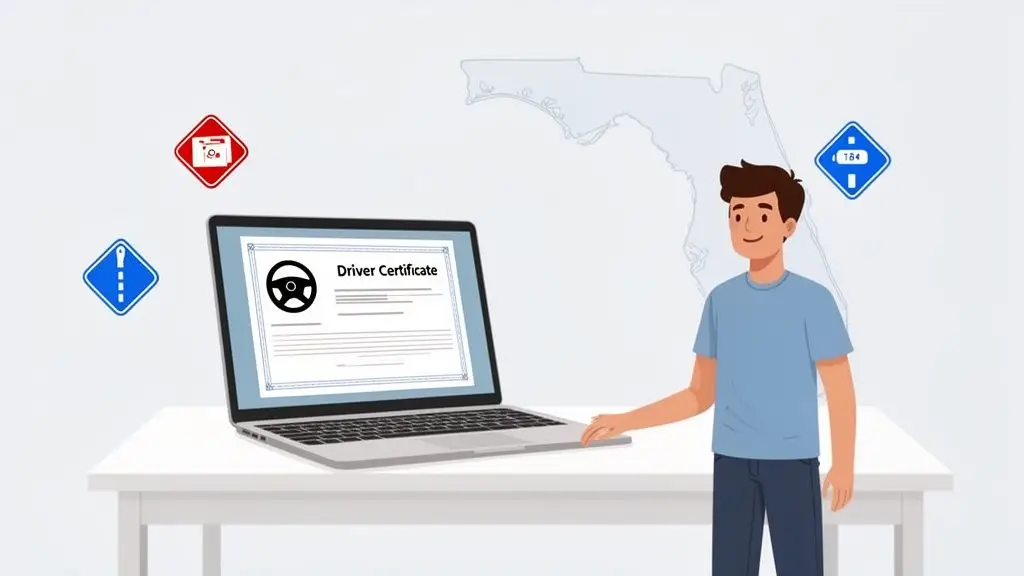
Getting your first driving permit in Florida is a huge rite of passage. It's that first real taste of freedom and the first step toward getting your full driver's license. The whole process is managed by the Florida Department of Highway Safety and Motor Vehicles (FLHSMV), and while it might seem like a lot of steps, it’s pretty straightforward once you know what to expect.
This guide will break everything down for you, making sure you have all the right courses, tests, and documents lined up for a hassle-free trip to the driver's license office.
Your Roadmap to a Florida Driving Permit
Whether you're a teen counting down the days until you can drive or an adult getting licensed for the first time, Florida’s path starts with a learner's permit, officially called a Class E Learner's License. Think of it as the foundational stage—it's all about building your knowledge and getting comfortable behind the wheel with a licensed driver beside you.
The state has a clear, structured system built on three pillars: education, testing, and identity verification. You can't just walk in and get a permit. You first need to show you’ve learned the rules of the road and understand the serious responsibility that comes with driving.
The Three Core Steps to Your Permit
Getting your permit really boils down to three key phases. First, you have to take a mandatory drug and alcohol course. Next, you pass the official knowledge test. Finally, you gather your paperwork and head to an FLHSMV office to make it official.
This flowchart gives you a bird's-eye view of the entire journey.

As you can see, each step naturally leads to the next. Nail the first one, and you're well on your way.
Understanding the Key Requirements
The requirements differ slightly depending on your age. For teens, the rules are very specific. If you’re 15, you must complete the Traffic Law and Substance Abuse Education (TLSAE) course, which most people just call the DATA or drug and alcohol course. After that, you need to pass the 50-question written knowledge test.
This initial course is non-negotiable and covers the absolute essentials every new driver needs to know, including:
- How alcohol and drugs impair your judgment and reaction time.
- Critical Florida traffic laws you'll see on the road every day.
- Safe and defensive driving strategies to avoid accidents.
What about adults? If you’re 18 or older and have never held a license in any state or country, you also have to take the TLSAE course. The good news is that once you get your permit, your path to a full license can be a bit quicker than it is for teens.
Expert Tip: The process is strictly sequential. You must complete the TLSAE/DATA course before you're eligible to take the permit test. Trying to take the test first is a common mistake that leads to a wasted trip and a lot of frustration.
No matter your age, the goal is the same: to make sure you’re prepared to be a safe, responsible driver.
Florida Learner's Permit Requirements at a Glance
To make things even clearer, here’s a quick comparison of the main requirements for teens versus adults getting their first Florida permit.
| Requirement | Teens (15-17) | Adults (18+) |
|---|---|---|
| Minimum Age | 15 years old | 18 years old |
| Mandatory Course | Yes, Traffic Law and Substance Abuse Education (TLSAE) course is required. | Yes, TLSAE course is required if you've never been licensed before. |
| FLHSMV Knowledge Test | Yes, must pass a 50-question exam on road signs and traffic laws. | Yes, must pass the same 50-question exam. |
| Parental Consent | Yes, a signed Parent/Guardian Consent Form is mandatory. | No, parental consent is not required. |
| Vision & Hearing Test | Yes, must pass both tests at the FLHSMV office. | Yes, must pass both tests at the FLHSMV office. |
This table covers the big-ticket items, but remember that document requirements (proof of identity, residency, etc.) are strict for everyone. Always double-check the FLHSMV website for what to bring before your appointment.
How to Prepare for the FLHSMV Knowledge Test
Let's be honest—the 50-question FLHSMV Knowledge Test is probably the part of this process that's stressing you out the most. I've seen it time and time again: applicants think a quick skim of the driver's handbook the night before will cut it. It won't.
To pass, you need to correctly answer at least 40 questions, which is an 80% score. This test isn't just about memorization; it's designed to see if you truly understand Florida's traffic laws, road signs, and the real-world situations you'll face behind the wheel.
The Florida Driver Handbook Is Your Bible
Your number one resource is, without a doubt, the official Florida Driver Handbook. But please, don't just read it cover-to-cover like a novel. That's a surefire way to forget everything.
Think of it as a textbook for the most important exam you've taken so far. Break it down into chunks and really zero in on the topics that are heavily featured on the test.
From my experience, you should pay extra close attention to these chapters:
- Traffic Signals and Road Signs: You need to know these on sight. Shape, color, symbol—it should all be second nature.
- Right-of-Way Rules: The test loves to throw tricky scenarios at you involving intersections, roundabouts, and pedestrians. Who has the right of way? You need to know instantly.
- Parking Regulations: It seems simple, but do you know the exact rules for parking on a hill or how many feet you need to be from a fire hydrant? The test will check.
- Speed Limits: Make sure you've memorized the default speed limits for residential areas, school zones, and highways when no sign is posted.
As you get ready, remember that a lot of your required coursework can be done online. For some great pointers on how to study effectively in a digital format, check out these helpful online course tips.
Focus on the Common Stumbling Blocks
Every year, I see new drivers get tripped up by the same types of questions. They’re usually the ones that require you to apply a rule to a specific scenario, not just recite a fact from the book.
Knowing the school zone speed limit is one thing. Knowing exactly when that speed limit is enforced is what the test is looking for.
Be sure to spend extra time mastering these notoriously tricky areas:
- Four-Way Stops: What happens when two cars get there at the same time? What about four? This is a classic.
- Emergency Vehicles: You need to know the precise steps to take when you see flashing lights or hear sirens approaching.
- Pavement Markings: Can you explain the difference between a solid yellow line, a broken yellow line, and a shared center lane used for turning? You'll be asked.
Real-World Insight: A common mistake I see is people over-studying the fines and penalties. While they're good to know, the bulk of the test is about safe driving practices. Prioritize your study time on the rules that actually keep you and everyone else safe on the road.
Make Practice Tests Your Best Friend
Practice tests are the secret weapon for passing on your first try. They do more than just show you what the real test will feel like—they pinpoint your exact weaknesses.
When you take a practice exam, don't just glance at your final score. Go back and analyze every single question you got wrong. Figure out why you got it wrong and understand the logic behind the correct answer.
This is what turns passive reading into active learning. You’ll start to see patterns in your mistakes, which tells you exactly which sections of the handbook you need to hit again. A great place to start is with a Florida DMV permit practice test to get a baseline of your current knowledge.
Here’s a simple, effective study plan:
- First Pass: Do a quick read of the handbook to get the lay of the land.
- Baseline Test: Take your first practice test to see where you stand right now. No pressure.
- Targeted Study: Now, go back to the handbook and focus like a laser on the topics you struggled with on the practice test.
- Rinse and Repeat: Keep cycling between testing and reviewing. Once you're consistently scoring well above 80%, you’re ready.
This method takes the guesswork out of studying and helps you walk into the FLHSMV office feeling confident, not just hopeful.
Getting Your Paperwork in Order: What to Bring to the DMV
There's nothing worse than waiting in line at the Florida Department of Highway Safety and Motor Vehicles (FLHSMV) only to be turned away because you're missing a single piece of paper. Trust me, it happens all the time. The state is incredibly strict about proving who you are, where you live, and your Social Security status.
Getting this right the first time will save you a massive headache and a return trip.

Think of it this way: you need to prove three things—your identity, your Social Security number, and your Florida address. For each, you'll need specific documents, and they absolutely must be originals or certified copies. Photocopies won't cut it.
Proving Your Legal Identity
This is your foundation document. It establishes your full legal name and date of birth. For most people born in the U.S., one of these will do the trick:
- Original or Certified U.S. Birth Certificate: This is the go-to for most applicants. Just make sure it's the official one from the vital statistics office, not the commemorative one from the hospital.
- Valid U.S. Passport: A passport book or card works perfectly as your primary ID.
- Certificate of Naturalization or Citizenship: If you’re a naturalized citizen, this is the document you’ll need.
A quick but important tip: If your name has changed (due to marriage, for example), you have to bring the legal documents linking your old name to your new one, like a marriage certificate or court order. The names must connect seamlessly across all your paperwork.
Verifying Your Social Security Number
Next up is your Social Security number (SSN). You can't just recite it from memory; you have to bring a document that shows the full, nine-digit number.
Your best bets are:
- Original Social Security Card: The easiest and most direct option.
- W-2 Form: As long as it's from the current tax year and shows your full SSN.
- Pay Stub: This works too, but it has to show both your name and your full SSN.
- SSA-1099 or Non-SSA-1099 Form: Official tax forms from the Social Security Administration.
Crucial Tip: I can't stress this enough—you must bring one of the physical documents listed above. Simply knowing your number isn't enough to get a driving permit in Florida. It’s a hard-and-fast rule.
Establishing Florida Residency
Finally, you need to prove you actually live in Florida. This is where many people get tripped up because you need two separate documents showing your current residential address.
For teens, mail addressed to a parent or guardian at the family's address is perfectly acceptable.
Here are some of the most commonly used proofs of address:
- Utility Bills: An electric, water, or cable bill from the last two months works great.
- School Records: For teens, a current report card or transcript with your home address on it is a fantastic option.
- Bank or Credit Card Statements: Make sure they're recent and clearly display your address.
- Rental or Lease Agreement: A signed, current agreement is solid proof.
For a complete rundown of every possible document and rule, it’s always smart to check the official source. You can find all the details directly in the https://bdischool.com/florida-drivers-manual/, which spells out every requirement.
The One Form Every Minor Needs
If you're under 18, there's one last, critical piece of paper: the Parental Consent Form for a Driver Application of a Minor.
A parent or legal guardian has to sign this form, but here's the catch: the signature must either be notarized beforehand or signed right there in front of the DMV examiner. Showing up with a pre-signed form that isn't notarized is a guaranteed rejection.
Plan ahead. Either get the form notarized or make sure your parent can come with you to the appointment. Forgetting this simple step is probably the number one reason teens are sent home empty-handed.
Understanding Your Permit Restrictions and Florida’s GDL Rules
Getting that learner's permit is a huge milestone—it’s your first real taste of freedom behind the wheel. But it’s important to remember that a permit isn’t a full license. It comes with a specific set of rules designed to keep you safe while you gain experience.
Florida uses a Graduated Driver Licensing (GDL) program. Think of it like a training program for new drivers. It’s not about making your life difficult; it’s about easing you into the complex task of driving by limiting high-risk situations until you’ve built up your skills and confidence. These rules are non-negotiable and are your roadmap to earning a full license.

The Golden Rule: Never Drive Alone
This is the most critical rule of all: with a learner's permit, you can never drive by yourself. Not for a quick run to the corner store, not even to move the car in the driveway.
Every single time you're behind the wheel, a licensed driver who is at least 21 years old must be in the front passenger seat, right next to you.
This person isn't just a passenger. They need to be awake, alert, and fully capable of taking control of the car if needed. They are your co-pilot, your second set of eyes, and your on-the-road instructor.
Master the Clock: Your Driving Curfews
Time of day matters a lot when you have a permit. The rules are designed to let you practice in lower-risk conditions first and then gradually expose you to more challenging situations.
For the first three months with your permit, you can only drive during daylight hours. This is a critical learning phase where you get comfortable with the basics of handling a car without the added challenge of darkness.
After those first three months, the window expands. You can then drive until 10:00 PM. This allows you to start practicing with headlights and in lower-light conditions, but keeps you off the road during the riskiest late-night hours.
Here’s a real-world example: Let's say you get a part-time job that ends at 9:30 PM. Once you've had your permit for more than three months, you can legally drive home as long as your 21-year-old dad is in the passenger seat. But if your shift ends at 11:00 PM, you can't drive—your dad would have to take the wheel.
The 50-Hour Practice Log
Getting your license isn't just about passing a test; it's about proving you have real-world experience. Before you can even apply for your intermediate license, you have to log 50 hours of supervised driving.
Your parent or guardian will have to sign a certification form confirming you’ve completed all 50 hours, so this isn’t something you can skip. The state knows that time on the road is what transforms head knowledge into muscle memory.
And it gets more specific. Of those 50 hours, a minimum of 10 hours must be at night. Driving after dark is a completely different ballgame. You're dealing with headlight glare, reduced visibility, and challenges with depth perception. These 10 hours are mandatory to ensure you can handle it.
Here’s a quick summary of your practice requirements:
| Driving Requirement | Hours Needed | Why It's Important |
|---|---|---|
| Total Supervised Driving | 50 hours | Builds core skills across different road types and traffic scenarios. |
| Night Driving (included in total) | 10 hours | Prepares you for the unique challenges of low-light conditions and nighttime hazards. |
Your best bet is to keep a detailed log. Every time you drive, jot down the date, how long you drove, and the conditions. Was it raining? Did you practice parallel parking? Did you navigate highway traffic? The more varied your practice, the more prepared you'll be.
To brush up on the specific rules of the road you'll be practicing, you can learn more about Florida's driving laws here. Following these GDL requirements carefully is the surest and safest way to earn your driver's license.
From Permit to License: The Final Stretch
That year with your learner's permit can feel like an eternity, but all that supervised practice is building the foundation for a lifetime of safe driving. Once you've logged your 50 hours—including 10 at night—and kept your record clean for 12 consecutive months (if you're under 18), you're finally in the home stretch. It's time to go for your Class E driver’s license.
This is the moment you’ve been working toward. The only thing standing between you and the freedom of driving on your own is the on-road driving test. Passing it is your chance to prove you can handle the car and make smart decisions without a co-pilot in the passenger seat.
Booking and Prepping for Your Driving Test
First things first, you can't just wander into the FLHSMV office for your road test. You absolutely have to schedule an appointment. Most county tax collector offices and service centers use the state’s online system, so book your slot well in advance—they fill up surprisingly fast.
When test day rolls around, showing up prepared is half the battle. This starts with the vehicle you bring. Before you even turn the key, the examiner will do a quick but thorough inspection.
They’ll be checking for:
- Working Equipment: Headlights, brake lights, turn signals, the horn, and even your windshield wipers need to be fully functional.
- Valid Paperwork: You must have proof of current Florida registration and auto insurance for the vehicle. No exceptions.
- Overall Safe Condition: The car needs working doors, a clear and uncracked windshield, and tires that aren't bald.
Failing this basic inspection means your test is over before it begins, and you'll have to go through the hassle of rescheduling. It’s a common mistake, but it's also completely avoidable. A quick five-minute check the day before can save you a world of frustration.
For a complete rundown of what the examiner is looking for, our guide on preparing for the behind-the-wheel test breaks down every detail.
What Happens During the On-Road Exam?
The driving test isn’t designed to trick you. It’s a straightforward, practical assessment of how you handle common road situations. The examiner just wants to see that you can operate the vehicle safely and legally in a real-world setting.
You'll be asked to demonstrate a handful of key maneuvers that show you're in control and know the rules of the road.
Expect to be tested on skills like these:
- Three-Point Turn: Can you turn the car around in a tight space without hitting a curb?
- Parking: You'll need to show you can handle straight-in parking or parking on a hill.
- Backing Up: This involves backing the vehicle in a straight line for about 50 feet without swerving all over the place.
- Smooth Stopping: They want to see controlled, gradual stops—not sudden, jarring ones.
- Yielding Right-of-Way: This is a big one. You have to demonstrate you know when to go and when to yield at intersections and for pedestrians.
- Lane Changes: The proper "signal, mirrors, over-the-shoulder" sequence is non-negotiable.
A Quick Tip from Experience: It's totally normal to be nervous, but don't let it make you forget the fundamentals. Most people lose points on the simple stuff: forgetting a turn signal, not checking mirrors often enough, or "rolling" through a stop sign instead of coming to a complete stop. Take a deep breath and just drive like you've been practicing for the last year.
Intermediate License Rules for Teen Drivers
Passing the test is an incredible feeling, but for drivers who are 16 or 17, the journey isn't quite over. Florida’s Graduated Driver Licensing (GDL) laws mean you'll get an intermediate license first, which comes with a few temporary restrictions designed to ease you into solo driving.
The biggest rules to remember are the curfews.
- For 16-year-olds: No driving between 11:00 PM and 6:00 AM. The only exceptions are if you're driving to or from work or have a licensed driver aged 21+ with you.
- For 17-year-olds: The rules are a bit more relaxed. The curfew is from 1:00 AM to 5:00 AM, with the same exceptions for work or being accompanied by an adult driver.
These curfews automatically disappear the day you turn 18. Sticking to them until then is critical for keeping your license in good standing and proving you’re ready for the full responsibility of the road ahead. This final phase completes your transition from holding a driving permit in Florida to becoming a fully licensed driver.
Your Top Questions About the Florida Driving Permit, Answered
Even when you follow all the steps, a few questions always pop up when you're trying to get a driving permit in Florida. You're not the only one wondering about things like online testing, what happens if you fail, or if you can just walk into the driver's license office.
Let's clear up some of the most common points of confusion so you can move forward with confidence.
Can I Take the Florida Permit Test Online?
Yes, but it depends entirely on your age.
If you're under 18, you're in luck. You can take the Class E Knowledge Exam online through a state-approved provider. This is a huge advantage, as you can tackle the test in a familiar, low-stress environment like your own home.
Just remember, passing the online test doesn't mean you get to skip the DMV altogether. You'll still have to show up in person to:
- Get your vision and hearing checked.
- Present all your official documents for verification.
- Have your picture taken for the actual permit.
Now, for anyone 18 or older, the process is different. You must take the knowledge test in person at a driver's license service center. There's no online option available for adults seeking their first permit.
What Happens If I Fail the Permit Test?
First off, don't panic. Failing the permit test isn't the end of the world, and plenty of people need a second try to pass the 50-question exam. It happens.
The main thing to know is that while you can take the test again, it's going to cost you. There's a retesting fee for every attempt after the first one. These fees can add up quickly, which is why preparing thoroughly the first time is your best and most affordable strategy.
A Crucial Tip for Teens: If you're taking the test online, you get three shots. Fail it three times, and the online system will lock you out. After that, all future attempts must be made in person at an FLHSMV office. It’s the state’s way of making sure you get the direct oversight you need to pass.
How Long Is a Florida Learner's Permit Valid?
Your Florida learner’s permit is good for exactly one year from the day it's issued. That one-year mark is incredibly important, especially for teen drivers.
Under Florida's Graduated Driver Licensing (GDL) laws, a teenager must hold their learner's permit for a full 12 months without any traffic tickets before they can even think about applying for their intermediate driver's license.
What happens if it expires? You can't just renew it. You'll most likely have to start the entire application process over—which could mean retaking the knowledge test and paying all the fees again. Keep a close eye on that expiration date and schedule your road test well in advance.
Do I Need an Appointment to Get My Permit?
Yes. Absolutely, yes.
The days of walking into a driver's license office and waiting in line are pretty much over. To manage the crowds and keep things running smoothly, most FLHSMV centers and county tax collector offices now work on an appointment-only basis.
Walk-in slots are incredibly rare and are usually for quick transactions, which getting a permit is not. The best thing you can do for yourself is to book your appointment online using the state's Online Appointment Service and Information System (OASIS).
Seriously, plan ahead. Schedule your visit as soon as you know you've got your courses done and your documents in order. It’s the only way to avoid the frustration of waiting all day just to be turned away.
At BDISchool, we believe that a prepared driver is a safe driver. Our state-approved courses give you the knowledge you need to not only ace your permit test but also build real confidence behind the wheel. From the required TLSAE course to in-depth driver education, we make learning the rules of the road straightforward and effective.
Ready to take the next step? Learn more about how we can help at https://bdischool.com.