Earning a passing score on the Florida Class E Knowledge Exam is your first real step toward getting a learner's permit. This isn't just any test; it’s a 50-question exam covering everything from road signs to traffic laws, and you've got to nail at least 40 of them to pass.
From my experience, the absolute best way to walk in feeling confident is to drill with a high-quality Florida DMV permit practice test. It makes all the difference.
What to Expect on the Florida Permit Test
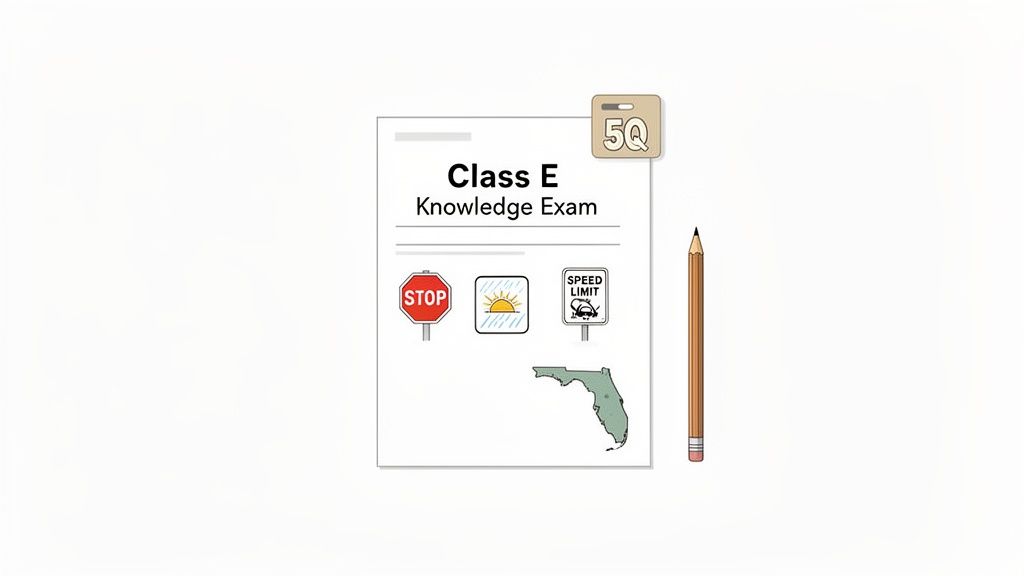
It’s completely normal to feel a bit of pressure walking into your permit test appointment. But a lot of that anxiety disappears when you know exactly what you're up against.
The whole point of the Class E Knowledge Exam is to make sure you have the basics of Florida’s traffic laws and safe driving down cold before you ever start the engine. This isn't about memorizing random facts—it's about showing you can make safe, smart decisions on the road.
Every single question you'll see comes from one source: the official Florida Driver Handbook. Think of it as your study bible.
Here's a quick rundown of what to expect on test day.
Florida Permit Test at a Glance
| Metric | Requirement |
|---|---|
| Total Questions | 50 multiple-choice questions |
| Passing Score | 80% (at least 40 questions correct) |
| Allowed Misses | 10 questions |
| Test Topics | Road Signs, Traffic Laws, Safe Driving Practices |
| Primary Source | Official Florida Driver Handbook |
Think of this table as your cheat sheet. Knowing these numbers helps you set a clear goal for your study sessions.
Key Test Components
The 50 questions are split pretty evenly between two main areas. You'll get about 25 questions on road signs and another 25 on traffic laws and general safety rules. This way, the state ensures you have a solid foundation in both recognizing and reacting to road conditions.
To pass, you need that 80% score, which means you can only miss 10 questions. It sounds straightforward, but some of the questions are designed to be tricky. In fact, a surprising number of first-timers don't make the cut. Many fail because they don't fully grasp how the rules apply in real-world driving situations.
Test Content Breakdown
Let's dig into the topics you absolutely must master. The test isn't trying to trick you, but it will definitely check if you understand specific rules for common scenarios.
Here’s what you should focus on:
- Traffic Laws: This is the big one. Know your speed limits (school zones, business districts, etc.), who has the right-of-way, the rules for passing other cars, and exactly what to do when you see an emergency vehicle.
- Road Signs and Signals: You need to identify signs instantly by their shape, color, and symbols. This includes regulatory signs like "Do Not Enter," warning signs like "Slippery When Wet," and guide signs.
- Safe Driving Practices: This part tests your practical knowledge. Expect questions about defensive driving, keeping a safe following distance, proper headlight use (especially in Florida rain!), and the serious dangers of driving while distracted or impaired.
The test is all about real-world application. It won't just ask, "What does a stop sign mean?" Instead, it might show you a four-way stop and ask which car gets to go first. This is exactly why practice tests are so crucial—they get you used to thinking through these scenarios.
What You'll Be Tested On: The Big Three
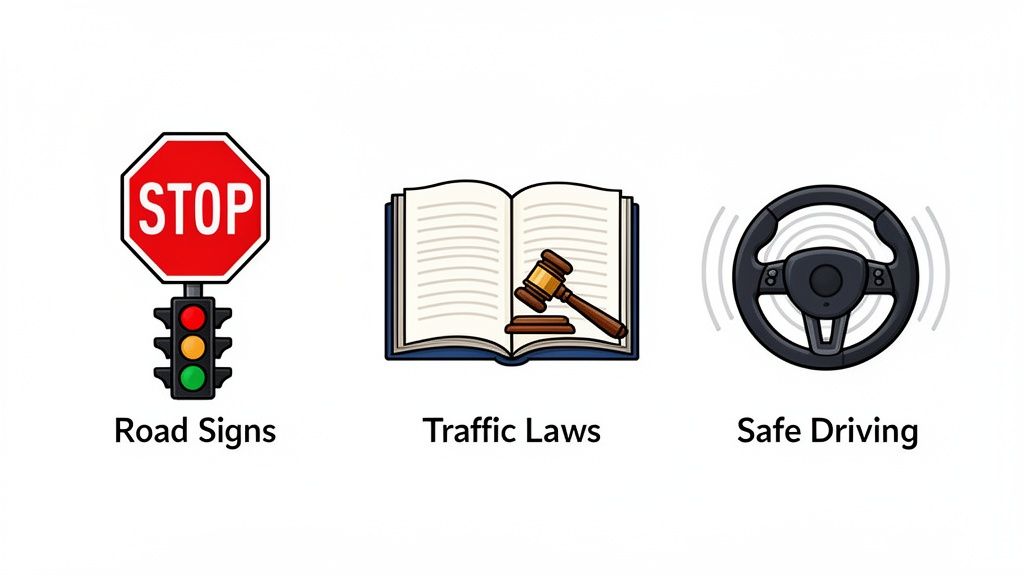
Staring at the Florida Driver Handbook can feel like you're about to read a phone book. It's a lot, I get it. But here’s the good news: the permit test doesn't pull random trivia from its pages. It's laser-focused on three core areas that every safe driver needs to know inside and out.
The trick is to stop thinking about it as memorization. Instead, focus on understanding why these rules exist. This is exactly what a good Florida DMV permit practice test helps with—it connects the dots between the handbook and the real world.
Road Signs and Signals
This is the most visual part of the exam, and it’s all about instant recognition. You won't just see a picture of a stop sign and be asked what it is. The questions are designed to test how quickly you can interpret a sign's meaning from its shape and color alone.
Think about it—when you're actually driving, you only have a split second to see a sign, understand it, and react. That's what the test is preparing you for.
For example, a round yellow sign always means a railroad crossing is ahead. An octagon shape is only used for stop signs. Knowing these visual shortcuts helps you process information faster on the road. For a great refresher, check out this guide on common traffic signs and their meanings.
Traffic Laws and Regulations
This section is where the rubber meets the road, literally. It’s not about reciting laws from memory; it’s about applying them to everyday situations you'll face in Florida.
You need to know the rules so well they become second nature.
- Right-of-Way Rules: Picture this: you pull up to a four-way stop, and a car arrives on your right at the exact same moment. Who gets to go? The law says you yield to the driver on the right. The test will throw that exact scenario at you to see if you can make the right call.
- Speed Limits: You have to know the default speed limits. In a Florida residential area, it's 30 mph unless a sign says otherwise. A test question might describe a neighborhood with no posted speed limit and ask what's safe and legal.
- Merging and Passing: Trying to get onto I-4 during rush hour is a classic Florida challenge. You need to know that the traffic already on the highway has the right-of-way and that you have to find your spot. The test loves to ask about these kinds of practical, high-stakes maneuvers.
A good way to study is to constantly ask yourself "why?" Why does the car on the right go first at a four-way stop? Because it eliminates confusion and prevents collisions at intersections. When you understand the logic, the rules stick.
Safe Driving Practices
This part of the test is less about specific laws and more about your judgment behind the wheel. It covers the defensive driving techniques and attitudes that keep you and others safe. It's all about anticipating problems before they happen.
These aren't just suggestions; they are life-saving habits the test wants to ensure you understand.
Here are some topics that always come up:
- Following Distance: The "three-to-four-second rule" is a big one. A question might give you a scenario—like driving on a highway in clear weather—and ask you to pick the safest following distance.
- Blind Spots: You have to know where your blind spots are and how to check them. A question could ask what you do after signaling for a lane change. The answer is always to check your mirrors and then physically look over your shoulder.
- Distracted Driving: Florida law is clear: no texting and driving. The test will make sure you understand just how dangerous—and illegal—it is to be on your phone.
- Impaired Driving: You absolutely must know the risks and consequences of driving under the influence. Questions will test your knowledge of how alcohol and drugs wreck your judgment, vision, and reaction time.
Taking a Florida DMV permit practice test is the best way to drill these scenarios. It gives you a feel for the real thing and provides instant feedback, which is far more helpful than just reading. This active approach builds the confidence you need to not just pass the test, but to be a smart, safe driver from your very first day on the road.
Creating Your Strategic Study Plan
Just reading the Florida Driver Handbook from cover to cover might seem like the obvious way to study, but it's rarely the most effective. If you want to walk into the DMV feeling confident, you need a real strategy—one that revolves around smart practice, not just rote memorization.
This is all about using the Florida DMV permit practice test as your primary tool. Think of it less as a test and more as a way to find out exactly what you don't know yet. This approach turns studying from a marathon reading session into a targeted mission.
Your First Practice Test: The Diagnostic Tool
Before you even crack open the official handbook, take a full-length practice test. Seriously. Don't worry about the score—this first attempt is purely for a baseline. It’s a diagnostic that will instantly highlight your strong suits and, more importantly, your weak spots.
Finished? Great. Now, look at the results. Did road signs trip you up? Were the right-of-way rules a bit fuzzy? Maybe you struggled with specific speed limits. Jot down every topic where you missed a question. That list is now your personalized study guide.
This method saves you a ton of time by preventing you from rereading chapters you’ve already got down pat. To get started on this crucial first step, you can find a solid driver's license practice test to use as your benchmark.
Building a Simple Weekly Schedule
With your weak areas identified, it's time to build a study schedule. The trick is to find a good rhythm between reading the handbook and actively testing your knowledge. Leaning too heavily on one or the other is a surefire way to burn out or forget what you’ve learned.
Here’s a simple framework you can tweak to fit your own schedule:
- Monday & Tuesday: Time for focused reading. Grab your list of weak topics and dive into those specific sections of the handbook. Take notes, highlight key rules, and really try to understand the concepts.
- Wednesday: Practice test day. Take another full-length test. The goal isn't perfection, but to see if your targeted studying from Monday and Tuesday made a difference. Your score in those areas should start creeping up.
- Thursday & Friday: Review your Wednesday test. Go through every question you got wrong. Just as important, review any you got right but felt unsure about. Head back to the handbook to understand the why behind the correct answer.
- Weekend: Keep it light. A quick 15-minute quiz on road signs or a brief scan of your notes is perfect. Remember, consistent, short study sessions are often more effective than cramming.
The real learning happens when you figure out why you made a mistake. For every wrong answer, ask yourself: "What was my thinking here, and why is the correct answer the right one?" This deepens your understanding far more than just memorizing facts.
Tracking Your Progress and Refining Your Focus
The Florida permit test isn't a walk in the park. It’s been designed to be challenging, especially in response to the state’s high crash rates among new drivers. The exam features 50 questions, and you need at least 40 correct answers—that's an 80% score—to pass. It covers everything from seat belt laws to handling a four-way stop. This is precisely why having a smart study plan matters so much. Data from online test simulators shows most people aim to make 10 or fewer mistakes, mimicking the real pressure of the exam where failing means you have to wait to try again. You can read more about Florida's rigorous permit test standards at NextDoorDriving.com.
This context is why tracking your progress is so critical. Keep a simple log of your practice test scores in a notebook or spreadsheet. Note which topics are improving and which ones are still giving you trouble. If questions about parking on hills keep tripping you up, that’s your new focus. This constant cycle of testing, analyzing, and refocusing is what builds true confidence and prepares you for success on test day.
Sample Practice Questions With Expert Breakdowns
Reading the handbook is one thing, but a Florida DMV permit practice test is where the rubber really meets the road. It's how you shift from simply knowing the rules to actually applying them.
Let's break down a few sample questions that are just like what you’ll face on the real test. The key isn't just memorizing the answer; it's understanding the why behind it.
Road Rules in Action
These types of questions throw you into common driving scenarios to see if you can apply Florida's traffic laws on the fly. The trick is to read carefully—the smallest detail can change everything.
Question 1: You are driving in a residential area with no posted speed limit sign. What is the maximum legal speed?
- A) 25 mph
- B) 30 mph
- C) 35 mph
- D) 45 mph
Correct Answer: B) 30 mph
Expert Breakdown: This is a classic test question pulled straight from the Florida Driver Handbook. When you don't see a speed limit sign, you're expected to know the default limits. In Florida, the speed limit in any business or residential district is 30 mph. They include this to make sure you know the baseline rules when no other signs are around to guide you.
Question 2: You approach a four-way stop at the same time as another vehicle to your right. Who has the right-of-way?
- A) You do, because you are on the left.
- B) The vehicle to your right.
- C) The vehicle that is driving faster.
- D) Whichever vehicle moves first.
Correct Answer: B) The vehicle to your right.
Expert Breakdown: The "yield to the right" rule is one of the most fundamental principles of traffic safety. When two drivers arrive at a four-way stop simultaneously, the driver on the left must yield to the driver on the right. This rule creates a clear, predictable order to prevent chaos and collisions at intersections. You can bet you'll see a scenario like this on the test.
Interpreting Road Signs
Your ability to instantly recognize a road sign by its shape and color is a non-negotiable skill. The exam will test you on more than just the obvious ones like the stop sign.
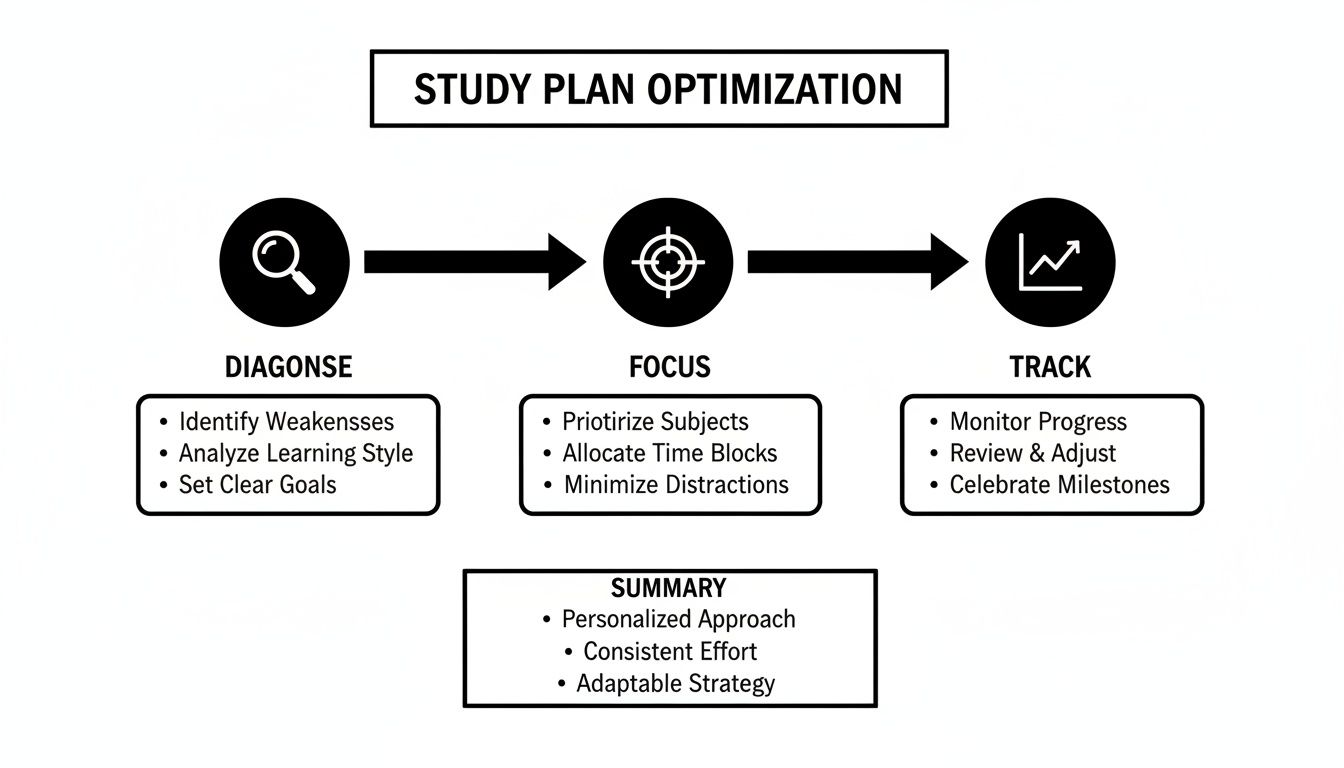
This kind of focused approach—diagnosing weak spots, concentrating your study time there, and tracking your progress—is exactly how you turn a failing practice score into a passing one.
Question 3: What does a round, yellow sign indicate?
- A) A stop sign is ahead.
- B) You are entering a school zone.
- C) A railroad crossing is ahead.
- D) A no-passing zone begins here.
Correct Answer: C) A railroad crossing is ahead.
Expert Breakdown: Think of sign shapes and colors as a universal language for drivers. In the U.S., a round yellow sign always means one thing: you're about to come upon a railroad crossing. The test uses questions like this to ensure you can spot and react to potential hazards long before you're close enough to read the text.
Some signs are easily mixed up, which is a common reason people lose points. Let’s look at a few pairs that often trip up new drivers.
Commonly Confused Florida Road Signs
| Sign Type | Meaning | Common Mistake |
|---|---|---|
| Yellow Pennant (Sideways Triangle) | No Passing Zone. This sign is on the left side of the road. | Confusing it with a general warning sign due to its yellow color. |
| Yellow Diamond with a Squiggly Arrow | Winding Road Ahead. A series of curves or turns is coming up. | Mistaking it for a "Slippery When Wet" sign, which has a car with skid marks. |
| Round Yellow Sign with "RR" | Railroad Crossing Ahead. A warning to prepare for tracks. | Thinking it's the actual crossing, which is marked by a crossbuck sign. |
| Red and White Inverted Triangle ("YIELD") | Yield Right-of-Way. Slow down and be prepared to stop for other traffic. | Treating it like a stop sign; you only stop if necessary to let others pass. |
Being able to tell these apart at a glance is crucial, not just for the test, but for staying safe on the road.
Question 4: You see a diamond-shaped sign with a picture of a truck on a slope. What does this mean?
- A) No trucks are allowed on this road.
- B) A truck stop is ahead.
- C) Watch for trucks entering the highway.
- D) A steep hill or grade is ahead.
Correct Answer: D) A steep hill or grade is ahead.
Expert Breakdown: Diamond-shaped signs are your heads-up for potential hazards. This specific symbol isn't just for truckers; it's a warning for all drivers that a steep grade is coming. This is critical information for managing your speed, whether you’re going up or down the hill.
Safe Driving Practices and Judgment
This is where the test moves beyond simple rules and gets into your decision-making skills. These questions are often based on real-world scenarios, forcing you to think like a safe, defensive driver.
The toughest questions are often the judgment calls. Remember, the right answer is always the safest choice, the one that prioritizes preventing an accident above all else.
Question 5: Under Florida law, you must turn on your low-beam headlights when:
- A) Driving between sunset and sunrise.
- B) Driving in rain, smoke, or fog.
- C) Your visibility is reduced to 1,000 feet or less.
- D) All of the above.
Correct Answer: D) All of the above.
Expert Breakdown: This is a great example of a question that bundles multiple rules into one. Florida's headlight law is very clear: they need to be on from sunset to sunrise, and also any time you're driving in bad weather like rain, smoke, or fog. Just remember the simple phrase: "wipers on, lights on." It's a key Florida law you're expected to know cold.
Question 6: What is the "three-to-four-second rule" used for?
- A) Estimating how long it takes to stop.
- B) Determining a safe following distance.
- C) Calculating how much time you save by speeding.
- D) Judging the time needed to pass another vehicle.
Correct Answer: B) Determining a safe following distance.
Expert Breakdown: This rule is a simple, practical way to make sure you have enough of a safety cushion to react if the car ahead slams on its brakes. A good Florida DMV permit practice test will always have questions on this because it’s a cornerstone of defensive driving. It's how you avoid the most common type of crash: the rear-end collision.
Sidestepping Common Test Day Blunders
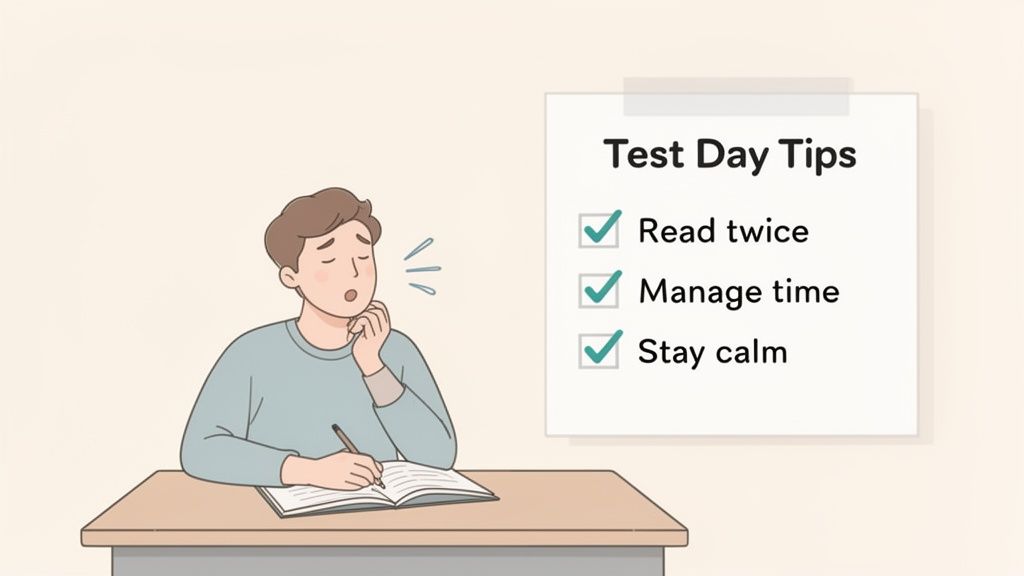
You can know the driver's handbook cover to cover, but that’s only half the battle. When it comes to test day, the real challenge is often keeping your cool and avoiding those simple, frustrating mistakes that can sink your score.
From what I've seen, most well-prepared applicants who fail don't stumble because of a lack of knowledge. They fall into common test-taking traps—small errors that add up and cost them the points they need to pass.
Rushing and Reading Too Fast
The number one culprit? Rushing. It’s so easy to blaze through the questions, but the FLHSMV exam loves to use keywords like "always," "never," or "except" that completely flip a question on its head.
For example, a question might ask which action you should not take when approaching a yield sign. If you’re flying through, your brain just registers "yield sign" and you might click the first correct action you spot, which is precisely the wrong answer.
Here’s a simple but powerful trick: read every single question twice. Do it before you even glance at the answer choices. This little habit forces you to slow down and really process what the question is asking.
Overthinking the Obvious
Just as dangerous as rushing is its polar opposite: overthinking. Some questions are genuinely straightforward—they’re simple gut-checks on basic road rules. If an answer seems obvious, it probably is.
Don’t get tangled up inventing bizarre "what if" scenarios that aren't part of the question. Stick to the facts presented and choose the answer that directly applies the rules you studied in the handbook.
The permit test isn't trying to catch you with some obscure legal loophole. It's designed to confirm you know the standard rules of the road. Trust your preparation and don't second-guess the simple stuff.
Panicking Over Specific Numbers
Another common pitfall is freezing up when a question asks for a specific number, like a following distance in feet or a particular fine amount. Yes, some numbers are critical (like the 30 mph residential speed limit), but the test is far more concerned with your grasp of overall safety concepts.
If you can't recall an exact number, don’t panic. Instead, use the process of elimination. You can often spot two or three choices that are completely unreasonable. Pick the most logical and safest option, and keep moving. This strategy prevents one tough question from shattering your confidence.
Taming Test Day Jitters
Walking into the testing center stressed out is a surefire way to make mistakes. Test anxiety clouds your focus and makes it tough to recall information you actually know quite well.
Here are a few practical tips to stay calm and collected:
- Get a Good Night's Sleep: Don't cram until 2 a.m. A rested brain works so much better.
- Arrive Early: Rushing to your appointment will only send your stress levels through the roof. Give yourself plenty of buffer time.
- Just Breathe: If you feel panic creeping in, take a few deep, slow breaths. It’s a simple trick that really helps you recenter.
And remember, it’s not the end of the world if you don't pass on your first attempt. You can always take it again. Learning how to overcome driving anxiety can also give you some great mental tools to stay composed during the exam.
Data from various practice test platforms shows a telling pattern: around 20% of users initially score below 60%. They often struggle with specific, rule-based questions about things like turn signal distances, merging onto highways, and proper headlight use—exactly the kind of details that are easy to miss when you're rushed or nervous.
Your Florida Permit Test Questions Answered
Even with all the studying, it’s completely normal to have some last-minute questions about how the whole process works. Let's be honest, sometimes figuring out the DMV's logistics can feel as tricky as the test itself.
Let’s walk through some of the most common questions I hear from new drivers. Getting clear answers to these practical things will help you walk in on test day feeling calm and ready.
What Happens if I Fail the Florida Permit Test?
First things first: don't panic. It happens more often than you might think, and it's definitely not the end of the road. If you don't hit that required 80% score on your first go, you can absolutely take it again.
You do have to wait at least one full day before your next attempt, and there will be a retake fee. My advice? Think of that first attempt as the ultimate diagnostic test. Try to remember the questions that tripped you up—was it a specific road sign, a right-of-way rule?
Use that knowledge to focus your next study session. Go back to those specific sections in the Florida Driver Handbook, hammer your weak spots with a good Florida DMV permit practice test, and you'll be in much better shape for round two.
Can I Take the Official Florida Permit Test Online?
Yes, and for many people under 18, it's a great option. The Florida Department of Highway Safety and Motor Vehicles (FLHSMV) gives a thumbs-up to certain third-party schools to administer the official Class E Knowledge Exam online.
If you go this route, just know that it will be proctored. This usually means you’ll need a computer with a working webcam. The software keeps an eye on you to make sure everything is fair and square—no peeking at notes or getting help. Always double-check that the provider you choose is officially approved by the FLHSMV to avoid any headaches later.
Taking the test from home can be a huge stress reliever. You're in your own space! Just make sure your internet connection is solid and you won't have any interruptions.
What Documents Do I Need for My Learners Permit?
Showing up to the DMV without the right paperwork is one of the most common and frustrating mistakes I see. Getting your documents in order ahead of time is the key to a smooth trip. You'll need original documents—not photocopies—to prove who you are and where you live.
Here’s a quick checklist of what you'll need to bring:
- Proof of Identity: An original or certified U.S. birth certificate or a valid U.S. passport.
- Proof of Social Security Number: Your original Social Security card is best, but a W-2 form with your full number on it usually works too.
- Two Proofs of Florida Residence: Think utility bills, school report cards, or bank statements with your address. They need to be from two different sources.
- Parental Consent Form: If you're under 18, a parent or legal guardian has to sign off. They often need to sign this right there at the DMV or have it notarized beforehand.
Requirements can change, so a smart final step is to always check the official FLHSMV "What to Bring" page before you leave the house.
Are Practice Test Questions the Same as the Real Test?
This is a fantastic question, and the short answer is no. You won't see the exact same questions from a practice test on the real exam. Simply memorizing answers won't get you a passing grade.
But here's why they're so valuable: a high-quality Florida DMV permit practice test is built from the same blueprint. The questions are pulled from the Florida Driver Handbook, written in the same format, and cover the exact same topics. They are designed to feel just like the real deal.
Think of practice tests as a simulator. Their purpose isn't to give you a cheat sheet. It’s to get you comfortable with the style of questions, pinpoint the areas where you need more work, and build the confidence to apply the rules to any situation the official test throws at you.
At BDISchool, our goal is to help new drivers build a foundation of safety and skill that lasts a lifetime. Our FLHSMV-approved courses provide the clear, straightforward education you need to not only pass your permit test but to become a responsible driver.
Check out our state-approved driver education programs at https://bdischool.com.