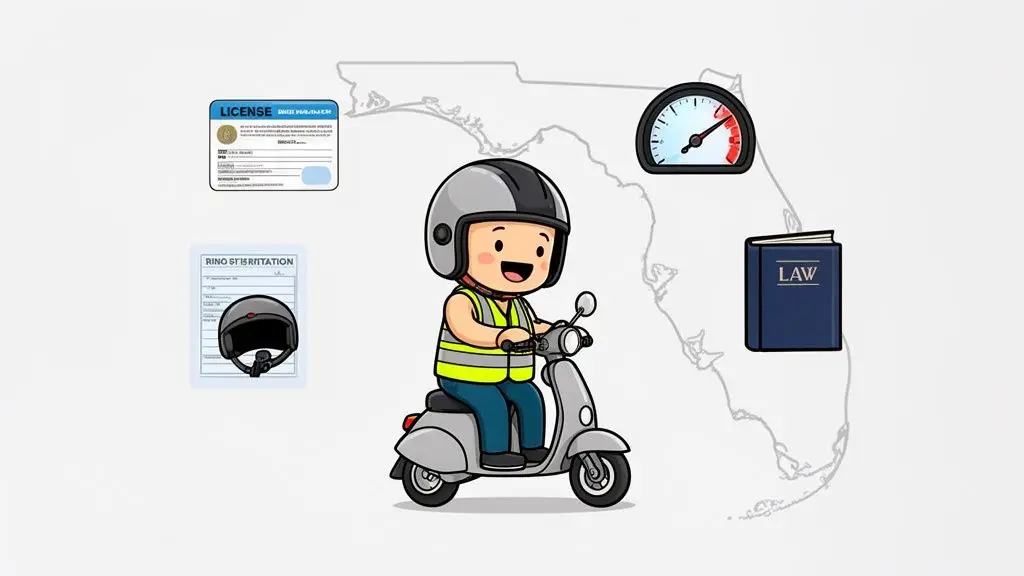
Riding a moped down a sun-drenched Florida road seems like the perfect, easy way to get around. It's fun, great on gas, and feels like a slice of freedom. But before you twist the throttle, it’s critical to know that Florida law is very particular about what is—and what isn't—a moped.
I’ve seen it countless times: a rider gets pulled over, thinking they're on a moped, only to find out their vehicle is legally a motorcycle. That's a ticket for no registration, no motorcycle license, and no insurance. It's a costly and completely avoidable mistake. The key is understanding exactly how the Sunshine State classifies your two-wheeled ride.
Think of it like this: Florida's vehicle code has specific boxes for "moped," "motorized scooter," and "motorcycle." Each box comes with its own set of rules. If your vehicle doesn't fit perfectly into the moped box, you're automatically playing by a different, stricter set of rules.
Why Getting the Definition Right Is So Important
This isn't just about avoiding a fine; it's about your safety and legal protection. For example, if you’re riding a scooter that can top 30 MPH without a motorcycle endorsement on your license, you're technically operating a vehicle without a valid license. If an accident happens, that small detail becomes a huge legal and financial problem.
This guide will walk you through everything you need to know, from the legal definitions straight from the FLHSMV to the practical rules of the road. We'll make sure you can ride with total confidence. For comparison, it’s also helpful to see how other two-wheeled vehicles are treated, as detailed in this guide to Electric Bike Laws By State.
The Absolute Basics for Florida Moped Riders
Before we get into the nitty-gritty, let's cover the foundational rules that every moped owner in Florida must follow. Getting these right is the first step.
- Age and License: You have to be at least 16 years old to ride a moped. You’ll also need a standard Class E driver's license (the same one you use for a car). A learner's permit won't cut it.
- Registration Is a Must: Your moped needs to be registered with the Florida Department of Highway Safety and Motor Vehicles (FLHSMV) every single year. The good news? Unlike a motorcycle, a moped does not require a certificate of title in Florida.
- Know Your Vehicle: The rules that apply to you depend entirely on your vehicle's specs. To be legally considered a "moped," it must have an engine under 50cc and be unable to go faster than 30 MPH on level ground.
These three points are the bedrock of Florida moped law. If you want a broader look at traffic rules, our overview of Florida state driving laws is a great resource for staying informed and protecting your driving record.
To help you see the differences at a glance, here’s a simple breakdown of how Florida law separates these popular two-wheeled vehicles.
Florida Vehicle Laws Moped vs Scooter vs Motorcycle
| Vehicle Type | Engine Size (CC) | Max Speed (MPH) | License Required | Registration Required |
|---|---|---|---|---|
| Moped | Under 50cc | Not over 30 MPH | Class E Driver's License | Yes |
| Motorized Scooter | 50cc-249cc | Over 30 MPH | Motorcycle Endorsement | Yes |
| Motorcycle | 250cc or more | Over 30 MPH | Motorcycle Endorsement | Yes |
As the table shows, that 50cc engine size and 30 MPH speed limit are the magic numbers. Cross either of those thresholds, and you’re no longer riding a moped in the eyes of the law. You've officially entered motorcycle territory.
What Exactly Is a Moped in Florida?
First things first: before you hit the road, you have to know what you're riding in the eyes of the law. This is single-handedly the most important step. A lot of people get this wrong, and it’s an easy mistake that can lead to some surprisingly hefty fines for being unlicensed, unregistered, or uninsured.
Think of it this way: you can't just call your vehicle a moped and expect the rules for mopeds to apply. Florida has a very specific, three-part test to determine if your ride is a true moped or if it's actually a motorcycle in disguise. Getting this wrong is the most common trap riders fall into.
The Official Three-Part Test for a Florida Moped
For your vehicle to legally qualify as a moped, it must pass all three of these tests. It's not a pick-and-choose situation. If you fail even one, Florida law will classify your vehicle as something else—usually a motorcycle, which comes with much tougher requirements.
- Engine Size: The engine displacement can’t be more than 50 cubic centimeters (cc). This is a hard limit. Even a 50.1cc engine bumps you into the motorcycle category.
- Top Speed: It cannot be capable of going faster than 30 miles per hour on a flat surface. Pay close attention to this one. If your 49cc scooter can hit 35 MPH, it's not a moped, period.
- Pedals: A true moped must have pedals that can be used to propel it. This is the old-school feature that, according to Florida Statutes § 316.003(44), separates it from a motor scooter.
If your ride checks all three of those boxes, you're officially riding a moped. If it misses the mark on any of them—especially speed or engine size—it's almost certainly a "motor scooter," which Florida treats exactly like a motorcycle.
This flowchart breaks down how the state classifies your ride.

As you can see, the second you go over that 50cc engine or 30 MPH speed limit, you've left moped territory and entered the world of motorcycles, which requires a completely different license, title, and registration.
The Scooter vs. Moped Trap
This is where things get tricky and where most riders get tripped up. Many of the small, two-wheeled vehicles you see for sale are marketed as "scooters" or even "mopeds," but they don't actually meet Florida's legal definition. They usually don't have pedals and can often go much faster than 30 MPH right out of the box.
The Key Takeaway: In Florida, any two-wheeled vehicle with an engine over 50cc is legally a motorcycle, no matter what it looks like. This means you'll need a motorcycle endorsement on your license, a proper title, and full motorcycle registration.
Here's a classic real-world example. You buy a slick-looking 49cc scooter. It's small, it feels like a moped, and the dealer might have even called it one. But you quickly discover it can easily hit 40 MPH on a straightaway.
Under Florida law, that scooter is not a moped. Its ability to break the 30 MPH barrier instantly reclassifies it as a motorcycle. If you get pulled over while riding it with just a standard driver's license, you could get a citation for operating a motorcycle without the proper endorsement. It's a simple misunderstanding that catches countless well-meaning people.
Always, always verify your vehicle’s true top speed, not just what's printed on the engine. It’s the only way to be sure you're following the right rules and staying out of trouble.
Getting Your Moped Licensed and Registered in Florida
So, you've figured out your two-wheeler is officially a moped. What's next? Getting it street-legal. Think of licensing and registration as your moped's official "hall pass" for Florida's roads. Without it, you're not just risking a ticket—you're riding illegally, and that can lead to some serious headaches.
The good news is that Florida keeps things pretty simple for moped riders, especially when you compare it to the hoops you have to jump through for a motorcycle. It really boils down to two things: making sure you personally have the right license and getting the proper registration for your ride.
Your Driver License Is Your Moped License
Here’s one of the best perks of owning a moped: you don't need a special motorcycle endorsement on your license. As long as you're 16 years of age or older and hold a standard Class E driver's license (the same one you use for a car), you're good to go.
But here's a common stumbling block: a learner's permit is not enough. You can't legally operate a moped on public roads with just a permit; you need a full, unrestricted driver's license. If you're still working on getting that first license, our guide on the Florida learner's permit can walk you through the process and its limitations.
This easy licensing is great, but it also puts a lot of responsibility on you. The state is essentially trusting that your Class E license means you already know the rules of the road.
This simple requirement is exactly why it’s so important to know Florida's moped laws inside and out. The law assumes you know how to handle yourself in traffic. If you don't, you're not just risking a fine—you're putting yourself and everyone else in danger.
Florida's approach makes mopeds an incredibly accessible option. It's interesting to see how different places handle this; for instance, the UK moped licensing requirements are quite a bit more involved.
The Moped Registration Process
While Florida doesn't require a title for a moped, you absolutely have to register it. This is a mandatory, annual process done through the Florida Department of Highway Safety and Motor Vehicles (FLHSMV). Don't skip it.
Once you register, you’ll get a license plate (or tag) and a decal for your moped. This is your proof that you’re legal.
To get registered, you’ll generally need to:
- Fill out an Application for Certificate of Title With/Without Registration (that’s Form HSMV 82040).
- Provide proof of ownership, like a manufacturer's certificate of origin or a formal bill of sale.
- Pay the registration fees.
Riding an unregistered moped is one of the easiest ways to get pulled over. Just keep it current, and you'll save yourself the hassle.
The Serious Risks of Riding Unlicensed
Even though getting licensed is straightforward, some people are still tempted to hit the road without one. This is a bad idea on every level. Legally, you're looking at fines and points on your record.
But the physical risks are far more serious. A deep dive into Florida moped crash data paints a stark picture. Of the 5,660 moped crashes analyzed, a staggering 18% resulted in severe or fatal injuries. Here's the kicker: of those who were severely hurt, 31% were unlicensed.
The connection is clear. Riding without the proper license isn't just a paperwork problem—it's a massive safety risk. You can dig into the complete findings from the Florida Traffic Crash Records Database analysis to see the data for yourself.
Florida Helmet Laws and Safety Gear

Once you've sorted out the licensing and registration, it's time to focus on what really matters: your safety. Florida has some very specific rules about the gear you need to wear, especially when it comes to helmets. Knowing these laws isn't just about avoiding a ticket—it's about protecting yourself from a life-altering injury.
Interestingly, the helmet laws for mopeds mirror the rules for motorcycles, and it all boils down to your age. This creates two distinct sets of requirements, so you need to be clear on which category you fall into.
The Helmet Rule for Riders Under 21
For anyone under the age of 21, the law is refreshingly simple and non-negotiable. You must wear a helmet. Period. This applies whether you're driving the moped or just riding as a passenger.
And it can't be just any helmet. It needs to be officially approved by the U.S. Department of Transportation (DOT). You can quickly check for this by looking for the DOT sticker on the back. If you're wearing a novelty helmet without that sticker, the law sees it as the same as wearing no helmet at all.
The Helmet Rule for Riders 21 and Older
Once you hit your 21st birthday, the Florida laws on mopeds offer you a choice. You can ride without a helmet, but there's a huge catch: you must have an insurance policy that provides at least $10,000 in medical benefits to cover injuries from a potential crash.
Basically, the state is saying you can accept the physical risk, but only if you're financially prepared for the consequences. If you're 21 or older but don't carry that specific insurance coverage, you're still legally required to wear a helmet.
Crucial Reminder: Police can and will ask for proof of this insurance during a traffic stop. If you're over 21, helmet-free, and can't show proof of coverage, you're going home with a citation.
Even though it's a legal option for some, riding without a helmet is a serious gamble. When Florida repealed its universal helmet law back in 2000, a study found a staggering 48.6% increase in rider deaths in the first year alone. The numbers don't lie—helmets save lives.
Essential Gear Beyond the Helmet
While helmets get all the attention, other gear is just as vital for staying safe out there. Some of it is required by law, and the rest is just plain common sense for any smart rider.
- Eye Protection: This is mandatory for all moped riders in Florida, regardless of your age or if your ride has a windshield. Approved eye protection includes a helmet's face shield, goggles, or even standard eyeglasses.
- Bright Clothing: On a moped, you're a small blip in a world of big cars. Wearing bright colors or reflective clothing makes you far more visible, especially at dawn, dusk, and nighttime when most accidents happen.
- Sturdy Footwear: Ditch the flip-flops. Closed-toe shoes are a must. They protect your feet from hot engine parts, flying road debris, and serious injury if you take a spill.
Getting these safety habits down is a huge part of being a responsible rider. For anyone who's gotten a ticket or just wants a refresher on the rules of the road, taking a driver safety course is a great way to reinforce Florida's traffic laws and learn valuable defensive driving skills.
Where You Can Legally Ride Your Moped

Alright, let's get down to one of the most practical parts of riding: knowing exactly where you belong on the road. When you're on a moped, you're in a bit of a unique category. You’re faster than a bicycle but not quite a motorcycle, so you have your own set of rules.
Figuring out these boundaries is crucial, not just to stay on the right side of the law, but to keep yourself safe. A lot of new riders get tripped up here, and a simple mistake can lead to a dangerous situation or an expensive ticket.
The Right of Way and The Right Side of the Road
On public roads, you have the same fundamental rights and duties as any other driver. But Florida law adds a key requirement specific to mopeds because of their lower speed.
You must always ride as far to the right side of the road as is safely practical. Notice the word "safely." This doesn't mean you have to hug the curb and swerve around storm drains or ride through gravel. Your safety comes first. The point is to stay to the right so that faster-moving cars, trucks, and motorcycles can pass you easily on your left.
Restricted Areas Where You Cannot Ride
Knowing where you can't ride is just as important as knowing where you can. The state has put several places completely off-limits to mopeds, and these rules aren't flexible. They exist to protect you and everyone else.
Here’s a simple breakdown of the no-go zones:
- On Sidewalks: This one is non-negotiable. Sidewalks are for pedestrians only. Riding your moped on one is illegal and incredibly dangerous for people on foot.
- On Bicycle Paths: Even if your moped has pedals, it's still a motorized vehicle. Dedicated bike paths are strictly for human-powered transportation like bicycles and scooters.
- On Interstate Highways: With a top legal speed of 30 MPH, mopeds are forbidden on interstates, expressways, and any other limited-access highways where minimum speeds are posted. You simply can't keep up with traffic, creating a massive safety risk.
A Critical Rule of Thumb: If you see a sign that posts a minimum speed limit—especially 40 MPH or higher—that road is off-limits. Trying to ride there is a recipe for disaster and will get you a hefty fine.
Navigating Turns and Intersections
Making turns, particularly left turns, is where moped riders need to be extra smart. Since you're supposed to be on the far right of the road, cutting across several lanes of traffic to make a left is both illegal and extremely dangerous.
Fortunately, you have two safe and legal ways to handle it.
Option 1: The Vehicular Turn
This works best on a simple two-way street with a single lane going in each direction. Just like a car, you can signal your turn, merge toward the centerline when it's safe, and make your left turn from there.
Option 2: The "Box Turn"
On busier, multi-lane roads, this is by far the safest approach. Think of it as making two separate crossings.
- From the right lane, ride straight through the intersection.
- Once you're across, pull over to the far-right corner of the street you want to turn onto.
- Position your moped to face the new direction, as if you were waiting at the cross-street.
- When the light turns green or traffic is clear, proceed straight ahead.
This two-stage turn keeps you safely out of the path of fast-moving vehicles. Getting comfortable with the box turn is a core skill every Florida moped rider should master.
Fines and Penalties for Moped Violations
Knowing the rules of the road is one thing, but understanding the real-world consequences of breaking them is what truly keeps riders safe and accountable. In Florida, a moped violation isn't just a minor slap on the wrist. These citations can lead to steep fines, points against your license, and sometimes, surprisingly harsh penalties for what might seem like a simple mistake.
It’s helpful to think of a traffic ticket not as a punishment, but as an expensive, official warning from the state. It’s a direct signal that you were riding in a way that was unsafe or illegal, and the penalties are designed to get your attention and prevent it from happening again.
Enhanced Penalties for Dangerous Riding
While a typical traffic ticket is bad enough, Florida law gets especially serious about certain types of reckless behavior. The state has put "enhanced penalties" in place for moped and motorcycle operators who show a blatant disregard for safety.
For instance, popping a "wheelie" or otherwise failing to keep both wheels on the ground is more than just a stunt—it's a costly legal violation. Under Florida law, performing this kind of maneuver or speeding excessively (going over 50 mph) on a moped triggers an automatic, additional $1,000 fine. This isn't a standalone penalty; it's tacked on top of the standard fines for the moving violation, making it an incredibly expensive mistake. You can read the official legal opinions on this from the Florida Attorney General's office.
Common Violations and Their Consequences
Beyond the high-dollar stunts, even everyday infractions can add up fast. Getting pulled over for any of these common offenses will almost certainly result in a ticket and points on your driving record.
Police are often on the lookout for:
- Riding without a valid Class E license: This is a fundamental mistake that questions your legal right to be on the road at all.
- Operating an unregistered moped: It’s an easy thing for an officer to spot and leads to an immediate citation.
- Not wearing a helmet (if under 21): This is a non-negotiable safety law with zero exceptions.
- Carrying a passenger: Mopeds are built and registered for one rider only. Violating this is both illegal and dangerous.
- Riding on a sidewalk or bike path: Mopeds belong on the street; riding in these off-limits areas is a common and easily-ticketed offense.
A traffic ticket is more than just a fine; it's a mark on your driving record. Accumulating too many points can lead to license suspension and a sharp increase in your insurance premiums.
Turning a Ticket into a Learning Opportunity
Getting a ticket is frustrating, no doubt about it. But it also gives you a chance to protect your driving record and sharpen your skills. For many common moving violations, Florida gives you the option to elect to take a Basic Driver Improvement (BDI) course.
Choosing to complete a state-approved BDI course has huge benefits. Most importantly, it can prevent points from being added to your license for that specific violation. This is the key to avoiding the long-term financial hit of higher insurance rates that follows a damaged driving record. Our guide on the Florida traffic ticket point system breaks down exactly how points work and why you want to avoid them.
Ultimately, the course is a great refresher on defensive driving tactics and the finer points of Florida laws on mopeds, making you a smarter, safer rider.
Common Questions About Florida Moped Laws
Even when you have a good handle on the basics, the real world has a way of throwing curveballs. Sorting through Florida's vehicle regulations can feel a little complicated, and specific questions almost always pop up right before you're ready to ride.
We've been there. To help you cut through the noise, we’ve put together answers to the most common questions we hear from moped riders. Think of this as your go-to guide for those "what if" scenarios, so you can hit the road with confidence.
Do I Need Insurance for My Moped in Florida?
Let's tackle the big one first: insurance. For a vehicle that's legally a moped (under 50cc and can't top 30 MPH), the state of Florida does not make you carry liability insurance.
But there’s a huge exception you need to know about. If you are 21 or older and decide not to wear a helmet, the law requires you to have an insurance policy with at least $10,000 in medical benefits.
Also, remember what your ride really is. If your scooter has a 50cc or larger engine, it's legally a motorcycle. That means you’ll have to get motorcycle-specific insurance, including Personal Injury Protection (PIP), no exceptions.
Can I Carry a Passenger on a Moped?
The answer is a simple, straightforward no. Florida law is crystal clear on this: mopeds are strictly for one rider.
These bikes just aren't built for two. They lack the required safety gear like passenger seats and footrests. Trying to give someone a ride isn't just asking for a traffic ticket—it's incredibly dangerous. It throws off the moped's balance and makes it much harder to brake safely.
What if My 50cc Scooter Goes Faster Than 30 MPH?
This is a classic trap for new riders, and it's a critical point in Florida law. If your 50cc scooter can go faster than 30 MPH on a flat road, it's not a moped. In the eyes of the law, you are riding a motorcycle.
This changes everything. You’re immediately on the hook for all motorcycle rules, which means you have to:
- Get a motorcycle endorsement on your driver's license.
- Properly title and register the vehicle as a motorcycle.
- Carry the required PIP and liability insurance for a motorcycle.
Getting caught on a fast scooter without the right credentials can lead to a handful of serious citations for being unlicensed, unregistered, and uninsured.
Don't just assume your 49cc ride is a moped. The real test is its top speed. Check the manufacturer's specs or safely test it yourself to make sure you're following the right set of laws.
Do I Need a Special Moped License in Florida?
Thankfully, no. Florida keeps it simple by not having a separate "moped license." To operate a moped legally, all you need is a standard Class E driver's license, the same one you use for a car.
A "Motorcycle Only" license works, too. The key thing to remember is that you cannot ride a moped with just a learner's permit. You must be at least 16 years old and hold a full driver's license.
Facing a traffic ticket or just want to be a smarter, safer driver? BDISchool offers state-approved online courses to help you dismiss points, prevent insurance hikes, and truly understand Florida's traffic laws. Check out our easy, self-paced courses at https://bdischool.com to protect your license and ride with confidence.