Let's be honest, staring at the Florida Driver Handbook can put anyone to sleep. But when it comes to passing your permit test, just reading isn't going to cut it. The single best thing you can do to prepare is to get your hands on a high-quality Florida permit practice test.
This isn't just about memorizing facts; it's about turning that passive knowledge into active, on-the-spot decision-making. That's what a good practice test does—it prepares you to be a safe, confident driver from the moment you get behind the wheel.
Why a Practice Test Is Your Best Study Tool
The real permit exam is all about applying the rules of the road, often under pressure. A practice test is the bridge between reading about a three-point turn and actually knowing what to do when faced with that question on the screen. It mimics the real exam environment, building your skills and your confidence at the same time.
Before we dive in, let's get a clear picture of what you're up against on test day.
Florida Class E Knowledge Exam at a Glance
Here’s a quick rundown of the official Florida permit test format. Knowing these details helps you understand why practice is so important.
| Exam Feature | Requirement |
|---|---|
| Total Questions | 50 multiple-choice questions |
| Topics Covered | Road Rules and Road Signs |
| Passing Score | 80% (at least 40 questions correct) |
| Time Limit | 60 minutes |
| Attempts | Varies by location and format |
With only a 10-question margin for error, there's not a lot of wiggle room. This is where a realistic practice exam becomes your most valuable tool.
From Theory to Reality
It’s one thing to memorize what a yield sign looks like. It's another thing entirely to know what to do when approaching a busy roundabout in Miami during rush hour. A good practice test won't just ask for definitions; it will throw you into realistic situations.
You'll get a feel for the types of questions that trip people up, such as:
- Who has the right-of-way at a four-way stop in a crowded Orlando neighborhood?
- What are the specific Florida laws about wearing headphones while driving?
- How does the "Move Over" law apply when you see flashing lights on I-95?
Working through these scenarios over and over makes the correct responses feel like second nature. You're not just studying for a test; you're learning to think like a driver.
Beat Test-Day Jitters Before They Start
For many new drivers, the biggest obstacle isn't the material—it's anxiety. The ticking clock and the pressure to pass can make you second-guess yourself and make simple mistakes. Practice tests are the perfect antidote to that stress.
By the time you sit for the real exam, the format, timing, and question styles will feel completely familiar. That familiarity is the key to staying calm and letting your knowledge shine through.
Each time you take and pass a practice exam, you're building a track record of success. You learn to spot the tricky wording, manage your 60 minutes wisely, and trust your gut. It's about building mental muscle memory.
To take your preparation to the next level, our complete driver's license practice test is designed to cover every topic you might encounter.
Ultimately, using a practice test isn’t about cheating or memorizing answers. It’s about deeply understanding the concepts so you can walk into that test center knowing you’ve got this. That confidence is what will make you a safer, more responsible driver on Florida's roads.
Turning the Driver Handbook Into a Study Guide
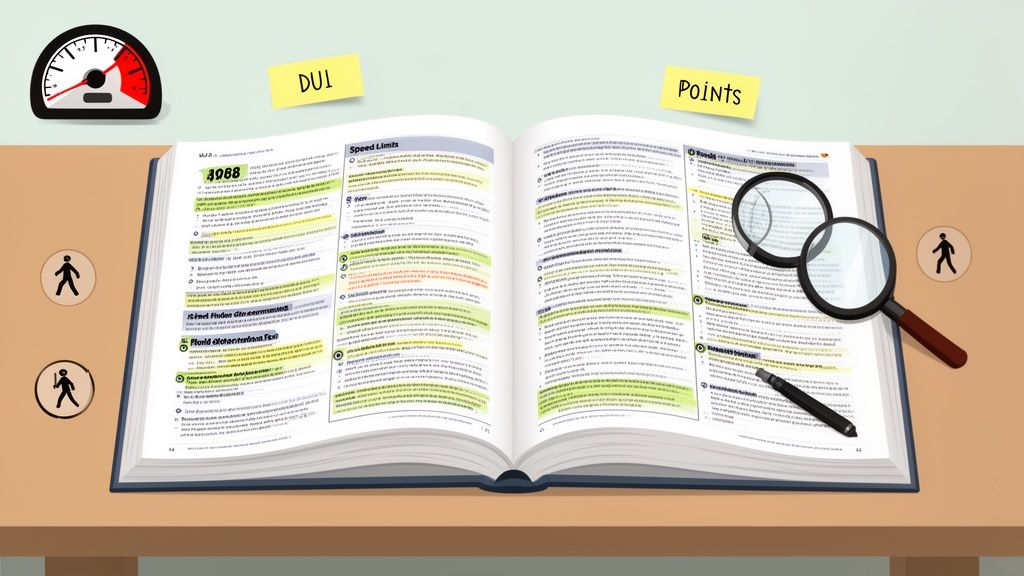
The official Florida Driver Handbook is the ultimate source for your permit test, but let’s be honest—it’s dense. A common mistake I see is teens trying to memorize it from cover to cover, which is a surefire way to get overwhelmed. The smart money is on treating it less like a novel and more like a reference book for a targeted study plan.
Your first move should be to figure out which chapters and sections actually matter most for the exam. This is where a high-quality Florida permit practice test becomes your secret weapon. It quickly reveals the topics the FLHSMV loves to ask about, showing you exactly where to focus your attention in that big handbook.
Prioritize the High-Stakes Topics
On the permit test, not all rules carry the same weight. Some topics are practically guaranteed to show up because they’re directly tied to safety and major legal trouble. You’ll want to nail these high-value areas first to build a solid foundation.
Make these a priority in your study sessions:
- Florida’s Point System: You need to know which mistakes add points to your license and what happens when you get too many.
- DUI Consequences: The test will definitely hit you with questions on blood alcohol concentration (BAC) limits and the harsh penalties for driving under the influence.
- Specific Speed Limits: They expect you to know the default speeds for business districts, neighborhoods, school zones, and rural interstates without hesitation.
- Right-of-Way Rules: Mastering four-way stops, unmarked intersections, and yielding to emergency vehicles is non-negotiable.
- Pedestrian and Cyclist Safety: These questions often get into specific distances and driver duties, making them a common source of tricky "gotcha" questions.
Think of it this way: the handbook has everything you could be asked, but practice tests show you what you will likely be asked. That simple shift in perspective can save you hours of wasted effort.
Connecting Rules to Real Florida Roads
Let's face it, abstract rules are tough to remember. The trick is to tie them to real-world driving situations you'll actually face. Instead of just memorizing a law, visualize how it plays out on a road you know.
For instance, when you're studying the "Move Over" law, don't just read the words. Picture yourself on I-75 and seeing flashing lights on the shoulder ahead. What, exactly, are you required to do? When you read about school zone speed limits, imagine driving past a local elementary school during pickup time. This mental connection is what makes the information stick.
The Florida permit practice test is great for this, as it frames questions around these very scenarios. It’s designed to mirror the real Class E Knowledge Exam, which has 50 multiple-choice questions on everything from road signs to defensive driving. To pass, you need to get at least 40 questions right for an 80% score.
The goal is to transform the handbook from an intimidating textbook into your personal cheat sheet. Use it to look up answers you get wrong on a practice test, read that specific section, and then test yourself on it again.
This cycle of testing, reviewing, and re-testing is worlds more effective than just passively reading.
Creating Your Personal Study Guide
As you go through the handbook, don't just be a passive reader. Get active and create your own condensed notes. Grab a notebook or open a document and start summarizing the most important stuff in your own words.
Here are a few methods that work wonders:
- Flashcards for Numbers: Perfect for memorizing specific numbers like speed limits, fines, and legal following distances.
- Diagrams for Scenarios: For complex right-of-way situations, sketch the intersection and draw arrows to show who goes first.
- Summarize Key Sections: After reading about a big topic like DUI laws, challenge yourself to write a single paragraph that captures the most critical takeaways.
This process forces your brain to actually engage with the material, making it much easier to recall on test day. For a more structured look at the source material, you can explore this breakdown of the Florida drivers manual to guide your note-taking. By using the handbook strategically, you’ll build a deep understanding that leaves you prepared for anything the test throws at you.
Getting a Handle on Florida's Road Signs and Traffic Laws
The Florida permit test is broken down into two main areas: road signs and traffic laws. They sound separate, but on the exam, they're woven together. A common mistake I see is people just trying to memorize shapes and colors. The real test, however, is all about context. This is where a good Florida permit practice test really shines—it forces you to move past simple recognition and into real-world application.
It's one thing to know an octagon means stop. It's another to know what to do at a four-way stop in a bustling St. Petersburg intersection versus a flashing red light on a rural road late at night. The exam is designed to throw these kinds of scenarios at you, testing how you apply the rules, not just if you can recite them.
Speaking the Language of the Road
Think of road signs as a visual language every driver needs to be fluent in. They're designed to communicate critical information quickly, and a huge chunk of your permit test questions will focus on them.
Your studying should break them down into three main categories:
- Regulatory Signs: These are the law, plain and simple. Think Stop, Yield, Speed Limit, and No U-Turn signs. Ignoring them isn't just a wrong answer on the test; it's a ticket waiting to happen.
- Warning Signs: These are almost always yellow and diamond-shaped. They’re giving you a heads-up about potential hazards, like a sharp curve, a slippery road, or a deer crossing.
- Guide Signs: Usually green, blue, or brown, these signs help you get where you're going. They point out routes, upcoming exits, and points of interest.
A practice test might throw a curveball at you, asking you to tell the difference between a "No Passing Zone" pennant (that yellow triangle on its side) and a standard "Yield" sign. It's catching those small details that often makes the difference between passing and failing. For a deeper dive, our guide on common traffic signs and their meanings is a great resource to have bookmarked.
Making Sense of Tricky Traffic Law Scenarios
While signs are visual, traffic laws are the written rules that can really trip people up. The questions often describe complex situations with a lot of moving parts. Just reading the handbook cover-to-cover isn't always enough; you have to see these laws in action.
Here are a few of the toughest areas you'll definitely see on the exam.
The Nuances of Right-of-Way
Right-of-way isn't about who gets to go—it's about who is legally required to yield. The permit test loves to quiz you on situations at uncontrolled intersections, T-intersections, and modern roundabouts.
Let’s look at a classic test question:
Two cars pull up to an uncontrolled intersection at the exact same moment. Car A is going straight, and Car B, on Car A's left, is also going straight. Who has to yield?
Car B must yield to Car A. The rule is simple: when two vehicles arrive at the same time, the driver on the left yields to the driver on the right. Drilling these scenarios with practice tests makes the right move second nature.
Calculating a Safe Following Distance
The Florida Driver's Handbook talks about the "three-to-four-second rule" for keeping a safe distance in perfect weather. But the test won't make it that easy. It’s going to ask you what to do when things get messy, like during a typical Florida downpour.
You need to know to double that following distance to at least six seconds in heavy rain. This gives you the buffer you need to stop safely if the car in front of you slams on its brakes. Practice questions will help cement this critical safety habit.
Florida's Zero-Tolerance Laws
Florida is incredibly strict when it comes to underage drinking and driving, and you can bet the test will check if you know the specifics. For drivers under 21, there is a zero-tolerance policy.
If a driver under 21 is pulled over with a Blood Alcohol Concentration (BAC) of .02 or higher, their license is automatically suspended for six months. That's a number you absolutely have to remember.
By hitting these topics again and again on a Florida permit practice test, you're not just memorizing. You're training your brain to spot the important details in a question and apply the right rule, every time. It’s a method that turns studying from a chore into a skill—one that will help you pass the test and become a confident, safe driver.
Building Your Two-Week Study Plan
Let's be honest: winging the Florida permit test is a terrible idea. I’ve seen countless people try to cram the night before, and it almost never works. A little structure goes a long way, and a smart two-week plan can be the difference between walking out with your permit or walking out empty-handed.
The goal here isn't just to memorize facts, but to build real understanding and confidence. We’ll use a simple, proven cycle: learn the material, test yourself with a Florida permit practice test, see where you’re weak, and then go back to the handbook to shore up those areas. It’s a game plan that turns a stressful exam into a manageable challenge.
Week One: Laying the Groundwork
The first week is all about building a solid foundation. Don't even think about the clock yet. Your only job is to get comfortable with the core concepts: Florida’s traffic laws and road signs. We'll tackle them one at a time.
- Days 1-3: Deep Dive into Traffic Laws. For the first three days, live and breathe Florida's traffic laws. Get into the official handbook and really focus on the tricky stuff—right-of-way rules, speed limits in different zones, and the serious consequences of a DUI. Cap off each study session with a practice quiz that only covers traffic laws. This will tell you what’s actually sinking in.
- Days 4-5: Master the Road Signs. Now, switch gears completely to road signs. This is perfect for flashcards or a sign-recognition app. You need to know the shapes, colors, and meanings by heart. Hammer it home with practice tests that are 100% road signs. You'll be surprised how fast you can get at identifying them.
- Days 6-7: Review and Connect the Dots. Use the weekend to put it all together. Take a full-length, 50-question practice test, but don't time it. Accuracy is the only thing that matters right now. Every time you get a question wrong, hunt down the answer in the handbook and jot down the rule or sign you missed. This simple habit is incredibly effective.
Week Two: Simulating the Real Deal
With the knowledge locked in, week two is all about performance. It’s time to get used to the pressure of the clock and the format of the actual exam. This is where you build the mental stamina to perform when it counts.
The knowledge you've been building—from signs to laws to crucial stopping distances—all comes together now.
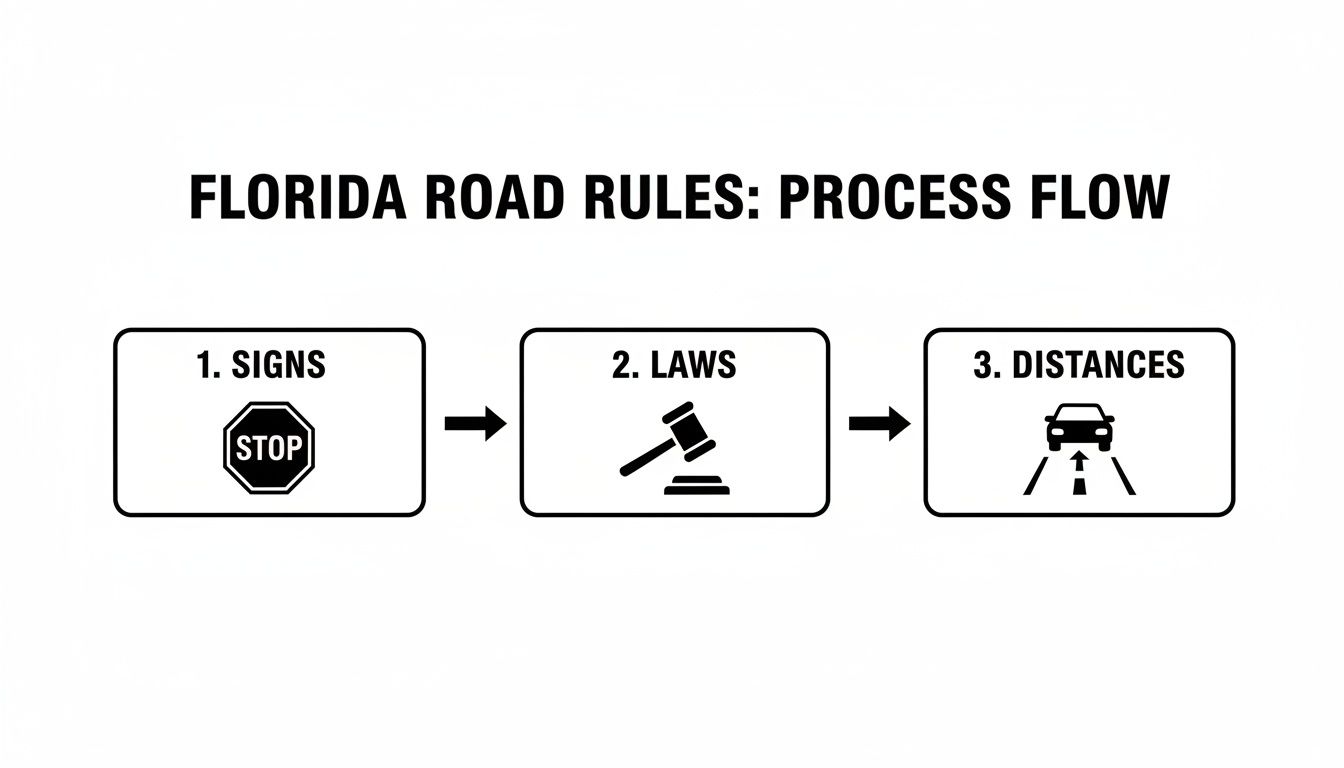
Your mission this week is non-negotiable: take one full, timed practice exam every single day.
Pro Tip: When you take these timed tests, act like it’s the real thing. No phone, no distractions, no notes. This isn’t just about answering questions; it's about training your brain to focus under pressure, just like you'll have to do at the FLHSMV office.
After each test, do a post-mortem. Don't just glance at your score. Dig into the questions you missed. Is there a pattern? Are right-of-way scenarios still tripping you up? Are you fuzzy on the fines and penalties? Your mistakes are your best teachers—they tell you exactly what to study in your final days.
Remember, the Class E exam has 50 questions, and you need to hit that 80% mark, which means getting at least 40 correct answers. These practice tests are designed to get you there. They cover all the handbook essentials, from yielding rules to dealing with Florida-specific situations like heavy pedestrian traffic and coastal storms.
If you want an extra edge, a solid Florida permit test study aid can help you quickly review the most critical information. Stick with this plan, and you won’t just be walking into the test hoping to pass—you’ll be walking in expecting it.
What to Expect on Test Day and Beyond
All your hard work studying and running through practice tests leads to one place: the driver's license office. Knowing what to expect when you get there is just as crucial as knowing the rules of the road. A little bit of planning can save you from a major headache and a wasted trip.
Let's be honest, nobody wants to get turned away at the counter. Walking in prepared means more than just having all the answers in your head; you need to have the right documents in your hand. The FLHSMV is notoriously strict, and forgetting a single piece of paper means you'll be rescheduling your appointment.
Your Test Day Checklist
Before you even think about leaving the house, run through this checklist. Getting your documents in order is non-negotiable, so make sure you have everything organized and ready to go.
Here's exactly what you'll need to bring with you:
- Proof of Identification: An original or certified copy of your U.S. birth certificate is standard. A valid U.S. passport also works.
- Proof of Social Security Number: Bring your original Social Security card. They won't accept copies.
- Two Proofs of Residential Address: Think utility bills, bank statements, or official school records that show your name and current address.
- Parental Consent Form: If you're under 18, your parent or legal guardian needs to sign a consent form. You can get this notarized ahead of time, or they can sign it in person right there at the office.
- Required Fees: You’ll have to pay for the test and the permit itself. The fees can change, so it's a good idea to check the official FLHSMV site for the latest costs before you go.
Having all this stuff ready will make the check-in process a breeze, so you can focus on what really matters—passing that test.
Managing Last-Minute Nerves
It’s completely normal to feel butterflies in your stomach on test day. The trick is to not let those nerves take over. The best way to stay calm? Trust your preparation. If you’ve been consistently acing your practice tests, you already know you have what it takes.
Remember, the point of a practice test isn't just memorizing answers. It's about getting so familiar with the format, the timing, and the types of questions that the real exam feels like just another drill.
A few simple things can make a big difference. Get a good night's sleep—a tired brain is more likely to make a silly mistake. Eat a decent meal, but maybe skip the extra-large coffee, as too much caffeine can make you feel even more jittery. On the morning of your test, do a quick review of your trickiest topics, like fines or specific right-of-way scenarios. It’s a great way to warm up your brain.
Life with a Learner's Permit
Passing the test is a huge milestone, but it's really just the starting line. Your new learner's permit comes with some important restrictions designed to keep you safe while you build real-world experience. Think of this as your training phase, not just a waiting period.
For new drivers under 18, the rules are very specific:
- You must always have a licensed driver who is at least 21 years old sitting in the front passenger seat.
- For the first three months, you’re limited to driving during daylight hours only.
- After those first three months, you can drive up until 10:00 PM.
The most important part? You are required to log 50 hours of supervised driving. At least 10 of those hours must be at night. This behind-the-wheel practice is where all the book smarts from the handbook and practice tests finally click. It's your chance to turn knowledge into skill and build the safe habits that will last a lifetime. For a full breakdown, check out our complete guide on how to get a driver's permit in Florida.
Got Questions About the Florida Permit Test? We've Got Answers
Even with the best study plan, you're bound to have a few questions about the permit test itself. It's a big deal, and getting answers now can save you a lot of stress later. Let's tackle some of the most common questions I hear from new drivers and their parents.
Getting these details sorted out makes the whole process feel less intimidating, so you can walk in on test day focused and ready.
What Happens if I Fail the Florida Permit Test?
First things first: don't panic. It happens more often than you think, and it's not the end of the road. If you don't pass the Class E Knowledge Exam on your first try, you can absolutely take it again.
You just have to wait at least one day before your next attempt, and yes, you'll have to pay the testing fee again. This is exactly why a good Florida permit practice test is your best friend.
By hammering out your weak spots with practice tests before you ever set foot in the FLHSMV office, you dramatically boost your chances of passing the first time. It saves you time, money, and a whole lot of frustration.
A good rule of thumb is to keep practicing until you're consistently scoring 90% or higher on a few different timed tests. When you can do that, you know you're ready for the real thing.
Think of it this way: a failed practice test is just feedback. A failed official test is a setback.
Can I Take the Florida Permit Test Online?
Yes, you can—but there's a catch. This option is only available for applicants who are under 18 years old. If that's you, you can take the Class E Knowledge Exam from the comfort of your own home through an approved third-party provider. It's a great way to test in a familiar, low-stress setting.
If you are 18 or older, you have to take the exam in person. You'll need to schedule an appointment at an official Florida Highway Safety and Motor Vehicles (FLHSMV) service center or a licensed tax collector's office that handles driver licenses.
It’s important to know that the test is the exact same whether you take it online or in person. Same content, same number of questions, same time limit, same passing score. This means that no matter your age, online practice tests are the most effective way to prepare.
Are the Practice Test Questions the Same as the Real Exam?
That's a smart question. The short answer is no, they aren't the exact same questions. The FLHSMV keeps its official test questions in a large, secure bank that it pulls from randomly.
But here's the important part: a high-quality Florida permit practice test is designed to feel incredibly similar. The questions are built to mirror the format, difficulty, and topics you'll face on the real exam because they are all based on the same source material: the official Florida Driver Handbook.
For example:
- The real test might ask: "When approaching a railroad crossing with flashing red lights, you must…"
- A practice test might ask: "What is the correct action to take when you see flashing lights at a railroad crossing?"
The goal isn't to memorize answers. It's to truly understand the rules of the road so you can apply that knowledge to any question they throw at you, no matter how it’s phrased.
How Long Do I Have to Hold My Learner's Permit?
For drivers under 18, Florida has a very specific timeline. You are required to hold your learner's permit for a minimum of 12 consecutive months without getting any traffic tickets.
Your permit is valid for one year, and this 12-month period is your hands-on training phase. During this time, you need to log 50 hours of supervised driving practice, and at least 10 of those hours must be at night.
This is where you move from theory to reality. You'll take everything you learned from the handbook and practice tests and apply it to real-world situations—from busy intersections to driving in the rain. Completing this supervised practice is a mandatory step before you can even think about getting your intermediate driver's license.
Ready to stop guessing and start passing? BDISchool offers the most reliable and comprehensive Florida-approved driver education programs to get you on the road safely and confidently. Explore our courses and start your journey today!