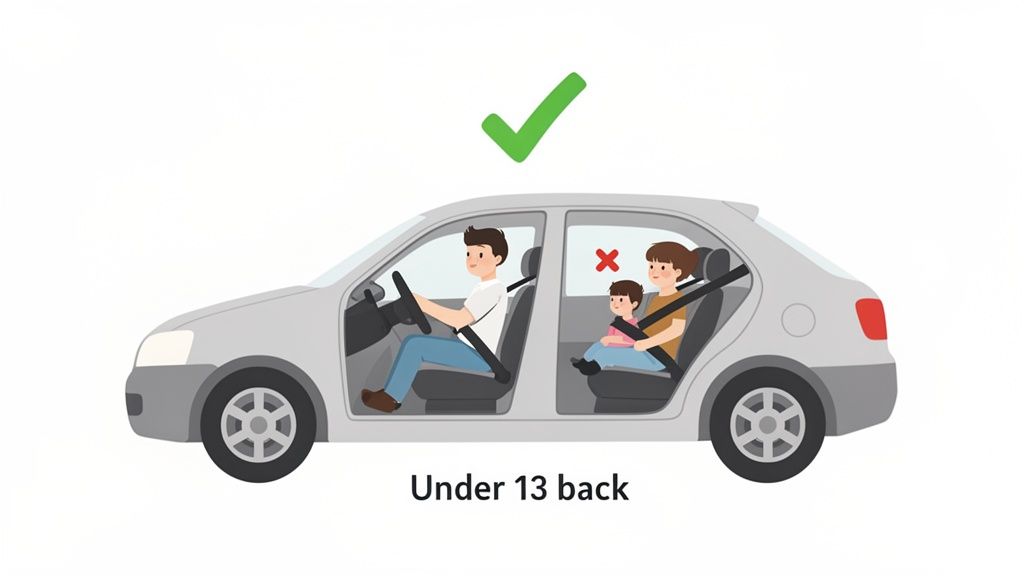
It's one of the most common questions we hear from Florida parents and guardians: "When can my child legally sit in the front seat?" While the state has specific laws for car seats and boosters, the single most important piece of advice from every safety expert is this: children under the age of 13 belong in the back seat. Always.
If you remember nothing else from this guide, let it be that.
Decoding Florida's Front Seat Laws: The Core Rules
Trying to untangle traffic laws can feel overwhelming, but Florida's rules for kids in cars are actually pretty straightforward once you understand the "why" behind them. The goal isn't just to make you buy more gear; it's to protect the most fragile passengers in your vehicle.
Think of it this way: a child’s body is still developing. Their bones aren't as dense, and their skeletal structure can't withstand the same forces an adult can. This is why the "back seat until 13" guideline is so critical. It's not an arbitrary number. It’s a safety standard backed by years of crash-test data, designed to shield kids from the brutal force of a front-end collision and a deploying airbag, which can be catastrophic for a small child. The back seat is simply the safest place for them to be.
Florida Passenger Seating At A Glance
To make this even easier, we've boiled down the key requirements and safety recommendations into a simple chart. Think of this as your quick-reference guide for keeping kids safe on the road.
| Age Group | Required Restraint | Recommended Seating | Key Consideration |
|---|---|---|---|
| Birth–3 Years | Rear-Facing or Forward-Facing Car Seat | Back Seat Only | The child must be in a separate carrier or a manufacturer’s integrated child seat. |
| 4–5 Years | Car Seat or Booster Seat | Back Seat Only | The right choice depends on the child's height and weight, not just age. |
| 6–12 Years | Booster Seat or Seat Belt | Back Seat is Safest | A booster is needed until the seat belt fits properly (usually around 4'9"). |
| 13+ Years | Seat Belt | Front or Back Seat | The passenger must be tall enough for the shoulder belt to lie flat across the chest, not the neck. |
As you can see, the law focuses on a child’s physical development. It's a progressive system designed to provide the right protection at the right time.
Following these rules is a fundamental part of being a responsible driver. These regulations are just one piece of the larger puzzle of Florida state driving laws that are all in place to keep people safe. When you strap your child in correctly, you’re not just avoiding a costly ticket—you’re doing the single most effective thing you can to protect them in a crash.
Coming up, we'll get into the nitty-gritty of each stage, why airbags pose such a threat to children, and the real-world consequences of getting it wrong.
From Backseat Habit to Front Seat Law: A Safety Story
It’s hard to picture now, but there was a time when hopping into the front seat without a seatbelt was just… normal. The strict front seat laws we take for granted weren't created in a vacuum; they’re the result of a long, hard-fought battle for road safety that has saved an incredible number of lives.
For most of the car's history, seat belts were treated more like an afterthought than a critical safety feature. Many cars didn't even have them, and when they did, buckling up was often seen as overly cautious. The common belief was that a serious accident was something that happened to the other guy.
A Culture Learns a Hard Lesson
That dangerous assumption started to crumble as the grim data from car crashes became impossible to ignore. The numbers told a tragic story: a simple strap of fabric was the single most effective way to keep people alive in a wreck. Public safety campaigns began showing the brutal reality of a collision—what happens when a human body hits a dashboard at 40 miles per hour.
This slow-but-steady shift in awareness set the stage for real change. Lawmakers began to see that just asking people to be safe wasn't cutting it. To truly protect drivers and passengers, seat belt use had to be mandatory. Moving from a personal preference to a legal requirement was a massive turning point for automotive safety.
The effect was nothing short of revolutionary. We went from a culture where safety was optional to one where it was the law. That fundamental change in thinking and behavior directly led to thousands of lives being saved every single year.
The numbers don't lie. Back in 1983, before seat belt laws really started to take hold, a measly 14% of people in the front seat actually buckled up. Jump ahead to 2023, and that figure has skyrocketed to 91.9% nationwide. That’s a powerful testament to how effective these laws have been. For a closer look at the data, you can explore the research on seat belt effectiveness.
Evolving from Belts to Boosters
The success of those early seat belt laws paved the way for the more nuanced rules we have today, especially when it comes to kids. Just as we figured out that adults were much safer buckled in, we also learned that children were especially vulnerable in a crash and needed protection designed specifically for them. This led directly to the child seat and booster seat requirements we follow now.
Knowing this history gives today's laws a lot more meaning. They aren't just random rules designed to be inconvenient. They are proven, life-saving measures built on decades of data. Every time you make sure a child is properly buckled in the back seat, you're playing a part in a safety legacy that has made our roads safer for everyone.
Florida Child Passenger Laws from Infancy to Adolescence
Think of Florida's child passenger safety laws as a series of crucial stepping stones. Each one is designed to give your child the right protection at the right time as they grow. The rules aren't just arbitrary age cutoffs; they form a system built around a child's height, weight, and development to keep them as safe as possible in a moving vehicle.
Following this progression is about more than just avoiding a ticket for violating front seat laws. It's about giving your child the best chance of walking away from an accident unharmed.
From Birth to Age Three: The Rear-Facing Rule
For your littlest passengers—from newborns up to at least age one and 20 pounds—a rear-facing car seat is an absolute must. In fact, most safety experts will tell you to keep them rear-facing as long as you can, often until they're two or three years old, or until they hit the maximum height or weight for their specific seat.
Why is this so important? A rear-facing seat acts like a protective cradle for a baby's fragile head, neck, and spine. If a frontal crash happens, the car seat takes the brunt of the impact, shielding the most vulnerable parts of their developing body.
Ages Four and Five: Forward-Facing and Boosters
When your child finally outgrows their rear-facing seat, it's time to turn them around. The next step is a forward-facing car seat with a five-point harness. Florida law is clear: children aged four and five must be secured in a separate carrier, an integrated child seat, or a booster seat.
The right choice here depends entirely on your child's size and what the seat manufacturer recommends. The golden rule is to keep them in a seat with a harness for as long as possible before making the switch to a belt-positioning booster.
The Booster Seat Years and Beyond
This is where things can get a little tricky for parents. While Florida law only requires a booster until a child turns six, the reality is that most six-year-olds are nowhere near big enough for an adult seat belt. A standard seat belt is designed for an adult body, and on a small child, it can ride up across the abdomen or neck, potentially causing severe internal injuries in a crash.
A child should stay in a booster seat until they are at least 4'9" tall and can comfortably pass the 5-Step Test. This test ensures the vehicle's seat belt fits them properly, which usually happens somewhere between the ages of 8 and 12.
Knowing when to transition is a big deal for both their safety and for staying on the right side of the law. You can dive deeper into specific milestones and checks for booster seat age requirements and readiness. And remember, even after they've graduated from the booster, the back seat is still the safest spot for any child under 13.
This flowchart breaks down the simplest rule for front-seat safety.
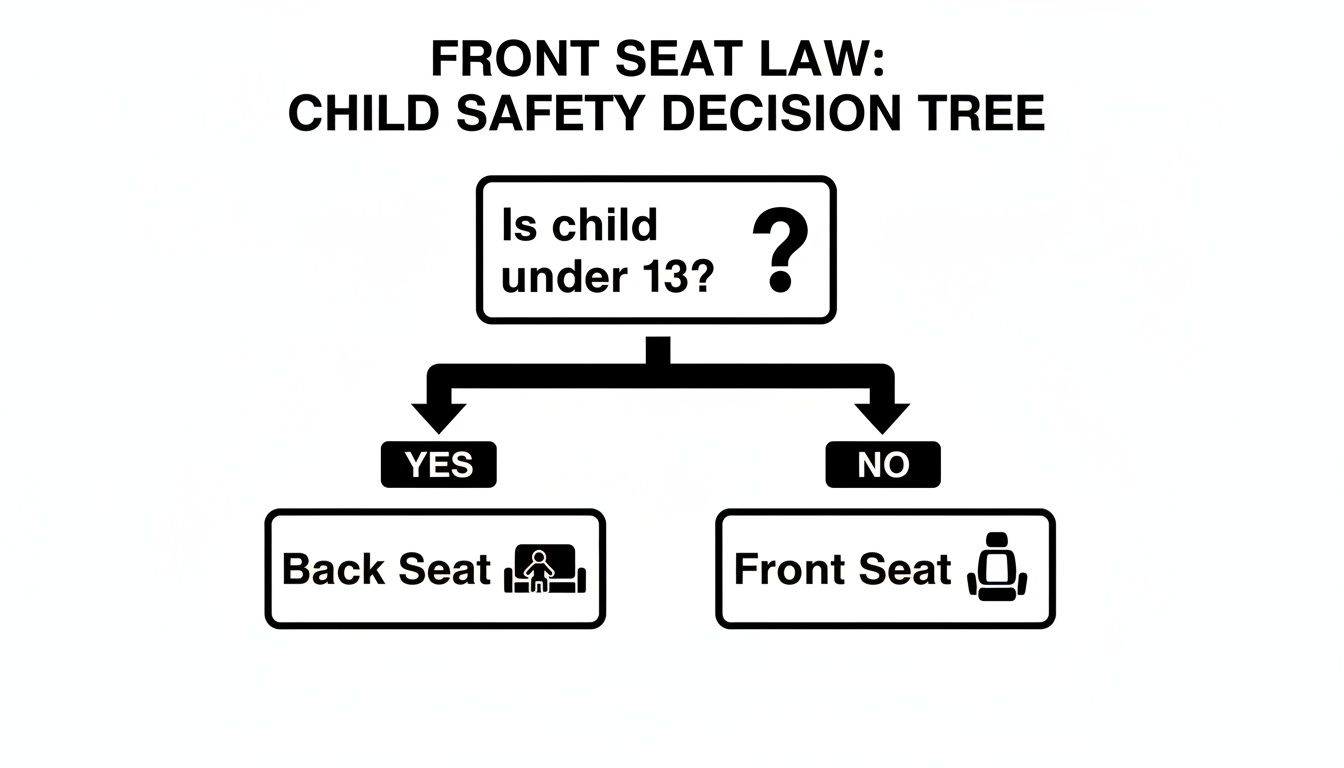
As you can see, age is the first and most critical factor when deciding if a child is ready for the front seat.
These rules aren't just a Florida thing; they're part of a global effort to protect kids. Sadly, the World Health Organization reports that only 9% of the world’s population lives in areas with best-practice child restraint laws. That’s a sobering statistic, especially when correctly used car seats can slash the risk of fatalities by up to 50%.
For a full rundown of all Florida traffic regulations, our guide to the https://bdischool.com/florida-drivers-manual/ is a great resource.
The Hidden Danger of Airbags for Young Passengers
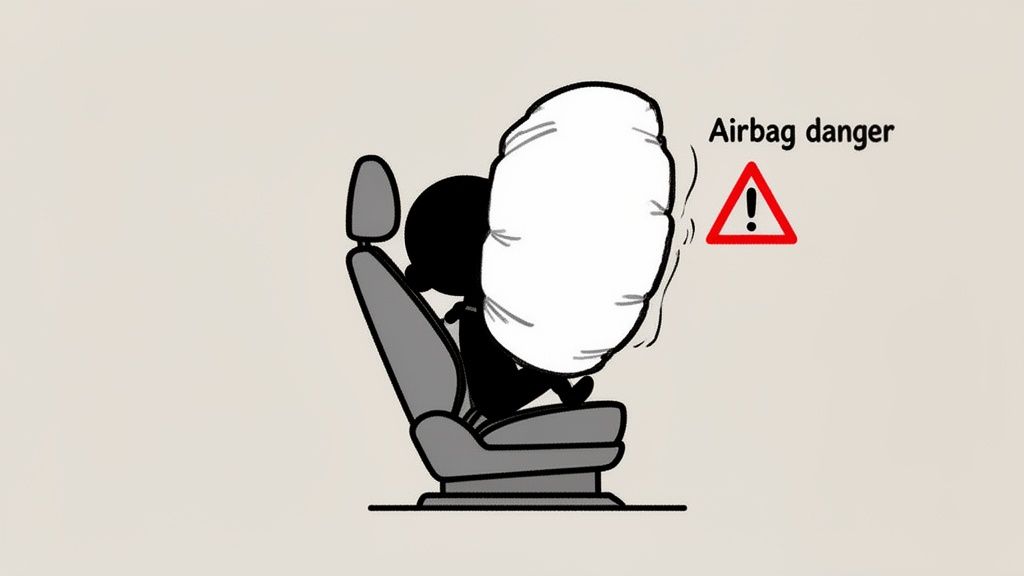
If there’s one single reason to take front-seat laws seriously, it’s the sheer force of a passenger-side airbag. They’re designed to save the life of a full-grown adult, but that same power can become a serious hazard for a child whose body isn't developed enough to handle the impact.
Think about how fast an airbag deploys. It’s not a gentle cushion—it’s a controlled explosion. The bag blasts out of the dashboard at speeds up to 200 miles per hour, inflating completely in just 1/20th of a second. That's literally faster than the blink of an eye. For a 165-pound adult, that force is a lifesaver. For a 40-pound child, it's a devastating blow.
The physics here are pretty unforgiving. A child’s smaller frame, lighter weight, and still-developing bones make them incredibly vulnerable. The airbag's force isn't spread out; it's concentrated right on their head, neck, and chest.
Why Airbags and Children Don’t Mix
When a child is sitting too close to the dashboard or isn't properly positioned, a deploying airbag can strike them with incredible power. This can cause the very same catastrophic injuries that the device was designed to prevent in adults.
The most common and severe injuries include:
- Head and Brain Trauma: The impact can easily cause concussions or even more severe traumatic brain injuries.
- Neck and Spinal Cord Injuries: A child's neck muscles simply aren't strong enough to withstand that violent, snapping force, which can lead to fractures or spinal damage.
- Chest and Internal Injuries: The powerful impact across a small torso can cause devastating harm to internal organs.
The Centers for Disease Control and Prevention (CDC) has found that children under the age of 13 are 40% less likely to be injured in a crash when they are properly buckled up in the back seat. This statistic really drives home the point: the back seat is the safest place, far away from the direct line of fire of a frontal airbag.
Making the Safest Choice
The solution couldn't be more simple: keep all children under 13 in the back seat. Every single time. This one habit dramatically reduces their risk of an airbag-related injury and it’s what every major safety organization recommends.
This kind of proactive thinking is at the heart of defensive driving. Understanding risks like airbag deployment is the first step in learning how to avoid car accidents and protect your most precious cargo. The back seat isn’t just a suggestion—it’s a proven safety measure that neutralizes a hidden but powerful danger in every modern car.
What Happens If You Get It Wrong? Penalties and Legal Consequences
It’s one thing to know the rules, but it’s another to understand what happens when you break them. Let’s be clear: violating Florida's child restraint and front seat laws isn't just a minor slip-up. It's considered a primary offense.
That means a police officer can pull you over just for that violation—they don’t need another reason, like you were speeding or ran a stop sign. Seeing a child in the wrong seat or an unbuckled passenger is enough.
Getting a ticket is more than just a hassle. It hits you with fines and, crucially, adds points to your driver's license. Those points are a big deal. They can make your insurance premiums shoot up, and if you collect too many, you could even lose your license.
The good news? A mistake doesn't have to haunt your driving record. Florida law offers a way for eligible drivers to turn a citation into a genuine learning experience.
Florida’s “Primary Enforcement” Laws in Action
Florida takes seat belt safety seriously, and the backbone of its approach is primary enforcement. Think of it as a proactive strategy.
In some states, an officer has to spot you doing something else wrong—like speeding—before they can also give you a seat belt ticket. That’s called secondary enforcement. But here in Florida, they can stop you the moment they see a seat belt violation. This single policy makes a massive difference in saving lives.
The impact of primary enforcement is undeniable. Across the U.S., states with these laws report a seat belt usage rate of 89%. In states with weaker, secondary laws, that number drops to 82%. It might not sound like much, but one major CDC study found that switching to primary enforcement saved nearly 3,000 lives simply because more people buckled up.
Turning a Ticket into a Fresh Start
Let's face it, seeing those flashing lights in your rearview mirror is stressful. But a ticket for a child restraint or seat belt violation doesn’t have to derail your driving record. For most non-criminal moving violations, you have the option to take a Basic Driver Improvement (BDI) course.
By completing a state-approved BDI course, you can stop points from ever hitting your license for that ticket. This is a huge benefit that helps keep your insurance rates down and your record clean.
Taking a BDI course is a simple and effective fix. At BDISchool, our online program lets you knock out the required four hours on your own schedule, from your phone, tablet, or computer. We walk you through Florida traffic laws, defensive driving skills, and child passenger safety in a way that’s easy to follow.
Once you finish, we handle the paperwork and report it directly to the state. The points from your ticket are then withheld. It’s a small investment that pays off by protecting your driving record and making you a safer, more confident driver.
To get a better handle on how different tickets can impact you, take a look at our guide on the Florida driver's license points system.
Let's Clear Up Your Questions About Florida's Front Seat Laws
Even when you think you have a handle on the rules, real-life situations have a way of making things complicated. Florida’s laws around who can sit where can bring up a lot of "what if" scenarios that you won't find spelled out in a driver's manual. This section is all about tackling those common questions head-on.
My goal here is to give you clear, practical answers so you can feel confident you're making the safest—and most legal—choice on the road. Let's dig into some of the most frequent questions I hear.
When Can My Child Finally Ditch Their Booster Seat in Florida?
This is probably the number one question parents ask, and the answer isn't just about the law—it's about safety. Legally speaking, Florida requires kids to be in a booster seat or another approved child restraint until they turn six.
But here’s the thing: safety experts almost universally agree that age is a terrible way to decide. A booster seat's entire job is to lift a child up so the car's seat belt fits them correctly. Without it, the lap belt can ride up on their stomach and the shoulder belt can cut across their neck, which can cause serious internal injuries in a crash.
So, how do you know they’re ready? Use the 5-Step Test:
- Can they sit with their back flat against the vehicle seat?
- Do their knees bend naturally at the edge of the seat cushion?
- Does the lap belt lie low across their hips and upper thighs (not on their belly)?
- Does the shoulder belt cross the middle of their chest and shoulder (not their face or neck)?
- Can they comfortably stay in this position for the whole ride?
Honestly, most kids don't pass this test until they're between 8 and 12 years old and are at least 4'9" tall.
Are There Any Exceptions for a Child in the Front Seat?
While keeping kids in the back until they're 13 is the gold standard for safety, the law does account for a few rare situations. For instance, if you drive a vehicle with no back seat, like a single-cab pickup truck, an exception can be made.
Another scenario is if all the back seats are already taken by younger children in car seats. In these limited cases, an older child might have to sit up front.
If you absolutely must put a child in the front seat, you have to do it carefully. Slide the passenger seat as far back as it can go to create distance from the airbag. The child must also be buckled up correctly for their size, whether that's in a car seat, booster, or just the seat belt.
How Can a BDI Course Help with a Child Restraint Ticket?
Getting a ticket for a car seat or seat belt violation is a pain, but it doesn’t have to wreck your driving record. In Florida, you often have an option. For most non-criminal moving violations like this, you can choose to take a Basic Driver Improvement (BDI) course.
When you complete a state-approved BDI course, you stop the points from ever going on your license for that ticket. That’s a huge deal. Points can make your insurance premiums skyrocket and even put your license at risk if you get too many. The course is a great way to hit the reset button and reinforce those good safety habits.
Do These Laws Apply in a Taxi or an Uber?
Yes, they do, but with one tricky little exception. Florida's general seat belt laws apply to everyone in any car, and that includes taxis, Ubers, and Lyfts. All adults and older kids have to be buckled up, period.
The loophole is that the specific law requiring car seats and boosters doesn't apply to "for-hire" vehicles. But just because it's legal doesn't make it safe. The laws of physics don't care if you're in your own car or a Lyft—a crash is just as dangerous. Safety experts and the rideshare companies themselves strongly recommend bringing your own car seat to keep your child safe.
Knowing the rules is the first step, but putting them into practice every day is what truly keeps your family safe. If you've gotten a ticket or just want to be a more knowledgeable driver, BDISchool offers Florida-approved online courses that make it simple to protect your record and sharpen your skills. You can learn more and enroll today on the BDISchool website.