When your driver's license gets suspended, it can feel like the world shrinks overnight. Suddenly, simple tasks like getting to work, taking kids to school, or making a doctor's appointment become logistical nightmares. A Florida hardship license is a lifeline designed for exactly this situation.
It’s not a get-out-of-jail-free card, but rather a restricted permit that allows you to handle life's essential travel while you work to get your full license back. Think of it as a temporary key to keep your world from grinding to a halt.
What A Florida Hardship License Actually Means
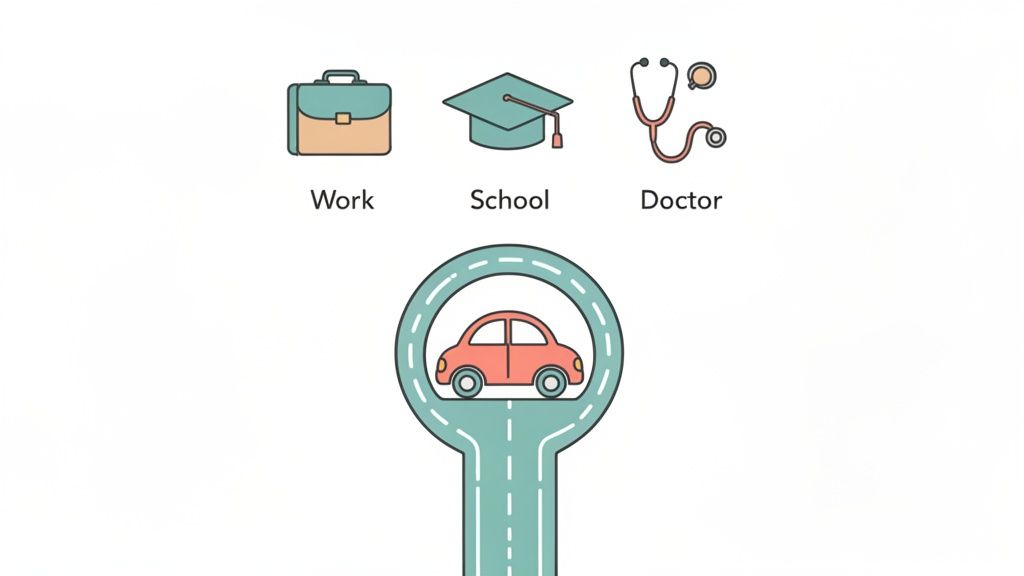
It’s crucial to understand that a hardship license doesn't mean you're getting your old license back ahead of schedule. Instead, you're being granted a special, limited-use permit. It won't let you go for a joyride or run casual errands, but it will allow you to drive for specific, approved reasons so a suspension doesn't completely upend your life.
This distinction is everything. The state issues these permits with very strict rules, and breaking them can land you in even hotter water. The entire system is built to give you a responsible way forward, not a loophole. Understanding what a suspended license means in our detailed guide is the perfect place to start.
Two Tiers Of Driving Privileges
Florida has two main types of hardship licenses. The one you qualify for depends on why your license was suspended in the first place.
- Business Purposes Only: This is the more flexible of the two. It covers driving to and from work, anything you need to do for your job, and essential trips for school, medical needs, and religious services.
- Employment Purposes Only: This one is much stricter. As the name implies, it only allows you to drive directly to your job and directly back home. That's it.
You might be surprised how many people need these. In Florida, over 700,000 drivers have lost their licenses simply because they couldn't afford to pay fines or fees. A shocking 75% of all suspensions in the state are tied to these financial issues, while only 3% are for serious offenses like a DUI. This shows that the system often penalizes people for financial hardship, not for being dangerous on the road.
To give you a quick overview, here’s how the two types of licenses compare.
Florida Hardship License At a Glance
This table breaks down the key differences between the "Business Purposes Only" and "Employment Purposes Only" licenses.
| License Type | Permitted Driving Activities |
|---|---|
| Business Purposes Only | Driving to/from work, on-the-job driving, plus essential travel for education, church, and medical appointments. |
| Employment Purposes Only | Driving only to and from your place of employment. No other trips are permitted. |
Knowing which one you might be eligible for is the first step in navigating the application process.
A hardship license is a privilege, not a right. It's a structured opportunity to demonstrate responsibility while managing life’s necessities after a suspension. Adhering strictly to its limitations is your path back to full driving privileges.
Getting the hardship license rules in Florida right is critical. This guide will walk you through everything you need to know, from applying correctly to staying compliant with the law.
Who Can Get a Hardship License?
Figuring out if you qualify for a Florida hardship license isn't a simple yes-or-no question. Instead, eligibility is a puzzle, and the pieces depend entirely on the specific reason your license was suspended in the first place. Think of it less like a general admission ticket and more like a key cut for a very specific lock.
The state lays out different hardship license rules for different offenses, and what works for a driver with too many points won't help someone facing a DUI suspension. The first and most critical step is to pinpoint your exact suspension type, as that alone dictates your path forward.
Suspensions for Too Many Points
This is a common one. You rack up too many points from traffic tickets, and suddenly you get a notice of suspension. If you've found yourself in this spot, there's a clear process to regain limited driving privileges, but you have to be patient.
Florida law makes you serve a mandatory "hard suspension" period first. This is a non-negotiable waiting time where you have zero driving privileges. For a 12-month suspension (from getting 24 points in 36 months), this hard suspension is typically 30 days.
Before you can even think about applying, you must enroll in a state-approved 12-hour Advanced Driver Improvement (ADI) course. This isn't a suggestion; it's a requirement. Proof of enrollment is mandatory for your hardship hearing, and without it, your application will be dead on arrival. You can explore a detailed breakdown of the requirements for a hardship license in Florida to make sure you have all your ducks in a row.
Navigating DUI Suspensions
A suspension for Driving Under the Influence (DUI) is a different ballgame entirely, with much stricter rules. The eligibility requirements and waiting periods are more severe, which reflects how seriously Florida takes this offense. Your chances often hinge on whether it’s your first offense and if you cooperated with chemical testing.
For a first-time DUI with a blood alcohol level (BAL) over .08, a driver has to sit out a 30-day hard suspension with no driving, period. After that month, they can apply for a hardship permit, but only after showing proof they’ve enrolled in a state-approved DUI school. Things get tougher if you refused the breathalyzer—the hard suspension jumps to a full 90 days. And, critically, drivers with two or more refusal convictions are permanently barred from ever getting a hardship license.
It's vital to remember that a hardship license is a restricted privilege. For DUI-related suspensions, any violation of the terms—like driving for non-approved reasons—can lead to immediate revocation and even more severe penalties.
Suspensions for Financial Reasons
Plenty of drivers lose their licenses for reasons that have nothing to do with their driving skills. These suspensions are often tied to unpaid traffic fines, court costs, or child support.
The good news is that the path to a hardship license in these cases is usually more straightforward. Generally, there isn't a mandatory "hard suspension" period like there is for point or DUI violations. However, you still have to take specific actions before you can apply.
- Enroll in a Driving Course: You'll likely need to sign up for a BDI or ADI course, depending on the details of your situation.
- Address the Root Problem: You must show a real effort to handle the financial issue. This could mean paying the fines in full or, more commonly, getting on an official payment plan with the court or agency.
- Prove Your Hardship: At your hearing, you’ll need to clearly explain that not having transportation prevents you from keeping a job—the very thing you need to pay off your debts.
The state understands the logic here: preventing you from working makes it impossible to pay the very fees that caused the suspension. Hearing officers are often willing to grant a hardship license if you can prove you’re taking concrete steps to get back on track.
Who Is Never Eligible for a Hardship License?
While many situations have a path forward, some offenses automatically disqualify you from getting a hardship license. It’s crucial to know if your suspension falls into one of these categories to avoid wasting time and money on an application that is guaranteed to fail.
You are not eligible for a hardship license in Florida if:
- You have two or more convictions for DUI.
- You are serving a five-year or ten-year license revocation.
- Your license was suspended for a second or subsequent refusal to submit to a breath, blood, or urine test.
- You have been convicted of vehicular manslaughter.
Understanding these hardship license rules in Florida is the foundation of a successful application. By identifying your suspension type and tackling the specific prerequisites, you can confidently move forward and take the next steps toward getting back on the road for your essential needs.
Your Step-by-Step Guide to the Application Process
Trying to get a hardship license can feel like navigating a maze blindfolded. But if you break it down into simple, actionable steps, what seems overwhelming becomes a straightforward checklist. Let's walk through the entire process, from figuring out your eligibility all the way to your hearing, so you know exactly what to do.
First things first: you have to wait. Before you can even think about applying, you must serve a mandatory "hard suspension" period. This is a non-negotiable amount of time where you absolutely cannot drive, and how long it lasts depends entirely on your offense. It's the first hurdle you have to clear.
Once that waiting game is over, it’s time to get proactive and start checking off the state's requirements. For almost everyone, this begins with enrolling in a specific, state-approved driver education course.
Confirm Eligibility and Enroll in Courses
Before you do anything else, you need to be certain you're actually eligible to apply. This means your hard suspension period is officially over. For a first-time DUI, you're looking at a 30-day wait. If you refused a breathalyzer test, that period jumps to 90 days. Trying to apply even a day early will get your application kicked back automatically.
Once you've cleared that mandatory waiting period, your very next priority is education. Depending on why your license was suspended, you'll need to enroll in one of two courses:
- DUI School: This is a must for anyone with a suspension related to alcohol or drugs. You’ll need to show proof of enrollment when you apply.
- Advanced Driver Improvement (ADI): This is a 12-hour course typically required for drivers who racked up too many points on their record.
This flow chart breaks down those critical first steps in your journey.
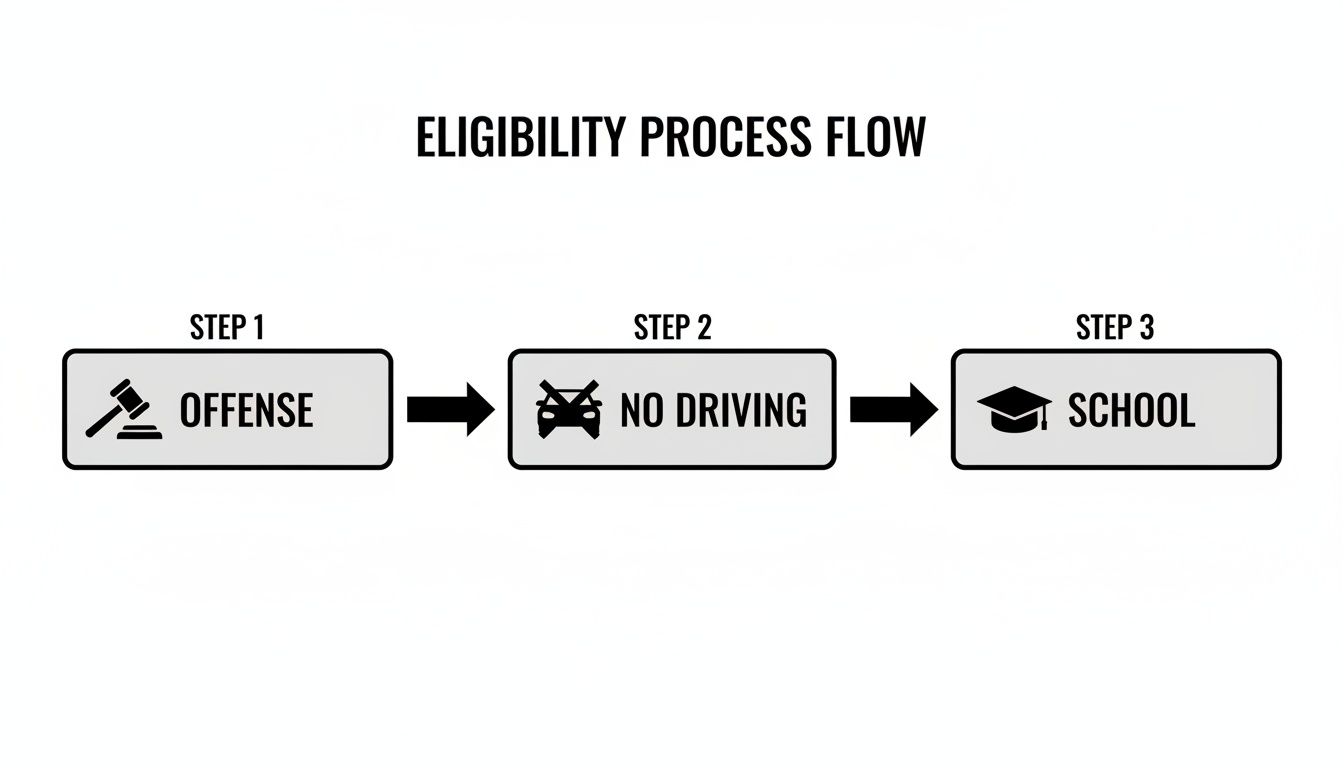
As you can see, the process starts with the offense, moves into the no-driving period, and then requires you to sign up for school before you can take the next step.
Gather Your Documents and Schedule a Hearing
With your course enrollment receipt in hand, it's time to build your application packet. Think of it as making your case—the more organized and complete your paperwork is, the smoother the process will be. You’ll need to meticulously fill out form HSMV 78306, which is the state's official Application for Hardship License.
Next up is scheduling an administrative hearing at a local Bureau of Administrative Reviews (BAR) office. These are the only offices that handle hardship cases, and you can't just show up. You have to make an appointment, and they can be booked weeks out, so don't wait until the last minute.
Finally, pull all your supporting documents together. This usually includes:
- Proof of Identity: Your birth certificate or a valid passport will work.
- Proof of Course Enrollment: The receipt you got from the ADI or DUI school.
- Application Form: Your completed HSMV 78306 form.
- Payment for Fees: Come prepared to pay both application and reinstatement fees.
Prepare for Your Hardship Hearing
The hearing is the final piece of the puzzle. This is your chance to sit down with a hearing officer and explain why you genuinely need limited driving privileges. The best approach is to be honest, prepared, and respectful. The officer's job is to confirm you’ve met all the legal requirements and that your need to drive is legitimate.
To make your case as strong as possible, bring proof of your hardship. A letter from your boss on company letterhead that details your work schedule is incredibly helpful. Likewise, a copy of your class schedule or a note from a doctor about essential medical appointments can make a real difference.
Be ready to explain why you need to drive, and keep it focused. Stick to the essentials: getting to your job, attending school, or making it to critical medical appointments. You need to show that this license is a necessity for your livelihood, not just a convenience.
If you're approved, you’ll be issued your restricted license right then and there. Just remember, this is a privilege that comes with very strict limitations. Following all the hardship license rules in Florida is the only way you'll get back on the path to having your full driving privileges reinstated.
Assembling Your Required Courses and Documents
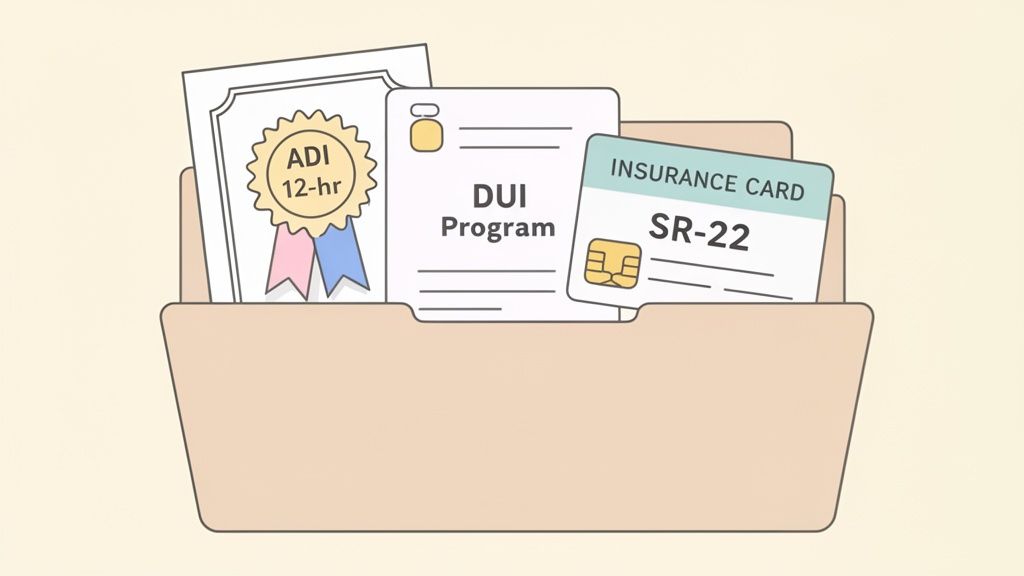
Trying to get a hardship license without the right paperwork is a recipe for disaster. Walking into that administrative hearing unprepared is like showing up to a final exam without studying—you're almost guaranteed to fail. To give yourself the best shot, you need to gather a specific set of documents and proof that you’ve completed the required courses.
This isn’t just busywork. It’s about proving to the hearing officer that you're taking this seriously and have met the state's strict requirements. Think of it as building your case file, piece by piece, to show you’re ready to be a responsible driver again.
Matching Your Suspension to the Right Course
Florida law is very clear: before you can even be considered for a hardship license, you have to complete a specific driving course. And here’s where a lot of people trip up—they sign up for the wrong one. The course you need is directly tied to the reason your license was suspended.
For example, if your license was suspended because you racked up too many points from traffic tickets, you’ll need to complete the 12-hour Advanced Driver Improvement (ADI) course. This program is designed to get at the root of habitual driving mistakes. But if your suspension is due to a DUI, you must enroll in a state-approved DUI Program, which focuses specifically on the dangers of impaired driving.
To make it simple, the table below shows exactly which course you need based on why your license was suspended.
Suspension Type and Required Florida Driving Course
This table breaks down the most common reasons for a license suspension and pinpoints the exact course Florida requires for hardship license eligibility. Make sure you enroll in the correct one to avoid any delays in your application.
| Reason for Suspension | Required Course | Course Length |
|---|---|---|
| Accumulating Excessive Points | Advanced Driver Improvement (ADI) | 12 Hours |
| First DUI Conviction | DUI Program Level I | 12 Hours |
| Multiple DUI Convictions | DUI Program Level II | 21 Hours |
| Court-Ordered (Non-DUI) | Basic Driver Improvement (BDI) | 4 Hours |
Getting proof of enrollment or completion before your hearing date is non-negotiable. That certificate is often the very first thing the hearing officer will ask for. If you've been ordered by a court to attend a class for a non-criminal ticket, a shorter 4-hour traffic class might be what you need to keep points off your record.
Your Essential Document Checklist
Once you've got your course certificate in hand, it's time to gather the rest of your paperwork. Don't just stuff it all in an envelope—get organized. A neat folder with everything in order sends a strong signal.
A complete and organized set of documents sends a powerful message to the hearing officer. It shows you respect the process and are prepared to follow the rules, which is exactly the kind of responsibility they are looking for when considering a hardship request.
Make sure you have every single one of these items ready for your hearing:
- Application for Hardship License (Form HSMV 78306): Fill this out completely and double-check it for accuracy before you go.
- Proof of Identity: You'll need an official document, like a certified birth certificate or a valid U.S. passport.
- Proof of Course Completion: This is the certificate you received from your ADI or DUI program.
- Reinstatement Fee: You must be ready to pay all the required fees during your appointment.
- Proof of SR-22 Insurance (if applicable): If your suspension is DUI-related, you absolutely must bring a certificate of financial responsibility, known as an SR-22, from your insurance company.
Having all these documents in order will make your hearing go much smoother and dramatically improve your odds of walking out with a hardship license.
Understanding Your Driving Restrictions and Penalties
Getting a hardship license is a huge step forward, but it's critical to understand what it really is: a privilege with a very strict set of rules, not just a slightly limited version of your old license. Think of it less like getting your car keys back and more like being given a special key that only works for essential trips. Pushing those boundaries comes with some pretty serious consequences.
The limitations are incredibly specific. A "Business Purposes Only" license lets you drive to keep your life running—things like getting to work, driving as part of your job, or going to a school or church. On the other hand, an "Employment Purposes Only" license is even more restrictive, permitting you to drive only to and from your job.
What You Can and Can't Do
Let's break this down with some real-world scenarios. Say you have a "Business Purposes Only" license.
- Allowed: Driving from your home to your office for your shift.
- Forbidden: Making a quick stop at the grocery store on the way home.
- Allowed: Taking your son to a scheduled doctor's appointment.
- Forbidden: Driving to the beach on a weekend or meeting friends for dinner.
Any driving that falls outside of these approved activities is a direct violation. The state offers this license as a lifeline to maintain your livelihood, not for your social life or convenience.
The Steep Price of Bending the Rules
The penalties for violating your hardship license restrictions are no joke. This isn't like getting a simple speeding ticket. If an officer pulls you over and you're driving outside of your approved purposes, you're looking at serious trouble.
You could face:
- Immediate Revocation: Your hardship license will be taken away, right then and there.
- A Longer Suspension: The original suspension period for your full license could be extended.
- New Criminal Charges: You could be arrested for driving with a suspended license, which is a misdemeanor that can lead to jail time and expensive fines.
It's also crucial to realize how other serious offenses, like reckless driving charges in Florida, can make your situation much worse and complicate your ability to drive legally.
Think of a hardship license as a test. If you violate its terms, you're showing the state that you can't be trusted with even limited driving privileges, which will make it much, much harder to get your full license reinstated down the road.
A Focus on Getting Back on Track
While the penalties are tough, there's a growing recognition in Florida that helping drivers comply is better than just punishing them. A fantastic example is the Driver’s License Suspension Task Force in Miami-Dade County, which has overhauled its approach and helped reduce suspended licenses by an incredible 73%.
Through new programs, officers can now guide drivers to a special court where 85% of people end up getting their licenses fully reinstated. This shows a real shift toward education and support, and you can read more about these transformative countywide reforms online. It really drives home just how important it is to follow the rules from the very beginning.
The Path from Hardship Permit to Full Reinstatement
Getting a hardship license is a huge relief, but it’s a temporary fix, not the final destination. The real goal is getting your unrestricted driving privileges back for good.
Think of your hardship permit as a bridge—it’s designed to get you through a tough time, but your focus should always be on reaching the other side. Once your official suspension or revocation period is over, you can start the final steps to get your full license back.
Finalizing Your Reinstatement Checklist
This last phase is all about tying up loose ends. You have to prove to the Florida Highway Safety and Motor Vehicles (FLHSMV) that you’ve met every single requirement tied to your suspension. It's not just about waiting for a date on the calendar to pass.
Before the FLHSMV will hand you a new license, you’ll need to tick off a final to-do list, which almost always includes:
- Paying All Fines and Court Costs: Every last cent of court-ordered fines has to be settled.
- Satisfying Court Orders: If you were ordered to do community service or complete other tasks, you’ll need the official paperwork to prove you did it.
- Paying the FLHSMV Reinstatement Fee: This is a separate fee paid directly to the state just to process the reinstatement itself.
Miss even one of these items, and your application will grind to a halt. You can dig deeper into these requirements in our guide on how to reinstate a suspended license in Florida.
Your Driving Record and Insurance Future
Even with your full license back in your wallet, the suspension will follow you for a few years, especially when it comes to car insurance.
If you were required to file for SR-22 insurance, you’ll likely need to keep it active for three years straight, with absolutely no gaps in coverage. This special form is how your insurance company proves to the state that you're staying insured.
An SR-22 isn't actually a type of insurance. It’s simply a certificate that your insurer files to vouch for you. Letting it lapse, even for a single day, can trigger an immediate re-suspension of your license, putting you right back where you started.
After the SR-22 period is over, the best way to lower your insurance premiums is simple: maintain a clean driving record. Avoiding new tickets and accidents shows insurers that your past mistakes are truly in the past. Over time, as you prove you’re a safe driver again, your rates will start to come back down.
Answering Your Top Questions About Florida Hardship Licenses
When you're trying to get back on the road, it's natural to have a lot of questions. Let's clear up some of the most common ones about Florida's hardship license rules so you know exactly what to expect.
How Long Does It Take to Get a Hardship License in Florida?
Getting a hardship license isn't an overnight thing; it's a process with a few moving parts. The first hurdle is the mandatory "hard suspension" period. You absolutely cannot drive during this time. For a first DUI, that's typically 30 days, and for refusing a breathalyzer, it's 90 days.
Once that time is up, the clock is in your hands. You'll need to enroll in the right course (like ADI or a DUI program) and get a hearing on the calendar. The biggest wildcard here is the wait time for an appointment at your local Bureau of Administrative Reviews office. It could be a few days or a few weeks, depending on how busy they are. The good news? If you show up with all your ducks in a row, you can walk out with an approval on the day of your hearing.
Can I Get a Hardship License for an Unpaid Ticket?
Yes, and this is a very common reason people find themselves needing one. A simple unpaid ticket can snowball into a full-blown license suspension if you ignore it. The state provides a clear pathway back to limited driving privileges.
To get approved, you'll need to show you're taking the situation seriously. This usually means:
- Enrolling in a state-approved driver improvement course (often the 12-hour ADI program).
- Paying the required reinstatement fees to the FLHSMV.
- Clearly explaining your need for the license to a hearing officer.
It's also worth noting that many Florida counties offer payment plans for the original fines. Getting on one of these plans is a great way to show the state you're making a good-faith effort to resolve the problem.
"Remember, a hardship license is a restricted permit, not a free pass. It's strictly for getting to and from essential places like work, school, or the doctor. If you're caught driving for any other reason, you risk losing the permit immediately and facing new criminal charges."
Is a Hardship License the Same as an Occupational License?
Yep, in Florida, they're one and the same. While you might hear people use the term "occupational license," the official state name is a "hardship license." This permit will be specifically marked for either "Business Purposes Only" or "Employment Purposes Only."
Think of it this way: different states use different names for the same concept. Whether it's called an occupational license, a limited license, or a hardship license, the idea is identical—it restricts your driving to only the most essential activities needed to maintain your livelihood.
Do I Need a Lawyer to Apply for a Hardship License?
Not always. For straightforward cases, like a first-time suspension from getting too many points, you can absolutely handle the process yourself. The key is to be meticulous, follow the state's instructions to the letter, and have all your paperwork ready.
However, for more serious situations, hiring a lawyer is a smart move. If you're dealing with multiple DUIs or have been flagged as a habitual traffic offender, the stakes are much higher. An experienced attorney can make sure your application is perfect and argue your case effectively at the hearing, giving you the best possible shot at getting approved.
Dealing with these rules can feel overwhelming, but you're not on your own. BDISchool provides the state-approved online courses you need, like Basic Driver Improvement and Advanced Driver Improvement, to satisfy your requirements. Enroll today and take the first real step toward getting back behind the wheel, safely and legally. Find the right course for you at https://bdischool.com.