At its heart, your car's headlight system is all about balance. You need to see as much of the road as possible, but you can't go around blinding every other driver out there. That’s where your high and low beams come in.
Think of low beams as your go-to, everyday lights for city driving and following traffic. High beams, on the other hand, are like powerful spotlights you save for those empty, dark roads. Really getting the hang of when to use each one is the bedrock of safe nighttime driving.
Your Guide to High Beam and Low Beam Headlights
Driving after dark brings a whole new set of challenges, and your headlights are your most critical tool for tackling them. It's best to think of your low and high beams as two different tools for two very different jobs. It’s not just about flipping a switch; it’s about choosing the right light for the moment.
When you use them correctly, you're not just protecting yourself and your passengers—you're looking out for everyone else on the road, too.
This guide will walk you through everything you need to know, from the basic differences in their light patterns to the specific rules of the road for using them.
Low Beams: The Everyday Essential
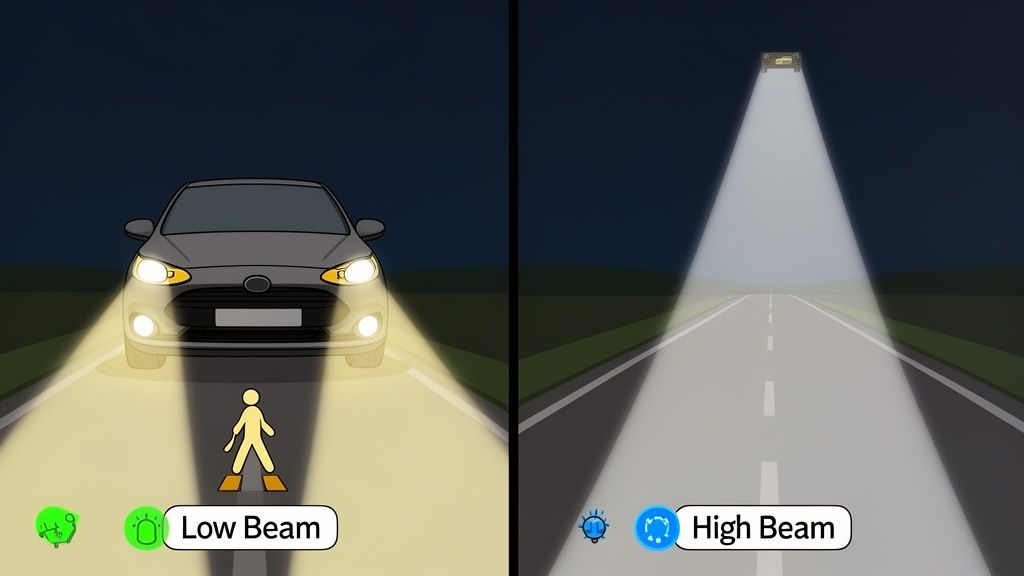
There’s a good reason your low beam headlights are the default setting. They're specifically designed to give you a clear view of the road directly ahead, typically lighting up a distance of about 150 to 200 feet.
Their beam pattern is aimed down and slightly to the right. This isn't random; it's a crucial design feature that keeps the bright light out of the eyes of oncoming drivers. This focused, controlled illumination makes them perfect for:
- Driving in cities or suburbs where you have streetlights.
- Following another car.
- Navigating through rain, fog, or snow, where super bright light would just reflect back and blind you.
High Beams: Maximum Visibility for Open Roads
High beams—what many of us call "brights"—are built for one thing: maximum visibility on dark, empty roads. They throw a powerful, straight-ahead beam that can light up the road for 350 to 500 feet or even more.
That extra range is a game-changer for spotting hazards like deer, pedestrians, or sharp curves with plenty of time to react. But all that power comes with a serious responsibility. Because the beam is aimed higher, it shines directly into the eyes of other drivers, causing a dangerous temporary blindness. It's critical to know when to switch them off, especially to avoid dangerous situations like learning what it means to overdrive your headlights.
To make it even clearer, here’s a quick side-by-side look at the two.
High Beams vs Low Beams At a Glance
| Feature | Low Beam Headlights | High Beam Headlights |
|---|---|---|
| Primary Purpose | Everyday driving, city streets, and when following other cars. | Illuminating dark, empty roads with no oncoming traffic. |
| Beam Range | About 150-200 feet. | 350-500+ feet. |
| Beam Direction | Aimed downwards and to the side to avoid glare. | Aimed straight ahead for maximum distance. |
| When to Use | In traffic, populated areas, or bad weather (rain, fog, snow). | On rural or unlit roads when no other cars are nearby. |
Essentially, your choice comes down to your surroundings. Low beams are for when other people are around; high beams are for when it's just you and the open road.
The Century-Long Quest for Better Night Vision
That simple switch you flick for your high beams? It’s the result of nearly a century of engineers trying to solve one huge problem: how to see clearly down a dark road without blinding everyone else. This balancing act between your visibility and the safety of others has always been the driving force behind modern headlights.
The story really gets going as cars became more common and driving at night went from a rare adventure to a daily routine. Early car lights were pretty pathetic—often little more than a faint glow. This made for some seriously dangerous situations on unlit roads, and it was obvious that a single, fixed beam of light just wasn't going to cut it.
The Birth of the Dual-Beam System
The big breakthrough came in the 1920s. As the auto industry grew, the need for safer nighttime driving became impossible to ignore. In 1924, the Bilux bulb changed everything. It was the first design to cleverly pack two separate filaments into a single bulb, one for a high beam and one for a low beam.
Just like that, the high and low beam headlight system we know today was born.
For the first time, drivers could choose between two different light patterns. One filament produced a lower, dipped beam perfect for city streets or when other cars were approaching. The second created a powerful, long-range beam for wide-open, empty roads. As you can learn in this detailed history of headlamps from State of Speed, nearly all modern headlight tech can be traced back to this simple, smart invention.
A Principle Forged in History: The struggle to balance a driver's need to see with the safety of others isn't a modern problem. It has shaped headlight technology from the very beginning, which is why using your beams correctly is such a fundamental, time-tested rule of the road.
Standardization for Universal Safety
Even with this game-changing tech, things were a bit of a mess for years. Different car makers had their own systems, so you never knew what to expect from an approaching vehicle. That all changed in the late 1930s when a major push for standardization swept across the United States.
By 1940, the entire U.S. auto industry had agreed to use a standard seven-inch round sealed-beam headlight. This was a huge deal. It meant every new car came off the line with a predictable and reliable high/low beam system. The move dramatically improved nighttime driving safety, making the dual-beam function a universal feature instead of a luxury option and setting a safety baseline that lasted for decades.
So, when you think about it, using your high and low beams correctly isn't just about being polite. It’s the result of a century-long effort to make night driving safer for every single person on the road.
Mastering the Rules for High and Low Beams in Florida
Knowing when to flick the switch between your high and low beams isn't just a minor detail—it's one of the most important skills you can have for driving safely after dark. It’s a mix of following the law and just plain good road etiquette.
Think of your low beams as your default, everyday tool. They're what you should be using for most of your nighttime driving, especially in town, when you're behind other cars, or when the weather turns nasty. High beams, on the other hand, are for special situations. You save those for when you're on a wide-open, unlit road with absolutely no one else around.
When to Stick with Low Beams
Your low beams are engineered to light up the road ahead without blinding everyone else. That’s why they’re the right choice nearly all the time.
Make sure you're using your low beams when:
- You're in the city or driving through suburbs. Streetlights already provide a good amount of visibility, so your low beams are perfect for seeing the road right in front of you without adding to the glare.
- You're following another vehicle. Nobody likes getting a blast of bright light in their rearview mirror. Keep your low beams on to be courteous and safe for the driver ahead.
- Driving in rain, fog, or snow. This one might seem counterintuitive, but high beams are your enemy here. They reflect off the moisture in the air, creating a solid white wall that makes it impossible to see. Low beams aim lower, cutting under the weather to illuminate the actual road.
Getting this right is a huge part of being a defensive driver. For a deeper dive, you can explore our guide on when you should use your headlights.
Florida's Specific High Beam Laws
While those are good rules of thumb anywhere, Florida has specific laws on the books that you absolutely need to follow. These regulations aren't just to help you avoid a ticket; they’re designed to prevent accidents caused by temporary blindness.
The Core Rule: Florida law is very clear. You must switch from your high beams to your low beams when you are within 500 feet of an oncoming car or within 300 feet of a vehicle you're following.
So, how far is 500 feet? Picture about one-and-a-half football fields. That’s a good amount of space, and it's designed to give the other driver plenty of time to react before your lights hit them. A sudden flash of high beams can leave a driver disoriented for several seconds—more than enough time for a disaster to happen. Following these distance rules is non-negotiable.
The whole concept of having two different beam settings came about to solve this exact problem of seeing far down the road without endangering others.
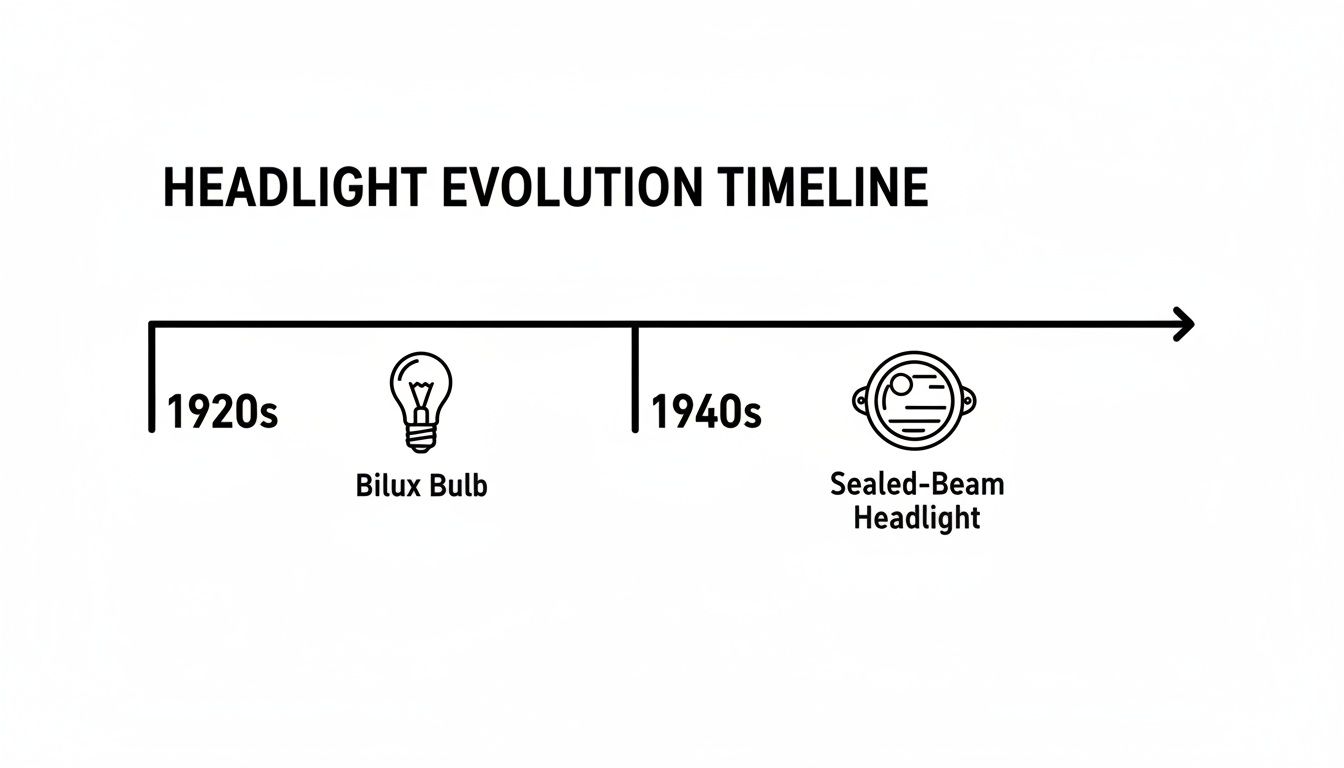
As you can see, engineers have been working on balancing visibility and safety for the better part of a century, which is what led to the laws and technology we have today.
From Halogen to Smart LEDs: The Future of Headlights
Knowing when to flick on your high beams is one thing, but how well you can actually see comes down to the technology in your car and whether you've taken care of it. Something as simple as a cloudy headlight lens or a slightly misaligned bulb can seriously hamper your vision at night.
It’s easy to overlook, but regular upkeep is a huge part of staying safe. You need to keep those lenses clear of that yellow, hazy oxidation that blocks so much light. You also have to make sure they’re aimed correctly—a misaligned headlight can point your high beams at the trees or turn your low beams into a blinding nuisance for everyone else on the road. For a deeper dive into keeping your car road-ready, take a look at our guide on essential Florida vehicle maintenance.
The Evolution of Headlight Technology
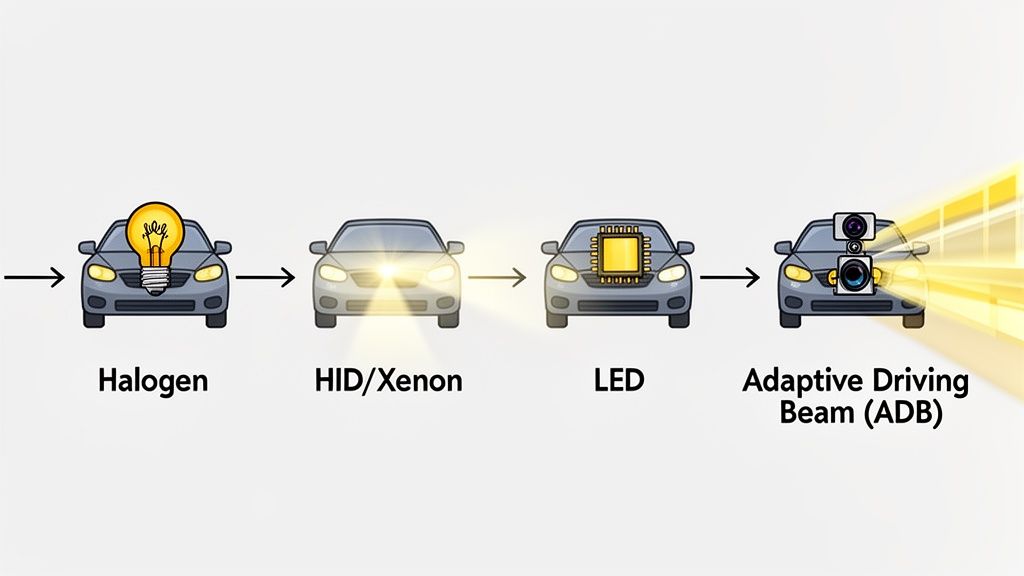
Headlights have come a long, long way from the dim sealed-beam units of old cars. Each new generation has brought huge gains in brightness, efficiency, and lifespan, making nighttime driving safer with every step.
- Halogen Bulbs: For decades, these were the go-to. They work by heating a tiny tungsten filament inside a capsule of halogen gas, which creates that familiar yellowish-white glow. They're cheap and easy to find, but they're also the dimmest and least efficient option out there.
- High-Intensity Discharge (HID/Xenon): HIDs were a game-changer. Instead of a fragile filament, they create an intensely bright light by zapping an electrical arc through xenon gas. The result is a much whiter and more powerful beam that lights up the road far better than halogens ever could.
- Light Emitting Diodes (LEDs): Today, LEDs have taken over, and for good reason. They create light by passing current through a semiconductor, making them incredibly energy-efficient, long-lasting, and small enough for designers to get creative.
The switch to LEDs happened fast. The technology got a serious boost in 2009 when mass production made them a real contender, offering more brightness for less power than even HIDs. As a result, the number of new vehicles equipped with LEDs shot up from just 23% in 2016 to an incredible 95% by 2023. This shift completely remade the industry. You can learn more about this pivotal shift in headlight evolution from Stanley Electric.
The Rise of Smart Headlights
Taking the incredible flexibility of LEDs one step further, engineers have created the next big thing in lighting: Adaptive Driving Beam (ADB) systems. We call them "smart" headlights because they actively respond to the world around them.
An ADB system uses a camera to spot the headlights and taillights of other cars. It then intelligently dims or shuts off individual LEDs in the headlight to carve out a "shadow" around the other vehicle.
This is a pretty brilliant solution. It means you can essentially drive with your high beams on all the time. The system keeps the road, the shoulder, and everything in between fully illuminated while automatically shielding other drivers from any glare. It’s the best of both worlds, tackling the age-old problem of seeing clearly without blinding everyone else.
Defensive Driving Tactics for Nighttime Glare
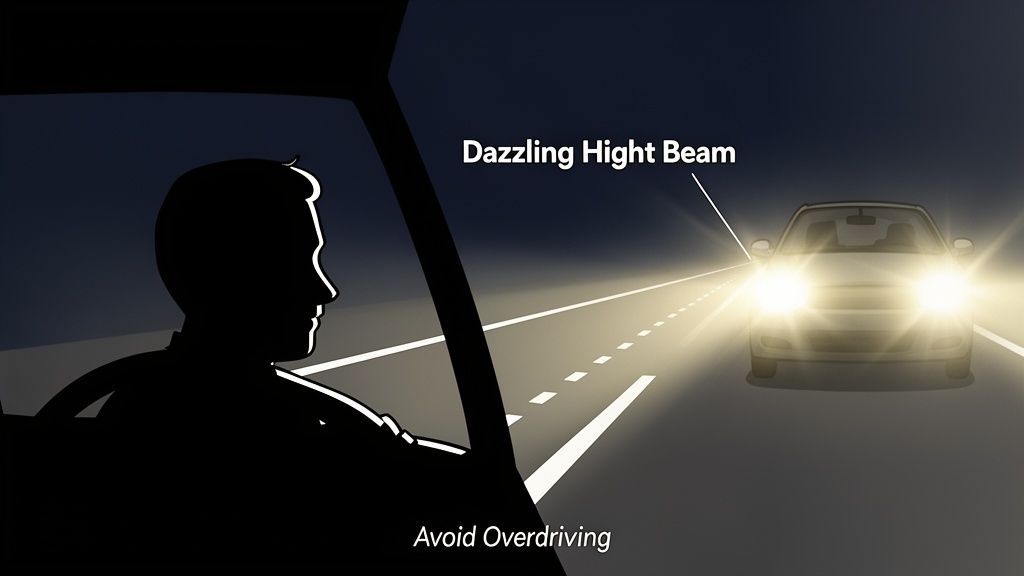
Headlight glare isn't just an annoyance. It's a genuine road hazard that can temporarily blind you, leaving you disoriented for a few critical seconds. Knowing how to handle these situations is a core part of safe nighttime driving.
We’ve all been there: an oncoming car approaches, and the driver has forgotten to switch off their high beams. It’s an honest mistake, but it puts you in a tough spot. Your gut reaction might be to stare back or flash your own high beams in frustration, but trust me, both are bad ideas.
The safest move is to protect your own vision. Instead of looking into the lights, shift your gaze down and to the right, focusing on the white line that marks the edge of your lane. This simple trick helps you stay on track without getting blinded.
Avoid Overdriving Your Headlights
Another huge risk on dark roads is "overdriving your headlights." It's a term we use when you're going too fast to stop within the distance your headlights illuminate. On a clear night, your low beams light up about 150 to 200 feet of road.
Think about it: at 60 mph, your car needs well over 250 feet to come to a complete stop. If you're out-driving your headlights, you could hit an obstacle before you even see it. Matching your speed to your visibility range is one of the most important night driving tips you can learn.
Your headlights create a finite bubble of visibility. Overdriving them means you are essentially driving blind into the darkness beyond that bubble, leaving zero room for error if an unexpected hazard appears.
Proactive Steps for Better Night Vision
Being a good defensive driver also means making sure your own car is set up for success after sundown. A little maintenance goes a long way in helping you see—and be seen.
You can be an expert at using your high and low beams, but if your headlights are cloudy and oxidized, you're not getting their full power. Understanding why headlights turn yellow is the first step to fixing a problem that seriously hurts your visibility.
Here are a few other simple things you can do:
- Keep Your Windshield Clean: Streaks and smudges on your windshield—inside and out—catch the light from oncoming cars and make glare much worse.
- Align Your Headlights: If your headlights are aimed incorrectly, they might point too low and shorten your view, or too high and blind other drivers even on the low beam setting. It's a good idea to have a mechanic check their alignment once a year.
- Dim Your Dashboard: A bright dashboard or infotainment screen can strain your eyes and make it harder to see into the darkness ahead. Turn down the interior lights to let your eyes adjust properly.
Your Top Questions About High and Low Beams, Answered
Even when you know the basics, real-world driving throws some curveballs. Let's dig into some of the most common questions drivers have about their headlights. Getting these answers right will make you a safer, more confident driver at night.
We'll cover everything from tricky legal situations and maintenance headaches to the unspoken language of the road.
Is It Illegal to Just Leave My High Beams on in Florida?
Yes, absolutely. Driving with your high beams on all the time isn't just rude—it's illegal and incredibly dangerous.
Florida law is crystal clear on this: you are required to switch to your low beams when you’re within 500 feet of an oncoming car. The same rule applies when you're within 300 feet of a vehicle you're following. Blasting the driver ahead of you through their mirrors is just as bad as blinding someone head-on.
Think of it this way: leaving your high beams on is like shining a spotlight in someone's eyes while they're trying to navigate. It dramatically increases the risk of a collision, and it's an easy way to get a ticket.
Why Do My High Beams Seem So Weak?
If flipping on your high beams feels… underwhelming, you're not alone. This is a super common complaint, especially with older cars, but the good news is that it's usually a straightforward fix.
There are a few usual suspects:
- Worn-Out Bulbs: Headlight bulbs have a lifespan. Just like the lights in your house, they get dimmer over time long before they actually burn out, especially older halogen bulbs.
- Foggy Headlight Lenses: The clear plastic covering your headlights takes a beating from the sun and road debris. Over years, it develops a hazy, yellowed layer that can trap a surprising amount of light, preventing it from ever hitting the road.
- Bad Alignment: Your bulbs could be brand new and perfectly bright, but if they're aimed at the ground 20 feet in front of your bumper, they won't do you much good. Headlights can get knocked out of alignment, pointing that powerful beam anywhere but where you need it.
Sometimes, a weak alternator that isn't pushing enough juice can also be the problem. A great first step is giving your headlight lenses a thorough cleaning and polishing. If that doesn't do the trick, it’s probably time to have a mechanic check the bulbs and get the alignment professionally adjusted.
Pro Tip: If you're replacing bulbs, remember that not all bulbs are created equal. A quality modern bulb can be 600-700% brighter than a standard old halogen, completely changing your nighttime driving experience.
What’s the Deal With Those Super Bright Blue-White Headlights?
You're most likely seeing either High-Intensity Discharge (HID/Xenon) or modern LED headlights. These are a huge leap in technology from the yellowish glow of old-school halogens, producing a much whiter, brighter, and clearer light. That’s why they come standard on most new vehicles.
But there's a big "if." When these super-powerful bulbs are dropped into a headlight housing designed for a halogen bulb (a popular but dangerous aftermarket mod), they spray light everywhere. This creates a blinding, uncontrolled glare for everyone else. Factory-installed LED and HID systems are engineered with special projectors and reflectors to control that intense light and shape it into a proper beam. Unregulated kits, on the other hand, often cause more problems than they solve.
Is It Okay to Flash My High Beams to Signal People?
A quick flash of the high beams is a classic, if unofficial, piece of road communication. It's a kind of shorthand that most experienced drivers instantly understand.
You'll often see it used to:
- Warn oncoming drivers about a hazard up ahead, like a deer, a stalled car, or an accident.
- Signal a truck driver that they're clear of your vehicle and have room to merge back into your lane.
The trick is to be quick and deliberate. One or two short flashes work as a helpful signal. Laying on the high beams or flashing erratically comes across as aggressive and is more likely to confuse or startle another driver than to help them.
At BDISchool, we believe that confident driving begins with clear knowledge. Our state-approved courses are designed to make Florida’s traffic laws easy to understand, helping you stay safe, avoid points on your license, and become a more aware driver. Enroll today at https://bdischool.com and take control of your driving education.