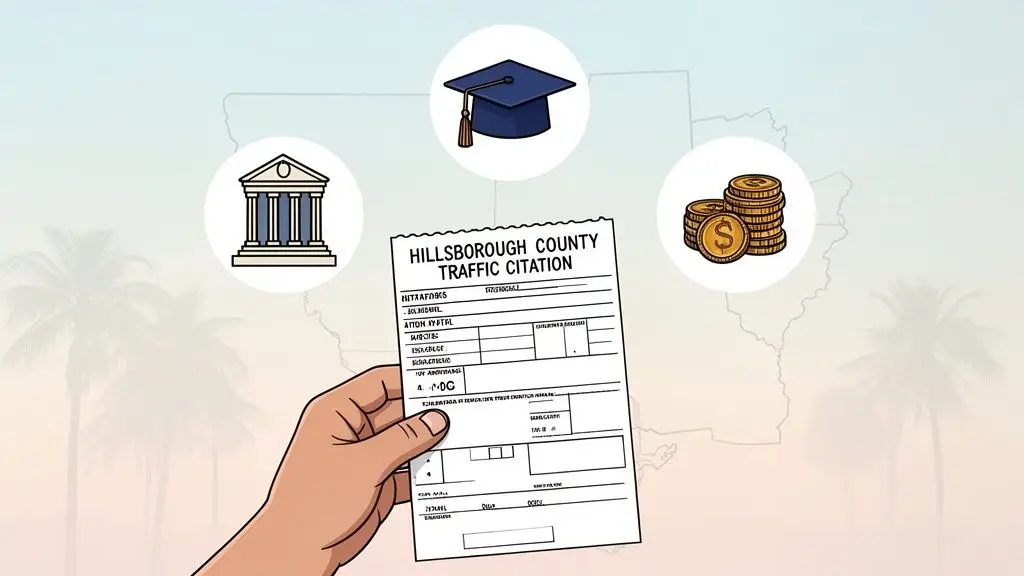
Getting a speeding ticket is always a gut-punch, and the first question that pops into your head is usually, "how much is a speeding ticket in Florida?" There's no single answer, but you can generally expect the starting point to be around $140 and climb well past $600, all depending on how fast you were going and where the officer clocked you.
Breaking Down Florida Speeding Ticket Fines
The dollar amount you see on that citation is just the beginning. Think of it like a sticker price on a new car—it’s the base cost before all the other fees and taxes get tacked on. Your final bill will be a mix of the base fine, mandatory court costs, and various county-level surcharges.
Two things really drive up that base fine: your speed and your location. Going a few miles over on the highway is one thing, but doing that same speed in a school zone is a completely different ballgame. Florida law is crystal clear on this: fines are doubled in designated school and construction zones to protect kids, pedestrians, and road crews.
Understanding the Base Fines
The state sets up the base fines on a simple tiered system. The faster you go, the more you owe. It’s a straightforward way to penalize riskier driving more heavily.
A ticket for going just 1-5 mph over the limit is a relatively minor hit, but once you cross the 15 mph threshold, you jump into a much more expensive bracket. For example, a standard ticket on I-95 might average around $200, but push it to 15 mph over, and the base fine alone can easily hit $250 before any other fees are added.
The key takeaway is simple: The faster you go, the more expensive the ticket becomes. This is especially true in protected zones where safety is the top priority, and penalties are designed to be a strong deterrent.
To really see how this works, let's lay out the numbers. The table below gives you a good idea of what to expect for the base fine depending on your speed and the type of zone you're in. It also shows the points that come with each violation. Remember, understanding the rules of the road is your best defense; you can learn more about Florida speed limit laws in our guide.
Estimated Florida Speeding Ticket Fines by Speed and Zone
This table provides a snapshot of estimated base fines for speeding in Florida, showing how costs increase with speed and vary significantly in sensitive areas like school and construction zones.
| Miles Per Hour (MPH) Over Limit | Fine in Regular Zone (Approx.) | Fine in School/Construction Zone (Approx.) | Points Assessed |
|---|---|---|---|
| 6-9 MPH | $141 | $156 | 3 Points |
| 10-14 MPH | $216 | $306 | 3 Points |
| 15-19 MPH | $266 | $406 | 4 Points |
| 20-29 MPH | $291 | $456 | 4 Points |
| 30+ MPH | $366+ (Mandatory Hearing) | $606+ (Mandatory Hearing) | 4 Points |
As you can see, the penalties ramp up quickly. That initial sticker shock is just one piece of the puzzle, and understanding this framework is the first step in figuring out the true financial impact of your ticket.
The Hidden Costs Beyond the Initial Fine
So, you’ve got a speeding ticket in your hand, and you’re staring at the fine. Whatever that number is, I can almost guarantee it’s not what you’ll actually end up paying. The amount on the citation is just the starting point—the tip of the iceberg, really.
Think of it like getting a surprisingly low quote for a car repair. By the time you see the final bill, all the "shop fees," "environmental surcharges," and taxes have been added, and the price has ballooned. A Florida speeding ticket works much the same way. The real shock comes from the stack of mandatory fees that get piled on top.
Deconstructing the Extra Fees
That base fine we talked about earlier? It’s just the foundation. On top of that, state law and county rules add a bunch of other non-negotiable charges. These aren’t optional, and they vary all over the state, which is why the exact same speeding violation can cost you more in a busy area like Miami-Dade than in a quieter, rural county.
Here’s a look at what you’re really paying for:
- Court Costs: This is a standard fee that gets tacked onto every moving violation. It’s there to keep the lights on at the Clerk of Court’s office.
- County Surcharges: Each county has its own set of additional fees. A major hub like Miami-Dade, which handed out a whopping 93,891 speeding tickets in a recent year, is going to have different surcharges than a smaller county.
- State-Mandated Fees: You'll also find a few required state fees, often funding things like brain injury research funds or emergency medical services.
This is why just looking at the base fine is so misleading. It's only one piece of a much larger puzzle.

As you can see, the total hit to your wallet is a combination of the violation itself (how fast you were going and where) plus a whole slew of administrative fees.
A Real-World Cost Breakdown
Let’s make this real. Say you were ticketed for going 16 mph over the limit on a highway in Miami-Dade County. The base fine for that is around $266.
But you won’t be writing a check for $266. Not even close. Once the county and state get their cut, that total starts climbing fast.
A $266 base fine can easily become a $300+ bill once all the administrative costs are factored in. That’s a jump of nearly 15-20% from fees alone.
This is the hidden financial trap of a speeding ticket. Simply mailing in a check is often the most expensive route you can take. Not only are you paying an inflated fine, but you're also pleading guilty, accepting the points on your license, and setting yourself up for even bigger costs down the road (hello, insurance hikes!). You can get the full scoop on the long-term impact by reading our guide on whether speeding tickets stay on your record.
When you see how quickly the costs add up, it becomes clear why looking into options like traffic school isn't just about avoiding points—it's a smart financial decision.
Understanding the Florida Driver's License Point System
The check you write for a speeding ticket is a one-time sting. The points added to your driver's license? That’s the penalty that keeps on costing you. Think of your license as a clean slate. Each time you get a ticket for a moving violation, the state adds demerit points—like black marks against your name in a game you really don't want to lose.
These points are how Florida keeps a running tab on your driving habits. But more importantly, they’re the exact metric your insurance company uses to label you as a "risky driver." The more points you rack up, the higher your insurance premiums are going to climb.
How Florida Assigns Points for Speeding
The Florida Department of Highway Safety and Motor Vehicles (DHSMV) doesn't just hand out points randomly. They have a straightforward system based on how serious your speeding violation was. It’s not a one-size-fits-all penalty; the faster and more reckless you drive, the more points you get.
Here’s a quick breakdown of what you can expect:
- 3 Points: This is the most common one. You'll get 3 points for speeding 15 mph or less over the limit. This also applies to most other garden-variety moving violations.
- 4 Points: If you get caught going more than 15 mph over the limit, the penalty bumps up to 4 points. Causing a crash that results in property damage will also land you here.
- 6 Points: These are reserved for much more serious offenses. Think leaving the scene of an accident with property damage over $50 or causing a crash with your speeding that injures someone.
These points aren't just harmless numbers on a state computer. They add up, and they can trigger some pretty serious consequences that directly affect your ability to drive.

The Consequences of Letting Points Pile Up
As your points start to stack up, so do the penalties. The DHSMV keeps a close watch on your record over specific timeframes, and if you hit certain thresholds, you’re looking at an automatic license suspension. It’s a system designed to get repeat offenders off the road.
The real danger isn't one single ticket, but the snowball effect. A few too many points in a short period can quickly lead to losing your driving privileges entirely.
Take a look at what triggers a suspension:
- 12 points within 12 months = 30-day suspension
- 18 points within 18 months = 3-month suspension
- 24 points within 36 months = 1-year suspension
Losing your license for even a month can throw your entire life into chaos—getting to work, school, or just running errands becomes a logistical nightmare. This is exactly why it’s so critical to handle every single ticket the right way.
Your Best Defense Against Points
This is where knowing your options becomes a total game-changer. For most non-criminal speeding tickets in Florida, the law gives you an out: you can elect to take a Basic Driver Improvement (BDI) course. Think of it as your most powerful tool for protecting your driving record.
When you successfully finish a state-approved BDI course, a few amazing things happen:
- Adjudication is withheld. This is legal speak for "you're not officially found guilty."
- No points go on your license. Your driving record stays clean from that specific ticket.
- Your insurance company can't raise your rates. Florida law actually forbids insurers from jacking up your premiums for a ticket if you complete a BDI course.
This one simple step connects all the dots, saving you from the long-term financial pain of points and skyrocketing insurance costs. To get the full picture, you can learn more about the Florida traffic ticket point system and see how to keep your record spotless.
When Speeding Crosses the Line into a Crime
Most speeding tickets in Florida are what's known as civil infractions. They’re a pain, they cost you money, and they can mess with your insurance, but they aren’t crimes. However, there’s a speed threshold that, once you cross it, completely changes the game. Your ticket goes from being a simple fine to a criminal misdemeanor, pulling you into a much more serious legal battle.
Think of it this way: a typical speeding ticket is like a parking fine. Annoying, but you pay it and move on. But when you hit a certain speed, Florida law says you're no longer just breaking a traffic rule—you're committing a crime.
This is the point where a simple mistake becomes a criminal act, often referred to as the 'Super Speeder' law. It draws a very clear, unforgiving line in the sand.
The Magic Number: From Ticket to Misdemeanor
So, where exactly is that line? In Florida, you've officially committed a criminal offense when you're caught driving 50 miles per hour or more over the posted speed limit. That’s it. It’s a bright-line rule that, once crossed, triggers a mandatory court appearance and penalties that are worlds apart from a standard ticket.
This isn't a situation where you can just hop online and pay the fine. The law requires you to show up in front of a judge. The state treats this level of recklessness with extreme seriousness because of the immense danger it poses to everyone else on the road.
Driving at such extreme speeds isn't just a mistake; it's seen as a willful disregard for public safety. That’s why the state takes away the easy option and forces a judicial review of your actions.
This fundamental shift from a civil infraction to a criminal charge changes absolutely everything about your case and what’s at stake.
The Stiff Penalties for Criminal Speeding
The consequences for criminal speeding are severe for a reason—they're meant to be a massive deterrent. With the passage of Florida's Super Speeder Law (HB 351), the penalties have gotten even tougher since July 1, 2025. For a first-time conviction of driving 50+ mph over the limit, the consequences are steep. You can get more details on this recent Florida super speeder law update.
Here’s what a first-time offender is up against:
- Fines: Up to $500.
- Jail Time: Possibility of up to 30 days behind bars.
- Mandatory Court Appearance: There is no "pay and forget" option.
It gets much worse if you're caught a second time. If you get another conviction for the same offense within five years, the penalties jump dramatically:
- Fines: Up to $1,000.
- Jail Time: Up to 90 days in county jail.
- License Revocation: Your driver's license will be revoked for up to one year—no exceptions.
It’s critical to understand this distinction. While this guide is focused on answering how much is a speeding ticket in Florida for everyday civil violations, pushing your speed past that 50 mph mark puts you in a whole different universe of legal trouble, one that can impact your freedom, your finances, and your entire future.
How Traffic School Protects Your Driving Record
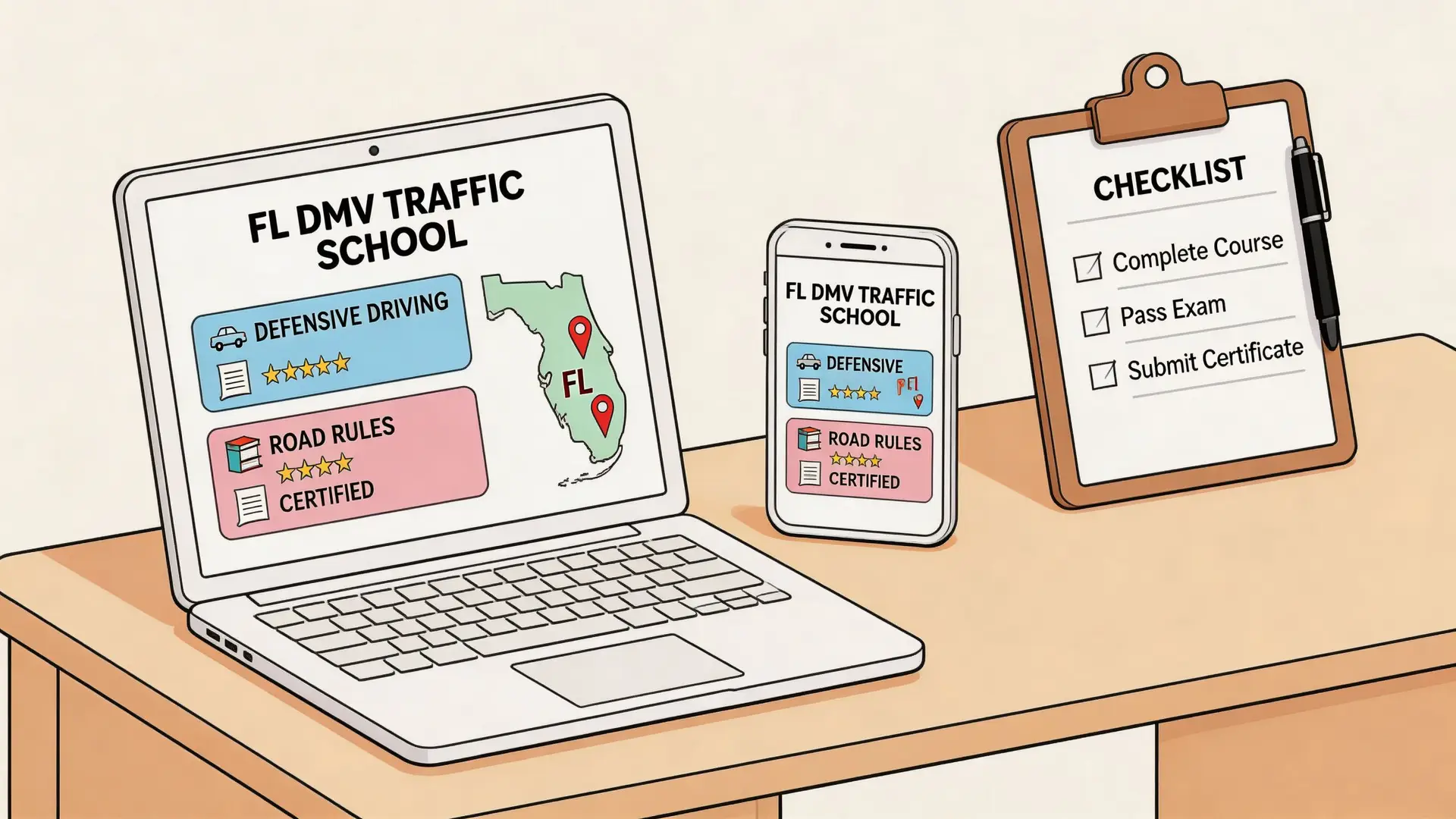
After the initial sting of seeing those flashing lights fades, you’re left with a choice. And honestly, it’s a decision that has a much bigger impact than just paying the fine listed on the ticket. This is where you can take back a little control and protect your driving record. For most drivers, the smartest move is electing to take a state-approved Basic Driver Improvement (BDI) course—what everyone just calls traffic school.
Think of traffic school as a shield for your license. It’s a mechanism built into Florida's system to give eligible drivers a chance to keep a clean record. It not only helps you dodge the long-term financial pain of a ticket but also serves as a great refresher on the defensive driving skills that keep everyone safer on the road.

Who Is Eligible for Traffic School
So, who gets to use this option? Florida law is pretty clear on this, and the good news is that it’s designed to cover most people who get a common, non-criminal moving violation. It's not some exclusive club; it's a practical way to encourage better driving.
You can almost certainly elect traffic school if:
- You have a standard Class E driver's license (not a commercial one).
- You haven't taken a BDI course in the last 12 months.
- You haven't used the traffic school option more than five times in your entire life.
This path is closed off for more serious stuff, like criminal speeding (50+ mph over the limit) or a violation that caused an accident with serious injuries. But for the huge majority of speeding tickets, a BDI course is your best bet.
The Two Biggest Benefits of Completing a BDI Course
When you decide to take a BDI course, you get two massive, immediate wins that directly protect your wallet and your driving privileges. These aren't loopholes; they're benefits written directly into Florida law, making traffic school a no-brainer compared to just paying the fine.
First, and most importantly, completing the course means no points get added to your license. This is the big one. As we've covered, those points are what insurance companies look for and what can lead to a license suspension. By keeping the points off, you keep your record clean and avoid all the long-term headaches.
Second, Florida Statutes are explicit: your insurance company is legally forbidden from raising your premiums or dropping your policy for a speeding ticket if you complete a BDI course. This single protection can save you from the most expensive part of a ticket—a rate hike that can easily cost you hundreds, if not thousands, of dollars over the next few years.
By taking a few hours to complete an online BDI course, you effectively erase the two most damaging consequences of a speeding ticket: the points on your license and the guaranteed hit to your insurance rates.
The Clear Choice: Pay vs. Traffic School
When you lay the options side-by-side, the right move becomes incredibly obvious. Paying the ticket is a quick fix with long-lasting financial pain. Going to traffic school requires a small bit of your time for a huge return in savings and peace of mind.
To really see how different the outcomes are, let's break them down. The choice you make within 30 days of getting that ticket will affect your finances for the next three to five years. For anyone wanting to make the most informed decision, checking out a state-approved traffic school online can offer even more clarity.
Your Options After a Ticket Pay vs. Traffic School
This table clearly contrasts the financial and long-term consequences of simply paying your speeding ticket versus completing a BDI course.
| Outcome | Option 1: Just Pay the Ticket | Option 2: Complete a BDI Course |
|---|---|---|
| Points on License | Yes. Points are added immediately, sitting on your record for years. | No. Adjudication is withheld, and no points are added to your record. |
| Insurance Impact | Yes. Your insurer will almost certainly raise your rates at renewal. | No. Florida law prohibits insurance companies from raising your rates. |
| Total Cost | High. You pay the full fine, plus surcharges and years of higher insurance premiums. | Lower. You pay the fine (sometimes reduced), plus the low cost of the BDI course. |
| Future Consequences | Increased Risk. Accumulating points gets you closer to a potential license suspension. | Reduced Risk. Your driving record stays clean, protecting you from future issues. |
Ultimately, answering "how much is a speeding ticket in Florida" means looking way beyond the initial fine. The real cost is in the points and insurance hikes. By choosing traffic school, you turn a potentially expensive mistake into a simple, manageable learning experience.
Your Next Steps After Getting a Florida Speeding Ticket
The moment those blue and red lights fade from your rearview mirror, an invisible clock starts ticking. In Florida, you have just 30 days to figure out your next move, and what you do in that short window can affect your finances and driving record for years.
It’s easy to feel backed into a corner, but you have more power than you think. Understanding your options is the key to minimizing the damage. Let's walk through the choices you have and what each one really means for you.
Choosing Your Path: The Three Main Options
When it comes to a non-criminal speeding ticket, you’re looking at three distinct paths. Each one leads to a very different destination.
Pay the Ticket: This is the path of least resistance, but it's often the most expensive in the long run. Paying the fine is the same as pleading guilty. The points go on your license, and you can almost guarantee your insurance company will notice and raise your rates.
Elect Traffic School: If you're eligible, this is almost always the smartest play. You'll still pay the ticket's civil penalty, but by completing a driver improvement course, you avoid the points. No points means no insurance increase—a huge win.
Contest the Ticket: This is your "not guilty" plea. You take your case to court, hoping to get the ticket dismissed. If you have a solid defense, it's a great option. But if you lose, you're on the hook for the full fine plus court costs.
That 30-day window is everything. Rushing to pay the fine might feel like ripping off a band-aid, but it’s the only option that guarantees the worst long-term financial hit.
Taking Action: How to Proceed
Once you've decided on a path, you need to make it official by notifying the Clerk of Court in the county where the ticket was issued. Don't miss that 30-day deadline.
Option 1: Paying the Fine (Pleading Guilty)
The instructions are right on the back of the citation. Most counties make it easy to pay online, by mail, or in person. Just remember, once you pay, the case is closed, and the points are locked onto your record.
Option 2: Electing Traffic School
You have to formally tell the Clerk of Court you’re choosing this option. This usually means signing an affidavit and paying the fine right then. From that point, the clock resets—you'll have an additional 60 to 90 days (it varies by county) to finish a state-approved Basic Driver Improvement (BDI) course and get the completion certificate submitted.
Option 3: Contesting the Ticket
You’ll need to formally plead not guilty, either in person or by mail. The court will then set a hearing date. It'll be you, the officer who wrote the ticket, and a judge. You can argue your own case or, for a better chance, hire a traffic ticket attorney to do the fighting for you.
Figuring out how much is a speeding ticket in Florida goes way beyond the dollar amount printed on the citation. It's about the total, long-term cost of points and insurance hikes. By weighing these next steps carefully, you can pick the route that best protects both your driving record and your bank account.
Got Questions About Your Florida Speeding Ticket? We've Got Answers.
Getting a speeding ticket is stressful, and it’s completely normal to feel confused about what to do next. Let's cut through the noise and get straight to the answers you need to make the best decision for your situation.
How Much Time Do I Have to Deal With This Ticket?
The clock starts ticking the moment you get that ticket. In Florida, you have exactly 30 calendar days to make a move.
Don't let this deadline sneak up on you. Missing it means the state can suspend your driver's license and tack on some hefty late fees. Within that 30-day window, you need to decide: pay it, fight it, or go to traffic school.
Can't I Just Pay the Fine and Be Done With It?
You sure can. But "being done with it" isn't quite what happens.
Paying the fine is the same as pleading guilty. Once you do that, the state adds points to your driving record, and those points will haunt your insurance company's records for 3 to 5 years. What does that mean for you? Almost certainly a spike in your insurance premiums when it's time to renew.
Think of it this way: Paying the ticket feels like the easy way out, but it’s usually the most expensive choice over time. That one-time payment can lead to years of higher insurance costs, easily adding up to hundreds, if not thousands, of dollars.
What if I'm a Commercial Driver?
If you have a Commercial Driver's License (CDL), you're playing by a different, much tougher set of rules.
CDL holders are not eligible to take a traffic school course to get points dismissed—it doesn't matter if you were ticketed in your big rig or your personal car. A speeding conviction on your record can put your job on the line. Your best bet is to talk to a lawyer who specializes in traffic law for commercial drivers.
How Do I Know if I Qualify for Traffic School?
For most people with a standard Florida driver's license, the answer is yes. You can sign up for a Basic Driver Improvement (BDI) course as long as you haven't taken one in the past 12 months and you haven't done it more than five times in your entire life.
Honestly, it's the smartest move you can make. It keeps the points off your license and stops your insurance company from jacking up your rates.
A Florida speeding ticket doesn't have to wreck your driving record or your wallet. The single best way to protect yourself from points and painful insurance hikes is by completing a state-approved BDI course. At BDISchool, our online courses are a breeze—they fit your schedule and cover everything the state requires to keep your record clean and your insurance costs low. Turn this headache into a simple fix. Get started today at https://bdischool.com.