Losing your license can throw your whole life into chaos. Suddenly, simple tasks like getting to work or school feel impossible. But in Florida, there's a practical solution that can get you back on the road for these essential trips: the hardship license.
Think of it as a restricted permit, not a full-blown reinstatement. It's a lifeline designed to keep a license suspension from turning into a life crisis, like losing your job. The process might seem daunting, but it starts with one simple, crucial step.
Your First Steps to Getting Back on the Road
Before you fill out a single form, you need to know exactly why your license was suspended. This is the single most important piece of information you can have, as it dictates everything that comes next.
Was it because of:
- Point Accumulation? Too many tickets in a short period of time?
- A Serious Offense? Something like a DUI conviction?
- Financial Issues? Unpaid fines or other obligations?
The answer is your road map. For example, a suspension for too many points usually means you'll need to complete a Basic Driver Improvement (BDI) course. A DUI suspension, on the other hand, involves a completely different set of requirements.
Why a Driver Improvement Course is So Important
When you go before the Florida Department of Highway Safety and Motor Vehicles (FLHSMV) to ask for a hardship license, they're looking for more than just paperwork. They need to see you're serious about being a safer driver.
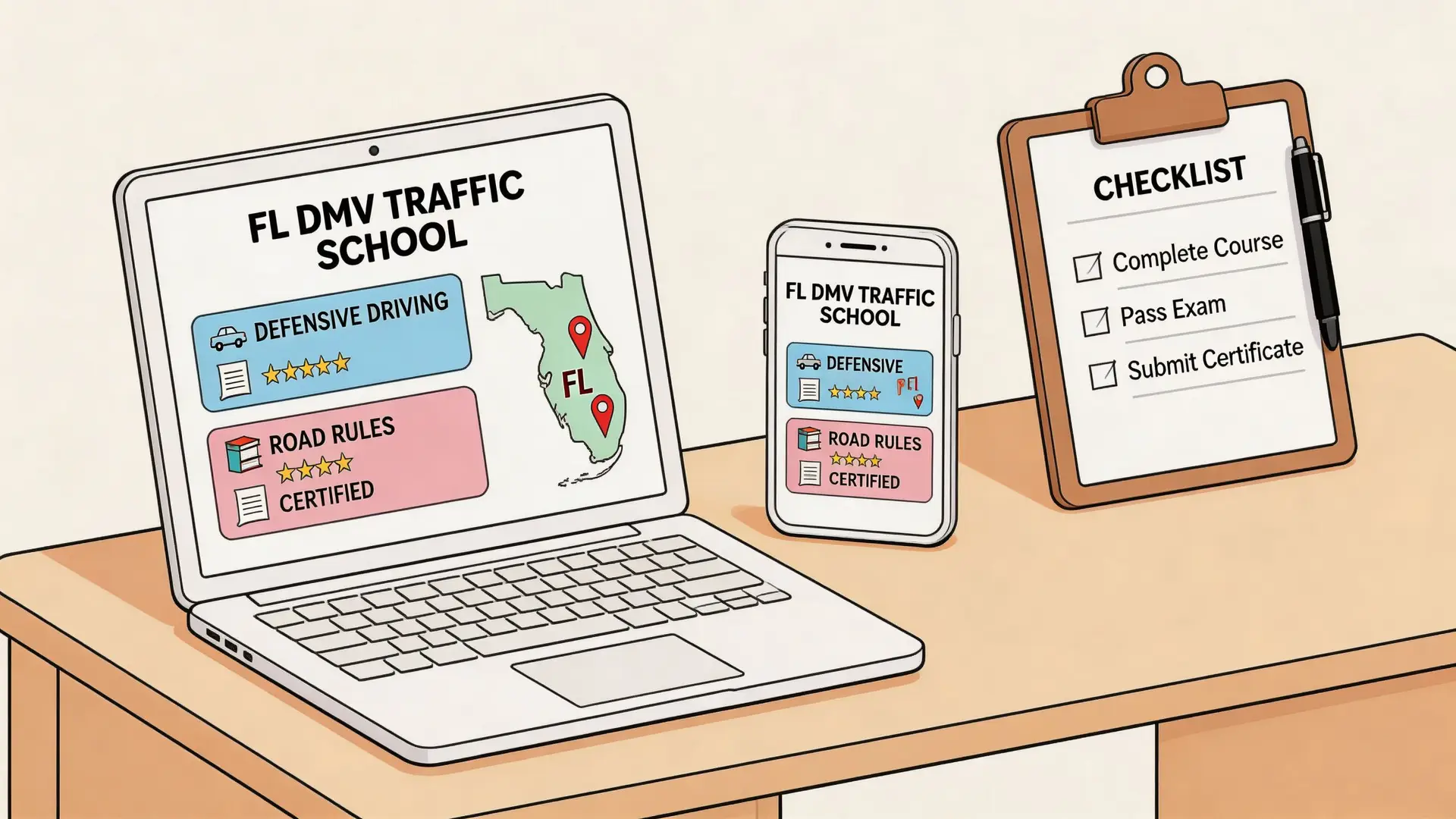
This is where taking a state-approved driver improvement course comes in. Enrolling in a class, like the 4-hour BDI, is often a mandatory first step. It shows the hearing officer that you're taking this seriously and are actively working to refresh your understanding of traffic laws and defensive driving. It’s not just a box to check—it’s a powerful statement about your commitment to getting things right. You can see how this fits into the bigger picture in our guide on how to reinstate a suspended license in Florida.
To help you get organized, here’s a quick overview of what you'll be looking at.
Florida Hardship License at a Glance
This table breaks down the core components of the hardship license application process, giving you a clear starting point.
| Requirement | Description | Why It Matters for Your Application |
|---|---|---|
| Proof of Course Enrollment | A certificate showing you've enrolled in or completed a required course (e.g., BDI or ADI). | This is often a non-negotiable prerequisite that demonstrates your commitment to safe driving. |
| Application Form | The official FLHSMV form for a hardship license hearing. | This is your formal request and must be filled out completely and accurately. |
| Proof of Employment/Need | A letter from your employer, school schedule, or doctor's note verifying your need to drive. | This justifies your request by showing driving is essential for your livelihood, education, or health. |
| SR-22 Insurance | A certificate from your insurance company proving you have the required liability coverage. | This is mandatory for many suspensions (especially DUIs) and confirms you are financially responsible. |
| Hearing Fee | A non-refundable fee paid to the FLHSMV for the administrative hearing. | Your application won't be processed without paying this fee. |
Getting these ducks in a row before you schedule your hearing will make the entire process smoother and significantly increase your chances of getting approved.
You're Not Alone in This
If you're feeling stressed about this, know that countless drivers face the same challenge. It’s a surprisingly common problem. Across the country, about 10% of all traffic offenses are committed by people driving without a valid license, often because of a prior suspension.
Financial pressures often make it tough to cover all the reinstatement costs, which is why thousands of Floridians apply for these restricted permits every year just to keep their lives on track. You can read more about the data behind unlicensed driving over at focus2move.com.
Key Takeaway: Your first move is simple: find out the official reason for your suspension. That single piece of information will unlock your path forward, telling you exactly which course to take and what documents to gather for your hearing.
Confirming Your Hardship License Eligibility
So, you've realized you need a hardship license to get back on the road. That's the first step, but the next one is crucial: figuring out if you actually qualify. The Florida Department of Highway Safety and Motor Vehicles (FLHSMV) has strict rules, and eligibility isn't a given. It all boils down to why your license was suspended in the first place.
The path forward for a driver who stacked up too many points is completely different from someone dealing with a DUI conviction. For example, if a few speeding tickets led to a 30-day suspension, you might be able to apply for a hardship license almost immediately, as long as you enroll in an approved driver improvement course.
However, more serious violations often come with a mandatory "hard suspension." This is a strict, no-driving period—no exceptions. A first-time DUI, for instance, typically includes a 30-day hard suspension before you can even think about applying. For repeat offenses, that waiting period gets significantly longer.
Are You in a Mandatory Waiting Period?
This "hard suspension" is non-negotiable. I've seen plenty of people waste their time and application fees by trying to apply before this period ends. It's an automatic denial.
Let's look at a real-world comparison:
- Driver A gets a 30-day suspension for hitting 12 points in 12 months. They can usually apply for their hardship license right away after providing proof of enrollment in a BDI course.
- Driver B is convicted of a DUI and gets a 180-day suspension. Before they can apply for a hardship license, they must sit out a 30-day hard suspension where absolutely no driving is allowed.
This waiting period is easily the biggest point of confusion for most drivers. Your first task is to find out if a hard suspension applies to you and, if so, exactly how long it lasts.
This flowchart can help you visualize your next steps based on your situation.

As you can see, identifying the reason for your suspension is the key that unlocks everything else, including which traffic school course you’ll need to complete.
Hardship License Disqualifiers
While many suspended drivers have a path to a hardship license, some violations are immediate deal-breakers. Knowing these up front will save you a lot of frustration.
Generally speaking, you are not eligible for a hardship license if:
- You were caught driving on a license that was already suspended.
- You have a second DUI conviction (or more), which can come with a one-year or longer hard suspension.
- You failed to complete a court-ordered Advanced Driver Improvement (ADI) course.
- Your license was permanently revoked for a major offense, like vehicular manslaughter.
Expert Tip: Think of a hardship license as a privilege the state is extending, not a right. The hearing officer's decision will hinge on your driving record and the seriousness of your violation. Trying to get around a hard suspension is a surefire way to get denied.
Being honest about your situation is the best way to start. If your suspension is for a common issue like point accumulation or a first-time offense, your chances are good. To get into the nitty-gritty of the rules, you can learn more about the requirements for a hardship license in Florida to make sure you have all your bases covered before you apply. A little preparation goes a long way.
Gathering Your Paperwork for a Smooth Application

Think of applying for your hardship license like building a case. Every document is a piece of evidence. If even one piece is missing or incorrect, your case can fall apart right there at the Administrative Reviews Office. They won't approve an incomplete application, so getting your paperwork in perfect order before you go is the secret to avoiding frustrating delays.
You’re not just filling out forms. You’re proving that you’ve met all the state’s requirements and that your need to drive is absolutely critical. Let’s walk through exactly what you need to pull together.
The Official Application: Form HSMV 78306
This form is the foundation of your entire request. It's officially called the "Application for Hardship License Hearing," and you can usually find the latest version on the FLHSMV website. Don't just glance over it—read every single instruction.
I’ve seen plenty of applications get held up because of simple mistakes here. A common one is giving vague answers. When the form asks why you need to drive, "for work" isn't going to cut it. A much stronger answer is, "To drive my work vehicle from my home in Orlando to my construction job site in Kissimmee, Monday through Friday, 7 AM to 5 PM." Specificity is your friend.
Proving Your Hardship with Concrete Evidence
This is where you show, not just tell. The state needs undeniable proof that not having a license creates a genuine, unavoidable hardship. Simply wanting to drive won’t be enough. You have to demonstrate that it’s essential for keeping your job, staying in school, or getting necessary medical care.
Your proof has to be official. Here’s what the hearing officers are looking for:
- For Work: Get a letter from your employer printed on company letterhead. It needs to list your job title, your exact work schedule, and clearly state that driving is a requirement of your job.
- For School: Provide a copy of your current class schedule from the registrar's office. Make sure it shows the campus location, class days and times, and, of course, your name.
- For Medical Reasons: You'll need a letter from your doctor outlining a recurring treatment schedule. This is for things like dialysis, ongoing physical therapy, or critical appointments for yourself or a dependent you’re responsible for.
A handwritten note from your boss just won’t do. The hearing officer needs to see formal, verifiable documents that back up your claim.
The All-Important Course Completion Certificate
As we covered earlier, completing the right driver improvement course is usually a non-negotiable step. Before you can even have your hearing, you need proof that you’ve done the work. Whether it’s the 4-hour BDI or the 8-hour IDI, your traffic school will issue a certificate of completion.
This certificate is more than a piece of paper; it’s proof that you’re taking this seriously and are committed to being a safer driver. Walking in with that certificate in hand is a huge step. In fact, Florida hearing officers are far more likely to approve petitions when the applicant has already completed their required course and has the paperwork to prove it.
For a broader look at driver requirements and statistics, you can find more info at Zutobi.com.
Your Application Packet Checklist
Before you even think about scheduling your hearing, do a final check. Make sure you have every single one of these items organized and ready:
- Completed Form HSMV 78306: Filled out 100%, signed, and dated.
- Proof of Hardship: Your official letter from your employer, school, or doctor.
- Proof of Course Completion: The certificate from your state-approved traffic school.
- Valid Identification: Your state ID card or another government-issued photo ID.
- Application Fee: The required non-refundable fee (always check the FLHSMV website for the current amount).
Showing up to the Administrative Reviews Office with a complete, organized packet tells the hearing officer that you are prepared and respect the process. It immediately removes the most common reasons for denial and puts you in the best possible position for a successful hearing.
The Hearing and Covering the Costs

Once your application packet is submitted, the process really kicks into gear. Now you’ll be focusing on the hearing itself and getting your finances in order. This is the moment where all your careful preparation comes into play, as you’ll be making your case directly to a hearing officer who holds the final say. Knowing exactly what’s coming can make a world of difference in keeping your stress levels down and boosting your chances of success.
Forget what you’ve seen in courtroom dramas. This is an administrative meeting, typically held at a local Administrative Reviews Office. The setting is professional and to the point. Your job is to simply and clearly state why you need a restricted license, using your documents to back up everything you say.
What to Expect at Your Hearing
The hearing officer has one main goal: to confirm that you are eligible and that your need to drive is real. They'll go through your application, look over your driving record, and review the proof of hardship you’ve provided. You should be ready to answer some direct questions.
You can expect them to ask you to:
- Confirm your personal details and the reason your license was suspended.
- Describe your hardship, walking them through your work, school, or medical schedule.
- Be specific about the routes you plan to drive and the times you'll need to be on the road.
Answer truthfully and stick to the facts. This is your chance to show you’re taking this seriously. If a DUI led to your suspension, understanding the mechanics of an Administrative License Revocation (ALR) hearing can be incredibly useful, as the core principle—presenting a clear, factual case—is very similar.
My Two Cents: Treat this hearing with respect. Dress professionally, show up early, and have your documents organized. Confidence and preparation tell the hearing officer more than you might think.
Managing the Financial Side of Things
Getting a hardship license isn’t free. There are specific fees and insurance requirements you'll have to meet. Getting a handle on these costs early on will help you budget and prevent any financial surprises from derailing your application at the last minute.
First, you have the non-refundable application fee, paid when you turn in your forms. If your application is approved, you’ll also have to pay a reinstatement fee to make the restricted license official. These fees can change, so it's always smart to check the current schedule on the FLHSMV website before you go. For more on navigating these types of costs, check out our guide on what to expect in traffic court, which has some related tips.
The SR-22 Insurance Requirement
One of the biggest financial pieces of the puzzle is the SR-22, often called a Certificate of Financial Responsibility. This isn't actually insurance—it's a form your insurance company files with the state to prove you have the minimum liability coverage required by law.
An SR-22 is almost always mandatory for drivers whose licenses were suspended for serious violations like a DUI or driving uninsured. It essentially flags you to the FLHSMV as a high-risk driver who is now correctly insured. You'll need to work with your insurance agent to get this filed, and you should expect your premiums to go up as a result.
This isn't a one-and-done deal. You’ll likely have to keep this coverage for a specific period, often three years, without a single day of lapse. If you let your SR-22 coverage drop, your license will be suspended again immediately, and you'll be right back at square one.
How a Driver Improvement Course Can Make or Break Your Case

When you're trying to get a hardship license, it’s easy to get lost in the sea of paperwork and deadlines. But one piece of the puzzle does more than just tick a box—it actively proves you’re serious about driving safely again. Completing a state-approved driver improvement course isn't just a hoop to jump through; it's your best tool for showing the hearing officer you’re taking responsibility.
Put yourself in their shoes for a second. Their job is to decide if giving you limited driving privileges is a safe bet. When you walk in with a certificate of completion from a 4-hour Basic Driver Improvement (BDI) course, it sends a powerful, proactive message. It says you didn't just wait for your suspension to end; you took action to fix the behavior that caused it.
It's More Than Just a Piece of Paper
The Florida Department of Highway Safety and Motor Vehicles (FLHSMV) often makes these courses a mandatory part of the process, and for good reason. The entire curriculum is built around the core issues that lead to license suspensions in the first place.
Whether it’s a BDI or an 8-hour Intermediate Driver Improvement (IDI) course, you’ll be covering ground that’s critical for safe driving:
- Real-world defensive driving skills for anticipating and avoiding trouble on the road.
- The latest updates to Florida traffic laws so you’re not caught off guard by a new rule.
- Proven strategies for crash avoidance that can make all the difference in a split-second decision.
By finishing a course, you're demonstrating to the FLHSMV that you've reinvested in your driving education. This simple act of good faith can be a huge factor in getting your application approved.
Expert Take: Think of your completion certificate as your first piece of evidence. It’s tangible proof that you’re committed to being a responsible driver, and it often speaks louder to a hearing officer than anything you can say.
Choosing the Right Course for Your Situation
This is where you need to pay close attention. The specific course you need is dictated by why your license was suspended. Showing up to your hearing with proof of the wrong course is an immediate roadblock.
To make sure you're on the right track, it's essential to understand which course aligns with your specific needs. This table breaks down the two most common options.
Choosing the Right Course for Your Situation
| Course Name | Duration | Best For | Benefit for Your Application |
|---|---|---|---|
| 4-Hour BDI | 4 Hours | Drivers with point-related suspensions from common moving violations. | Fulfills the most common requirement for hardship applications, showing you've addressed the offense. |
| 8-Hour IDI | 8 Hours | Drivers ordered by a court or the FLHSMV for more serious or repeat offenses. | Demonstrates a deeper commitment to correcting driving habits, which is vital for more complex cases. |
Always, always double-check your suspension notice or court documents. If a judge ordered an 8-hour course, a 4-hour certificate simply won't cut it. Getting this right from the start saves you time, money, and a whole lot of frustration.
The Smart Way to Get It Done: Go Online
A license suspension already throws your life into chaos. The last thing you need is to figure out how to get to a physical classroom. This is where modern, online courses are a lifesaver. You can knock out the entire program from home, on a schedule that actually works for you.
This flexibility is a game-changer. You can chip away at the modules late at night or over the weekend without disrupting work or family life.
Once you’re done, your completion is usually reported straight to the FLHSMV, and you get a digital certificate you can print immediately for your application packet. It’s a seamless way to satisfy a key requirement and move one big step closer to getting back on the road. You can see how a state-approved Florida driver improvement course online can fit your schedule and strengthen your application.
Got Questions About the Florida Hardship License? We’ve Got Answers.
Even with a perfect plan, navigating the hardship license process can leave you with a few lingering questions. It’s totally normal. There are a lot of moving parts, and the details really matter. To help you feel more confident, I've put together answers to some of the most common questions we hear from drivers across Florida.
How Long Does It Take to Get Approved?
This is the big one, right? The good news is, if you’ve done your homework, you could walk out with your license the same day as your hearing.
When you show up fully prepared—with every form filled out correctly and all your documents in order—the hearing officer can often make a decision on the spot. If they approve your application, you can usually pay the fees and get your restricted license right then and there.
But any hiccup can cause a delay. Missing paperwork or incorrect info on a form means the officer has to put your case on hold. That can set you back days or even weeks. Preparation is everything.
Can I Really Only Drive to Work?
People get tripped up on this all the time. The license is for "business purposes," but that term is broader than you might think. It’s not just about your 9-to-5 commute.
The state defines it as any driving necessary to “maintain livelihood.” This actually covers quite a bit:
- Driving to and from your job, of course.
- Getting to class if you're a student.
- Taking yourself or a family member to a necessary doctor’s appointment.
- Running essential household errands, like going to the grocery store or to church.
What’s strictly off-limits is recreational driving. A trip to the beach, swinging by a friend's house just to hang out, or catching a movie? Absolutely not. If you get caught using your hardship license for non-essential travel, it will be revoked immediately, and you’ll be facing much bigger problems.
My Advice: Before you turn the key, ask yourself if you can justify the trip to a police officer. If the answer is no, don't risk it. You have to be able to prove that your driving is essential for maintaining your household.
What Happens If My Application Is Denied?
Getting a "no" is tough, but it doesn't always mean it's over. The first thing you need to do is find out exactly why you were denied. The hearing officer is required to give you a specific reason.
Most denials fall into a few common categories:
- Simple Mistake: You were missing a form or a signature.
- Bad Timing: You applied too early, during a mandatory "hard suspension" period where no driving is allowed.
- Weak Case: You didn't provide enough proof that you truly need the license.
- Ineligible Record: A past offense on your record makes you ineligible for a hardship license.
If it was just a paperwork error, you can usually fix it and apply again. For more serious reasons, like being in a hard suspension period, you may just have to wait it out.
Is an SR-22 Always Required?
Not for everyone, but it’s extremely common. If your license was suspended for a DUI, driving without insurance, or another serious violation, you can pretty much count on needing an SR-22.
Think of the SR-22 as a special certificate from your insurance company that proves to the state you have the required liability coverage. It’s not insurance itself, but a guarantee that you’re insured. You’ll have to keep it active, without any gaps in coverage, for three straight years. If you let it lapse, your insurance company will notify the FLHSMV instantly, and your license will be suspended all over again.
What’s This Going to Cost Me?
It’s smart to budget for this process, because the fees can add up. The exact amounts can change, but here’s a realistic breakdown of what you should expect to pay.
| Fee or Cost | Typical Range | Important Details |
|---|---|---|
| Hearing Application Fee | $12 – $25 | You pay this upfront, and it's non-refundable, even if you're denied. |
| License Reinstatement Fee | $45 – $75 | This is what you'll pay after you get approved. |
| Driver Improvement Course | $25 – $75 | The cost depends on the school and whether you need a 4-hour or 8-hour course. |
| SR-22 & Insurance Hike | Varies widely | The filing fee itself is small, but your insurance premiums will likely go up a lot. |
These are just estimates, so always double-check the official FLHSMV website for the current fee schedule before you go to your hearing.
Tackling the Florida hardship license requirements is a lot less stressful when you have the right pieces in place. Completing your state-mandated driver improvement course is a non-negotiable step, and BDISchool makes it easy. Our 100% online, FLHSMV-approved courses let you work at your own pace, on your own schedule. Finish the course, get your certificate, and strengthen your application. Enroll today at https://bdischool.com and take a confident step toward getting back on the road.