Staying out of accidents starts before you even turn the key. The safest trips aren’t a matter of luck; they’re the result of a deliberate mindset that turns a few simple checks into a rock-solid, pre-drive ritual. It all comes down to a quick vehicle inspection, getting your cabin set up right, and being honest with yourself about whether you’re fit to drive.
Your Pre-Drive Ritual for Safer Journeys
Most people just jump in the car, find a good song, and take off. But taking a moment to run through a quick routine is one of the smartest habits you can build to prevent a crash. Think of it like a pilot’s pre-flight check—it’s a simple process designed to spot a small problem before it turns into a big one on the highway.
This whole ritual breaks down into three easy-to-master parts.
The 60-Second Walk-Around
Before you even open the door, take a quick lap around your car. It sounds almost too simple, but this one-minute habit can help you spot hazards you would have otherwise missed completely. You’re not doing a full mechanical diagnosis, just looking for obvious red flags that could affect your control on the road.
As you walk around, keep an eye out for these things:
- Tires: Do they look properly inflated? A visibly low or flat tire can make steering and braking unpredictable, especially if you have to swerve suddenly. Also, scan for any obvious damage like a nail or a bulge in the sidewall.
- Lights: Are your headlights, taillights, and turn signals clean and working? A quick visual check can tell you if a bulb is out or if they’re caked in mud, making sure other drivers can see you and know what you’re doing.
- Leaks: Glance at the pavement under your car. Are there any new puddles? Bright green, pink, or oily black spots could mean you’re leaking coolant, transmission fluid, or oil—all things that need to be checked out right away.
This quick walk-around is a fundamental part of being a responsible driver. For a more thorough breakdown, our guide on Florida vehicle maintenance has more detailed checklists you can use.
Create Your In-Car Safety Bubble
Once you’re inside, the next step is to set up your immediate environment for total control and awareness. Think of it as creating a personal “safety bubble” that lets you see everything and react in a split second.
Adjust your seat so you can easily press the pedals to the floor without stretching. Position your mirrors to virtually eliminate blind spots—a quick turn of your head should be all you need to see what’s in the next lane.
The last, and maybe most critical, step before you shift into drive is to put your phone away. Distracted driving is the number one cause of fatal and injury crashes for teens in the U.S. A cell phone is a triple threat: it takes your eyes off the road, your hands off the wheel, and your mind off of driving.
The Final Mental Checklist
At the end of the day, you are the most important safety feature in your car. Before putting the vehicle in gear, do a quick mental check-in.
Are you exhausted? Stressed out? Agitated? Drowsiness is just as impairing as alcohol, slowing your reaction time when you need it most. High emotions can also push you toward making aggressive or impulsive moves behind the wheel.
If you’re not in the right headspace to drive, the safest call is to wait it out, hand the keys to someone else, or find another way to get where you’re going. This honest self-check is the final piece of the puzzle, ensuring you’re just as ready for the road as your car is.
Mastering the Road with Proactive Driving
Once you’re buckled in and ready to go, the real work of defensive driving begins. Staying safe isn’t about slamming on the brakes at the last second. It’s about seeing trouble developing far ahead and making small, early adjustments to sidestep it entirely.
This proactive mindset is what separates a truly skilled driver from a reactive one, giving you the time and space you need to navigate Florida’s busy roads safely. It’s a shift from just operating the car to actively managing your entire driving environment.
That means mastering a few core skills: controlling your following distance, constantly scanning the road, and learning to predict what other drivers will do before they even do it.
Create Your Buffer Zone
The single most important safety feature you have is the space around your vehicle. A healthy following distance is your best defense against rear-end collisions, one of the most common types of crashes out there. The gold standard for this is the “Three-Second Rule.”
It’s simple to use:
- Pick a fixed object ahead, like a bridge overpass or a specific sign.
- When the car in front of you passes it, start counting: “one-thousand-one, one-thousand-two, one-thousand-three.”
- If you reach that same object before you finish counting, you’re too close. Ease off the gas and let the gap grow.
This three-second cushion gives you just enough time to see a problem, react, and brake safely—but only in perfect weather.
Let’s be honest, “ideal conditions” are a rare sight on Florida roads. The moment rain starts falling, traffic gets heavy, or the sun goes down, you need to double that buffer. Increase your following distance to at least six seconds whenever you’re dealing with bad weather, night driving, or tailgating a big truck that blocks your view.
This pre-drive ritual is a great way to get your head in the game before you even start the engine.
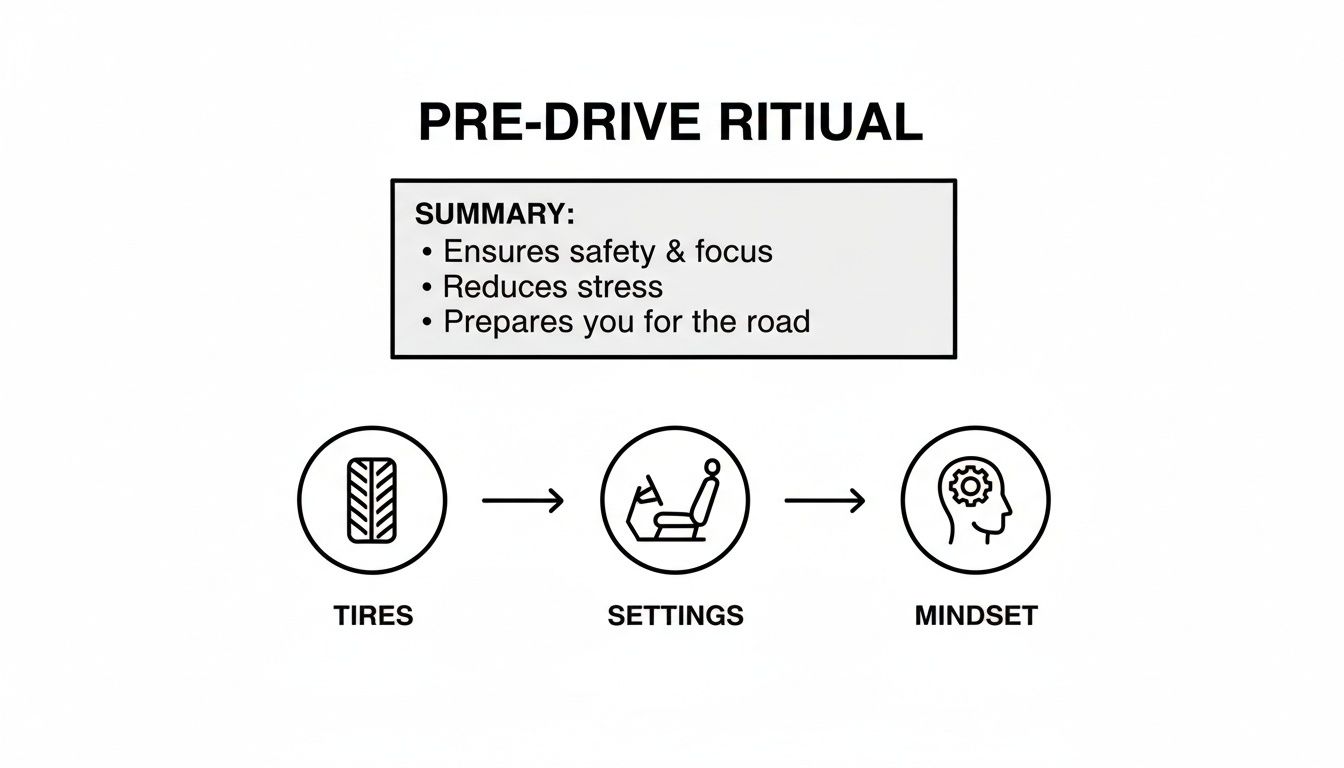
Taking a moment to check your tires, adjust your settings, and focus your mindset ensures both you and your car are ready for what’s ahead.
Learn to Read the Traffic Ahead
Defensive driving means looking way past the bumper of the car directly in front of you. Don’t fixate on one spot; keep your eyes moving. You should be scanning 12-15 seconds down the road. In the city, that’s about a full block. On the highway, it’s closer to a quarter-mile.
This long-range view lets you spot brake lights two, three, or even four cars ahead. When you see a slowdown that far in advance, you can just ease off the accelerator and coast, avoiding a sudden stop. It’s smoother, safer, and makes you more predictable to the driver behind you.
Pay attention to the little clues other drivers give off. A car drifting in its lane could signal a distracted or tired driver. Someone who keeps tapping their brakes in flowing traffic might be lost or anxious. Spotting these patterns is your cue to give them plenty of extra room. For more expert advice, take a look at our collection of advanced defensive driving tips.
Anticipate Hidden Dangers
Often, the biggest risks are the ones you can’t see. When you’re approaching an intersection where buildings or trees block your view, you have to assume a car might pull out. Get in the habit of “covering the brake”—hovering your foot over the pedal without pressing it—to slash your reaction time.
Think about a chaotic merge onto I-95 during rush hour. A reactive driver just looks for a gap. A proactive driver is watching the speed of the merging traffic, guessing who might try to cut over, and adjusting their own speed to create a safe pocket for someone else to enter. It’s a constant mental game of “what if” that keeps you prepared.
Managing your own environment is just as crucial. A secure MagSafe wireless car charger mount is a smart way to keep your phone in place and out of your hands, cutting down on one of the biggest distractions.
To help you put these ideas into practice, here’s a quick-reference guide for handling common road hazards before they become emergencies.
Defensive Driving Action Plan for Common Road Hazards
| Hazard | Proactive Action | What You Avoid |
|---|---|---|
| Sudden Braking Ahead | Maintain a 3-6 second following distance. Scan 12-15 seconds down the road. | A rear-end collision and multi-car pile-ups. |
| Blind Intersections | Reduce speed and cover your brake pedal as you approach. | A T-bone crash from a car you didn’t see. |
| Tailgaters | Slowly increase your own following distance to create a larger buffer in front. | Being pushed into the car ahead if you must stop. |
| Distracted/Erratic Driver | Change lanes or slow down to put as much distance as possible between you and them. | Getting caught in an accident caused by their mistake. |
| Merging Traffic | Adjust your speed early to create a safe gap for others to enter. | A sideswipe or dangerous last-minute maneuvers. |
This proactive approach, where you’re constantly anticipating and adjusting, is the core of staying safe on the road.
Ultimately, your speed is the one factor that governs how much time you have to react to any of these scenarios. Sticking to the speed limit is non-negotiable. Research from the World Health Organization is clear: for every 1% increase in average speed, there is a 4% increase in the risk of a fatal crash. That powerful statistic proves why managing your speed is the foundation of preventing accidents.
Handling Challenging Conditions Like a Pro
Florida’s weather can change in a heartbeat. One minute you’re cruising under a clear blue sky, and the next, you’re in the middle of a torrential downpour. Knowing how to handle these sudden shifts—from blinding rain to a deer darting into your headlights—is what separates a safe driver from a statistic.
It’s not just about slowing down. It’s about knowing exactly how your car will behave when the pavement gets slick or visibility drops to near zero, and having the right instincts to stay in control.

Navigating Florida’s Rain and Hydroplaning Risks
Those infamous Florida downpours can make the roads treacherous in seconds. The biggest danger here is hydroplaning—that terrifying moment when your tires lose contact with the road and start gliding on a thin layer of water. When this happens, you have zero control over steering or braking.
If you feel the car start to float, your first instinct might be to slam on the brakes. Don’t do it. That’s the worst possible move.
- Gently ease your foot off the accelerator. Let the car slow down on its own.
- Keep the wheel straight. Look where you want to go and make only small, gentle steering corrections to keep from sliding sideways.
- Stay off the brake pedal. Hard braking will lock your wheels and throw you into an uncontrollable skid. Only once you feel the tires grip the pavement again should you even think about braking.
Of course, the best way to handle hydroplaning is to avoid it altogether. As soon as the rain starts, slow down. Way down. Keep a sharp eye out for standing water and make sure your tires are properly inflated with good tread. For a closer look at these skills, our guide on driving in adverse conditions has you covered.
Mastering Night Driving
Once the sun goes down, the road becomes a completely different animal. Your depth perception is off, it’s tougher to judge the speed of other cars, and hidden dangers lurk just beyond your headlights. This is especially true on weekends, when a shocking number of fatal accidents happen.
The most dangerous time to be on the road? According to Forbes, it’s Saturday night, specifically between 8 p.m. and 11:59 p.m. This deadly window is often chalked up to more cars on the road and a higher probability of encountering impaired drivers.
To drive safely at night, you have to change your approach. On dark, empty roads, use your high beams, but be ready to flick them off in an instant. The rule I always follow is to switch to low beams when you’re about 500 feet from an oncoming car or 300 feet behind someone else.
And keep your eyes moving. Don’t get tunnel vision by staring only at the patch of road your headlights illuminate. Scan the shoulders and ditches for pedestrians, cyclists, or the tell-tale glint of an animal’s eyes—that might be the only warning you get.
Responding to Wildlife on the Road
From the deer in North Florida to the gators down south, our state’s wildlife doesn’t pay much attention to crosswalks. A sudden animal encounter forces a split-second decision: do you brake or do you swerve?
As counterintuitive as it might feel, in almost every situation, braking hard in a straight line is the correct, and safest, choice.
Your gut reaction will be to yank the wheel to avoid the animal. Fight that urge. Swerving can easily lead to a far worse outcome, like rolling the vehicle, hitting a tree, or veering into oncoming traffic. Stay in your lane, hit the brakes, and if a collision is unavoidable, brace for it. Hitting a deer is bad, but hitting an oak tree or another car is almost always worse.
Your Vehicle: The First Line of Defense
Your skill behind the wheel is critical, but it’s only half the story. The other half is the vehicle you’re driving. A well-maintained car is a predictable car, and predictability is exactly what you need when you have to swerve or brake suddenly to avoid an accident.
This isn’t about learning to be a mechanic. It’s about recognizing that your car is your most important piece of safety equipment.
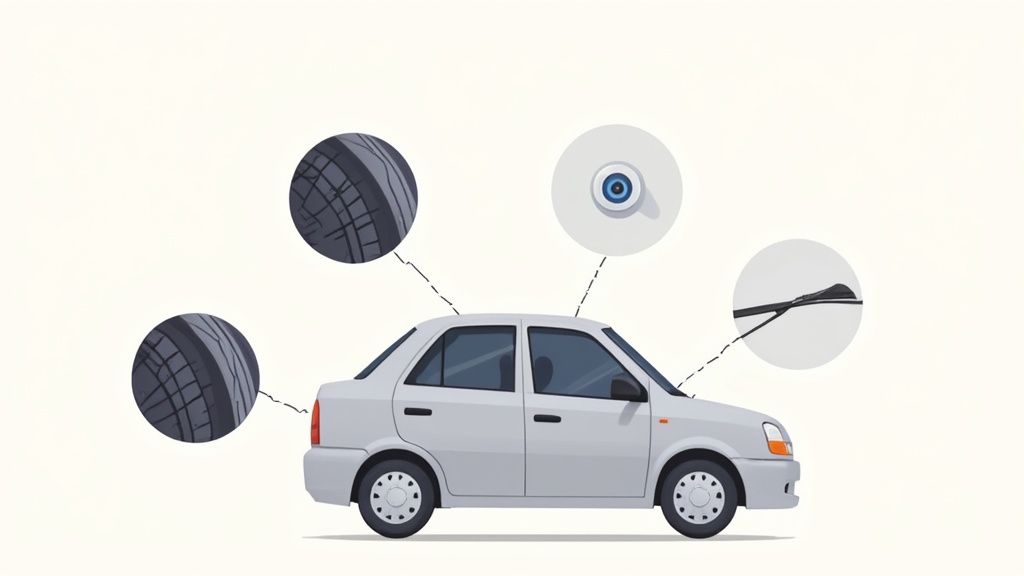
Ignoring basic upkeep is like trying to run a marathon in flip-flops—you’re just asking for trouble. From the rubber on your tires to the blades on your windshield, every part of your vehicle plays a role in keeping you safe.
The Foundation: Your Tires
Think about it: the only thing connecting your two-ton vehicle to the pavement is four small patches of rubber. Everything you do—steering, braking, accelerating—relies entirely on their grip. If your tires are in bad shape, your ability to avoid a crash plummets.
You really only need to focus on two things here:
- Proper Inflation: Underinflated tires can overheat and blow out on the highway. Overinflated tires have a smaller contact patch with the road, which kills your traction. Check your pressure once a month with a good gauge. The right PSI isn’t on the tire itself; it’s on a sticker inside your driver’s side door jamb.
- Tread Depth: The grooves in your tires are designed to push water out from underneath them, keeping you from hydroplaning. Once they wear down, that ability is gone. An easy way to check is with the penny test. Stick a penny in the tread with Lincoln’s head upside down. If you can see all of his head, your tires are dangerously worn and need to be replaced immediately.
These simple checks are non-negotiable, especially with Florida’s notorious afternoon downpours. Bad tires are a huge factor in loss-of-control accidents.
A Quick Monthly Safety Checklist
You don’t need a lift or a set of fancy tools for this. Just a few minutes once a month can help you catch a small problem before it becomes a big one on I-95.
Get in the habit of running through this list:
- Wiper Blades: When that Florida rain hits, your vision is everything. Old, cracked wipers just smear water across the glass, blinding you at the worst possible moment. If you see streaks or hear chattering, it’s time for a new set.
- Fluids: Pop the hood and check your engine oil, coolant, and windshield washer fluid. Low oil can seize your engine, and an empty washer reservoir is a major problem when a truck splashes mud all over your windshield.
- Lights and Signals: This is easiest with a friend. Quickly test your headlights (high and low beams), brake lights, and turn signals. A single burnt-out bulb makes you far less visible and can be the direct cause of a rear-end collision.
A predictable car is a safe car. When you know your brakes will grab firmly and your tires will hold the road, you can react with confidence in an emergency. Routine maintenance eliminates the dangerous element of surprise.
Understanding Your Car’s Smart Safety Features
Most newer cars come loaded with technology designed to be a digital co-pilot. These Advanced Driver Assistance Systems (ADAS) use a network of sensors to watch the road around you and can even step in to prevent a crash.
Some of the most common ADAS features are:
- Automatic Emergency Braking (AEB): Can detect a potential collision and hit the brakes for you if you don’t react fast enough.
- Blind Spot Monitoring: Uses a light or a chime to warn you if a car is hiding in your blind spot—a lifesaver on multi-lane highways.
- Lane Departure Warning (LDW): Alerts you if you start drifting out of your lane without using your turn signal.
And this stuff really works. Studies show that cars with these features have 27% fewer rear-end crashes and 11% fewer incidents of drifting out of their lane. As technology helps compensate for human error, these systems become essential tools.
Just remember to keep the sensors—usually found in the bumpers, grille, and behind the windshield—clean and clear of dirt or ice. You can learn more about these powerful accident prevention statistics and see just how much of a difference they make.
How a BDI Course Reinforces Your Defensive Driving Skills
Let’s be honest—even the best drivers can pick up bad habits over time without even realizing it. A small tailgating habit here, a moment of distraction there. That’s why a formal refresher course isn’t just for new drivers or someone who’s gotten a ticket. It’s one of the smartest things you can do to stay sharp and master the art of avoiding accidents.
Think of a Basic Driver Improvement (BDI) course as a dedicated tune-up for your driving brain. It’s designed to bring the core principles of defensive driving back to the forefront, turning theory you might have forgotten into practical, real-world instincts.
From Rules to Reflexes
A great BDI course goes way beyond just reciting traffic laws. It digs into the why behind the rules, using realistic scenarios and interactive lessons that make safe driving practices actually stick.
You’re not just told to keep a safe following distance; you’ll see simulations that show exactly how fast that cushion vanishes when the car ahead slams on its brakes. The whole point is to sharpen your hazard perception so you can spot trouble before it starts—that pedestrian about to step off the curb, the car drifting in its lane—and react calmly, not frantically.
A BDI course isn’t a punishment. It’s an empowerment tool. It provides a structured way to fine-tune your defensive instincts, turning good advice into second-nature habits that keep you out of harm’s way.
These courses are also incredibly valuable because they tackle the modern problems we all face on the road. You’ll get specific, actionable strategies for dealing with smartphone notifications and other distractions, hammering home just how critical your undivided attention really is.
The Financial and Legal Perks of Taking a BDI Course
Beyond just making you a better driver, a BDI course has some serious practical benefits, especially if you’ve recently been handed a traffic ticket. In Florida, if you get a non-criminal moving violation, you have the option to complete an approved BDI course.
When you do, you get a huge win: no points are added to your driving record for that ticket.
This has a powerful ripple effect on your wallet and your license:
- Keeps Your Insurance Rates Down: Since the points never go on your license, your insurance company won’t see the violation. This helps you dodge a painful premium increase.
- Protects Your Driving Privileges: A clean record is your best defense against a potential license suspension if you happen to get another ticket down the road.
- Satisfies Court Orders: Sometimes, a judge will require a driver to complete a BDI course as part of their ruling on a traffic citation.
Taking the course is an investment in your safety, your finances, and your ability to legally stay on the road.
A Commitment to Staying Sharp Behind the Wheel
At the end of the day, driving is a skill that requires lifelong learning. The roads are always changing, with new vehicle technologies, different traffic patterns, and updated laws. A driver’s education is never really finished.
A BDI course is the perfect way to stay current and refresh your commitment to safety.
Whether you need to get a ticket dismissed or you simply want to become a more confident, aware driver, the lessons are invaluable. Our Florida BDI course online is built to be convenient and genuinely effective, letting you reinforce these crucial skills whenever it fits your schedule. It’s a powerful tool for anyone serious about mastering how to avoid car accidents.
Common Questions About Avoiding Accidents
Even the most careful drivers run into tricky situations on the road. Knowing the right move to make in a split second can be the difference between a close call and a collision. Let’s break down some of the most common questions I hear from drivers about handling these tough spots.
Think of this as your go-to guide for those “what if” moments that can pop up unexpectedly. Having these answers in your back pocket will sharpen your defensive driving instincts and prepare you for almost anything Florida roads can throw at you.
What Is the Safest Lane to Drive in on the Highway?
This is a great question, and the answer surprises a lot of people. It’s easy to think the far-right lane is the safest because it’s the “slow lane,” but that’s where you’re constantly dealing with traffic merging on and off the highway—a recipe for conflict. The far-left “fast lane,” on the other hand, often encourages speeding and can leave you with no room to escape a problem.
Most of the time, the center lane on a three-lane highway is your sweet spot.
- It gives you options. If something happens up ahead, you have an escape route to the left or the right.
- It acts as a buffer. You’re insulated from the high-speed traffic on your left and the unpredictable cars entering and exiting on your right.
Of course, this isn’t a hard-and-fast rule. The safest lane is always the one that gives you the best visibility and the most space around your car. Let your real-time awareness be your ultimate guide.
Should I Honk My Horn to Avoid an Accident?
Your horn is a fantastic safety tool, but only if you use it correctly. A long, angry blast is more likely to escalate road rage than prevent an accident. But a quick, polite tap of the horn? That’s an incredibly effective way to get another driver’s attention before they make a critical mistake.
Try a quick “beep-beep” in these scenarios:
- A car begins to drift into your lane.
- A driver is backing out of a parking spot and clearly hasn’t seen you.
- You’re about to pass a bicyclist, just to give them a friendly heads-up you’re there.
The goal is to alert, not to annoy. Think of your horn as a tool for communication, not frustration. It’s a simple “Hey, I’m right here!” that can snap a distracted driver back to reality and give them a chance to correct their course.
A short, polite honk can be one of the best ways to prevent a crash caused by simple inattention.
What Should I Do if I Witness an Accident?
Seeing a crash happen right in front of you can be shocking. The most important thing is to keep yourself safe. Don’t slam on your brakes in a live lane of traffic or do anything else that puts you in immediate danger.
If you can safely pull over, get your vehicle well off the road and switch on your hazard lights. Then, you can help.
- Call 911 immediately. Give the dispatcher a clear location, how many cars are involved, and if you see anyone who appears to be injured.
- Offer help, but be smart about it. Unless there’s an immediate threat like a fire, it’s almost always best not to move an injured person. You could make their injuries worse.
- Be a good witness. When law enforcement arrives, give them a calm, factual account of what you saw. Stick to the facts—what you saw and heard—and don’t guess about who was at fault.
Your statement as a neutral observer can be incredibly valuable. And while we always aim to avoid accidents, it’s wise to know what to do after a car accident in Ontario because the core steps for safety and reporting are similar in many places.
How Can I Tell if Another Driver Is Impaired?
Spotting a drunk or otherwise impaired driver is a massive defensive driving win. Their actions are often erratic and just don’t fit with the normal rhythm of traffic.
Stay far away from any driver who is:
- Weaving or drifting all over the road, sometimes jerking the car back into the lane.
- Driving way too slow or way too fast for conditions.
- Braking for no reason or stopping in the middle of the road.
- Taking turns way too wide or nearly sideswiping curbs and mailboxes.
If you see someone driving like this, don’t try to pass them or get their attention. The safest thing you can do is hang back, increase your following distance, and pull over when it’s safe to call 911. Tell them the car’s make, model, color, license plate, and the road they’re on. That phone call could save someone’s life.
Turning these skills into habits is exactly what we focus on. At BDISchool, our Florida-approved online courses are built to make you a more aware, more confident driver—all while helping you keep points off your license. Find out more at https://bdischool.com and take control of your driving record today.