More goes into checking your blind spot than a quick peek in the mirror. It's a deliberate, physical head turn to see the area your mirrors simply can't cover. The tried-and-true method for how to check blind spot while driving is a simple sequence: signal first, check your mirrors, then—and this is the crucial part—glance over your shoulder before you make a move.
That physical head turn is the only way to be 100% sure the lane next to you is truly clear.
Why Blind Spots Are a Bigger Risk Than You Think
Let’s be real for a moment: relying solely on your mirrors is a gamble, especially on busy Florida roads. It's a dangerous habit many drivers—even those with years of experience—fall into. They forget that every single vehicle has large areas completely hidden from view.
These are the infamous "No-Zones," spots where a motorcycle, a smaller car, or a cyclist can disappear in the blink of an eye.
Learning to manage your vehicle's blind spots isn't just a suggestion; it's a core defensive driving skill. This isn't about passing your driving test. It’s about preventing a devastating collision when you're merging onto I-95 or just trying to get across town in rush hour.
The Real-World Dangers of Neglecting Blind Spots
The fallout from a missed blind spot check can be catastrophic. In fact, failing to check properly before changing lanes is one of the top causes of serious accidents. A major study by the National Highway Traffic Safety Administration (NHTSA) found that lane-change and merge crashes contribute to up to 610,000 reported incidents every single year.
The most jarring finding? The study revealed that 36 percent of drivers didn't even bother to check their right-side mirrors or windows before moving over. You can dig into the data yourself in the 100-Car Naturalistic Driving Study.
This one simple mistake is a huge factor in so many collisions. It's why building a solid, automatic routine is so important. A closer look at what causes most car accidents shows that preventable human errors like this are almost always the root cause.
A blind spot isn't just an empty space; it's a potential hazard zone where another vehicle could be traveling at any moment. Treating it as such is the first step toward becoming a safer, more aware driver.
The Three Pillars of Blind Spot Safety
To really get this right, you need to go beyond the basics and build a system. This guide is built on three core pillars that, when combined, give you a nearly 360-degree view of your surroundings.
- Optimizing Your Mirrors: We’ll show you exactly how to position your mirrors to minimize glare and shrink your blind spots as much as possible.
- Mastering the Shoulder Check: This is the non-negotiable physical action that confirms what your mirrors can't show you. Think of it as your final safety check.
- Integrating Modern Technology: We’ll cover how to properly use systems like Blind Spot Monitoring (BSM) as a valuable assistant, not as a replacement for your own awareness.
Focusing on these three areas will help you build the kind of deep-seated safety instincts that keep you and everyone else safe on the road.
Optimizing Your Mirrors for Near-Total Visibility
Before we even get to shoulder checks, let's talk about the biggest mistake I see drivers make every single day. Most of us were taught to set our side mirrors so we could see a little slice of our own car. It feels reassuring, right? But that's actually creating a massive, dangerous blind spot on both sides of your vehicle.
The real goal isn't to admire your own paint job; it's to see what's next to your car. Think of your three mirrors—rearview and both side mirrors—as one continuous, panoramic screen. A car leaving your rearview mirror should instantly appear in the side mirror. This is the core idea behind a technique called the BGE (Blindspot and Glare Elimination) setting. Get this right, and you'll practically eliminate those scary "no-zones" where a car can vanish.
Adopting the BGE Mirror Setting Method
This will take you all of 60 seconds, and I promise it's one of the most impactful safety adjustments you can make to your driving habits. First things first, though: your posture matters. If you're slouched or sitting too far back, your mirror settings will be off. Take a moment to get settled in a comfortable, alert driving position. You can find some great tips on how to make car seats more comfortable and supportive for the road.
Ready? Here's how to set your mirrors the BGE way:
- Driver's Side Mirror: Lean your head over until it just about touches the driver's side window. Now, adjust that left mirror outward until you can barely see the edge of your car's rear quarter-panel. When you sit back up straight, you shouldn't see your own car at all.
- Passenger's Side Mirror: Now for the other side. Lean your head to the right until it's hovering over the center console. From that spot, adjust the right mirror outward until you can just glimpse the passenger side of your car.
What you've just done is extend your peripheral vision, pushing your mirrors' view out into the lanes beside you instead of having them overlap with what your rearview mirror already shows.
The diagram below breaks down the ideal safety flow: it all starts with properly set mirrors, followed by a physical check, and finally, using your car's tech as a backup.
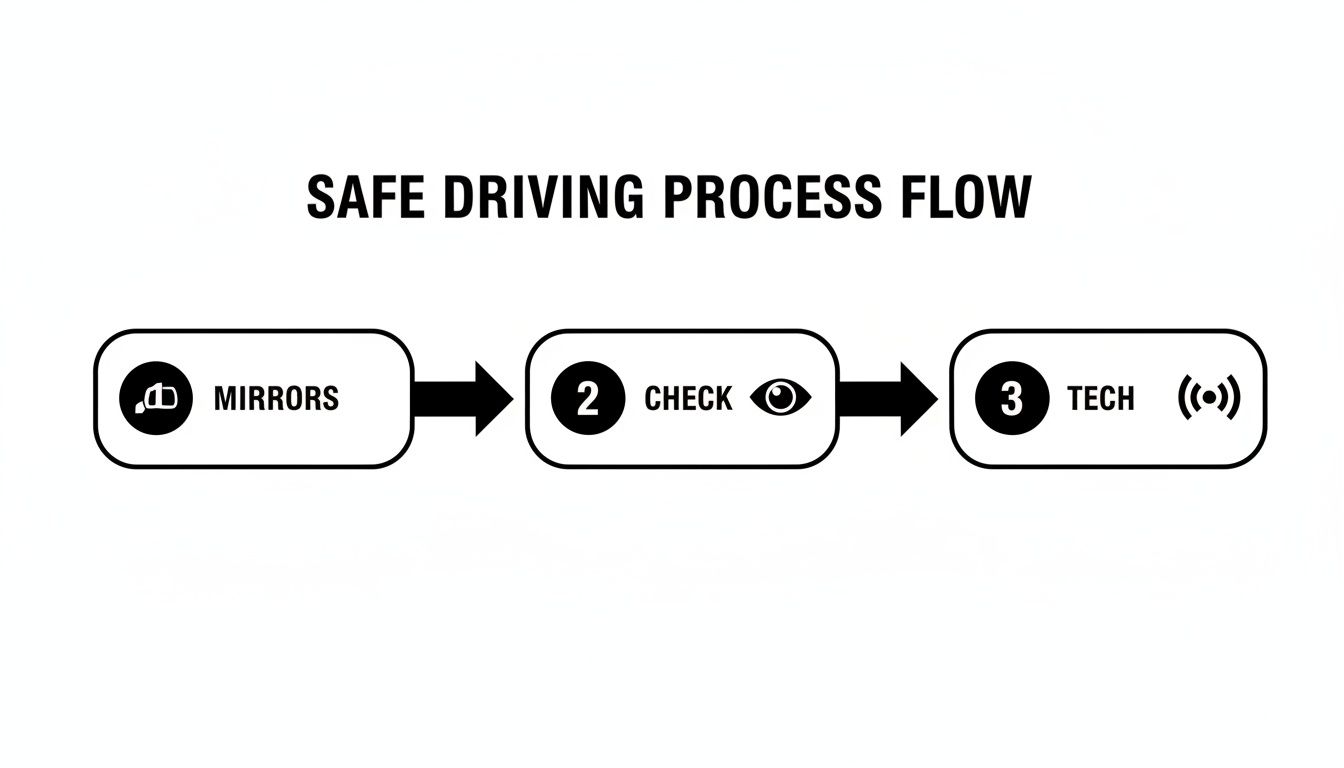
This process shows that getting your mirrors right is the foundational first step. Everything else builds on it.
Traditional vs BGE Mirror Settings
Still not convinced? Let's break down the difference. The traditional method most of us learned feels intuitive, but the BGE setting is objectively safer because it provides more information about the traffic around you.
| Feature | Traditional Mirror Setting | BGE Mirror Setting |
|---|---|---|
| View of Own Car | Significant portion of the mirror is wasted showing the side of your car. | The side of your car is not visible, maximizing the view of the adjacent lane. |
| Field of View | Narrow. Creates a large blind spot between the side and rearview mirrors. | Wide and panoramic. Creates a near-seamless transition from rearview to side mirrors. |
| Glare from Headlights | Headlights from cars behind are often reflected directly at the driver. | Headlights are angled away, significantly reducing nighttime glare. |
| Safety | High risk of missing vehicles hiding in the large blind spot. | Drastically reduces blind spot size, making lane changes much safer. |
Once you get used to the BGE setting, you'll wonder how you ever drove without it. It turns your mirrors from simple reflectors into a powerful situational awareness tool.
Confirming Your New Mirror Setup
So, how do you know you nailed it? Take a drive on a quiet, multi-lane road or find an empty parking lot to do a quick test.
As a car passes you from behind, watch it in your rearview mirror. The moment it starts to disappear from the rearview, it should immediately pop into view in your side mirror. There should be no gap—no moment where the car is completely invisible. If it vanishes for a second, your side mirrors need to be angled just a tiny bit further out.
Mastering this setup is a core part of learning how to change lanes properly and is a game-changer for highway driving.
By eliminating the view of your own car, you transform your side mirrors from redundant tools into essential instruments for spotting hidden vehicles. This single change drastically reduces the size of your blind spot.
Of course, even perfectly adjusted mirrors can't see everything. There will always be a small area that requires a physical head turn. That’s why the BGE method makes your mirror checks more powerful, but it never, ever replaces the life-saving shoulder check.
Mastering the Life-Saving Shoulder Check
Even after you've set your mirrors perfectly, a small but dangerous blind spot will always exist. It's that sneaky little zone technology can miss and mirrors just can't cover. This is where the old-school shoulder check comes in—it’s an indispensable, physical head turn that acts as your final, critical line of defense.
This isn't some dramatic, body-twisting maneuver. A proper shoulder check is a quick, crisp action. You're just making a 90-degree glance over your shoulder into the lane next to you for a split second. The whole point is to get a quick snapshot of the area beside your car's rear quarter-panel before snapping your eyes back to the road ahead.
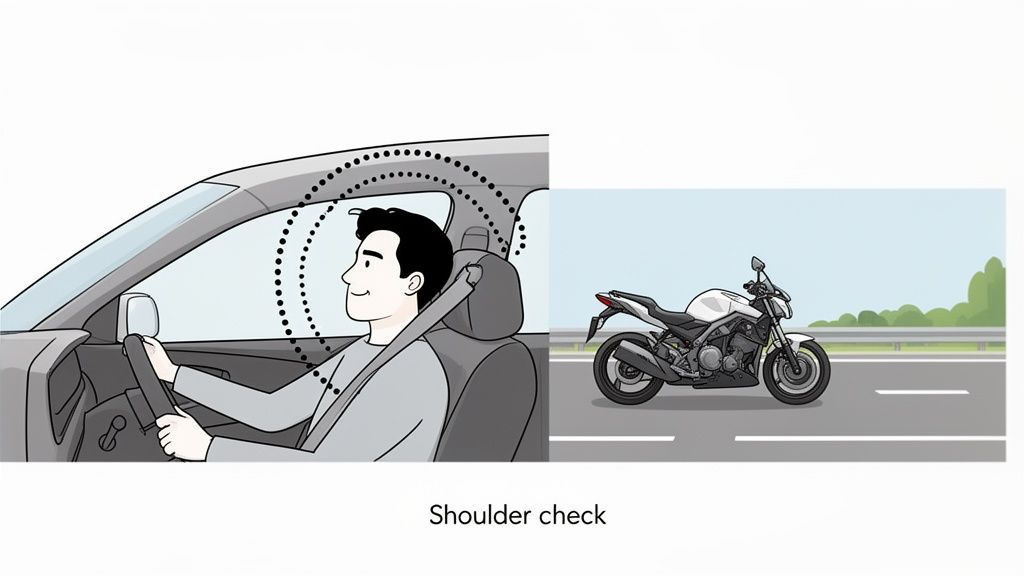
Honestly, this move has to become second nature. It's a non-negotiable habit for any time you plan to move your car sideways.
When a Shoulder Check Is an Absolute Must
There are certain moments behind the wheel where skipping this step is just asking for trouble. Ingraining this check into your routine for these situations is the key to avoiding a collision.
- Changing Lanes: This is the big one. Before you even think about drifting over that line, your sequence should be locked in: signal, check your mirrors, and then perform that final shoulder check.
- Merging Into Traffic: Whether you're getting onto a busy highway or dealing with a yield sign, you have to physically look to confirm there's a safe gap for you to slide into.
- Pulling Out from the Curb: Before you move back into traffic from a parking spot, a quick look over your left shoulder is essential to spot any approaching cars, cyclists, or even pedestrians.
- Making a Turn: This is especially true on roads with multiple lanes or when you're making a wide turn. A quick glance can save you from cutting someone off or, worse, hitting a cyclist riding in the bike lane.
Making this physical check is more vital today than ever before. It's a bit ironic, but as cars get safer with thicker support pillars, their blind spots are actually getting bigger. Some studies have found that visibility in many popular vehicles has gotten significantly worse over the years. According to one analysis, this is a global issue—of the 1.2 million traffic deaths that happen each year, half involve vulnerable road users hit in blind spots. You can learn more from this study that shows America's blind spots are expanding.
Think of the shoulder check as your ultimate confirmation. Your mirrors give you valuable information, but your eyes provide the final, undeniable proof that the lane is clear.
A Smart Habit for When You're Parked, Too
The shoulder check isn't just for when you're driving. A fantastic safety habit to get into is what's known as the "Dutch Reach" when you're getting out of your car.
Instead of opening the door with the hand closest to it, reach across your body with your far hand to grab the handle.
This simple switch forces your body to turn, which naturally makes you look over your shoulder. You'll automatically scan for approaching cyclists or cars before swinging your door open into their path. It’s a tiny change in your routine that can prevent a serious accident and helps build that life-saving muscle memory of looking before you act.
Using Driver-Assist Technology the Smart Way
Many new cars come loaded with driver-assist features, and Blind Spot Monitoring (BSM) is one of the most common. It's a fantastic piece of tech that uses sensors to detect a vehicle lurking where you can't see it, usually flashing a small light in your side mirror.
While these systems are an incredible safety net, it's easy to start relying on them too much. Think of your BSM as a helpful co-pilot, not the pilot. It’s there to back you up, not to replace your own eyes and good judgment.
Understanding Technology's Limits
As smart as they are, Blind Spot Monitoring systems aren't perfect. They’re designed primarily to see cars and trucks, which means they can sometimes struggle with smaller, quicker-moving things on the road.
Here are a few scenarios where you absolutely need to be extra vigilant:
- Motorcycles and Cyclists: Their narrow profile can be tough for sensors to track consistently, especially if they’re zipping into your blind spot quickly.
- High Speeds: Some systems can be less reliable when you're flying down the highway or navigating chaotic, stop-and-go traffic.
- Bad Weather: Heavy rain, snow, or even thick fog can mess with the sensors, causing them to either miss a car or give you a false alarm.
The truth is, blind spot accidents are a serious problem. Technology is helping, though. Research shows that blind spot warning systems can slash lane-change injury crashes by a whopping 23 percent. They're also critical for preventing backover accidents, a huge risk with larger vehicles. The blind zones behind some pickups and SUVs can hide a small car or pedestrian for up to 35 feet. For a deeper dive into this, you can read the full research on vehicle backover avoidance technology.
Treat your BSM light as a "second opinion." It's there to confirm what you should already be checking, but it should never be the first or only thing you look at before making a move.
Your Safe Lane-Change Sequence
So, how do you put it all together? You need a solid, repeatable routine that blends your own checks with what the car's tech is telling you. This way, you get the full picture every single time.
- Signal First: Always hit your turn signal before you do anything else. It's the universal language of the road, giving everyone around you a heads-up about your next move.
- Check Your Mirrors: Start with a quick glance at your rearview mirror, then the side mirror for the direction you're heading. This is your first check to see if the coast is clear.
- Glance at the BSM Light: Right after checking the mirror, your eyes will naturally fall on the BSM indicator. If it's not lit up, that's another good sign.
- Do the Final Shoulder Check: This is the one step you can never, ever skip. A quick, sharp turn of your head to look over your shoulder is the only way to be 100% sure the space is empty.
- Move Smoothly: If all clear, guide your car gently into the next lane. No sudden jerks.
With a little practice, this sequence becomes pure muscle memory. You'll do it without even thinking, ensuring you never miss a beat. As you build these habits, you might also want to check out some helpful apps for safe driving that can reinforce your skills behind the wheel. When used correctly, technology is a driver's best friend.
Common Blind Spot Mistakes and How to Fix Them
Even experienced drivers fall into bad habits. When it comes to checking your blind spots, some of these seemingly small slip-ups can have massive consequences. Let's break down the most common mistakes I see on the road and talk about how to get them corrected for good.
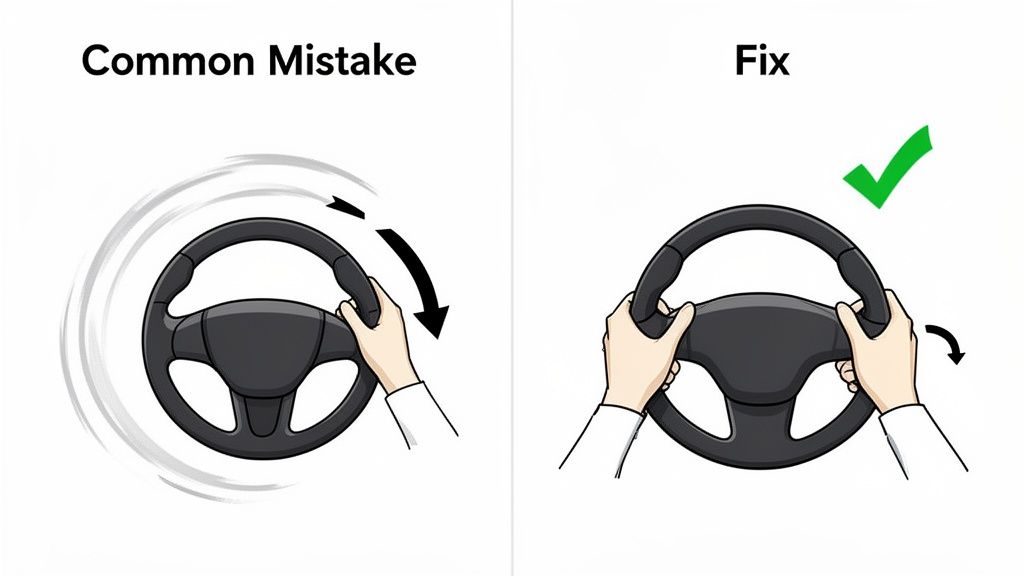
One of the biggest culprits? Turning the steering wheel while doing a shoulder check. It’s an almost unconscious reflex for many people—your hands instinctively want to follow your head. But even a slight turn can cause your car to drift into the next lane or onto the shoulder, which is the last thing you want.
The fix here is all about building new muscle memory. Consciously practice keeping a steady, relaxed grip on the wheel. Think of the head turn as a quick, separate action from what your hands are doing. You’re just taking a swift glance, not a long, lingering look that could pull your car off its path.
Poor Timing and Rushed Checks
Another frequent problem is simply bad timing. If you check your blind spot too early, another vehicle can easily slip into that space before you actually start to move. Check too late, and you won't have any time to react if the lane isn't clear. That final shoulder check needs to happen immediately before you initiate the lane change.
The perfect blind spot check is part of a deliberate sequence: Signal, Mirrors, Shoulder Check, Move. Rushing or reordering these steps breaks the chain of safety and can easily lead to an improper lane change.
Drill that sequence into your head until it's second nature. Don't even think about turning the steering wheel until your head is facing forward again after that final check. Failing to follow this order is exactly what leads to an improper lane change, which is a ticket you definitely want to avoid.
Navigating Challenging Conditions
It’s one thing to check your blind spots on a sunny day, but things get trickier when the conditions aren't perfect. These situations demand extra caution and a few adjustments to your technique.
At Night: Vehicle headlights are easy to spot, but a motorcycle's single headlight can look like a car that's much farther away than it actually is. Always take an extra moment to properly judge the distance and speed of any light you see.
In Heavy Rain: Bad weather slashes your visibility. You need to slow down, creating more time to check your surroundings and for other drivers to see you. The spray kicked up by other vehicles can completely hide a car in your mirror, making that physical shoulder check absolutely essential.
When Towing a Trailer: This is a whole different ballgame. A trailer creates massive new blind spots you're not used to. You'll need to rely heavily on properly adjusted towing mirrors. If you have a passenger, don't be afraid to ask for an extra set of eyes. Remember to signal much earlier and give yourself plenty of room for wider turns.
By recognizing these common errors in your own driving and actively working to fix them, you’ll become a much safer, more confident driver who can handle just about any situation the road throws at you.
Your Blind Spot Questions, Answered
Even when you know the rules, real-world driving throws curveballs. It's natural to have questions as you work on making these safety checks a true habit. Let's dig into some of the most common questions I hear from drivers about handling blind spots.
Think of this as a quick-reference guide to clear up any lingering confusion and help you feel more confident behind the wheel.
How Often Should I Really Check My Blind Spots?
Forget about a stopwatch or a set time interval. The rule is simple: every single time you intend to move your vehicle sideways, you need to do a shoulder check. No exceptions.
This isn't just about switching lanes on I-95. This critical safety check is mandatory when you're:
- Merging onto a busy road from an on-ramp.
- Pulling out from the curb after being parallel parked.
- Making a turn, especially where cyclists or pedestrians might be sharing the road.
Here's the bottom line: if your car is about to move into a different lane or path of travel, your head needs to turn. It's that important.
What's the Best Way to Check Blind Spots in a Big Truck or SUV?
When you’re behind the wheel of a larger vehicle, you're dealing with much larger blind spots. That massive area directly behind your truck or SUV is a huge risk, especially for backover accidents. You’ll need to adjust your approach.
First, getting your mirrors set up perfectly is non-negotiable. Many experienced truck and SUV drivers add small, convex blind spot mirrors to their side mirrors. They give you a much wider, fish-eye view that can catch a vehicle hiding just out of sight.
A quick tip from experience: Even with wide-angle mirrors, you can't skip the head turn. In a bigger vehicle, I often find I have to lean forward a bit as I turn my head to get a clear line of sight past the bulky door pillars.
And when you're in reverse, that backup camera is your best friend. The blind zone behind a big pickup truck can stretch for 35 feet—plenty of room to completely hide a small car, or worse, a child.
Can I Trust My Blind Spot Monitor to See a Motorcycle?
While today's Blind Spot Monitoring (BSM) systems are incredibly advanced, they are not infallible, especially with motorcycles. A bike's narrow profile and quick acceleration can sometimes fool the sensors.
Never, ever make a lane change relying only on your car's BSM light. Think of it as a helpful co-pilot, a great "second set of eyes," but not the final word. Your own eyes and a quick shoulder check are still the only surefire way to know you're clear, particularly when smaller vehicles are nearby.
Can I Actually Fail My Driving Test for Not Checking My Blind Spot?
Yes, 100%. Missing a shoulder check is one of the quickest ways to get an automatic fail on your driving test, here in Florida and pretty much everywhere else. Driving examiners consider it a major safety violation.
They're trained to watch for this specific action. Forgetting to check your blind spot before a merge, lane change, or even just pulling away from the curb sends a clear signal to the examiner that you haven't mastered the fundamental skills of defensive driving.
At BDISchool, we know that skills like mastering your blind spots are the building blocks for a lifetime of safe driving. Our state-approved courses are designed to turn these essential techniques into second nature, helping you stay safe and protect your driving record. Enroll in a course today at https://bdischool.com.