Getting that suspension notice in the mail is a gut-punch, no doubt about it. But figuring out how to reinstate a suspended license starts with one critical piece of information: the exact reason for the suspension. This single detail is the key that unlocks everything else—what documents you need, what fees you’ll pay, and which hoops you’ll have to jump through to get back on the road.
What to Do After Your License Is Suspended
When you’re holding that official letter from the Florida Highway Safety and Motor Vehicles (FLHSMV), the first instinct might be to panic. Don’t. Your first move is to play detective.
Getting your license back is a specific, step-by-step process. If you jump ahead without understanding why it was suspended in the first place, you’re just setting yourself up for wasted time, extra fees, and a whole lot of frustration. Think of it like this: a doctor has to diagnose the illness before prescribing the right medicine.
A suspension for unpaid tickets is a completely different ballgame than one for a DUI conviction or for letting your car insurance lapse. Each path to reinstatement is unique.
Suspension vs. Revocation vs. Cancellation
The FLHSMV uses very specific terms, and they aren’t interchangeable. Knowing the difference is crucial because it tells you how serious the situation is and what the road back looks like.
- Suspension: This is the most common and means your driving privileges are paused temporarily. Usually, you can get them back after a set period or once you’ve met certain requirements.
- Revocation: This is much more serious. Your driving privileges are terminated indefinitely. Getting your license back after a revocation is a long haul, requiring a full reapplication process after a mandatory waiting period.
- Cancellation: This is when your license is declared void, often because of an error on your original application (like a bounced check for the fee) or if you’re deemed medically unfit to drive.
Figuring out which of these applies to you is the first real step in building your game plan.
Common Reasons Your License Was Suspended
While a suspension feels personal and often like you’ve committed a major driving sin, the reality is frequently much more mundane. A surprising number of suspensions stem from administrative slip-ups, not dangerous driving.
In fact, a New Jersey study found that a jaw-dropping 91% of license suspensions were for non-driving issues, like failing to pay fines or fees. It’s often the paperwork, not the driving, that trips people up.
Here in Florida, the reasons vary, but we see the same few pop up over and over again.
Common Reasons for License Suspension in Florida
This table breaks down some of the most frequent causes of a license suspension. It’s a good way to quickly identify what might have happened in your case and what your first move should be.
| Suspension Reason | Common Cause | Typical First Step |
|---|---|---|
| Excessive Points | Getting too many traffic tickets in a specific timeframe. | Complete a state-approved BDI/Traffic School course. |
| Failure to Pay Fine | Not paying a traffic ticket or court-ordered fine by the deadline. | Contact the Clerk of Court in the county of the violation to pay the fine. |
| DUI Conviction | Being convicted of Driving Under the Influence. | Enroll in a DUI program and potentially apply for a hardship license. |
| Insurance Lapse | Not maintaining required PIP/PDL car insurance coverage. | Provide proof of new, valid insurance (SR-22 is often required). |
| Child Support | Failing to pay court-ordered child support. | Contact the Department of Revenue to resolve the outstanding payments. |
These are just the starting points, of course. Each situation has its own set of requirements. For a deep dive into the complex process following a DUI, this guide on License Suspension After DUI Explained is an excellent resource.
Your Most Important Tool: Before you do anything else, get a copy of your official driving record from the FLHSMV. It lists the specific codes and details that explain exactly why you were suspended and what the state requires to clear it.
Don’t just show up at the DMV hoping for the best. Your first move is to check your license status online. It gives you a quick snapshot of the problem. For a more detailed walkthrough, our guide shows you how to do this and what it all means: https://bdischool.com/check-to-see-if-license-suspended/
Getting this information first turns a confusing mess into a clear, actionable checklist.
Getting Your Ducks in a Row: What You Actually Need
Before you can get back on the road, you first need to figure out exactly why you were taken off it. Think of the Florida Highway Safety and Motor Vehicles (FLHSMV) as the doctor; you need a precise diagnosis before you can get the right treatment. Taking the time to do this now will save you from making multiple frustrating trips to the DMV later on. The goal here is to get a clear, personalized action plan.
Your first stop should be the FLHSMV’s online portal to check your license status. This isn’t just a simple “valid” or “suspended” check—it’s your direct window into their official records. It will show you any specific flags, holds, or compliance issues that are attached to your driving record, giving you the official starting point for your reinstatement journey. No more guesswork or relying on secondhand information.
Your Personalized Document Checklist
Once you know the why, you can start building a checklist of what you need to bring. While some documents are standard for just about everyone, your specific situation will dictate the final list. Trust me, showing up with incomplete paperwork is the number one reason people get turned away from the service center counter.
Let’s start with the basics that nearly everyone needs. Gather these first.
Core Documents for Almost Everyone:
- Proof of Identity: Your original or a certified copy of your U.S. birth certificate, a valid U.S. passport, or a Certificate of Naturalization.
- Proof of Social Security Number: The original Social Security card itself or a W-2 form will work.
- Two Proofs of Florida Residence: Think utility bills, bank statements, or a lease agreement—anything official with your name and current address on it.
Pro Tip: Make copies of everything. The FLHSMV needs to see the originals, but having a full set of copies for your own records can be a real lifesaver if something gets misplaced.
With these basics covered, you’ll add the documents specific to your suspension. This is where knowing your driving record inside and out is crucial. If you’re not sure how to get that info, our guide on how to see my driving record breaks it down step-by-step. The details in that report will tell you exactly what else the state is waiting on from you.
Paperwork Specific to Your Suspension
This is where the path splits. A driver who racked up too many points has a completely different set of requirements than someone dealing with a DUI.
For instance, if your license was suspended for getting too many points from traffic tickets, a non-negotiable item on your list is the certificate of completion from an Advanced Driver Improvement (ADI) course. This is a mandatory 12-hour class.
On the other hand, if the problem was a lapse in car insurance, you’re going to need an SR-22 form. This isn’t insurance itself, but rather a certificate from your insurance company proving you have the required liability coverage. Your insurer usually files it with the state for you, but you should always have your own copy handy.
Here’s a quick look at what your specialized checklist might include.
| Suspension Reason | Key Document Required | What You Need to Do |
|---|---|---|
| DUI Conviction | DUI School Completion Certificate | You have to enroll in and finish a state-approved DUI program. |
| Excessive Points | ADI Course Completion Certificate | You must pass a 12-hour Advanced Driver Improvement course. |
| Insurance Lapse | FR-44 or SR-22 Form | Call your insurance agent to get this proof of coverage filed. |
| Unpaid Fines | Letter of Clearance from the Court | Pay the outstanding fine, then get official proof from the Clerk of Court. |
Gathering these specific items is absolutely critical. Without that course certificate or the clearance letter from the court, the FLHSMV simply can’t process your reinstatement. By meticulously confirming every single requirement before you even think about heading to a service center, you turn a chaotic ordeal into a straightforward to-do list and seriously boost your chances of getting it all done in one visit.
Completing Your Reinstatement Requirements
Alright, you’ve got your personalized checklist from the FLHSMV. Now comes the part where the rubber meets the road—literally. This is where you actually do the work to get your license back.
Every suspension is different, and the steps you take are tied directly to the reason you lost your driving privileges in the first place. Think of it as a specific roadmap for your situation. Following it exactly is the only way to get back behind the wheel without hitting more bumps.
Let’s break down the game plan for the most common suspension scenarios we see in Florida.
For Point-Based Suspensions
Did you rack up too many points from traffic tickets? If so, your path to reinstatement goes through a classroom—or, more likely, an online course.
Florida requires you to complete a 12-hour Advanced Driver Improvement (ADI) course. This isn’t your average traffic school; it’s a deep dive designed for drivers who have made a habit of collecting violations.
You can’t just pick any driving class you find online. It must be approved by the Florida Highway Safety and Motor Vehicles (FLHSMV). Once you finish, you’ll get a completion certificate. Hold onto that thing—it’s the official proof the state needs to see before they’ll even think about clearing your suspension. For a state-approved option that checks all the boxes, you can find details on the Florida Driver Improvement Course online.
For DUI Suspensions
As you can imagine, a suspension for a DUI is a much steeper hill to climb. The requirements are more intense, reflecting just how seriously the state takes this offense. Simply waiting for your suspension period to end won’t cut it.
Here’s what you’ll almost certainly need to do:
- Enroll in DUI School: This is non-negotiable. You must sign up for and complete a state-approved DUI program. The specific course level depends on whether this is your first offense or a repeat one.
- Install an Ignition Interlock Device (IID): Depending on your conviction, you may have to get an IID installed in your car. It’s essentially a breathalyzer that you have to blow into before your car will start.
- Get SR-22 Insurance: This is a big one. An SR-22 isn’t actually insurance, but a certificate your insurer files with the state to prove you have the minimum required liability coverage. Expect to need this for several years after a DUI.
This flowchart can help you visualize how to start gathering your documents.
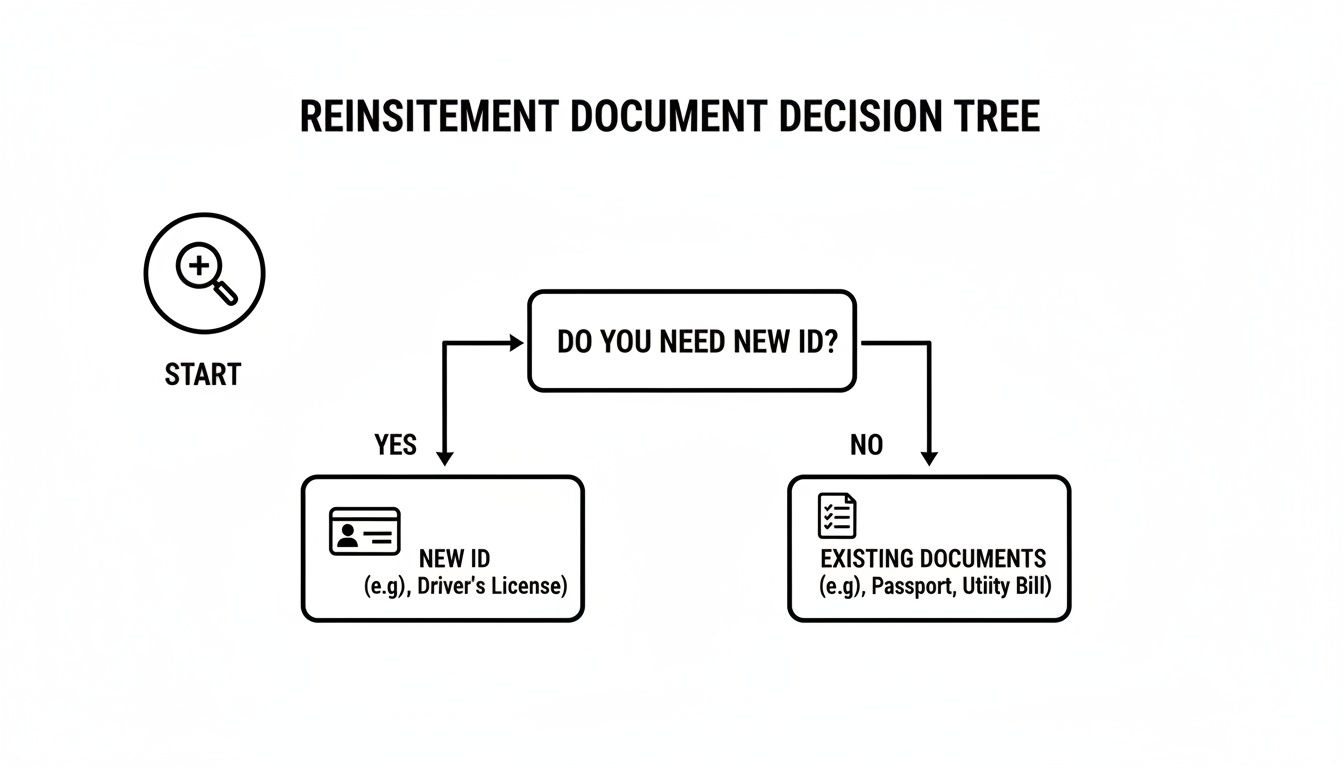
As you can see, one of the first things to figure out is whether your current ID is still valid and acceptable or if you’ll need to go through the process of applying for a new one.
For Financial Responsibility Issues
A huge number of suspensions have nothing to do with bad driving. They’re administrative, usually falling under what the state calls “financial responsibility.” This is often a fancy term for things like unpaid traffic tickets or letting your car insurance lapse.
If an unpaid ticket is holding you back, your first call should be to the Clerk of Court in the county where you got the ticket. You’ll have to pay the original fine plus any late fees that have piled up. Once you’re paid up, the court will either give you a physical clearance letter or, more commonly, update the state’s system electronically.
For an insurance lapse, you’ll need to show proof that you have active coverage again. This often involves getting that SR-22 form filed, just like with a DUI, to prove you’re back in compliance.
It’s wild how many suspensions are for non-driving issues. Some policy analysis shows that just eliminating suspensions for failure to pay could reduce total suspensions by as much as 57%. These administrative holds tend to hit lower-income drivers the hardest, which is why figuring out your specific suspension reason is so important.
Navigating Online vs. In-Person Visits
Once you’ve jumped through all the hoops—finished the course, paid the fine, got the insurance—it’s time to seal the deal with the FLHSMV. The good news? You might be able to skip the dreaded trip to the driver’s license office.
You Can Probably Reinstate Online If:
- Your issue was a simple insurance lapse or an unpaid ticket that’s now settled.
- You don’t need a new license photo or updated ID documents.
- The court or your course provider has already sent the electronic “all-clear” to the state.
You’ll Likely Need an In-Person Visit If:
- You were suspended for a DUI.
- You need to apply for a hardship license to get to work or school.
- You have to turn in original documents like a court order or birth certificate.
- It’s time for a new photo for your driver’s license.
If you do have to go in person, do yourself a favor and make an appointment. Most service centers are appointment-only now. Check the FLHSMV website to schedule your slot. Showing up on time with all your paperwork organized is the best way to make the experience as painless as possible.
Dealing with Reinstation Fees and SR-22 Insurance
Let’s be honest—the financial part of getting your license back is often the biggest headache. It’s not just the court fines or class fees. You also have to deal with the administrative costs from the Florida Highway Safety and Motor Vehicles (FLHSMV) before you can legally drive again.
Knowing these costs upfront, along with any special insurance requirements, is the key to creating a realistic budget and avoiding any nasty surprises at the DMV counter.
How Much Will Reinstatement Cost?
There’s no single answer here. The fee to reinstate your license is tied directly to why it was suspended in the first place. Think of it as a tiered system where more serious violations come with a steeper price tag.
For a common suspension, like failing to pay a traffic ticket or letting your insurance lapse, you’re typically looking at a $60 reinstatement fee. But for something more serious, like a DUI, that fee can easily jump to $135 or more, and that’s just for a first offense. These are purely administrative fees paid straight to the FLHSMV.
To give you a clearer picture of what to expect, here’s a breakdown of common fees.
Florida License Reinstatement Fee Estimates
A breakdown of common reinstatement fees based on the type of suspension to help you anticipate costs.
| Suspension Type | Estimated Reinstatement Fee | Additional Potential Costs |
|---|---|---|
| Failure to Pay Traffic Ticket | $60 | Court fines, late fees, collection agency costs |
| Insurance Lapse | $150 (1st offense) | SR-22 insurance, potential premium increases |
| Points Suspension | $75 | ADI course fees, potential SR-22 insurance |
| DUI (1st Offense) | $135 | Court fines, DUI school, ignition interlock device |
These fees can change, so it’s always a good idea to confirm the exact amount with the FLHSMV. This table is meant to give you a solid starting point for budgeting.
The SR-22 Requirement: What It Really Is
One of the most misunderstood parts of the process is the SR-22. A lot of drivers think it’s some special, expensive type of insurance policy. It’s not.
Simply put, an SR-22 is a form. It’s a Certificate of Financial Responsibility that your insurance company files directly with the state of Florida. It’s your insurer’s way of telling the FLHSMV, “We’ve got this person covered, and they meet the minimum liability insurance requirements.”
You won’t need an SR-22 for every type of suspension. It’s reserved for more serious violations, such as:
- A DUI conviction
- Getting caught driving without insurance
- Being the at-fault driver in an accident while uninsured
- Racking up too many points on your driving record
If you’re told you need an SR-22, you must keep it active without any interruptions for a set period—usually three years. If your insurance lapses for even one day, your provider is required to notify the state immediately, and your license will get suspended all over again.
My Advice: The fee to file an SR-22 is cheap, often just $25. The real financial hit comes from the much higher insurance premiums you’ll pay because of the violation that led to the SR-22 requirement in the first place.
How to Get an SR-22 Filed
The process is pretty simple. Just call your auto insurance agent and tell them you need an SR-22. If your provider offers them, they’ll handle filing the form with the FLHSMV for you.
But be prepared: not all insurance companies will file an SR-22, especially for drivers they now consider “high-risk.” If your current insurer turns you down, you’ll need to shop around for a new policy from a company that works with high-risk drivers.
The points from your violation will absolutely drive up your rates, so it’s important to understand how those points impact your insurance costs.
Tackling these financial responsibilities is a non-negotiable step. By budgeting for the fees and getting your SR-22 in order, you’ll clear the last major hurdle and be that much closer to getting back on the road.
Common Mistakes That Delay Your Reinstatement
Knowing the steps to get your license back is half the battle. The other half is avoiding the common pitfalls that can trip you up and send you right back to the beginning of the process. I’ve seen it happen time and time again—small, easy-to-miss details that end up causing massive delays.
One of the most frequent errors I see is showing up with incomplete or incorrect paperwork. Just imagine the frustration of waiting in a long line at the DMV, only to be turned away because the proof of address you brought isn’t on their approved list or you forgot your course completion certificate. Before you even think about leaving the house, pull up the FLHSMV website and double-check exactly what they require.
Procrastination is another huge one, especially when it comes to mandatory courses. If you’ve been ordered to complete an ADI or DUI program, don’t put it off. These classes have specific time commitments, and spots can fill up fast. Missing a court-ordered deadline for a class doesn’t just look bad; it can trigger a whole new set of problems and extend your suspension even longer.
Mismanaging Your SR-22 Insurance
If an SR-22 is part of your reinstatement plan, you need to treat it with extreme care. This isn’t a “set it and forget it” task; it requires your constant attention.
Letting your insurance policy lapse, even for a day, is a critical mistake. Your insurer is legally obligated to immediately notify the state that your coverage has been canceled. That notification automatically triggers a new suspension, and you’re back at square one, complete with another reinstatement fee.
Here’s how to stay on top of it:
- Set up automatic payments. This is the simplest way to make sure a premium is never missed.
- Talk to your agent. If you think you might have trouble making a payment, call your insurance provider before it’s due. They may have options to help you.
- Mark your calendar. Know the exact date your SR-22 requirement ends. Once that day passes, follow up with the FLHSMV to confirm it’s been removed from your record.
Confusing a Hardship License with Full Reinstatement
This is a common and costly misunderstanding. Getting a hardship license feels like a huge win, but it is not a reinstated license. It’s a temporary, highly restricted privilege that only allows you to drive for essential reasons, like getting to work, school, or the doctor.
You still have to complete every other requirement—serving out your suspension period, paying all your fines and fees, and finishing any required courses—before you can get full driving privileges back. If you get caught driving outside your restrictions, you’ll face another violation and potentially a much longer suspension.
A critical takeaway here is that your success really depends on meticulously following the specific rules for your case. Research backs this up; one study found that over 90% of drivers who actively worked to get their license back were successful once they completed all the required steps. This shows just how vital it is to understand and follow every single requirement to the letter. You can read more about these driver reinstatement findings.
Finally, a simple tip that can save you a world of headaches: keep a detailed file. Make copies of every form you submit, every receipt for fees you pay, and every certificate you earn. This personal record is your best defense if a document gets lost in the shuffle or if there’s ever a question about your compliance. Being organized is your secret weapon for a smooth reinstatement.
Common Questions We Hear About Getting Your License Back
Even when you know the steps, getting your license reinstated can feel like navigating a maze. Questions always come up, and getting clear answers is half the battle. Let’s break down some of the most frequent questions we get from drivers in Florida.
Think of this as the practical advice you need to set realistic expectations. The process isn’t always fast, but it’s a lot less stressful when you know what’s coming.
How Long Does This Actually Take?
Honestly, the timeline for getting your license back is all over the map. It really hinges on why it was suspended in the first place.
If you just had a minor administrative hiccup, like a brief insurance lapse that’s now fixed, you might be able to pay the reinstatement fee online and see your status updated almost instantaneously.
But for more complex situations, you’ll need to be patient. If your suspension requires you to complete an ADI course, file an SR-22, and wait out a mandatory suspension period, the entire process could easily stretch over several weeks or even months. The best advice I can give is to start tackling your requirements the moment you get that suspension notice.
Here’s the bottom line: The biggest variable is you. The faster you complete your courses, get your documents in order, and submit everything to the Florida Highway Safety and Motor Vehicles (FLHSMV), the sooner they can clear your record.
Can I Do Everything Online or Do I Have to Go to the DMV?
This is a big one. Everyone wants to avoid a trip to the DMV if they can, and sometimes you can. But it completely depends on your situation.
- When you can probably stay home: Many non-driving issues can be handled through the FLHSMV’s online portal. This is common for things like paying a reinstatement fee after you’ve already handled the underlying ticket or submitted proof of new insurance.
- When you’ll likely need to go in person: More serious offenses nearly always require a face-to-face visit at a driver license service center. Think suspensions for DUIs, situations where you need to present new ID documents, or if you’re applying for a hardship license.
What’s the Difference Between a Hardship License and Full Reinstatement?
It’s really common to mix these two up, but they serve very different purposes.
A hardship license is a temporary, restricted license. It allows you to drive for essential reasons only—like getting to work, school, or the doctor—while your full suspension is still in effect. It’s a lifeline, not a solution.
Full reinstatement means your driving privileges are completely restored with no restrictions. This only happens after you’ve served the entire suspension period and met every single requirement from the state. You might be eligible to apply for a hardship license months before you can get fully reinstated.
Once your license is back in good standing, you’re good to go. And if you ran into other problems during your suspension, like misplacing your car keys, a simple guide to replacing a lost car key can help tie up any loose ends.
Trying to meet all the state’s requirements can be a headache, but you don’t have to figure it all out on your own. If a points suspension or other violation has you needing a state-approved course, BDISchool has you covered with easy-to-use online programs. We can help you check that box and get one step closer to getting back behind the wheel. Check out our courses at https://bdischool.com.