When you see a sign that says "Left Turn Yield on Green," it's a simple but critical instruction. It means you can inch into the intersection to make your turn, but you absolutely do not have the right-of-way. Your job is to wait and give way to all oncoming traffic and anyone in the crosswalk.
Think of that solid green light not as a "go" signal, but as a "proceed with caution" sign. For this specific maneuver, you are the last in line to move.
Demystifying the "Permissive" Left Turn
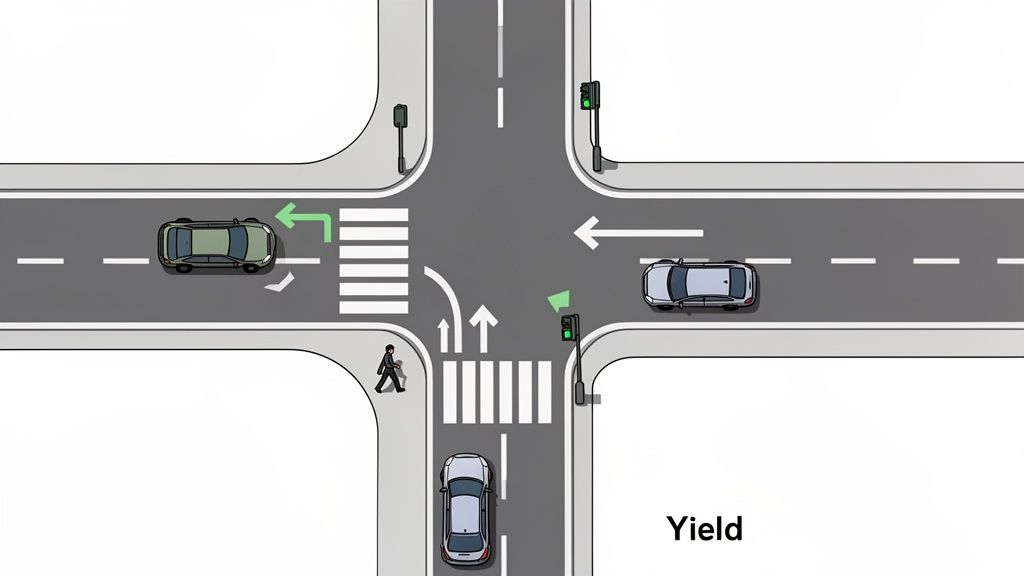
When you pull up to an intersection planning to hang a left, the kind of green light you get tells you exactly what to do next. A solid green circle—what some people call a "green ball"—signals what road safety experts call a permissive left turn. This simply means you’re allowed to turn, but only when it’s safe to do so.
Your number one responsibility is to yield. This isn't just a friendly suggestion; it's a core rule of the road designed to keep traffic moving safely. You have to patiently wait for a big enough gap in oncoming traffic before you can complete your turn. For a deeper dive into the specific rules, you can explore our guide on Florida's state driving laws.
Protected vs. Permissive Turns
The easiest way to really understand the "yield on green" concept is to see how it differs from a "protected" turn.
A protected turn is simple: you get a green arrow. That arrow gives you the exclusive right-of-way. Oncoming traffic has a red light, so you can make your turn without having to worry about cross-traffic. It's protected.
A permissive turn, on the other hand, puts the decision squarely on your shoulders. With just a solid green light, you become the judge. You have to gauge the speed and distance of oncoming cars, motorcycles, and cyclists, all while keeping an eye out for pedestrians. Only when the coast is completely clear can you go.
Getting this right is absolutely critical. Mistaking a permissive green light for a protected green arrow is a recipe for disaster and a frequent cause of severe T-bone collisions. In fact, safety studies have shown how much clearer signals matter. A 2022 analysis revealed that intersections that switched to a flashing yellow arrow—another way to signal "yield"—saw left-turn crashes plummet by a remarkable 17.73%.
Left Turn Signals at a Glance
For a quick and easy reference, here's a breakdown of the two main signals you'll encounter when making a left turn.
| Signal Type | What It Means for You | Your Required Action |
|---|---|---|
| Solid Green Light | You have permission to turn, but you must yield to everyone else. | Wait for a safe gap in oncoming traffic. Yield to pedestrians. Turn only when clear. |
| Green Arrow | You have the exclusive right-of-way to make your turn. | Proceed with your turn confidently but cautiously. Oncoming traffic is stopped. |
This table helps illustrate the fundamental difference: a green arrow gives you the right-of-way, while a solid green light requires you to give it away.
The Critical Difference: Green Arrow vs. Solid Green Light
When you’re staring at a traffic signal, it's tempting to think "green means go." But when you're making a left turn, the type of green signal you see changes everything. This isn't just a minor detail—it's the core rule that determines who has control of the intersection, and getting it right is one of the most important habits of a safe driver.
Think of it this way: a green arrow is your exclusive, all-access pass. It means the intersection is yours. Oncoming traffic has a red light, and you have been given a clear, protected path to make your turn. You have the undisputed right-of-way.
A solid green light, on the other hand, is more like a standby ticket. You're allowed to enter the intersection, but you have no special priority. You can make that turn, but only after yielding to all oncoming traffic and pedestrians. The responsibility is completely on you to find a safe gap.
Protected vs. Permissive Turns Explained
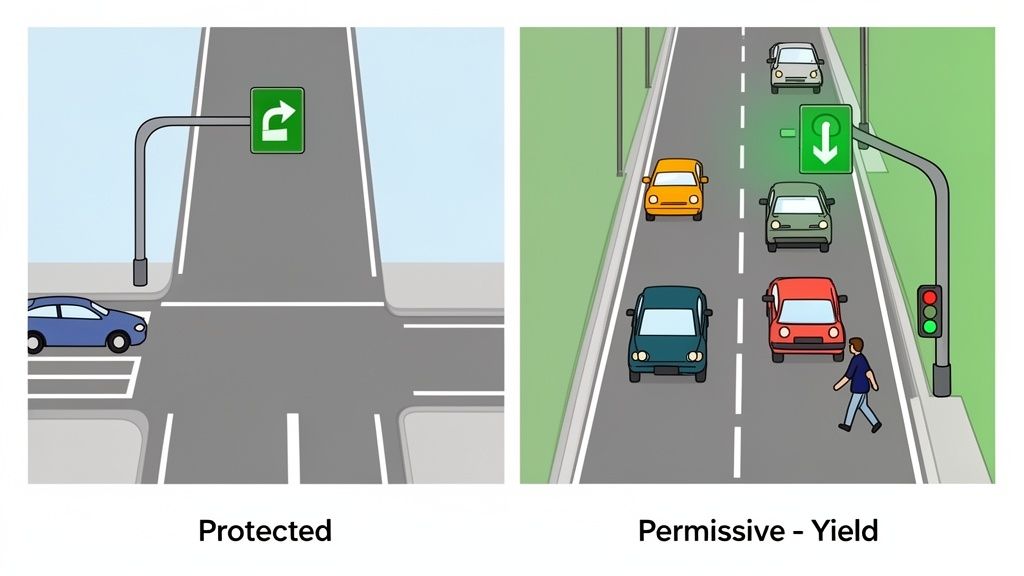
Traffic experts use specific terms for these two situations: "protected" and "permissive." They perfectly describe what's happening. A green arrow gives you a protected turn, while a solid green circle (or "ball") gives you a permissive turn.
- Protected Turn (Green Arrow): This is the traffic signal giving you a clear runway. Oncoming cars are stopped, which removes the biggest danger of making a left.
- Permissive Turn (Solid Green Light): The signal is giving you permission to go, but only when you can do so safely. It's up to you to judge the speed of oncoming cars, check crosswalks, and wait for an opening.
This setup, often called Protected/Permissive Left-Turn (PPLT) phasing, has been a game-changer for traffic safety since the 1990s. By giving drivers a protected green arrow phase first, followed by a permissive solid green, intersections can move traffic more efficiently and safely. In fact, studies have shown that this two-phase system can reduce left-turn crashes by over 50% compared to intersections that only have a permissive green light.
The bottom line is simple: An arrow gives you the right-of-way. A solid green light means you have to give it away. Confusing the two is one of the most common causes of serious intersection collisions.
Why This Matters So Much in Florida
Here in Florida, our intersections are built to handle a massive amount of traffic. That makes knowing these turn signals inside and out absolutely essential. Many busy intersections will start with a green arrow (the protected phase) and then switch to a solid green light (the permissive phase) to keep things flowing.
It’s your job to recognize which phase you're in. If you miss that initial green arrow, your entire mindset needs to shift immediately from "go" to "yield." For new drivers, truly understanding this distinction is a huge milestone. It’s covered in detail in the state handbook, and it's a good idea for every driver to review the rules in the Florida driver's manual. Never, ever assume a green light automatically means it's your turn.
Mastering Right-of-Way at Intersections
So, you're at an intersection with a solid green light, ready to make a left turn. The big question is always, "Who goes first?" The answer is pretty straightforward: pretty much everyone else. The "yield on green" rule sets up a clear pecking order, and knowing it inside and out is crucial for staying safe.
Oncoming traffic going straight through the intersection always gets top billing. Think of their path as a protected lane you simply cannot enter until it's totally clear. Trying to race an oncoming car is one of the most dangerous bets you can make on the road, often ending in a serious T-bone crash.
And it’s not just about cars. This right-of-way hierarchy includes everyone using the road. After oncoming vehicles, you have to yield to any pedestrians using the crosswalk and cyclists who might be in their lane. You can only make your turn once you’re absolutely certain you won’t interfere with any of them.
Your Mental Checklist Before Turning
The best way to turn a high-stress decision into a smooth, safe maneuver is to build a mental checklist. Running through these steps every single time will help you develop the defensive driving habits needed to nail a permissive left turn.
Your internal thought process should go something like this:
- Oncoming Traffic: Do I see any cars, trucks, or motorcycles heading my way?
- Pedestrians: Is anyone currently in the crosswalk or about to step into it?
- Cyclists: Are there any bikes coming up in the bike lane or on the shoulder?
- Speed & Gap: How fast is that traffic moving? Is the gap big enough for me to turn safely without making anyone else brake or swerve?
At its core, the left turn yield on green rule puts the responsibility for safety squarely on you, the turning driver. If you have even a shadow of a doubt about the gap in traffic, the only right move is to wait. It's always better to miss your chance than to cause a crash.
The Dangers of Misjudgment
Failing to yield the right-of-way correctly is a top cause of intersection accidents. It’s easy for drivers turning left to get so fixated on finding a gap between cars that they completely miss smaller, more vulnerable people on the road. This is a massive mistake, as pedestrians and cyclists have the right-of-way in the crosswalk you’re about to drive through.
On top of that, it’s notoriously tricky to judge the speed of an approaching vehicle when you're stopped. A car that looks a safe distance away might be closing that gap much faster than you realize. For a more detailed guide on handling these situations, our article on right-of-way rules can help clear things up.
The laws are written specifically to prevent these kinds of miscalculations. For a closer look at right-of-way principles and how they play out in real-world scenarios, you can read more about who has the right of way in Texas car accidents. While laws vary by state, the core idea of yielding never changes. Just remember, a solid green light gives you permission to go—it doesn't give you the right-of-way.
A Step-by-Step Guide to Executing a Safe Left Turn
Knowing the rules of the road is one thing, but pulling off a safe left turn in the middle of busy traffic? That's where theory meets reality. The whole point is to make the maneuver feel second nature—smooth, predictable, and automatic. Breaking it down into a few clear, repeatable steps is the best way to build the muscle memory you need to handle intersections with confidence.
This simple decision flow shows you exactly what should be going through your head.
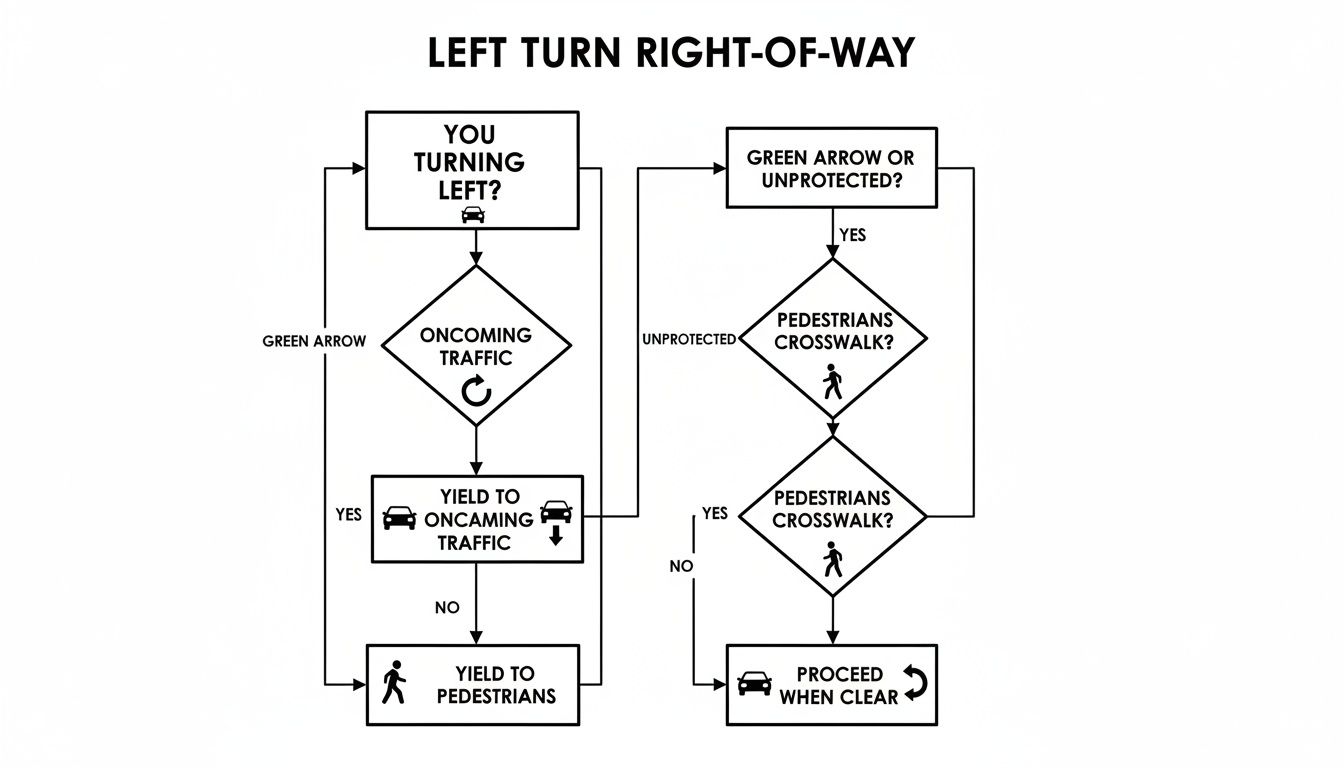
As you can see, your turn is the very last thing that happens. It only comes after you’ve given the right-of-way to every oncoming car and pedestrian.
Phase 1: Approaching the Intersection
Your preparation starts long before you ever get to the stop line. What you do in these crucial seconds sets you up for a safe and uneventful turn.
Signal Early: Flip on your left turn signal at least 100 feet before the intersection. This is non-negotiable. It tells everyone behind you what you're doing and gives them plenty of time to react to you slowing down.
Get in Position: Ease your way into the designated left-turn lane. If there isn't one, hug the centerline. This gives other drivers room to pass you on the right if the road allows.
Slow Down Smoothly: Begin to reduce your speed gradually. A safe turn isn't just about rules; it's also about having a car you can count on. Being aware of potential car brake problems is critical, as you need to be able to stop reliably when yielding.
Phase 2: Waiting in the Intersection
Okay, the light is green, and you've moved into the intersection. This is where your focus needs to be razor-sharp. Your judgment is everything right now.
Keep Your Wheels Straight.
This is one of the most important habits you can learn. While you’re waiting for a gap in traffic, never angle your steering wheel to the left. If someone rear-ends you, straight wheels will push you forward. But if your wheels are already turned, that same impact can shove you directly into oncoming traffic, turning a simple fender-bender into a devastating head-on collision.
Seriously, don't even think about turning that wheel until your foot is on the gas and you're actively making the turn.
Phase 3: Executing the Turn
You've spotted a safe opening in traffic. Now it's time to act—decisively, but smoothly.
Scan for a Gap: Your head needs to be on a swivel. You're looking for oncoming cars, of course, but also for pedestrians in the crosswalk you're about to enter and cyclists who might be sharing the road. And always, always look twice for motorcycles—they're smaller and can be incredibly hard to spot.
Judge Speed and Distance: Never just guess how fast another car is moving. You need a gap big enough to get your vehicle completely through the turn without forcing the other driver to slam on their brakes or swerve. When in doubt, wait it out.
Accelerate and Go: Once you're committed, accelerate gently through the turn. Aim for the leftmost lane on the new road and try not to cut the corner. Staying in your lane and being aware of your surroundings is crucial; it's a good reason to always check out our guide on how to check your blind spot while driving.
To put it all together, here is a quick pre-turn safety check you can run through in your head every time you approach an intersection for a left turn.
Your Pre-Turn Safety Checklist
| Safety Check | Action to Take | Why It Matters |
|---|---|---|
| Signal Intent | Activate your turn signal at least 100 feet before the turn. | Communicates your plan to other drivers, preventing rear-end collisions. |
| Vehicle Position | Move into the correct lane and keep wheels straight while waiting. | Ensures you're in a predictable spot and prevents being pushed into traffic if rear-ended. |
| Traffic Scan | Continuously scan for oncoming cars, motorcycles, cyclists, and pedestrians. | Identifies all potential hazards and ensures the path is completely clear. |
| Gap Judgment | Wait for a gap large enough to complete the turn safely at a normal speed. | Prevents forcing oncoming traffic to brake suddenly or swerve to avoid you. |
| Final Glance | Before accelerating, take one last look at the crosswalk you're entering. | Catches any last-second pedestrians or cyclists you may have missed. |
Making these checks a subconscious habit is the key to mastering the permissive left turn and keeping yourself—and everyone else—safe on the road.
Common Left Turn Mistakes and How to Avoid Them
Even the sharpest drivers can develop bad habits, and permissive left turns are where those little mistakes can turn into big dangers. Knowing the common pitfalls is the first step to building the defensive driving instincts you need to handle these intersections with confidence. More often than not, these errors boil down to a simple misunderstanding of what left turn yield on green meaning truly entails.
It's no secret that driver confusion at these signals is a major cause of accidents. In fact, collisions involving left turns account for nearly 25% of all crashes at intersections with traffic lights. Research on driver response times found that when a driver is surprised by an obstacle mid-turn, the chances of a crash are incredibly high, which really highlights why your judgment call has to be spot on.
Misjudging Speed and Distance
This is probably the most frequent and dangerous mistake a driver can make. An oncoming car that looks like it's a safe distance away might be eating up that distance far faster than you realize, leaving you stuck in the middle of the intersection with nowhere to go.
- The Mistake: You see a car and focus only on how far away it is, not how fast it's moving. The thought process is, "Oh, they're way down there," but you fail to account for the fact they could be going 50 mph or more.
- How to Avoid It: Live by the rule: "When in doubt, wait it out." It’s that simple. If making your turn would force the other driver to so much as tap their brakes, the gap isn't big enough. It’s always better to wait for the next green light than to risk a collision.
Defensive Driving Tip: Instead of just looking for a gap in traffic, watch for signs of slowing traffic. If you see brake lights on distant cars, it's a good clue your light is about to turn yellow and they are preparing to stop. That's often your safest window to clear the intersection.
Feeling Pressured by Other Drivers
The pressure of a car tailgating you while you wait to turn can be immense. A honking horn or a car inching up in your rearview mirror can create a false sense of urgency, pushing you to take a risk you know you shouldn't.
- The Mistake: Letting another driver's impatience rush your decision. You might gun it into a gap that’s way too small, just to get the person behind you off your back.
- How to Avoid It: You have to tune them out. Your primary job is to keep yourself and the oncoming traffic safe, not to manage the schedule of the person behind you. Take a breath, ignore the noise, and don't move until you are 100% certain it is safe. Remember, they don't have the same view of oncoming traffic that you do.
By keeping these common traps in mind, you can actively guard against them. This turns what could be a dangerous move into just another routine, safe part of your drive.
Common Questions About Making a Left Turn
Even when you know the rules by heart, some intersections just make you hesitate. Those "what if" moments are what separate knowing the rules from mastering the art of the left turn in the real world. Let's walk through some of the most common questions drivers have, so you can handle these tricky spots with confidence.
Remember, the goal in every one of these situations is to think defensively and put safety way ahead of speed.
What if the Light Turns Yellow While I'm in the Intersection?
This happens all the time, and thankfully, the rule is straightforward. If you've already pulled into the intersection to wait for a gap in traffic and the light turns yellow, you have the right—and the responsibility—to complete your turn. Think of it as "clearing the intersection."
Oncoming traffic now has to stop for their yellow, and eventual red, light. That’s the gap you were waiting for. The worst thing you can do is panic or slam on your brakes. Just check to make sure the oncoming cars are actually stopping, and then carefully complete your turn.
Can I Really Get a Ticket for Turning Left on a Solid Green Light?
You bet. A solid green light isn't a free pass; it's permission to enter the intersection only when it's safe. You can absolutely get a ticket for "failure to yield right-of-way" if your turn forces an oncoming driver to slam on their brakes or swerve out of the way.
That ticket comes with fines, points on your license, and if there's a crash, you'll almost certainly be found at fault. The burden to yield is 100% on you, the turning driver.
A solid green light for a left turn is conditional. The law puts the responsibility squarely on your shoulders to give way to oncoming traffic and pedestrians. A ticket is a harsh reminder of that fact.
How Do I Judge the Speed of Oncoming Cars?
Learning to judge speed and distance is a skill that honestly just takes practice, but there are some tricks to it. My best advice? Don't even think about turning unless the gap is so big that you're positive the oncoming car won't have to touch their brakes.
Watch the car approaching. How fast is the space between you shrinking? If it's closing quickly, that car is moving faster than you think. If you have even a shadow of a doubt, it’s not a big enough gap. It is always, always better to wait for the next green light than to risk a head-on collision.
What if an Oncoming Driver Flashes Their Headlights at Me?
We've all seen it—the friendly headlight flash from another driver, waving you on. While it’s usually a kind gesture, you should never treat it as an official signal to go. That driver can't legally give you the right-of-way, and more importantly, they might not see the car flying up in the lane next to them.
Always make your own final call. You can give a quick wave to acknowledge them, but only after you've personally scanned and confirmed that the path is completely clear. The final decision to turn has to be yours and yours alone.
At BDISchool, our mission is to create drivers who are not just licensed, but truly safe, informed, and confident. Our state-approved online courses break down everything from basic traffic laws to advanced defensive driving skills, helping you protect your driving record and stay safe on Florida's roads. Find out more and get started at https://bdischool.com.