When you see that solid green light, it's easy to think "go," but for a left turn, it's a bit more complicated. The left turn yield on green meaning is simple: you can turn left, but only after giving way to all oncoming traffic and pedestrians. Think of it as a conditional "okay to proceed," not an automatic green flag for your turn. You absolutely must wait for a safe gap in traffic before you go.
Decoding the Left Turn Yield on Green Signal
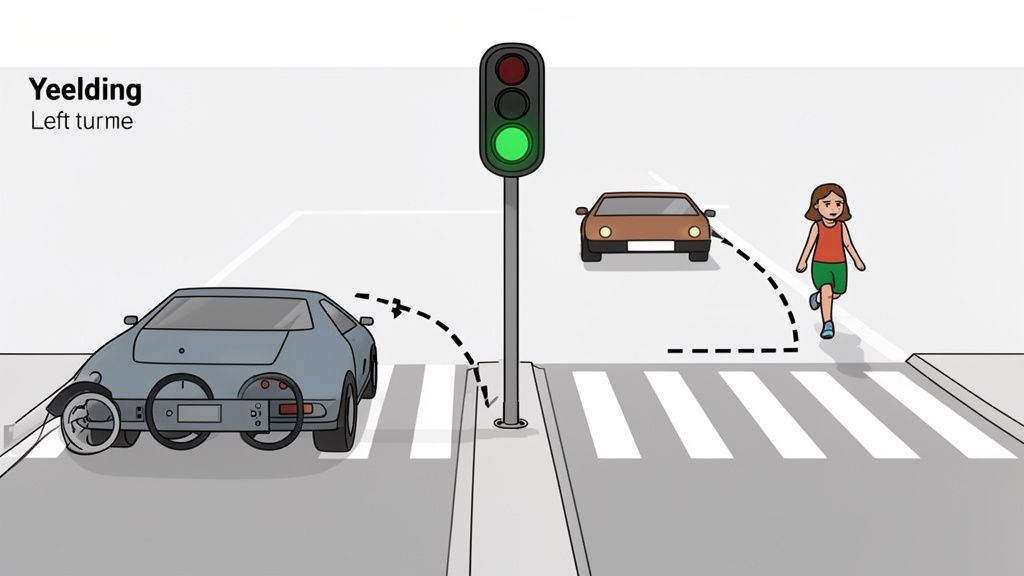
Let's be honest, that unprotected left turn can be one of the most nerve-wracking maneuvers for any driver, new or experienced. That glowing green circle can give you a false sense of security, but its real meaning is much more nuanced. All it's telling you is that the intersection is open for you to enter—placing you at the bottom of the right-of-way totem pole.
It's really a waiting game that demands patience and sharp awareness. Your job is to make sure your path is completely clear of cars, motorcycles, bikes, and anyone crossing the street before your foot even considers moving to the gas pedal.
Understanding Your Obligations
The whole point of this rule is to prevent crashes. Traffic coming straight through the intersection has the undisputed right-of-way. Your permission to turn is entirely based on their movement. One of the biggest causes of serious T-bone accidents is misjudging the speed and distance of an oncoming car.
The numbers don't lie. Left-turn crashes are a huge safety problem, making up about 22.2% of all vehicle accidents at intersections. The stakes are high; a study on intersection safety found that drivers who hesitate or are slow to react in these situations have a 20% higher chance of crashing. You can review the study on intersection safety to see the data for yourself.
A solid green light is not a command to go; it is permission to proceed only when safe. For a left-turning driver, safety means yielding to everyone else first.
Florida Green Light Signals at a Glance
To make it crystal clear, let's break down the different green signals you'll see in Florida and what they mean when you're waiting to turn left.
| Signal Type | What It Means for Left Turns | Your Action |
|---|---|---|
| Solid Green Light | You may turn left only after yielding to all oncoming traffic and pedestrians. | Proceed with extreme caution and wait for a safe gap. |
| Green Arrow | You have the protected right-of-way to turn left. Oncoming traffic is stopped. | Proceed with your turn, but remain aware of your surroundings. |
Getting this difference down is one of the most important things you can do as a driver. For a complete look at who has priority in different situations, our guide on Florida's right-of-way rules at intersections has you covered.
Who Has the Right of Way at Intersections?
Figuring out who goes first at an intersection isn't just a courtesy—it's a set of non-negotiable rules that keep traffic from turning into total chaos. Think of right-of-way as the road's grammar; everyone has to follow the same structure for the system to work. This concept is never more critical than when you're waiting to make a left turn on a solid green light.
Let's get straight to the point: the driver turning left does not have the right-of-way. The law requires you to yield to any vehicle, pedestrian, or cyclist that could be a potential hazard. This creates a simple, predictable hierarchy that every driver needs to respect.
The Right-of-Way Pecking Order
When you pull into an intersection to make that left turn, you are at the bottom of the priority list. You have to wait for several other groups before it's your turn to go.
- Oncoming Traffic: Any car, truck, or motorcycle coming straight through the intersection from the opposite direction has the absolute right-of-way.
- Opposing Right Turns: Drivers coming from the other direction who are turning right also get to go before you.
- Pedestrians and Cyclists: You must yield to anyone in a crosswalk, whether it's marked or not. Your turn has to wait until they have completely cleared your path.
This pecking order is all about protecting the most vulnerable people on the road and keeping traffic flowing predictably. The whole idea behind left turn yield on green is that you are giving up your turn for the safety of others.
The Law and Your Responsibility
Official guidance is clear: when you see a solid green light but no green arrow, you are permitted to turn left only after yielding to all oncoming traffic. It’s a move that demands your full attention and quick, safe judgment. A solid green light doesn’t give you the right to go; it just gives you permission to proceed when it's safe. You can dive deeper into the data by exploring research on traffic control and driver behavior.
In Florida, failing to yield the right-of-way isn't just a simple mistake. It's a moving violation that can hit you with points on your license, hefty fines, and a spike in your insurance rates.
This rule is a fundamental part of defensive driving. For a complete rundown of this and other essential road rules, you can get the official details right from the Florida Driver's Manual.
Remember, the burden of finding a safe gap in traffic and ensuring the intersection is clear falls squarely on you, the driver turning left. Your permission to turn is always conditional on everyone else's safety.
A Step-by-Step Guide to Making the Perfect Left Turn
Knowing the rules is one thing, but putting them into practice is what builds real confidence on the road. Nailing a safe left turn on a solid green light isn’t about luck—it’s about following a calm, deliberate process every single time. Let's break down this common maneuver into simple, repeatable steps.
Think of this as your mental checklist. Following it helps build the muscle memory you need to handle one of the most stressful situations new drivers face.
Step 1: Position Your Vehicle Correctly
Your turn starts long before you reach the intersection. First things first, get into the correct lane. As you approach, move into the designated left-turn lane. If there isn't one, position your car closer to the centerline. This gives you the best possible view of what's ahead.
Don't forget that blinker! Signal your intention early. For a refresher on the rules, check out our guide on when to use turn signals. A simple flick of the wrist tells everyone around you what you're planning, preventing a lot of confusion and even rear-end collisions from drivers who aren't expecting you to slow down.
Step 2: Pull Forward and Keep Your Wheels Straight
Once the light turns green, it's okay to ease forward into the intersection. Don't just hug the stop line; pull out into the middle of the intersection to claim your space. This puts you in the perfect spot to complete your turn as soon as there's a safe opening.
But here’s a critical detail that many drivers forget: keep your wheels pointing straight ahead while you wait. Why? If someone bumps you from behind and your wheels are already turned, you could be pushed directly into oncoming traffic. It's a terrifying and completely avoidable scenario.
Keeping your wheels straight until you’re actually ready to move is a massive safety buffer. This tiny habit can be the difference between a small fender-bender and a catastrophic head-on collision.
Step 3: Scan Relentlessly for Hazards
This is where your head needs to be on a swivel. You’re not just looking for a gap between cars. You need to see the entire picture of what's happening around you. Your scanning pattern should cover:
- Oncoming Traffic: Obvious, yes, but look for cars, motorcycles, and trucks. Motorcycles can be especially hard to spot.
- Pedestrians: Check every crosswalk. Is anyone about to step off the curb?
- Cyclists: Be on the lookout for cyclists in bike lanes or riding alongside traffic. They have the right-of-way, too.
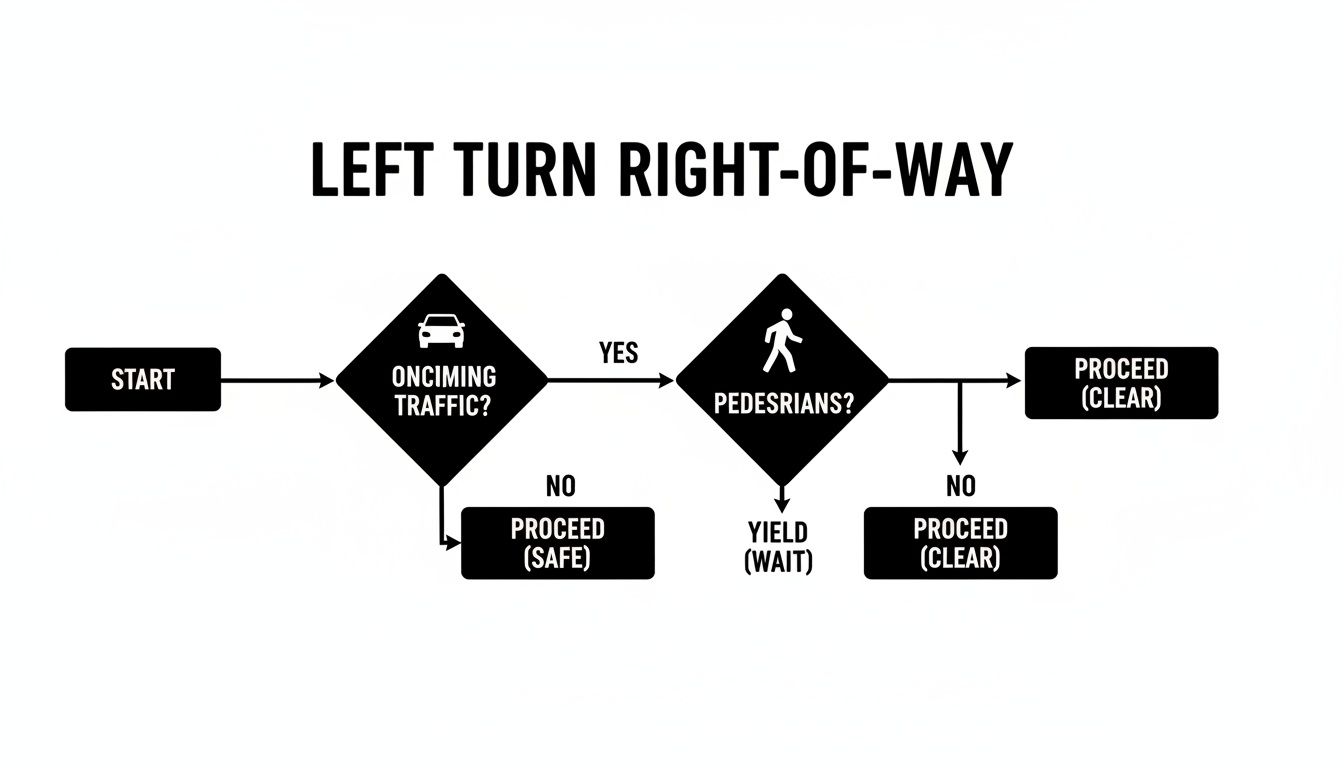
This flowchart is a great visual reminder of your duties. Your permission to turn is completely conditional—you must yield to anyone already in the intersection.
Step 4: Judge the Gap and Commit
This is the moment of truth. You need to spot a gap in traffic that’s big enough for you to accelerate through the turn and get up to speed without forcing anyone coming toward you to slam on their brakes.
Here's a pro tip: watch the tires of oncoming cars, not just the car itself. The tires give you a much better read on their actual speed and direction.
Once you’ve found that safe gap, commit to your turn. Don't hesitate. A timid, jerky turn can be just as dangerous as a reckless one. But if you have any doubt at all, just wait. It's always better to wait for the next green light than to risk it. A few seconds aren't worth your safety.
Navigating Tricky Real-World Left Turn Scenarios
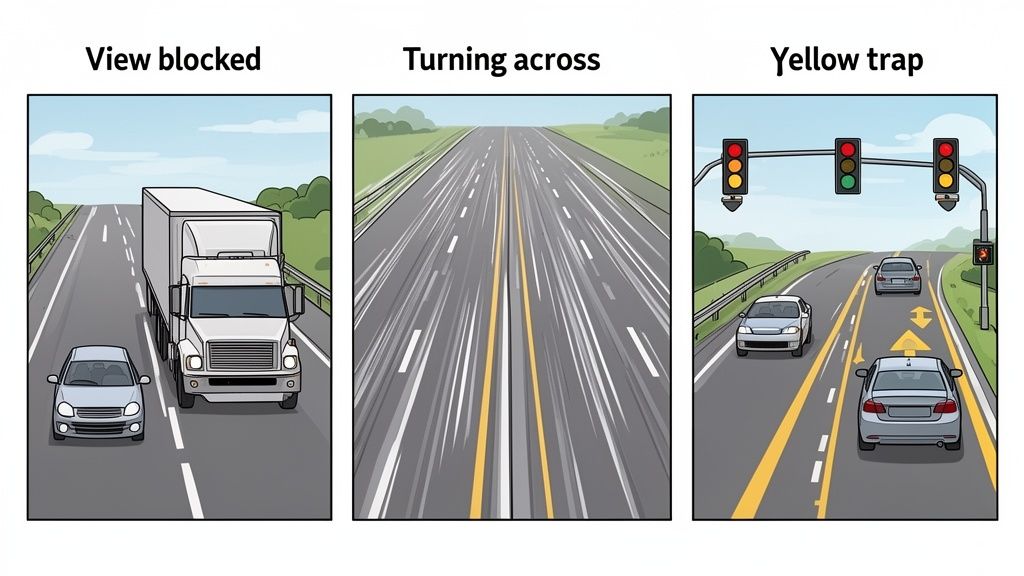
Knowing the rules is one thing, but the real world throws curveballs. Intersections aren't all built the same; some have weird layouts, heavy traffic, or unique quirks. This is where your classroom knowledge of the left turn yield on green meaning truly gets put to the test.
Let's walk through a few of the toughest left-turn situations you'll almost certainly encounter on Florida's roads. Thinking through them now will help you build the muscle memory to make the right call in a split second.
Scenario 1: The Obstructed View
You're at the front of the line, ready to turn left. The problem? A massive box truck in the opposite turn lane is completely blocking your view of oncoming traffic. You can’t see a thing, but you can feel the driver behind you getting impatient.
- The Common Mistake: Getting antsy and creeping forward, trying to "peek" around the truck. This is a classic recipe for disaster. Nosing your car out puts it directly in the path of a vehicle you can't even see, setting you up for a brutal T-bone collision.
- The Smart Move: Hold your ground. It’s a simple but non-negotiable rule: if you can't see, you don't go. Be patient. It's far better to wait for the truck to clear out or for the light to cycle back to a protected green arrow. A few seconds of waiting is a small price to pay for your safety.
For more on keeping your surroundings in check, take a look at our complete guide on how to check blind spot while driving.
Scenario 2: The Yellow Trap
You’ve pulled into the intersection, waiting for a safe gap in traffic. The light turns yellow. You figure oncoming traffic will stop, and you get ready to complete your turn. But their light stays green for a few crucial seconds after yours has changed, leaving you stranded in the middle of the intersection as your light turns red.
This nerve-wracking situation is called a "yellow trap," and it’s a real danger at older intersections with unsynchronized signals. It's a stark reminder that you can never assume what other drivers are going to do.
- The Common Mistake: Panicking. Some drivers will either floor it to rush the turn in front of speeding cars, while others try to reverse back behind the line, which can easily cause a rear-end crash.
- The Smart Move: Stay calm and stay put. Once you've entered the intersection, you've legally "claimed" that space. You have the right-of-way to clear the intersection once oncoming traffic has stopped. Wait for your opening, and complete the turn safely, even if your light is red.
Scenario 3: The Multi-Lane Highway
This is a big one. You need to make a left across three lanes of traffic, and everyone's moving fast. A gap finally opens up in the lane closest to you, but you have no idea if the other two lanes are clear.
- The Common Mistake: Thinking a gap in one lane means a gap in all of them. This is a fatal assumption. A car in the far lane can be completely hidden and appear out of nowhere, leaving you with no time to react. This is easily one of the highest-risk left turns you can make.
- The Smart Move: Wait for a large, undeniable gap across all lanes. If your view of any lane is even partially blocked, the answer is always no. This maneuver demands extreme patience and a deeply defensive mindset.
It helps to know why these challenges pop up. Engineers are always trying to improve safety; for example, newer "displaced left-turn" (DLT) intersections can cut down on traffic conflict points by 6-12%. But even the most modern designs have their own learning curves, proving that a vigilant driver is still the most important safety feature on the road.
How to Avoid Costly Left Turn Mistakes and Tickets
A split-second bad decision on a left turn can lead to some long-lasting and expensive headaches. It's not just about dodging a ticket; understanding the most common mistakes is about keeping yourself, your passengers, and your bank account safe. That seemingly simple act of turning left on green is full of potential traps.
So, what are the most common slip-ups? Usually, it's the small miscalculations that have the biggest impact. You might misjudge the speed of an oncoming car, feel rushed by the impatient driver honking behind you, or completely miss a pedestrian stepping into the crosswalk.
Every single one of those mistakes can land you a citation for Failure to Yield Right-of-Way, which is a serious moving violation.
The Real Cost of a Left Turn Error
In Florida, failing to yield isn't a slap on the wrist. The penalties start with a fine but create a ripple effect that can mess with your driving record and your budget for years to come.
- Expensive Fines: A failure to yield ticket isn't cheap. Depending on the county, you could be looking at a fine well over a hundred dollars.
- Points on Your License: This specific violation will add 3 points to your Florida driver's license. Rack up enough of those, and you risk a full suspension.
- Skyrocketing Insurance Rates: Insurance carriers see this ticket as a major red flag for risky driving. Don't be surprised if your premiums jump significantly when it's time to renew your policy.
These consequences are stiff for a reason. They drive home the core principle of the left turn yield on green: the turning driver is 100% responsible for making sure the coast is clear before proceeding.
Turning a Mistake into a Learning Opportunity
Getting a ticket doesn't have to be the final word. This isn't about scaring you—it's about showing you how to take back control. Florida law actually gives drivers a great option if they receive a non-criminal moving violation like this one.
If you're eligible, you can complete a state-approved Basic Driver Improvement (BDI) course to prevent the points from ever hitting your license. This is a game-changer. It can stop your insurance rates from climbing and helps you hang on to your safe driver status.
Taking a BDI course is more than just a quick fix for a ticket. It's a proactive way to sharpen the defensive driving skills that prevent you from getting into these situations in the first place.
Think of it as hitting the reset button. A good BDI program from a reputable provider like BDISchool.com will give you a solid refresher on traffic laws, fine-tune your ability to spot hazards, and build your confidence for handling tricky intersections. It's a way to turn a costly mistake into a powerful lesson that makes you a safer, smarter driver.
Got Questions About Left Turns? Let's Clear Them Up.
Even when you know the rules, some moments behind the wheel can make you second-guess yourself. Let's tackle some of the most common questions and tricky situations drivers face when making a left turn. Think of this as your go-to cheat sheet for building confidence and making the right call every time.
Getting these scenarios straight in your head now means you can act decisively and safely when they happen in real time.
What if the Light Turns Yellow While I'm in the Intersection?
This is a classic nail-biter. You’ve done everything right—you’ve pulled into the intersection to wait for a gap in traffic, but before one appears, the light flips to yellow. What's the move?
Relax, the law has your back. If you’ve already entered the intersection on a green light, you have the right-of-way to complete your turn. Don't panic and definitely don't try to back up. Just wait for the last of the oncoming cars to clear, and then finish your turn. It’s perfectly okay if the light has turned red by the time you go; you’re simply clearing the intersection as required.
Who Goes First if Two Cars Are Turning Left at Each Other?
Picture this: you're in the left-turn lane, and so is a driver across the intersection, facing you. You both want to turn left. So, who gets to go?
In this case, neither of you technically has priority over the other. The standard, courteous way to handle this is for both cars to turn at the same time, passing in front of each other and staying in your respective new lanes. But this dance requires you both to be on the same page. If you feel any uncertainty about what the other driver is about to do, the safest bet is always to hang back, make eye contact, and let them go first.
The whole idea behind the left turn yield on green is putting safety before anything else. When in doubt, always yield.
Can I Really Finish My Turn After the Light Turns Red?
Yes, you can, but only in one specific situation. As we covered above, if you were already waiting in the middle of the intersection when the light changed from green to yellow, you are legally required to clear the intersection by completing your turn. You can't just sit there and block the box.
What you absolutely cannot do is enter the intersection on a yellow or red light hoping to sneak through. This rule only applies if you were already legally positioned in the intersection before the light changed.
How Do I Get Better at Judging Gaps in Traffic?
Figuring out the speed and distance of oncoming cars is a skill, and it’s probably the trickiest part of making a left turn. It definitely gets easier with experience, but here are a few pro tips to help you nail it.
- Look past the first car. Your eyes will naturally lock onto the closest vehicle, but force yourself to look further down the road. This gives you a much better sense of the overall traffic flow and whether a bigger, faster car is hiding behind the first one.
- Watch the wheels. This is a great little trick. Instead of just looking at the body of an approaching car, focus on its tires. The speed at which they're spinning and moving across the pavement gives you a much more accurate read on how fast the car is truly moving.
- Use the three-second rule. Find a fixed object up the road, like a light post or a sign. When an oncoming car passes it, start counting: "one-one-thousand, two-one-thousand, three-one-thousand." If you can't get to three before that car reaches your turning point, the gap is too small. Don't risk it.
Try practicing these techniques on less busy roads to get the hang of it. Before you know it, judging traffic will feel like second nature, and you'll be making smooth, safe left turns without a second thought.
At BDISchool, our mission is to make Florida's roads safer, one well-informed driver at a time. Our state-approved courses give you the real-world skills you need to drive with confidence and keep your record clean. Learn more about our Basic Driver Improvement courses at BDISchool.com.