When you see that distinctive yellow, pennant-shaped sign on the side of the road, it’s not a suggestion—it’s a command. The meaning of a No Passing Zone sign is straightforward: you're heading into a stretch of road where passing the car in front of you is illegal because you simply can't see far enough ahead.
These zones are specifically designated in areas with hills, curves, intersections, or other obstructions that create dangerous blind spots.
What a No Passing Zone Really Means in Florida

Picture this: you’re on a two-lane road, stuck behind a slow-moving vehicle. The temptation to swing out and pass is strong. But then you spot it—a yellow, sideways triangle on the left that reads "NO PASSING ZONE." This is your cue to hold back.
That sign is a critical warning. It’s the road's way of telling you that your line of sight for oncoming traffic is severely limited. Essentially, it says, "Trust us, you can't see what's coming over that hill or around that bend."
The Key Visual Signals
Recognizing a no-passing zone isn't just about one sign. It’s a system of visual cues designed to work together, leaving no room for doubt. The two main things to look for are the sign itself and the markings on the road.
- The Pennant Sign: This unique, elongated triangle is always on the left side of the road, facing you. Its shape is unlike any other traffic sign, making it instantly stand out.
- Solid Yellow Pavement Lines: At the same time, the dashed yellow centerline on your side of the road will become a solid yellow line. This line is the legal boundary. Crossing it to pass is strictly forbidden.
Think of the pennant sign as the heads-up and the solid yellow line as the rule in effect. You must stay in your lane until that solid line becomes broken again, signaling that the no-passing zone has ended. Understanding these markings is a fundamental part of driver's ed, as detailed in the official Florida driver's manual.
To make it even clearer, here's a quick breakdown of what you'll see.
No Passing Zone at a Glance
This table sums up the visual cues and what they mean for every driver in Florida.
| Component | Description | What It Means for Drivers |
|---|---|---|
| Pennant-Shaped Sign | A yellow, sideways triangle with black text reading "NO PASSING ZONE" | This is the advance warning. It's placed on the left side of the road to be highly visible. |
| Solid Yellow Line | A solid yellow line painted on the pavement on your side of the centerline. | This is the legal boundary. You cannot cross this line to overtake another vehicle. |
| End of Zone | The solid yellow line on your side returns to a broken (dashed) yellow line. | The restriction is lifted. Passing is now permitted, provided it is safe to do so. |
These elements combine to create a clear, legally-binding instruction that is vital for preventing one of the most dangerous types of accidents: the head-on collision.
How to Read the Signs and Lines on the Road
Florida roads speak a language all their own through a combination of signs and pavement markings. Learning to read them on the fly isn't just a good idea—it's a critical part of being a safe, responsible driver. The "no passing zone" is a perfect example of how these elements team up to give you a clear, unmissable instruction.
Your first heads-up is the unmistakable, pennant-shaped "NO PASSING ZONE" sign. Its unique shape and placement—always on the left side of the road—are designed to catch your eye long before the zone actually starts. Think of it as an early warning system, letting you know that the road ahead has hidden dangers that make passing a bad idea.
You'd think a sign that clear would be universally understood, but that's not always the case. While a staggering 97% of drivers agree that road signs are essential for safety, some studies show that comprehension isn't as high as we'd hope. For example, only 88% of drivers can correctly identify a basic "do-not-enter" sign. This suggests a similar knowledge gap might exist for the less common no-passing pennant.
Decoding the Pavement Markings
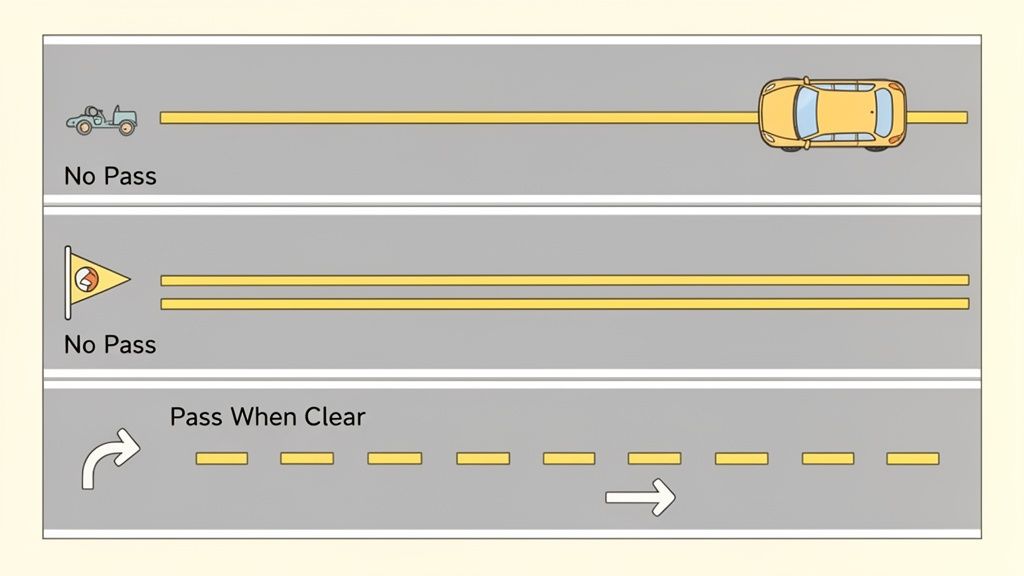
Right after you see the sign, the lines on the road itself give you the final, legally-binding order. This is where the real rule is written, and it’s all about the yellow centerline. The most important thing to remember is to focus on the line closest to your lane.
Here's a simple breakdown of what those yellow lines mean:
- Single Solid Yellow Line: If the line on your side is solid, you've entered a no-passing zone. You are not legally allowed to cross it to overtake the car in front of you.
- Double Solid Yellow Lines: This is the most restrictive marking. It means passing is prohibited for traffic in both directions. It’s a hard barrier you should never cross from either side.
- Broken Yellow Line: When the line on your side is dashed or broken, you are permitted to pass—but only if the coast is clear and you have plenty of time and space to do it safely.
The Bottom Line: That solid yellow line on your side of the road is your stop sign for passing. The pennant sign warns you it's approaching, but the solid line is the absolute, non-negotiable rule.
How the Signs and Lines Work Together
This system is built for clarity. The pennant sign gives you a crucial heads-up, letting you prepare mentally and adjust your driving. Then, the solid yellow line shows you precisely where the restriction begins and, just as importantly, where it ends.
Once that solid line on your side transitions back to a broken pattern, you're out of the no-passing zone and can consider overtaking again if conditions are safe. This combination eliminates all the guesswork, ensuring every driver gets both an advance warning and a clear visual boundary. Reading these signals correctly is just as fundamental as knowing how to change lanes properly on the interstate. When you master this road language, you become a safer, more predictable driver for everyone around you.
Why These Zones Are Critical for Driver Safety
No Passing Zones aren't just random suggestions; they're the result of careful traffic engineering designed to prevent the most devastating types of collisions. It all comes down to a simple but crucial concept: sight distance.
Think of it like throwing a football to a running receiver. To complete the pass, you need a clear, unbroken line of sight to judge their speed and path. It's the same on the road. Sight distance is the minimum clear view you need to safely pass a car and get back in your lane without forcing an oncoming vehicle to slam on its brakes.
The Science of Safe Sightlines
Traffic engineers don't guess where to put these zones. They meticulously study roadways to pinpoint specific areas where your view ahead is dangerously short.
You'll almost always find no-passing zones in these high-risk spots:
- Hills and Crests: As you drive toward the top of a hill, your visibility of what's coming up the other side drops to zero. It's a total blind spot.
- Sharp Curves: A sharp bend in the road completely hides oncoming traffic until it's just seconds away.
- Intersections and Driveways: These areas introduce unpredictable traffic entering the roadway, making a passing attempt incredibly risky.
- Bridges and Tunnels: The narrow and confined space on bridges and in tunnels leaves absolutely no room for error if a pass goes wrong.
These zones are a direct countermeasure against head-on collisions, which are among the deadliest accidents on two-lane highways. The solid yellow line and the pennant-shaped sign are there for one reason: to warn you that your sight distance is severely limited.
A No Passing Zone is a guarantee from road safety experts that you simply cannot see far enough ahead to pass safely. Ignoring it is like betting against the laws of physics—a bet you're almost certain to lose.
When you understand the reasoning, the sign transforms from a frustrating rule into a vital safeguard. It’s similar to how strict emergency exit signage requirements are legally required in buildings to guide people to safety. Both are non-negotiable rules put in place to save lives.
Seeing that sign means acknowledging that a proven, invisible danger lies just over that hill or around that curve. Recognizing these hazards is a fundamental part of learning how to avoid car accidents.
The Real Cost of an Improper Passing Ticket
Let's be blunt: ignoring a No Passing Zone sign in Florida is a bad move. It's not a simple slap on the wrist. It’s a moving violation that state troopers and local police take very seriously, mainly because it's an incredibly dangerous maneuver that puts lives at risk. If you get caught, the penalties are designed to be memorable for all the wrong reasons.
First up is the immediate hit to your wallet. While the exact fine can differ depending on the county, you can expect a ticket for improper passing to cost you anywhere from $165 to over $250. That’s a significant, unplanned expense for most people. But honestly, the fine is just the start of the headache.
It's More Than Just the Money
The most lasting damage from a passing violation comes in the form of points on your driver's license. Here in Florida, an improper passing citation lands you three points on your permanent driving record. Three points might not sound like a catastrophe, but they add up faster than you'd think and can have some pretty severe consequences down the road.
For example, getting 12 points within a 12-month period triggers an automatic 30-day license suspension. That one ticket for a risky pass just put you a quarter of the way there. On top of that, every point on your record is a giant red flag for your insurance company, telling them you've become a riskier driver to cover.
A ticket for improper passing is a near-certain way to see your car insurance premiums go up. Over the next few years, that rate hike can easily end up costing you much more than the original fine.
To really see what's at stake, let's break down the penalties you're facing for a single bad judgment call in a no-passing zone.
Here's a quick summary of what a citation for improper passing will mean for you in Florida.
Florida Penalties for Violating a No Passing Zone
| Violation | Typical Fine Range | Points on License | Potential Long-Term Impact |
|---|---|---|---|
| Improper Passing | $165 – $250+ | 3 Points | Increased insurance rates, risk of license suspension. |
As you can see, the consequences are no joke.
The good news is that Florida law offers a way out of the long-term pain. If you've received a non-criminal moving violation like this one and haven't attended a traffic school course in the past year, you have a valuable option.
You can choose to complete a state-approved Basic Driver Improvement (BDI) course. Doing so prevents those pesky points from ever being added to your license. It's the single best thing you can do to protect your driving record and stop your insurance rates from climbing. A course from a provider like BDISchool.com is easy to complete online, letting you turn a costly error into a chance to brush up on your driving skills.
Navigating Real-World Passing Scenarios and Exceptions
The rules for a no-passing zone are pretty black and white, but the real world is full of gray areas. We’ve all been there: stuck behind a tractor crawling along at 10 mph on a two-lane road, or trying to safely get around a cyclist on a blind curve. This is where textbook knowledge has to meet real-time, on-the-road judgment.
Let's walk through some common, tricky situations to see where the line is drawn between patient, legal driving and an illegal, dangerous pass. Florida law does allow for a few specific exceptions, but they put all the responsibility squarely on your shoulders as the driver.
When Patience Is Your Only Legal Option
Picture this: you're behind a huge semi-truck or a piece of farm equipment that's moving way under the speed limit. The urge to just whip around them is strong. I get it. But in a no-passing zone, this is where you have to hold back.
Passing any slow-moving motor vehicle by crossing a solid yellow line is a clear-cut ticket, and it's incredibly dangerous. That zone exists for a reason—your view of oncoming traffic is compromised. A big truck just makes that blind spot even bigger.
The Bottom Line: If the vehicle in front of you is a car, truck, or any motorized farm equipment, you have to wait. The risk of a head-on collision is just too high. Slow down, keep a safe distance, and wait for the passing zone to end.
The Exceptions: Obstructions and Bicyclists
So, are there any situations where you can cross the line? Yes, but they are very specific. Florida law recognizes that sometimes things are in your lane that aren't other vehicles.
This is where it gets a little more nuanced. According to Florida Statute 316.0875, you can cross the centerline in a no-passing zone to get around an obstruction, but only if you can do it safely and without getting in the way of oncoming traffic.
What counts as an "obstruction"?
- A Bicyclist or Pedestrian: You are allowed to cross the line to give a cyclist the legally required three feet of clearance. But you can only do this when the road ahead is completely clear.
- Debris on the Road: If a fallen tree branch or other debris is blocking your lane, you can carefully maneuver around it.
It's absolutely critical to understand that "obstruction" does not mean a slow-moving car or truck. A very common and dangerous myth is that you can pop around a car that's slowing down to make a left turn. This is strictly illegal and a recipe for a truly nasty accident.
This decision tree shows the simple choices you face after getting a ticket for improper passing.
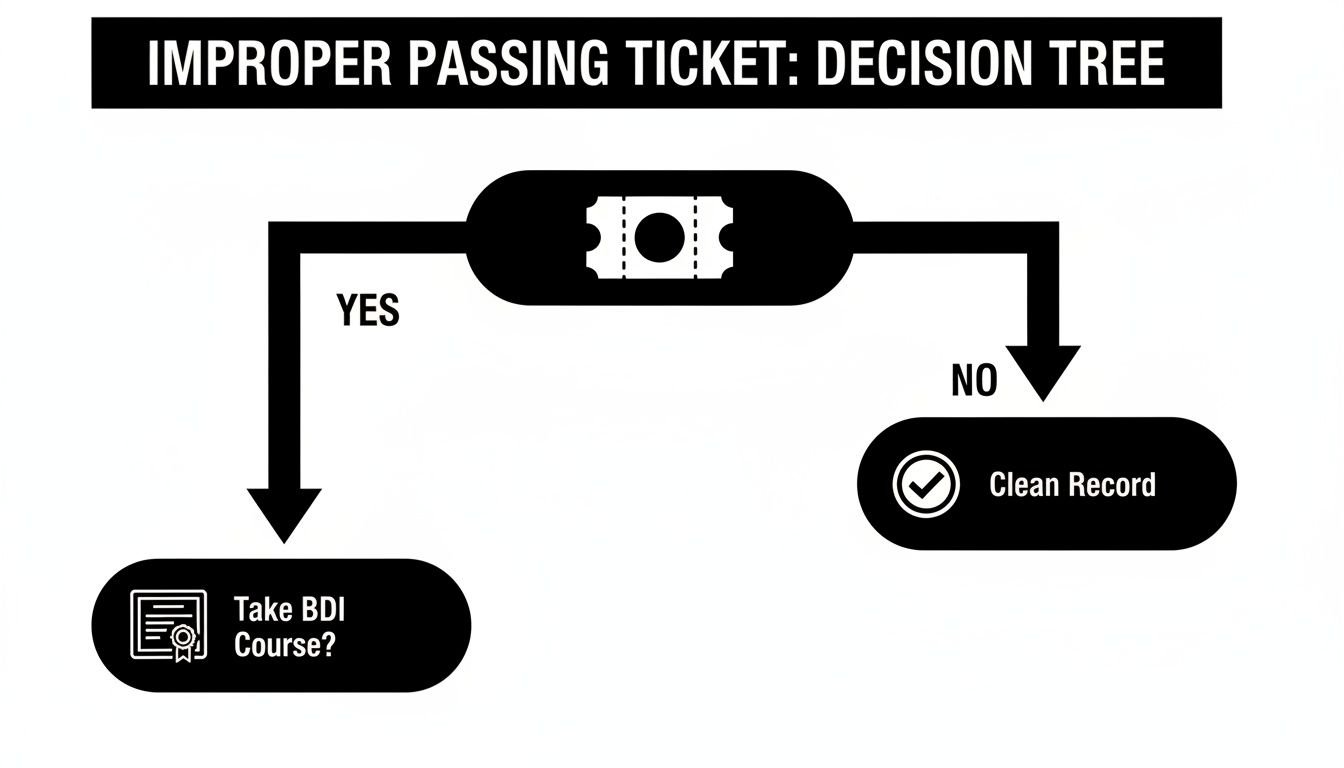
As you can see, the smartest route is clear: choosing to take a Basic Driver Improvement (BDI) course is the best way to keep points off your license and maintain a clean record.
Got a Ticket? Here’s How to Protect Your Driving Record
Getting a ticket for improper passing is a real gut-punch. It's not just the immediate fine; it's the points on your license, the potential insurance hikes, and the blemish on your driving record. It’s a situation that can quickly spiral, costing you a lot more than just the initial penalty.
But a ticket doesn't have to be a long-term problem. For Florida drivers, there's a smart, straightforward way to handle a moving violation like this: a state-approved Basic Driver Improvement (BDI) course. Think of it as hitting the undo button on that citation. It’s your best defense against the points and financial headache that follow.
Your Path to a Clean Record
Enrolling in a BDI course is a simple move with huge upsides. The main goal is to keep those pesky points off your license. No points means no negative report to your insurance company, which is the key to keeping your rates from skyrocketing.
Here’s exactly what our course helps you do:
- Prevent Points on Your License: When you pass the course, the state agrees not to add points for your violation. It's that simple.
- Avoid Insurance Rate Increases: Since no points are assessed, your insurance provider won't be notified, and you can avoid a costly premium hike.
- Satisfy Court Requirements: If a judge has ordered you to take a driver improvement course, our BDI program checks that box for you.
Taking a BDI course isn't an admission of guilt. It's a strategic move to take control of the situation. It’s the smartest financial and legal decision you can make after a passing-zone ticket.
Don't let one mistake on the road jeopardize your driving future. Our program is designed to be as painless as possible—it's 100% online and self-paced, so you can work on it whenever and wherever you want, without messing up your daily routine. You can turn this frustrating moment into a chance to refresh your knowledge and become a safer driver.
Ready to put this ticket in your rearview mirror? You can enroll in the Florida BDI course online right now and take the first step toward a clean driving record.
Answering Your Top Questions
Even the most seasoned drivers run into situations on the road that leave them scratching their heads. Let's clear up some of the most common questions we hear from Florida drivers about no-passing zones and what to do when you get a ticket.
Can I Pass a Super Slow Vehicle in a No-Passing Zone?
The short answer is almost always no. That solid yellow line means what it says—no passing, regardless of whether you're stuck behind a slow-moving truck or a tractor. The rule here is simple: patience is key until you see a broken yellow line indicating it's safe and legal to pass.
There is, however, a very specific exception. Florida law allows you to carefully cross the line to go around an obstruction like a bicyclist or a pedestrian. This is only permitted if the oncoming lane is completely clear and you can get around them without creating a risk for anyone.
What’s the Real Difference Between a Single and Double Solid Yellow Line?
Both markings mean "do not pass," but they communicate slightly different things about the road. A double solid yellow line is a universal stop sign for passing—it's forbidden for traffic going in both directions. Think of it as a two-way barrier.
Now, if you see a broken yellow line right next to a solid yellow one, the rule changes based on which side you're on. If the solid line is on your side, no passing for you. But if the broken line is on your side, you're free to pass when the coast is clear.
Does a BDI Course Make a Ticket Disappear from My Record?
This is a common point of confusion. Completing a state-approved Basic Driver Improvement (BDI) course doesn't actually wipe the ticket from your driving history. What it does do is arguably more important: it prevents the points from ever being added to your license.
Why does that matter so much? Because keeping points off your license is what helps you avoid a spike in your insurance premiums and protects you from a potential license suspension down the road.
A single ticket doesn't have to derail your clean driving record. At BDISchool, our state-approved online courses are the simplest and quickest way to keep points off your license and your insurance costs in check. You can protect your record and enroll in just a few minutes over at BDISchool.com.