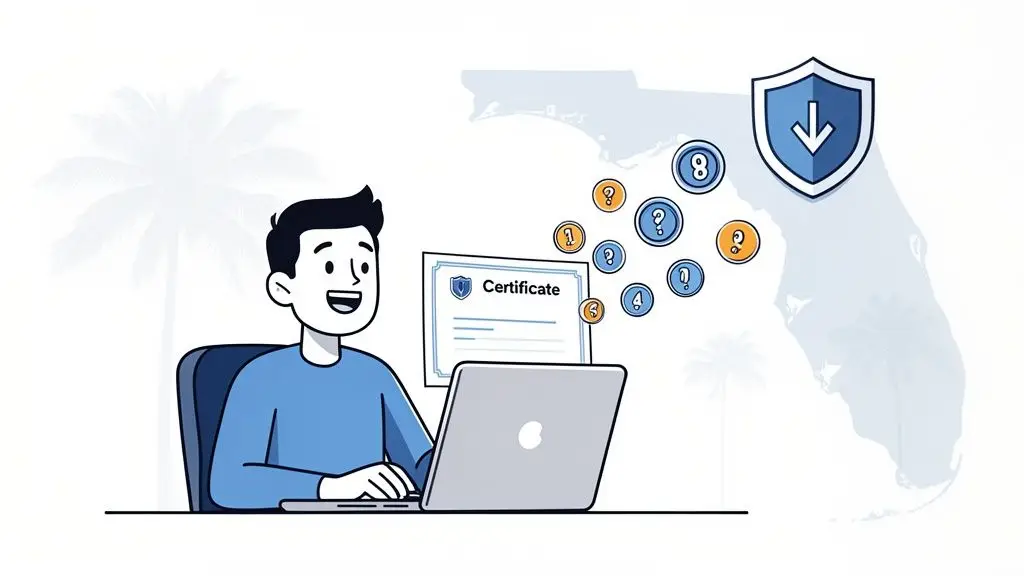
For Florida teens, getting a driver's license is a huge milestone. It’s a mix of pure excitement and, let’s be honest, a little bit of nerve-wracking responsibility. Online drivers ed for teenagers is now the go-to starting line for this journey, offering a flexible, state-approved way to knock out that first requirement without having to sit in a stuffy classroom. This guide is your family’s roadmap to making the whole process feel simple and straightforward.
Your Teen's First Step To Driving in Florida
That moment a teen gets their driver's license is a big deal, but the road to get there starts long before they ever turn the key. It begins with building a strong foundation—learning the rules of the road, understanding the real-world risks, and accepting the responsibilities that come with driving.
In Florida, this first step is a mandatory course. Choosing to do it online can turn what used to be a scheduling nightmare for parents into a convenient experience your teen can tackle at their own pace.

Why Proper Training Is Non-Negotiable
The freedom that comes with a driver's license is paired with very real risks, especially for new drivers. The statistics on teen driving can be sobering, which is why a thorough education isn't just a box to check—it’s a critical tool for keeping everyone safer on the road.
According to the National Highway Traffic Safety Administration (NHTSA), a staggering 2,148 young drivers aged 16-25 died in U.S. traffic crashes in 2023. That's a 5% jump from the year before. This is exactly why programs like those from BDISchool.com are so important for Florida teens getting ready to drive. You can discover more insights about these driving market trends and see why this training is vital.
Think of it this way: You wouldn't let someone operate a complex piece of machinery without first making them read the instruction manual. A quality online drivers ed course is that essential manual for the most dangerous machine your teen will ever use—a car.
We’re here to demystify the whole thing. We'll walk you through how state-approved online providers give you a modern, clear path to meeting Florida’s requirements. Consider this the guide that will take your family from course sign-up all the way to safely getting behind the wheel.
Our goal is simple: to make sure your teen starts their driving career on solid ground, equipped with the knowledge and confidence for a lifetime of safe driving. Let's get started.
What Is the Florida TLSAE Course?
So, your teen is ready to get their first Florida driver's license. As you start looking into the process, one of the very first things you'll run into is a requirement called the "TLSAE course." What on earth is that?
Think of it as the official rulebook for Florida's roads, built specifically for new drivers. Officially, it’s the Traffic Law and Substance Abuse Education (TLSAE) course, and it's a mandatory first step for anyone under 18 who wants to drive. You'll often hear it called the "drug and alcohol course," because a huge part of the curriculum is dedicated to the very real dangers of driving under the influence.
Ground School for New Drivers
The best way to understand its purpose is to think of it like ground school for a pilot. Before a pilot ever touches the controls of a plane, they have to spend hours in a classroom learning the theory—aerodynamics, navigation, weather, and what to do in an emergency. They build a solid foundation of knowledge on the ground long before they ever take to the sky.
That’s exactly what the TLSAE is for your teen. It’s not behind-the-wheel practice. Instead, it’s a four-hour, state-required program that teaches the core principles of safe driving before they even qualify for a learner's permit.
The TLSAE is all about the "why" behind the rules of the road. It doesn't just teach the speed limit; it explains why that limit exists and the physics that come into play during a crash. That deeper understanding is what helps build good judgment.
This is a critical distinction. The course ensures every new driver in Florida starts with the same fundamental understanding of traffic laws, road signs, and the serious risks involved in driving—especially when it comes to drugs and alcohol.
Key Benefits of an Online TLSAE Course
Taking this course online makes a mandatory step feel less like a chore and more like a genuinely helpful experience. It’s about meeting your teen where they are.
Choosing a state-approved online provider like BDISchool gives you some real advantages over an old-school classroom setting:
- Real-World Convenience: Your teen can complete the coursework right from home, the library, or anywhere with an internet connection. No more driving them to and from a scheduled class.
- Learn at Their Own Pace: Instead of being locked into a fixed schedule, your teen can work through the material at a speed that makes sense for them. They can take extra time on tricky subjects or breeze through concepts they already know.
- Engaging and Interactive Content: Let's be honest, a textbook on traffic laws is pretty dry. Modern online courses use videos, animations, and quick quizzes to keep things interesting and help the information stick.
Ultimately, the Florida TLSAE course is the first official part of a structured process designed to create safer, more aware young drivers. By understanding its role and taking advantage of a flexible online option, you can give your teen a strong, confident start to their driving journey. You can dive deeper into the specifics of this requirement in our guide on the Florida drug and alcohol course and see exactly how it fits into the licensing timeline.
Florida's Official Roadmap to a Learner's Permit
Trying to figure out Florida's driver's permit process can feel overwhelming, especially with a teenager eager to get on the road. It's easy to get lost in the details. We've been there, and we've guided countless families through it. Let's cut through the confusion and give you a straightforward, step-by-step plan.
First things first, your teen must be at least 15 years old to be eligible for a learner's permit. Before you can even think about heading to a Florida Department of Highway Safety and Motor Vehicles (FLHSMV) office, there are three essential tasks your teen needs to complete.
The 3 Core Permit Requirements
Getting a permit in Florida really comes down to checking three main boxes. If you miss one, you can't move forward. The good news is that the first two hurdles can be cleared right from your own home, which is why online drivers ed for teenagers has become such a popular and practical option.
Complete the TLSAE Course: This is the four-hour Traffic Law and Substance Abuse Education course. It's a mandatory first step and serves as the educational backbone for every new driver, covering the essential rules of the road and the serious risks involved.
Pass the Class E Knowledge Exam: This is the official written permit test. It’s a 50 multiple-choice question exam on Florida traffic laws, signals, and signs. Your teen needs to get at least 40 questions right—an 80% score—to pass. For anyone under 18, this test can be taken online through an approved provider.
Visit an FLHSMV Service Center: Once the course is done and the exam is passed, it’s time for an in-person visit. You'll bring your documents to an FLHSMV office or a local tax collector's office that handles driver licenses to finalize the process.
Here’s a quick visual of how it all comes together, showing the simple path from enrolling online to getting ready for your permit.

As you can see, using an approved online school makes the first two steps incredibly convenient, letting your teen work at their own pace.
Your Permit Checklist
To make sure you don't miss a thing, we've put together this simple checklist. Follow it closely to avoid any frustrating surprises or a second trip to the driver's license office.
Florida Learner's Permit Checklist
| Step | Action Required | Key Details & Tips |
|---|---|---|
| 1. Enroll & Complete TLSAE | Sign up for a Florida-approved online TLSAE course. | Make sure your provider is on the FLHSMV’s official list. They should report completion to the state automatically, but always keep a copy of the certificate for your records. |
| 2. Pass the Knowledge Exam | Take the 50-question Class E Knowledge Exam, either online or in person. | Many schools offer a bundle with the TLSAE course and the online exam. This is a great way to save time and knock out both requirements from home. |
| 3. Gather Your Documents | Collect all required identification and residency documents. | This is where people often get stuck. You need original documents or certified copies—photocopies won't be accepted. Check the FLHSMV "What to Bring" list before you go. |
| 4. Visit the DHSMV | Make an appointment at a service center to submit documents and get your permit. | During the visit, your teen will take vision and hearing tests, get their picture taken, and pay the fees. You'll also need a signed Parental Consent Form. |
Following these steps in order will set you up for a smooth and successful experience.
Preparing for Your DHSMV Visit
That final, in-person visit is where all your preparation truly counts. Trust me, nothing is more aggravating than waiting for an hour only to be turned away because you're missing one piece of paper.
A successful trip to the DHSMV is 90% preparation. Double-check every required document the night before your appointment. This single act can save you hours of time and a massive headache.
To make sure your visit goes off without a hitch, you'll need specific documents to prove your teen's identity, Social Security number, and residential address. For a complete, up-to-date checklist, take a look at our detailed guide on getting your Florida learner's permit. Getting the paperwork right is the final key to unlocking your teen’s driving journey.
How to Choose a Florida-Approved Online Course
Picking an online drivers ed for teenagers can feel a bit like searching for a needle in a haystack. A quick search brings up dozens of options, and they all start to look the same. So, how do you know which one is right for your teen?
The most important thing—and I can't stress this enough—is making sure the provider is officially approved by the Florida Department of Highway Safety and Motor Vehicles (FLHSMV). This isn't just a friendly suggestion; it's the law.
If you sign up for a course that isn't on the state's approved list, the completion certificate your teen earns won't be worth the paper it's printed on. You’ll be out the time and money, and you'll have to do it all over again with a legitimate school.
Think of FLHSMV approval as a stamp of quality. It’s the state’s way of saying, "We've checked this course, and it meets our standards for curriculum, support, and proper reporting."
This approval is your peace of mind. It ensures the course meets Florida’s requirements and that getting that learner's permit will be a smooth, straightforward process.
Green Flags to Look For
Once you're looking at a list of state-approved schools, you'll start to notice that some just feel more professional than others. These "green flags" are clues that you're dealing with a high-quality program.
- FLHSMV Approval: This is the big one. A good school will be proud of its state approval and display it clearly on its website. If you have to dig for it, that's a bad sign.
- Transparent Pricing: You should know exactly what you're paying for. A trustworthy provider won't hit you with surprise certificate fees or hidden charges later on.
- Positive Student Reviews: What are other Florida families saying? Look for real, honest feedback from parents and teens about their experience. Good customer service and an engaging platform are always great signs.
- Mobile-Friendly Platform: Let's be real—teens live on their phones. A course that works just as well on a smartphone as it does on a laptop gives them the flexibility to learn whenever and wherever they have time.
It’s no surprise that digital learning is booming. The Teen Driver Technology Market is expected to grow by a massive $1,745.19 million by 2032 as more families turn to these tools. With so much growth, it's more critical than ever to choose a well-vetted, high-quality online driving school. You can read more research on teen driver technology to see where the industry is headed.
Red Flags to Avoid
On the flip side, there are some obvious warning signs that should make you think twice. Spotting these "red flags" can save you from a huge headache.
Steer clear of any provider that shows these signs:
- "Guaranteed Pass" Claims: This is a huge red flag. No legitimate school can guarantee you'll pass the state exam. It's a cheap marketing tactic used by less-than-credible outfits.
- Outdated Website or Content: If the website looks like it was built in 2005 or talks about old traffic laws, the company isn't investing in its program. Driving rules and safety practices evolve, and the course content must keep up.
- Lack of Customer Support: Can you easily find a phone number or an email address? If it’s tough to get in touch with someone before you pay, just imagine how frustrating it will be if you need help later.
- Unusually Low Prices: Everyone loves a good deal, but a price that seems too good to be true usually is. These "bargain" schools often have terrible content or make up the difference with a mountain of hidden fees.
At the end of the day, this is about more than just checking a box for the state. A great course uses real-life scenarios, interactive lessons, and current information to build a solid foundation of safety awareness. It's an investment that doesn't just help your teen get a permit—it helps shape them into a safer, smarter driver for life.
A Look Inside the Online Drivers Ed Curriculum
So, what exactly is your teen learning when they log into an online drivers ed course? It's a fair question for any parent. Forget the idea of a dry, digital textbook. A well-designed course is more like a flight simulator for the brain, letting them practice critical thinking long before they're in the driver's seat.
The curriculum isn’t just a random collection of traffic rules. Every state-approved course is intentionally structured to build a solid foundation of knowledge. It’s about connecting the dots between an abstract rule and a real-world, split-second decision that could save a life. It gives them the "why" behind every "what" they'll do on the road.
Building the Foundation With Core Modules
Every Florida-approved TLSAE course is required to cover specific topics mandated by the state. These modules are the non-negotiable building blocks of your teen's driving education—the essentials they must master before even thinking about turning the key.
A typical curriculum is broken down into several key areas:
- Florida Traffic Laws: This goes way beyond simple speed limits. It dives into the nuances of right-of-way, how to navigate complex intersections, and the serious legal responsibilities that come with a driver's license.
- Road Signs, Signals, and Markings: Think of this as learning a new visual language. Students learn to instantly recognize and react to regulatory signs (like a stop sign), warning signs (like a curve ahead), and informational signs. This visual literacy is absolutely critical for safe navigation.
- Defensive Driving Principles: This might be the single most important part of the course. It’s where teens learn to be proactive, not reactive. They’re taught how to spot potential hazards early, maintain a safe buffer zone around their car, and constantly manage their space to avoid trouble.
These aren't just pages of text. The concepts are brought to life through animations, quick videos, and relatable scenarios, which helps make the information stick.
The true power of modern online drivers ed is its ability to bridge the gap between theory and reality. Interactive quizzes and simulated driving challenges help a teen connect a rule they see on a screen to a decision they'll have to make going 45 miles per hour.
This hands-on approach keeps your teen actively involved, ensuring they truly understand the material instead of just passively reading it.
Tackling Today’s Most Urgent Driving Dangers
Beyond the fundamentals, a high-quality curriculum focuses on the specific issues that pose the greatest risk to new drivers. Today’s best courses put a heavy emphasis on the behavioral and psychological side of driving.
Two topics get special, in-depth attention:
The Science of Impaired Driving: The course lays out the hard science of how drugs and alcohol hijack the brain and body. It covers delayed reaction times, poor judgment, and the life-altering legal and personal fallout from a DUI. The goal is to debunk myths with cold, hard facts.
The Reality of Distracted Driving: This module goes far beyond a simple "don't text and drive" warning. Modern online drivers ed for teenagers uses powerful, sobering statistics and real-world scenarios to illustrate how a few seconds of looking away can lead to disaster.
The battle against distracted driving is more urgent than ever. A recent survey found that 1 in 3 teens aged 16 and older admitted to using their phone while driving within the last month. Even more troubling, 1 in 10 teens say the adults driving them 'almost always' use their phones, setting a terrible and dangerous example. You can read the full research on teen driver distraction to see just how vital this part of the training is.
By tackling these subjects head-on, the curriculum moves beyond teaching technical skills and starts building safe driving character—an education designed to guide a lifetime of smart choices.
From Permit to License: Your Role as a Parent
Once your teen finishes their online drivers ed for teenagers, it’s a big milestone, but it’s really just the beginning. The knowledge they’ve picked up is the textbook theory. Now, your job evolves from cheerleader to full-time co-pilot as they transition from the screen to the street.

You are now the most important coach your teen will ever have. This is where classroom rules become real-world habits—the kind that stick for a lifetime. Your guidance is what makes the difference between a teen who just knows the rules and one who can actually apply them safely under pressure.
Mastering the Supervised Driving Requirement
Florida law is crystal clear about what comes next. Before your teen can even think about getting their provisional driver's license, they must log a specific number of practice hours with a licensed adult who is 21 years or older. This isn't a friendly suggestion; it's a non-negotiable requirement.
The state mandates a minimum of:
- 50 total hours of supervised, behind-the-wheel driving.
- At least 10 of those 50 hours must be driven at night.
This supervised period is crucial. It’s designed to expose your new driver to all kinds of road conditions, traffic, and weather, all while you're right there to provide immediate feedback. You’ll have to formally certify these hours have been completed when they go for their driving test.
Structuring Practice for Success
Just driving around to rack up hours isn't the point. The quality of that practice time is what builds a safe driver. Your role is less about being a passenger and more about being an active, hands-on instructor. Treat every trip, even just to the grocery store, as a mini-lesson.
A great way to build confidence is to start small and work your way up:
- Empty Parking Lots: Begin in a wide-open, safe space. This is perfect for getting a feel for the car—practicing smooth starts and stops, turns, and of course, parking.
- Quiet Residential Streets: Once they've mastered the basics, move to low-traffic neighborhoods. Here, they can focus on staying in their lane, obeying speed limits, and spotting pedestrians without feeling overwhelmed.
- Heavier Traffic and Night Driving: Gradually introduce more complex scenarios. This means tackling multi-lane roads, navigating busier intersections, and learning to handle the unique challenges that come with driving after dark.
Your main job as co-pilot is to stay calm and give clear, constructive feedback. Narrate the road ahead. For instance, say, "Okay, see that green light up there? It's been green for a while, so start covering your brake in case it changes."
This approach teaches a teen driver how to develop true situational awareness—the skill of spotting potential problems before they escalate. To help keep things on track, you might want to look into some of the top apps for promoting safe driving to monitor progress and reinforce good habits.
The Driving Skills Test and Beyond
After your teen has held their learner’s permit for at least one full year (or until they turn 18, whichever comes first) and has the 50 practice hours logged, they're eligible to take the official road test. In the weeks leading up to it, be sure to practice the specific skills they’ll be tested on, like three-point turns, quick stops, backing up, and parallel parking.
Finally, don’t forget to get rewarded for all that hard work. Completing a state-approved course almost always makes you eligible for a "driver training" discount on your auto insurance. As soon as that license is in hand, give your insurance agent a call with the course completion certificate ready. That one phone call can lead to some pretty significant savings, proving that a good online drivers ed for teenagers is an investment that pays you back.
Your Top Questions About Teen Drivers Ed, Answered
It's completely normal for both parents and teens to have a lot of questions when it comes to getting that first driver's license. To make things a little easier, we’ve tackled some of the most common ones we hear about online drivers ed for teenagers in Florida.
How Long Does the Online Drivers Ed Course Take?
The state of Florida requires the TLSAE course to be a minimum of four hours long. But here’s the great part about doing it online: your teen doesn't have to tackle all four hours in one go.
The course is built for real life. They can log in and out as needed, fitting lessons in between schoolwork, soccer practice, or whatever else fills their schedule. Many teens actually find it easier to absorb the material this way. Once they finish, the provider handles the paperwork and reports it directly to the FLHSMV for you.
Can My Teen Take the Permit Test Online Too?
Yes, absolutely. In Florida, anyone under 18 can take their Class E Knowledge Exam—which is the official permit test—online. This is done through an approved third-party provider and is technically a separate item from the TLSAE course, but they often go hand-in-hand.
A lot of driving schools, including BDISchool, offer a convenient package deal that bundles the TLSAE course with the online permit exam. This is a popular choice because your teen can knock out both major requirements right from home, really simplifying the whole process.
Getting both the course and the exam done online is one of the fastest ways to get on the path toward a learner's permit.
What Happens After My Teen Passes the Course?
Once your teen completes their online course, the next steps are pretty straightforward. The course provider will automatically send their completion record over to the Florida Department of Highway Safety and Motor Vehicles (FLHSMV). You don’t have to do a thing—this is what officially checks the box for their educational requirement.
With that done, your teen is all set for the next big milestone: passing the Class E Knowledge Exam (if they haven't already). After that, it’s time to head to a DHSMV service center with all your documents to get that learner's permit in hand.
Will This Course Lower Our Car Insurance Premiums?
There's a very good chance it will. Most insurance companies in Florida offer some kind of "driver training" or "good student" discount for new drivers who have finished a state-approved course like the TLSAE. Your teen’s completion certificate serves as the proof you'll need.
Of course, the exact discount and the rules vary from one insurer to another. The best thing to do is simply call your insurance agent. Tell them your teen has completed the course and ask them directly what kind of savings you can expect.
Ready to get your teen started on the right foot? BDISchool offers a Florida-approved online TLSAE course that's convenient, engaging, and designed to prepare them for a lifetime of safe driving. Enroll today and take the first step. Learn more at bdischool.com