It’s helpful to think of the points on your license like a running score for your driving. Every time you get a ticket for a traffic violation, points get added to your record. If you rack up too many, you'll face some pretty serious consequences, from expensive insurance hikes to losing your license entirely.
Getting a handle on how this system works is your best defense for keeping your driving privileges intact.
What License Points Really Mean For Florida Drivers
Florida's driver's license point system isn't just about handing out penalties. At its core, it's a statewide framework built to encourage safer driving and identify motorists who consistently put others at risk.
The logic is straightforward: the more dangerous the violation, the more points you get. These points create an official history of your driving habits, one that both the state and your insurance company can see.
More Than Just a Number
It's tempting to just pay a ticket and forget about it, but the points that tag along have a much longer shelf life. They directly impact how insurers see you—as a bigger risk—which often translates to a painful spike in your premiums. We're not talking about a few dollars; this can cost you hundreds or even thousands over the next few years.
Then there's the biggest threat: your license itself. Accumulating points puts your ability to drive in real jeopardy. The system is designed with built-in warnings, but if you ignore them, the consequences escalate until you’re facing a suspension that can throw a major wrench into your life and job.
A point-based driving license system is a proven method for improving road safety. Global research shows these systems contribute to a 21% reduction in negative outcomes like accidents and injuries, demonstrating their effectiveness in promoting safer driving habits. You can learn more about these global safety findings in the full study.
You Have Control Over Your Record
The good news? You're not just a passenger here. You have real options to protect your driving record and soften the blow of a traffic ticket.
By understanding how the system works, you can make smarter choices. For example, for many common violations, you can choose to take a Basic Driver Improvement (BDI) course from BDISchool. Completing the course can prevent points from ever hitting your license in the first place, keeping your record clean and your insurance rates from climbing.
Point systems like Florida's are used all over the world to keep roads safer. If you're curious about how another place handles it, you can see how the Careless Driving Demerit Points Ontario system works up in Canada.
How the Florida Driver's License Point System Works
If you've ever gotten a traffic ticket in Florida, you've probably heard about "points." But what are they, really? Think of the Florida point system as a way for the state to keep track of high-risk drivers. It’s not just about the fine you pay; it’s about your overall driving behavior.
Each time you're convicted of a moving violation, the Florida Highway Safety and Motor Vehicles (FLHSMV) adds a set number of points to your license. The more serious the offense, the more points you get. This is the state’s official scorecard for your driving habits.
Florida Traffic Violation Point Values
So, how much trouble is one ticket? It all depends on the violation. A minor speeding infraction is one thing, but reckless driving is in a completely different league. Knowing exactly what you're up against is key.
Here’s a quick reference guide to see how points are assigned for some of the most common tickets you might see in Florida.
Florida Traffic Violation Point Values
| Violation Type | Points Assigned |
|---|---|
| Leaving the scene of an accident (damage >$50) | 6 points |
| Speeding resulting in an accident | 6 points |
| Reckless driving | 4 points |
| Running a red light or stop sign | 4 points |
| Speeding (16+ MPH over the limit) | 4 points |
As you can see, serious violations carry heavy penalties. For a more complete breakdown, you can learn more about the full Florida traffic ticket point system and check the value of other specific infractions.
The Real Danger: How Quickly Points Add Up
One ticket might not seem like a big deal, but the real trouble starts when points begin to stack up. Florida has a very clear-cut system for suspending your license based on how many points you accumulate in a certain timeframe.
If you get too many points in a set period, a license suspension isn't a possibility—it's automatic. The state doesn't negotiate once you hit these numbers.
The system works on a rolling basis, meaning the state is always looking at your record over the last few years.
- 12 points in a 12-month period = 30-day suspension
- 18 points in an 18-month period = 3-month suspension
- 24 points in a 36-month period = 1-year suspension
It’s easier to hit these limits than you might think. For example, just three 4-point tickets—like running a red light and a couple of speeding violations—within a year is enough to get your license suspended for a month.
And don't forget about your insurance company. While a suspension is a state penalty, those points stay on your driving record for 3 to 5 years for insurance purposes. That means one bad decision on the road can lead to years of higher premiums. This is exactly why it’s so important to handle every single ticket with care.
The True Cost Of Accumulating License Points
That dollar amount printed on your traffic ticket? Think of it as just the down payment. The real financial sting from getting points on your license comes later, often quietly hitting your bank account for years to come.
For insurance companies, these points are more than just numbers; they’re red flags. Each point signals that you're a higher risk to insure, and insurers are all about managing risk.
Once new points pop up on your driving record, you can bet your insurance provider will take notice. Their data shows a clear link between drivers with recent tickets and drivers who file expensive claims. This increased risk gets passed directly onto you through higher premiums. A single speeding ticket can easily trigger a rate hike that costs you hundreds, or even thousands, of dollars over the three to five years the violation typically stays on your record.
The Ripple Effect On Your Insurance Premiums
Your driving record is a lot like a credit score, but for the road. Just like a late payment dings your credit, a traffic ticket with points damages your driving history. To an insurer, this makes you a bigger liability.
How much will your rates go up? That depends on a few things, like the severity of the violation and your specific insurance company. But one thing is for sure: the impact is almost always noticeable. Some major violations can even cause your rates to double. If you want to dig deeper, you can learn more about how points affect your insurance and what you can do to fight back.
This chart gives you a quick look at the point values for some of the most serious offenses here in Florida.
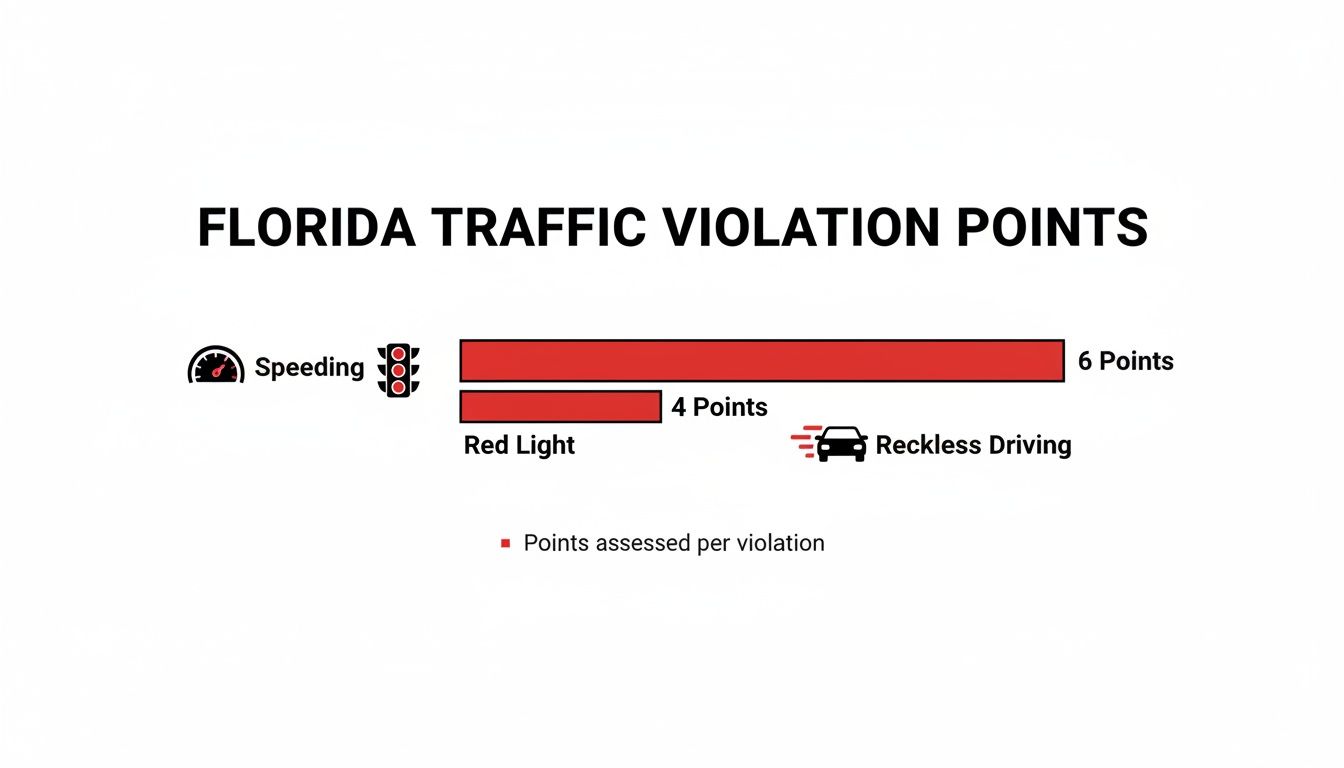
As you can see, high-risk moves like reckless driving or serious speeding pack a heavy punch, racking up points that push you closer to a license suspension and painful insurance hikes.
Beyond The Financial Burden
The consequences of too many points go way beyond your wallet. The fallout can create a domino effect, touching parts of your personal and professional life you might not expect.
The stress of a potential license suspension can be overwhelming. You're left constantly worrying about how you'll get to work, pick up your kids, or just run basic errands. Losing your driving privileges, even temporarily, can throw your entire life into chaos.
On top of that, a lot of jobs require a clean driving record. If your work involves a company car, making deliveries, or operating machinery, your employer will be looking closely at your driving history. A few too many points on your license could slam the door on a great career opportunity or even put your current job at risk.
This is why dealing with a ticket isn't just about avoiding a fine—it's about protecting your license, your budget, and your future.
How To Check The Points On Your Florida License
Think of your driving record as your driving report card. The only way to know where you stand is to look at it, which is why regularly checking the points on your license is one of the smartest things any Florida driver can do. You can’t fix a problem if you don’t even know it’s there.
Thankfully, Florida doesn't make you jump through hoops to see your record. The Florida Department of Highway Safety and Motor Vehicles (FLHSMV) provides a complete history that shows any violations, court outcomes, and, most importantly, your current point total.
Requesting Your Florida Driving Record
Getting a copy of your record is pretty straightforward, and you have a few ways to do it. Just pick the one that fits your life best.
- Online: This is the fastest method by far. Head over to the FLHSMV website, have your driver's license number and a credit card ready, and you can usually get your record instantly.
- In-Person: If you prefer doing things face-to-face, you can stop by any Florida driver license service center. Just remember to bring a valid ID with you.
- By Mail: For those who like a paper trail, you can download a request form from the FLHSMV site and mail it in with the fee.
Whichever path you choose, you’ll get a detailed report. For a full walkthrough of the process and what to look for, take a look at our complete guide on how to check points on a license.
Pro Tip: Always double-check your driving record for accuracy. Mistakes can happen, and a clerical error could end up costing you with higher insurance premiums or even a wrongful suspension if you don't catch it early.
How to Read Your Driving History
Once you get your hands on the report, you'll see it's more than just a single number. It’s a full history of your traffic tickets, showing the dates, the specific violations, and what happened—whether you paid the fine, were found guilty in court, or got the case thrown out.
Scan the document for a section that lists your point total. This is the magic number that tells you how many active points on your license are counting toward a potential suspension. Go through each entry line by line and make sure it all lines up with your own records. If something looks wrong, you have the right to dispute it.
Your Best Move for Removing Points With a BDI Course
Getting a traffic ticket is a frustrating experience, but it doesn't have to be a permanent stain on your driving record. Thankfully, Florida law gives eligible drivers a powerful way to handle the situation: a state-approved Basic Driver Improvement (BDI) course.
Think of it as hitting the reset button. By completing a BDI course, you're not just dealing with one ticket. You’re taking a proactive step to keep your record clean, sidestep a potential insurance rate hike, and sharpen your defensive driving skills.
How Does a BDI Course Work?
When you get a non-criminal moving violation in Florida, you have a few paths you can take. You can simply pay the fine and accept the points, or you can fight the ticket in court. But often, the smartest choice for your wallet and your record is electing to attend traffic school.
The process is straightforward:
- Notify the Court: First, you have to tell the Clerk of Court in the county where you got the ticket that you plan to take a BDI course. You must do this within 30 days of the citation date.
- Pay the Fine: Even though you're taking the course, you'll still need to pay the ticket's civil penalty when you notify the court.
- Enroll and Complete the Course: After you've made your election, you’ll have a deadline—usually between 60 and 90 days—to sign up for and finish a state-approved BDI course.
Once you pass, the school reports your completion to the state, and the court withholds the "adjudication of guilt." In plain English, that means no points are added to your license for that violation. You can easily enroll in our Florida-approved online BDI course to get this process started today.
Who Is Eligible to Take Traffic School?
While a BDI course is an excellent tool, it's not a free-for-all. Florida has some ground rules to make sure the option is used fairly.
You can generally choose to take a BDI course if:
- You hold a valid, non-commercial driver's license.
- Your ticket was for a non-criminal moving violation.
- You haven't taken a BDI course to dismiss a ticket in the last 12 months.
- You have not used this option more than five times in your lifetime.
Taking a proactive approach to a ticket is crucial. With violations on the rise globally, protecting your record is more important than ever. For instance, the United Kingdom saw a staggering 243% increase in driving points from 2021 to 2024, highlighting a worldwide trend toward stricter enforcement.
Because your opportunities are limited, it’s a smart strategy to save your BDI election for a violation that carries more significant points on your license.
The Benefits Are Clear and Immediate
Opting for a BDI course delivers real, tangible benefits that extend well beyond a single ticket. The most obvious win is avoiding points, which is the key to preventing your insurance company from jacking up your rates because of the violation.
Beyond that, the course itself is a fantastic refresher. You'll brush up on defensive driving techniques, get reacquainted with Florida traffic laws, and learn practical strategies for staying safe on the road. With modern online courses from BDISchool, you can do it all from the comfort of your home, and even choose your preferred language—English, Spanish, or Portuguese. This makes it incredibly easy for any eligible Florida driver to protect their record and become a better, safer driver.
Proactive Habits For A Clean Driving Record
The best way to deal with points on your license is, of course, to never get them in the first place. While things like traffic school are great for cleaning up a mess after the fact, the real secret is building solid, safe driving habits for life.
This isn't about learning fancy driving maneuvers. It's about making smart, conscious choices every single time you turn the key. Think of it as defensive driving—a mindset that's all about being aware of your surroundings and anticipating what other drivers might do. It keeps you one step ahead of trouble.
Foundational Defensive Driving Techniques
You'd be surprised how much of a difference a few core habits can make. If you want to dramatically lower your odds of getting a ticket or being in an accident, start here:
- Maintain a Safe Following Distance: The classic three-to-four-second rule isn't just a suggestion; it's a lifesaver. That gap between you and the car ahead is your safety buffer, giving you the time you need to react to a sudden stop without slamming on the brakes.
- Manage Your Speed Effectively: Pay attention to the conditions, not just the posted speed limit. If it's raining, traffic is heavy, or you're in a construction zone, that's your cue to ease off the gas and give yourself more control.
- Eliminate Distractions: This one's huge. Put the phone away, get your GPS set before you start moving, and keep your eyes on the road. A single second of looking away is all it takes to cause a collision you could have easily avoided.
Even with the best habits, accidents can happen. If you find yourself in that situation, knowing how to file an auto insurance claim is crucial for handling the aftermath and protecting yourself financially.
Staying Aware and Prepared
Being a defensive driver also means understanding the bigger picture, including how traffic laws are enforced. A fascinating 2025 study of rideshare drivers in Florida revealed that racial or ethnic minority drivers were 24% to 33% more likely to get a speeding ticket than white drivers, even when traveling at the same speed. This highlights why thorough driver education is so important—it gives every driver the tools to minimize violations and protect their record. You can Read the full research about these traffic enforcement findings for more detail.
A well-maintained vehicle is a safe vehicle. Regular checks on your tires, brakes, lights, and wipers are not just good for your car—they are essential components of road safety that can help you avoid equipment-related violations.
At the end of the day, a clean driving record comes down to being consistent and mindful. By making these proactive habits part of your routine, you’re not just driving safer—you're taking control and drastically reducing the chances you'll ever have to worry about points again.
Common Questions About the Florida Points System
When you're dealing with a traffic ticket, a lot of questions can pop up about how points work. Let's clear up a couple of the most common ones Florida drivers ask.
How Many Times Can I Take a BDI Course To Avoid Points?
You have a limited number of chances to use a Basic Driver Improvement (BDI) course to wipe points from a ticket. In Florida, the rule is you can take the course once every 12 months.
There's also a lifetime limit: you can only use this option a total of five times. So, it’s a good idea to save it for when you really need it and always double-check that you're eligible before you sign up.
Do Points From a Ticket in Another State Transfer to My Florida License?
Yes, they almost always do. Florida is part of an agreement with most other states called the Driver License Compact.
Think of it as a data-sharing plan for traffic violations. If you get a ticket in another member state, they'll report it back to Florida, and those points will likely end up on your Florida license just as if you got the ticket at home.
A quick heads-up: If the court allows you to take a BDI course, make sure you finish it by the deadline they give you. Missing that date is a big deal. The points will go on your record, you could get hit with more fines, and you might even have your license suspended. Don't let it slide—get it done on time.
At BDISchool, our state-approved online courses are the easiest way to take care of a ticket, keep points off your license, and stop your insurance from going up. Protect your driving record and enroll in a BDI course today.