In Florida, your license can get suspended for all sorts of reasons. Most people think of major offenses like a DUI or racking up too many points on their record. But honestly, a lot of drivers are blindsided when they find out their license was suspended for something that didn't even happen behind the wheel, like unpaid court fines or missing a court date.
The Unexpected Problem of a Suspended License
Finding out your driver’s license is suspended is almost always a shock. One minute you're heading to work, the next you’re pulled over and handed a ticket for something far more serious than a broken taillight. Because driving is a privilege in Florida, not a right, losing it throws a major wrench into your life.
If you're feeling overwhelmed, that's completely normal. The good news is there’s a way to fix this. Think of this guide as your roadmap—it’s here to help you figure out exactly why your license was suspended and walk you through the steps to get it back.
Navigating the Suspension Process
The very first step is figuring out why you were suspended. It’s not always about reckless driving; sometimes, it’s just an administrative slip-up that snowballed. For example, many drivers don't realize there's often an immediate license suspension after a DWI arrest, long before a conviction.
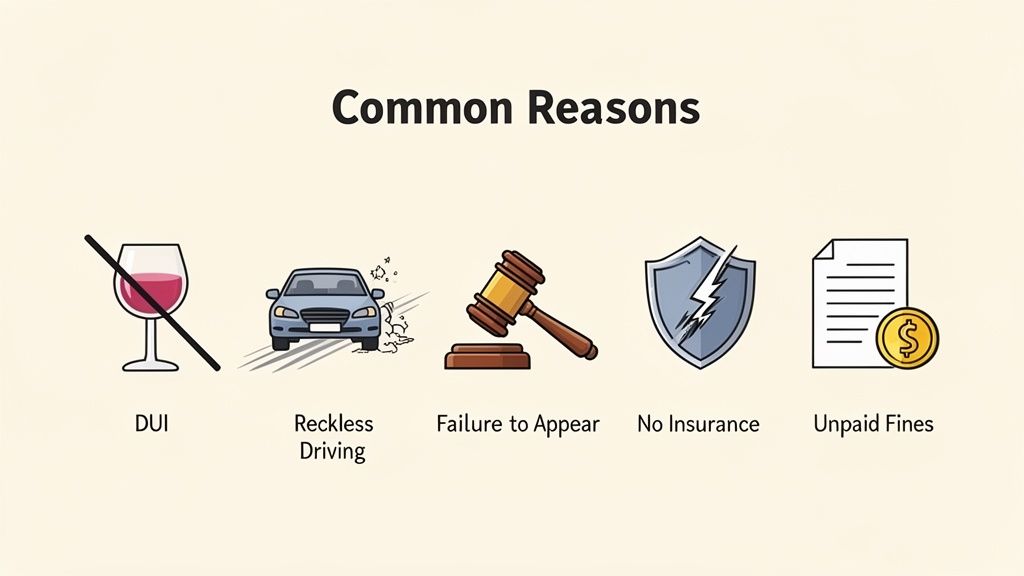
The reasons for a license suspension in Florida typically fall into a few main buckets:
- Driving-Related Offenses: This is the obvious stuff—getting too many points, a DUI conviction, or causing a crash when you don't have insurance.
- Administrative Violations: These are the ones that catch people by surprise. Things like failing to pay traffic tickets, not showing up for a court date, or even falling behind on child support.
- Medical Reasons: In some cases, certain medical conditions that could affect your ability to drive safely can lead to a suspension.
Dealing with the Florida Highway Safety and Motor Vehicles (FLHSMV) can seem intimidating, but if you take it one step at a time, it's manageable. The key is to fix the original problem, complete whatever the state requires, and get your driving privileges back legally.
This guide will break down the most common reasons for suspension one by one. We'll also cover the real-world consequences and give you a clear plan for reinstatement. We’ll even explain how state-approved traffic courses can be a key part of getting back on the road.
If you’re unsure about your current status, a good starting point is to find out how to check if your license is suspended. By the time you're done reading, you'll have the information you need to tackle this head-on.
Why Your Florida Driver's License Gets Suspended
Let's be honest—a suspended license rarely comes out of the blue, even when it feels like a total surprise. The Florida Department of Highway Safety and Motor Vehicles (FLHSMV) doesn't suspend licenses randomly; there's always a reason. Knowing what triggers a suspension is the first and most important step in protecting your freedom to drive.
Think of your driver's license as a privilege, not a right. It's an agreement between you and the state of Florida. As long as you drive safely and handle your legal responsibilities, you're good to go. But when that agreement is broken, the state can and will hit the pause button on your driving privileges.
So, let's get into the nitty-gritty of why that happens.
Too Many Points on Your Record
Florida's point system is basically a scorecard for your driving habits. Every time you're convicted of a moving violation, points get added to your license. The worse the offense, the more points you get. If you collect too many points in a set period, a suspension is automatic. No ifs, ands, or buts.
Here’s the breakdown:
- 12 points in 12 months = 30-day suspension
- 18 points in 18 months = 3-month suspension
- 24 points in 36 months = 1-year suspension
These points can sneak up on you fast. For instance, a single ticket for speeding that causes an accident can dump 6 points on your record. Get just two of those in a year, and your license is suspended. To see the full picture, check out our guide on how many points it takes to get your license suspended in Florida.
Florida License Suspension Triggers at a Glance
To make it even clearer, here’s a quick-reference table that sums up some of the most common reasons drivers lose their licenses in Florida.
| Violation Type | Typical Suspension Period (Varies by Case) | Reinstatement May Involve BDISchool Course? |
|---|---|---|
| Too Many Points | 30 days to 1 year | Yes, court-ordered ADI course is often required. |
| DUI (First Offense) | 180 days to 1 year | Yes, DUI school is mandatory. |
| No Auto Insurance | Indefinite, until proof of insurance (SR-22) | No, but essential for getting back on the road. |
| Unpaid Traffic Fines | Indefinite, until paid | Yes, if the court also requires a course. |
| Failure to Appear | Indefinite, until resolved with the court | Yes, often part of the resolution. |
| Reckless Driving | Varies, per court order | Yes, ADI is frequently required. |
This table is a starting point, of course. Every situation is unique, but it highlights just how crucial it is to address any driving-related issue head-on.
Serious Driving Offenses
Some mistakes on the road are so dangerous they can lead to an immediate suspension, no matter how clean your record was before. These are the major league offenses, and Florida takes them very seriously.
The one everyone knows is Driving Under the Influence (DUI). A first-time conviction can get your license suspended for 180 days to one year. Just refusing to take a breath, blood, or urine test when asked by law enforcement? That's an automatic one-year suspension right there.
Other big ones include:
- Reckless Driving: This isn't just a mistake; it's driving with a willful disregard for everyone's safety.
- Fleeing a Law Enforcement Officer: Trying to outrun the police is a surefire way to lose your license.
- Hit-and-Run: Leaving the scene of an accident, especially one with injuries, has severe consequences.
These aren't just traffic tickets. They are criminal offenses that can lead to jail time, massive fines, and a criminal record that follows you around for life—on top of losing your license.
Money and Insurance Problems
Believe it or not, a lot of suspensions have nothing to do with how you drive. They're about failing to meet your financial obligations. These are the ones that often catch people completely off guard.
A huge one is failing to have car insurance. If you cause an accident and you're not insured, the FLHSMV will suspend your license until you prove you're financially responsible, which usually means getting a special insurance form called an SR-22.
Other money-related issues include:
- Unpaid Traffic Tickets: Ignoring a ticket is the worst thing you can do. The court will eventually tell the FLHSMV, and your license will be suspended until you pay up.
- Failure to Pay Court-Ordered Fines: This isn't limited to traffic court. Other unpaid legal debts can also come back to haunt your driving privileges.
Court and Paperwork Issues
Finally, your license can get suspended for simply failing to follow through with the legal process. This is less about your driving and more about your follow-through.
The most common culprit here is a Failure to Appear (FTA) in court. If you get a ticket that requires a court appearance and you blow it off, the judge can order an immediate suspension.
In the same vein, a Failure to Comply with a court's instructions—like not finishing a mandatory traffic school course on time—can also result in a suspension. The state uses your license as leverage to make sure you follow the rules. Knowing what can go wrong is the best way to keep yourself on the right side of the law and on the road.
Understanding Non-Driving Related Suspensions
It’s a costly and surprisingly common mistake to assume your driving record is only about what happens behind the wheel. In Florida, your driver's license is often used as a tool to enforce court orders and financial responsibilities that have absolutely nothing to do with traffic safety.
These non-driving suspensions frequently catch people completely off guard. Suddenly, you're in a tough spot where the solution feels just out of reach, and you can't legally drive.
Think of your license as more than just a piece of plastic; it's a key that unlocks your ability to work, pay bills, and just live your life. When the state takes that key away for reasons unrelated to your driving habits, it can feel both confusing and deeply unfair. Let's break down why this happens so you can protect your driving privileges.
Financial and Legal Obligations
The number one reason for a non-driving suspension is failing to keep up with financial or legal requirements. These are often small issues that, when ignored, snowball into major problems that directly threaten your license. It's a bit like a library book: forget to return it, and you get a small fine. But if you ignore that fine for months, you can lose your borrowing privileges altogether.
Here are the most common triggers in Florida:
- Failure to Pay Child Support: Florida takes child support enforcement very seriously. If you fall significantly behind, the Florida Department of Revenue can order the FLHSMV to suspend your driver's license until you make arrangements to pay what you owe.
- Unpaid Court Fines: This goes way beyond traffic tickets. Any unpaid fines from other civil or even criminal court cases can lead to a license suspension. The court system uses this as powerful leverage to make sure fines get paid.
- Failure to Appear in Court: If you're ordered to appear in court for any reason—traffic or not—and you fail to show up, a judge can issue a "Failure to Appear" notice. This notice almost always triggers an immediate suspension of your license.
This isn't just a Florida issue; it highlights a nationwide trend. A study of New Jersey drivers, for instance, found something shocking. Of the 424,869 individuals with suspended licenses in 2018, an incredible 91% of those suspensions were for issues unrelated to driving. You can learn more about these findings on license suspensions and traffic safety.
The Unintended Cycle of Suspension
While the goal is to enforce accountability, these policies can trap drivers in a frustrating cycle. Losing your license makes it incredibly difficult to get to work. That, in turn, makes it even harder to earn the money you need to pay the original fine or support obligation that caused the suspension in the first place.
This vicious cycle can keep people in a state of suspended driving privileges, turning a small financial hurdle into a mountain that feels impossible to climb.
The real problem is that a tool originally meant for public safety—getting dangerous drivers off the road—is now widely used for debt collection and administrative enforcement. Understanding this is the first step to figuring out the system.
Fixing these types of suspensions means going straight to the source. It’s not about taking a driving course; it’s about contacting the specific court or agency that put the hold on your license. You'll either need to pay the outstanding balance in full or negotiate a payment plan to get your license reinstated. Being proactive and communicating with the right authorities is the only way to break the cycle and get back on the road legally.
The Real-World Consequences of a Suspended License
Let's be honest: losing your driving privileges is far more than a simple legal headache. It’s a problem that can pull at the threads of your daily life until things start to unravel. A license suspension often sets off a domino effect, where one small inconvenience snowballs into serious personal and financial trouble.
The first thing you'll notice is the hit to your freedom. Everyday tasks you never thought twice about—running to Publix, picking up a prescription, or getting the kids to soccer practice—suddenly become major logistical hurdles. You're left depending on public transportation, pricey rideshare services, or the kindness of friends and family, which can put a real strain on your relationships and your bank account.
The Impact on Your Job and Finances
For most of us in Florida, our car is our lifeline to our job. A suspended license can be a direct threat to your employment, especially if driving is part of your job description. But even if you work in an office, just consistently getting there on time can turn into a daily battle.
This struggle with transportation can quickly trap you in a cycle of financial instability. The costs pile up faster than you’d think:
- Higher Transportation Costs: Daily fares for the bus, Ubers, and Lyfts can drain your budget in a hurry.
- Risk of Losing Your Job: If you can't get to work reliably, your job could be on the line, cutting off your main source of income.
- Trouble Finding a New Job: Many applications ask if you have a valid driver's license. Answering "no" can close a lot of doors.
The financial pressure is often made worse because many suspensions happen because of unpaid fines in the first place. In Michigan, for instance, Failure to Appear charges were behind 70% of license suspensions in recent years. This creates a catch-22 where people can't drive to work to earn the money they need to pay the very fines that got their license suspended. You can read more about how debt-based suspensions create barriers and trap people in this cycle.
Skyrocketing Insurance Premiums
Even after you've jumped through all the hoops to get your license back, the financial fallout isn't over. Insurance companies see a license suspension as a massive red flag, immediately branding you a high-risk driver.
A suspension on your record is a near-guarantee that your car insurance premiums will shoot up. Many insurers will also require you to get an SR-22 certificate—basically, a document that proves you have the state-mandated minimum liability coverage. This alone can keep your rates painfully high for years.
This insurance hike isn’t just a short-term slap on the wrist; it’s a long-term financial burden that makes the simple act of driving more expensive than ever. To get a clearer picture, you can check out our guide on how points on your record affect insurance costs.
When you add it all up—reinstatement fees, original fines, legal costs, and inflated insurance rates—it can create a financial hole that feels impossible to climb out of. This is exactly why it's so important to be proactive and deal with any of the reasons for suspended license before they get to this point.
Your Step-by-Step Florida License Reinstatement Plan
Feeling that pit in your stomach when you realize your license is suspended is something no one wants to experience. But take a deep breath—getting back on the road is absolutely achievable. The trick is to stop seeing it as one giant, overwhelming problem and start looking at it as a series of small, manageable steps.
Think of this as your personal roadmap. It all starts with one critical piece of information: finding out exactly why you were suspended in the first place. Once you know that, you can tackle each requirement one by one until your driving privileges are back in your hands. Let's walk through it together.
Step 1: Find Out Why Your License Was Suspended
Before you can fix anything, you need a clear diagnosis. The only place to get the real story is directly from the source: the Florida Department of Highway Safety and Motor Vehicles (FLHSMV). Don't waste time guessing or trying to remember what happened. Get the official facts.
The easiest way to do this is to check your license status online through the FLHSMV's official portal. In just a few minutes, you’ll see a report detailing why you're suspended and, more importantly, a checklist of everything you need to do to fix it. This is your personalized to-do list from the state.
Step 2: Satisfy All Court Requirements
Most suspensions are linked to a court matter, whether it’s for an unpaid ticket, a DUI, or even just missing a court date. Your next move is to handle these legal loose ends.
This usually involves a few key actions:
- Paying Outstanding Fines: You'll need to get in touch with the clerk of court in the county where you got the ticket and settle up any unpaid fines.
- Completing Court-Ordered Courses: A judge may have ordered you to complete a specific driving course, like a Basic Driver Improvement (BDI) class or a more in-depth Advanced Driver Improvement (ADI) course. Make sure you enroll in the correct, state-approved program.
- Resolving a Failure to Appear (FTA): If you missed a court date, you have to contact that court to clear the FTA. This might mean setting a new court date or paying additional fees, but it's a non-negotiable step.
It’s incredibly tempting to keep driving while you sort this out, but the risk just isn’t worth it.
Step 3: Handle Insurance and Reinstatement Fees
With the court's demands met, your final steps are with the FLHSMV. This is the administrative part of the process—proving you have the right insurance and paying the state's fees.
For certain violations, like a DUI or causing a crash without insurance, you’ll be required to get SR-22 insurance. This isn't really insurance itself; it's a certificate your provider sends to the state to prove you have liability coverage. It essentially flags you as a high-risk driver, and you'll probably have to keep it for a few years.
This is the point where the consequences really start to stack up if you don't get things handled.
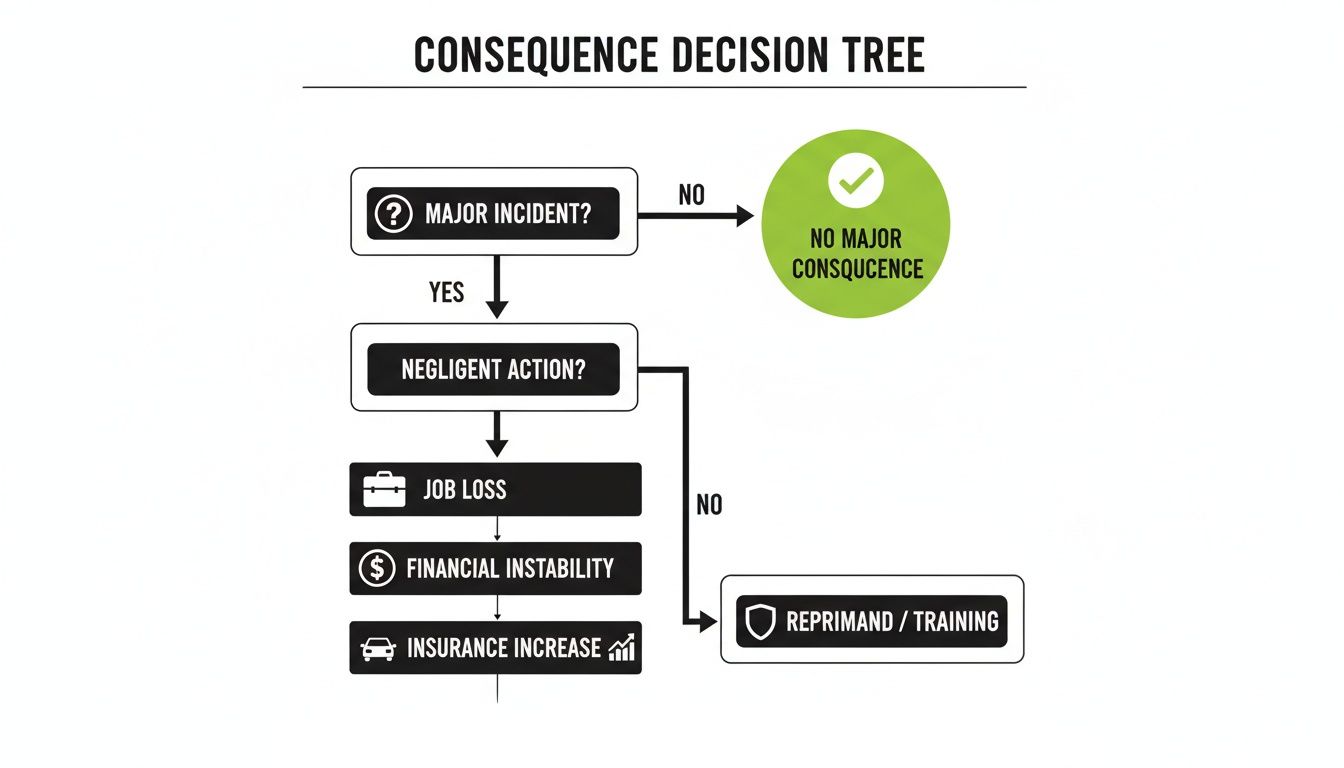
As you can see, not being able to drive can quickly spiral into bigger problems, threatening your job and your finances. It's a powerful motivator to see this process through to the end.
Finally, you’ll pay the reinstatement fees directly to the FLHSMV. The cost depends entirely on why your license was suspended. For a complete walkthrough of all the details, check out our guide on how to reinstate a suspended license in Florida.
Once all the boxes are checked and the fees are paid, your license will be reinstated. You'll officially and legally be back on the road.
Common Questions About Florida License Suspensions
Dealing with a suspended license can feel overwhelming, and it's natural to have a lot of questions. Let's clear up some of the most common concerns Florida drivers have when they find their driving privileges are on the line.
How Can I Check if My Florida License Is Suspended?
The quickest and most accurate way to find out your license status is to go straight to the source. The Florida Department of Highway Safety and Motor Vehicles (FLHSMV) provides an official online portal specifically for this purpose.
Just visit the FLHSMV’s Driver License Check tool online. You'll need your driver's license number, and it will give you real-time information. You can see your current status, understand why it might be suspended, and get a list of what you need to do to fix it. This should always be your first move.
What Is a Hardship License and How Do I Get One?
Think of a hardship license as a restricted license that can be a real lifeline. Officially called a "Business Purposes Only" license in Florida, it lets you drive for essential activities during a suspension period—things like getting to work, driving to school, or making it to doctor's appointments.
But not everyone qualifies. Eligibility depends heavily on the reason for your suspension. For many suspensions, you first have to serve a "hard-stop" period where no driving is allowed at all. After that, you'll typically need to complete a state-approved 12-hour Advanced Driver Improvement (ADI) course before you can even apply to the FLHSMV. Serious offenses, especially repeat DUIs, will almost certainly disqualify you.
Can a BDI Course Prevent a License Suspension?
Absolutely. In fact, it's one of the smartest, most proactive things you can do to protect your driving record. For most common moving violations, Florida law allows you to take a 4-hour Basic Driver Improvement (BDI) course.
By completing the course for a ticket, you prevent any points from being added to your license for that violation. This is huge because it stops point accumulation dead in its tracks, keeping you from hitting the thresholds that trigger an automatic suspension (like 12 points in 12 months). As a bonus, it also keeps your car insurance rates from skyrocketing. In Florida, you can choose this option once every 12 months, up to a maximum of five times in your life.
What Is the Difference Between a Suspended and Revoked License?
This is a point of major confusion for a lot of drivers, but the distinction is critical. The easiest way to remember it is that a suspension is temporary, while a revocation is a total cancellation.
Suspension: This is like hitting the pause button on your driving privileges. Your license is invalid for a set period, but once you’ve paid your fines, completed any required courses, and the time is up, you can get it reinstated.
Revocation: This is more like hitting the delete button. Your license is completely terminated. Getting back on the road after a revocation is a much tougher, longer process that often involves a formal FLHSMV investigation and applying for a brand-new license after a significant waiting period. Revocations are reserved for the most severe driving offenses.
The length of time you can lose your license for either a suspension or revocation depends heavily on the violation and the state you're in. Many drivers wonder how long your drivers license can be revoked in other states, as the penalties can differ quite a bit from Florida's.
Knowing these differences helps you understand the seriousness of your situation and what it will take to move forward. No matter what, taking action—whether that means paying a fine or signing up for a course—is always the right move to get back on the road safely and legally.
Don't let a traffic ticket put your driving privileges at risk. At BDISchool, our FLHSMV-approved online courses make it simple to prevent points, satisfy court requirements, and become a safer driver. Enroll in a course today and take control of your driving record at https://bdischool.com.