Nobody likes seeing flashing lights in their rearview mirror on a busy Broward road like I-95. Once an officer hands you that ticket, a 30-day clock starts ticking, and you’ve got a decision to make.
First things first, take a close look at the citation itself. You need to find the citation number, the specific violation, the fine amount, and—most importantly—the deadline to respond. If you’ve misplaced the ticket or can’t make out the details, our guide on how to perform a citation number lookup in Florida can help you track down the information online.
Whatever you do, don’t just ignore it. Florida doesn’t mess around with unanswered traffic tickets, and failing to act will lead to a driver’s license suspension.
It might feel personal, but you’re not alone. Broward County law enforcement issues a staggering number of tickets. In 2026, a huge chunk of these were for non-criminal moving violations—things like speeding, rolling through a stop sign, or careless driving. Speeding is, by far, the most common offense. The sheer volume shows just how intense traffic enforcement is in South Florida.
Your Three Options for a Broward Traffic Citation
When you get a non-criminal moving violation in Broward County, you have three ways to handle it. Each choice has a very different outcome for your driving record and your wallet. Let’s break them down.
| Action | Points on License | Impact on Insurance | Key Consideration |
|---|---|---|---|
| Pay the Fine | Yes. You will get points (e.g., 3-4 for speeding). | Very Likely. Points almost always trigger a rate increase. | This is an admission of guilt. It’s fast, but it has long-term financial consequences. |
| Fight in Court | Maybe Not. Points are avoided if you win. | None if you win. Your rates will increase if you lose. | This takes time and effort, with no guarantee of success. Best if you have strong evidence. |
| Elect Traffic School | No. Points are withheld upon course completion. | None. Prevents the violation from triggering a rate hike. | This is the best option for most eligible drivers to protect their record and insurance rates. |
As you can see, simply paying the fine is the fastest way to get points on your license. Fighting it is a gamble. For most drivers, electing traffic school is the smartest play.
What Each Choice Really Means
Paying the fine is the easiest path, but it’s an admission of guilt. This means points get added to your license, and your insurance company will almost certainly raise your rates at your next renewal. Just one ticket for going 16 mph over the limit can add 4 points to your record.
You could also request a court date and plead not guilty. This makes sense if you genuinely believe you’re innocent and have evidence, like a photo or witness, to back it up. But be prepared to spend a day in court, and if the judge doesn’t rule in your favor, you’ll still have to pay the fine and court costs.
That brings us to the third option: electing to attend a driver improvement course. For eligible drivers, this is often the best move. By completing a state-approved Basic Driver Improvement (BDI) course, you can have the state “withhold adjudication.”
What does “withholding adjudication” mean? It means you’re found neither guilty nor not guilty. You pay the fine, complete the course, and the state agrees not to assess points on your license. This keeps the violation off your public driving record and, crucially, away from your insurance company.
If your ticket was for an equipment failure, like a broken tail light, the court might dismiss the citation if you show proof of repair. Learning about fixing a broken tail light can help you get it sorted out quickly and might even save you from a fine.
Navigating Your Plea Options and Critical Deadlines
That piece of paper on your passenger seat—the Broward County traffic ticket—has a strict deadline. From the moment the officer hands it to you, you have just 30 days to make a decision. Ignoring it is the worst thing you can do. Let that deadline slide, and you’re looking at a suspended license and extra fees, turning a simple citation into a major headache.
With only a month to act, you need to understand your options and choose wisely. Your decision will directly impact your driving record and how much you pay for car insurance for years to come.
Choosing to Pay the Fine
The most straightforward path is to just pay the fine. It’s fast, sure, but it’s also an admission of guilt. By paying, you’re telling the state, “I did it,” and the points that come with the violation are guaranteed to hit your license.
Think about it this way: a ticket for going just 16 mph over the speed limit will slap 4 points on your Florida record. Insurance companies are not shy about checking these records, and those points are a red flag that almost always triggers a rate hike. What seems like a quick fix can easily cost you hundreds, if not thousands, in higher premiums down the road.
This chart breaks down the three main paths you can take after getting a traffic citation in Broward.
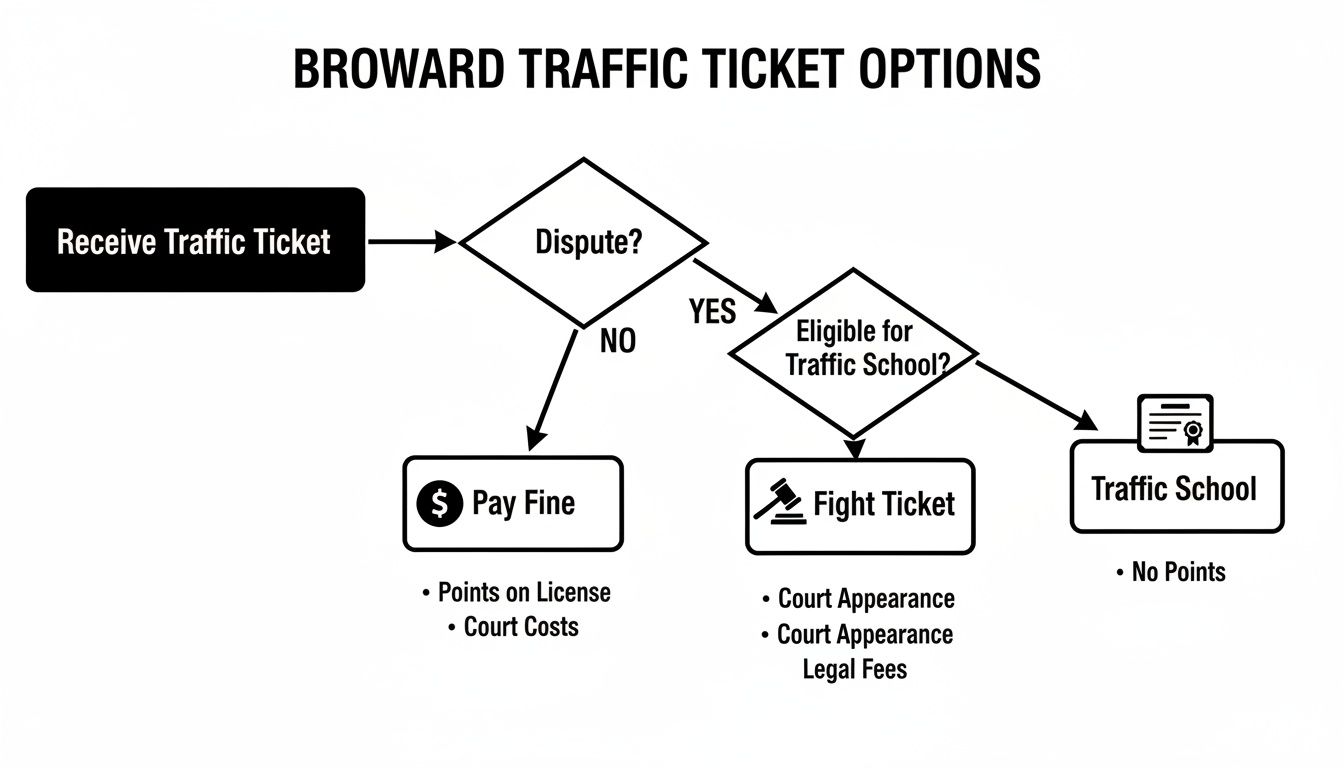
As you can see, electing traffic school is the only choice that gives you control over whether points get added to your license.
Contesting the Ticket in Court
Your second option is to plead not guilty and take your case to court. This is the “fight the ticket” route, and it’s a good choice if you genuinely believe you’re innocent and have solid proof to back it up—like dashcam video or a reliable witness.
Be prepared for a real commitment, though. You’ll have to show up in person at a Broward County courthouse and argue your case before a judge. If you win, it’s a clean slate: no fine, no points. But if you lose, you’re on the hook for the original fine plus court costs. If this is the path for you, it’s a smart move to learn more about what to expect in traffic court so you can go in prepared.
Electing Traffic School
For most drivers, the third option makes the most sense. When you elect to attend a state-approved traffic school, you get something called “adjudication withheld.”
This is a key legal phrase. It means that even though you pay the ticket’s civil penalty, the court doesn’t formally convict you. The best part? No points are assessed against your license. This keeps the violation off your public driving record, so your insurance company never sees it and has no reason to raise your rates.
There are a couple of rules, of course. You can only use the traffic school option if you haven’t elected it for another ticket in the past 12 months, and you can only do it a total of five times in your entire life. It’s an invaluable tool for keeping your record clean when you make an occasional mistake on the road.
Choosing the Right Florida Driver Improvement Course
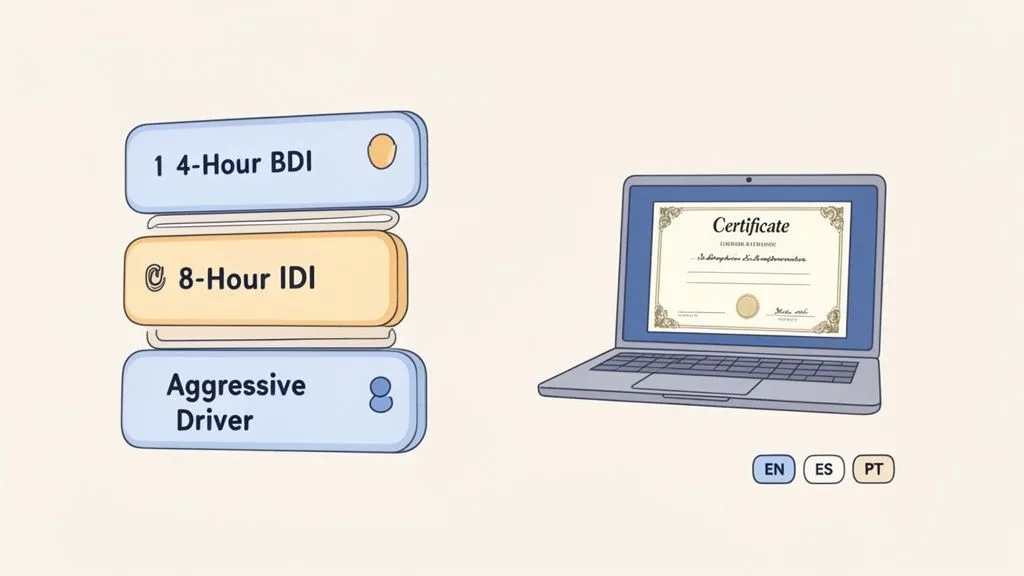
Alright, so you’ve made the smart choice to elect traffic school for your Broward citation. Now comes the next step: picking the actual course. This decision is more important than you might think. Choosing the correct Florida-approved program is essential for satisfying the court and, most importantly, keeping those points off your license.
For the vast majority of drivers, the choice is simple. The 4-Hour Basic Driver Improvement (BDI) course is the standard for anyone who got a non-criminal moving violation—like speeding or failing to stop—and wants to keep their record clean. If you voluntarily elected traffic school, this is almost certainly the course for you.
The Standard Choice: 4-Hour Basic Driver Improvement (BDI)
Think of the BDI course as your key to making that ticket disappear from your insurance company’s view. It’s a straightforward refresher on state traffic laws and defensive driving skills. Completing it is what gets you that coveted “adjudication withheld” status, which means no points on your license.
This is where the convenience of modern online courses really comes into play. A state-approved program like the one from BDISchool.com is built for real life. It’s 100% online and designed to be completed entirely on your schedule.
- Totally Flexible: You can log in and out whenever you have a spare moment. Complete it over a lunch break, late at night—whatever works for you.
- Use Any Device: Start on your laptop at home and finish on your phone while waiting for an appointment. It works seamlessly across computers, tablets, and smartphones.
- Learn in Your Language: The course material is available in English, Spanish, and Portuguese, so you can learn comfortably.
Best of all, once you’re done, your completion certificate is sent directly to the Florida Department of Highway Safety and Motor Vehicles (FLHSMV) for you. It’s a seamless process. To get a closer look at how it works, check out our guide to the Florida driver improvement course online.
For Court-Ordered Situations: 8-Hour IDI
Now and then, a judge will require a driver to complete a more intensive program. This is where the 8-Hour Intermediate Driver Improvement (IDI) course comes in. This is not a course you elect yourself; it’s something you are ordered to take, usually due to a more serious violation or a history of citations.
Let’s face it, driving in Broward County can be intense. With nearly 5,000 miles of roadway, accidents are unfortunately common. A judge might order the IDI course after a careless driving incident on a busy road like the Sawgrass Expressway, hoping a more in-depth course will prevent future issues. Our Intermediate Driver Improvement (IDI) course is specifically designed for these court-ordered requirements.
The Bottom Line: The BDI course is what you choose to do to avoid points. The IDI course is what a judge orders you to do as part of a sentence.
Unless a Broward County judge has specifically told you to take the 8-hour IDI course, the 4-hour BDI course is your ticket to resolving that citation and keeping your driving record clean.
How to Handle Serious Violations and Repeat Offenses
Not every traffic ticket in Broward County is a straightforward fix. Some violations are far more serious, bringing heavy penalties and demanding a different approach than your run-of-the-mill citation. If you’ve been ticketed for aggressive driving or are considered a repeat offender, you’re playing in a different league, and simply electing a basic course probably won’t cut it.
These situations often land you in front of a judge. For instance, if you’ve collected too many points on your license, the Florida Department of Highway Safety and Motor Vehicles (FLHSMV) has the power to suspend it. We cover this in detail in our article on driver’s license suspension in Florida, which explains how to get your driving privileges back. Often, a judge will order you to complete a specific course as a condition for keeping your license.
Court-Mandated Aggressive Driver Courses
Florida’s roads are busier than ever, and unfortunately, so are driver tempers. Speeding tickets in Broward County have been climbing, and a statewide increase in improper lane change violations since 2021 points to a growing trend of aggressive driving on packed roads like Florida’s Turnpike. You can see more data on these traffic enforcement trends on TheTicketClinic.com.
For drivers involved in road rage incidents or those flagged as habitual offenders, a judge can mandate an 8-Hour Aggressive Driver Course. This isn’t your standard traffic school. It’s a specialized program designed to dig into the root causes of dangerous driving behaviors. The curriculum moves beyond basic traffic laws to cover:
- Practical anger management techniques for stressful driving situations
- Identifying the psychological triggers behind road rage
- The real consequences of aggressive tailgating and erratic lane changes
- Mastering right-of-way rules to de-escalate potential conflicts
Our 8-hour Aggressive Driver Course at BDISchool.com is built around these real-world scenarios to help you change your habits and drive more responsibly. This isn’t about avoiding points—it’s about fulfilling a court order to maintain your driving privileges.
Proactive Steps for Mature Drivers
Improving your driving skills isn’t just for people who’ve gotten a ticket. Even the most experienced drivers can benefit from a refresher, especially with today’s changing traffic laws and vehicle technology. Florida actually encourages this with a program designed specifically for senior drivers.
The Mature Driver Course is a voluntary, 6-hour program created for drivers aged 55 and older. You don’t need a ticket to take it; it’s all about being proactive.
The main incentive is financial. Once you complete the course, Florida law mandates that your insurance provider give you a discount on your car insurance premiums for up to three years. It’s a simple, effective way to lower your annual costs.
This course serves as a great refresher on modern defensive driving techniques, gets you up to speed on new in-car safety technologies, and offers strategies for adjusting to age-related changes in vision and reaction time. Taking the course is a smart move that demonstrates your commitment to safety and puts money back in your pocket.
Finishing the Course and Putting That Ticket Behind You
Deciding to take a driver improvement course for your traffic citation broward is a smart call. But just enrolling isn’t enough to make the ticket go away. The real finish line is completing the course and making sure the Broward County Clerk of Courts knows you did it. This last part is where everything comes together.
Getting started with a state-approved provider like BDISchool.com is refreshingly straightforward. You can sign up online with your phone or computer, punch in your citation number, and dive right in. No waiting for books in the mail or rearranging your life to sit in a stuffy classroom.
Once you’re in, you’ll find the course is actually designed to keep you engaged. It uses a mix of short videos, animations, and scenarios you’ll recognize from driving around South Florida.
What the Course Is Actually Like
The whole program is self-paced, which puts you in the driver’s seat. You can chip away at it whenever you have a spare moment—knock out a chapter on your lunch break or finish a module after the kids are in bed. The system saves your progress automatically, so you can log off and pick up right where you left off.
And the content isn’t just a rehash of the driver’s handbook you skimmed when you were 16. It’s a genuinely useful refresher on skills that matter on our crowded roads. You’ll cover things like:
- Defensive Driving Essentials: How to read the road and anticipate what other drivers might do, giving you that crucial extra second to react.
- The Reality of Distracted Driving: It goes beyond just “don’t text and drive,” showing the real-world impact of trying to multitask behind the wheel.
- Current Florida Traffic Laws: A no-nonsense update on the rules you’re expected to follow, including recent changes you might have missed.
The goal isn’t to lecture you. It’s to give you practical knowledge that can help you avoid another citation down the road.
The Final—And Most Important—Step
After you pass the final quiz, you’ve reached the most critical part of the entire process: reporting your completion. This is the one step I’ve seen countless drivers mess up, leading to them getting points on their license despite doing all the work.
Don’t let a missed deadline undo all your effort. If the Clerk of Courts doesn’t get proof of your course completion by the due date on your affidavit, your case will default. The violation gets reported to the FLHSMV, and those points you worked to avoid will end up on your record anyway.
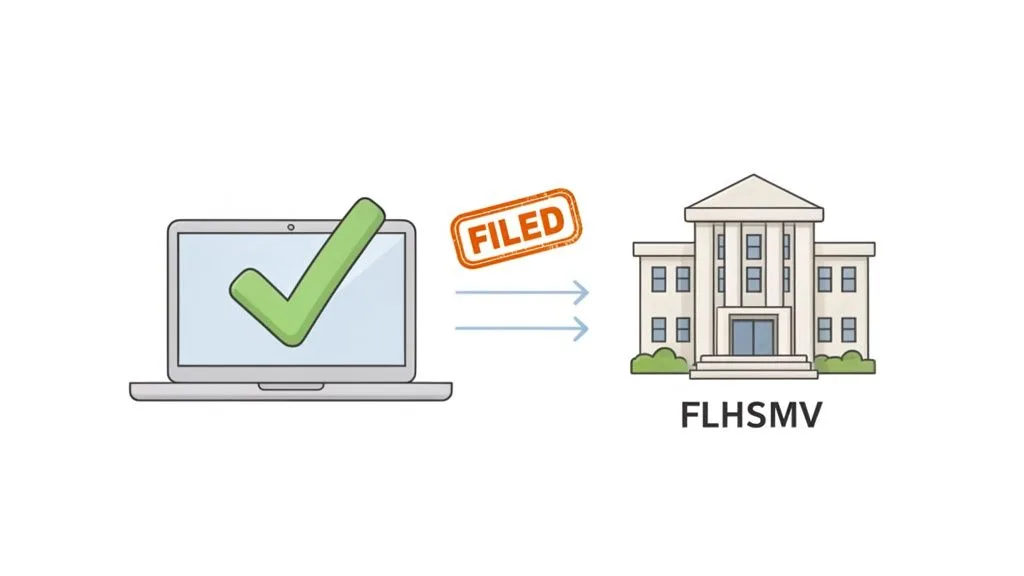
This is exactly why choosing a school that handles the paperwork for you is a game-changer. BDISchool.com electronically reports your completion directly to the Florida Department of Highway Safety and Motor Vehicles (FLHSMV) the moment you finish. You’ll get a certificate to download for your own records, but the official reporting is done for you, guaranteeing it arrives on time.
By finishing an approved course, you do more than just satisfy a court requirement. You protect your driving record, prevent your insurance company from jacking up your rates, and can finally move on from the whole incident. You’ve turned a negative situation into a positive, proactive step for your future on the road.
Your Top Questions About Broward Traffic Tickets Answered
Getting a ticket in Broward County can feel overwhelming. Suddenly, you’re dealing with legal jargon, deadlines, and a lot of uncertainty. Let’s clear things up and tackle the most common questions we hear from drivers every day.
What If I Miss My Court Date?
Let’s be blunt: you really don’t want to do this. Missing a mandatory court appearance for a traffic ticket in Broward isn’t something you can just ignore. The judge will almost certainly issue a bench warrant for your arrest.
What does that mean for you? Any future run-in with law enforcement, even for something as simple as a broken taillight, could end with you in handcuffs. On top of that, Florida law considers a “failure to appear” a separate criminal offense, piling more legal headaches onto your original violation.
An Expert’s Advice: If you’ve already missed your date, don’t panic, but do act fast. The problem will only escalate. Your best move is to contact a traffic attorney immediately. They know how to communicate with the court and can often work to resolve the warrant before things get worse.
Will My Insurance Rates Definitely Go Up?
Not necessarily, but it’s a major risk if you just pay the fine. Insurance companies see points on your license as a red flag—a sign that you’re a higher-risk driver. This often leads them to hike up your premiums when your policy renews.
This is where traffic school saves the day. When you complete a BDI course and the court withholds adjudication, no points hit your record. Your insurance company never sees the violation, so they have no ticket-related reason to raise your rates. It’s a common worry for many people trying to find affordable Florida car insurance options after getting a citation.
How Many Points Am I Facing If I Just Pay?
The points you’ll get depend entirely on the violation. The more serious the offense, the more points you’ll see on your driving record.
Here’s a quick look at some common violations in Broward County:
- Speeding (less than 15 mph over the limit): 3 points
- Speeding (16 mph or more over the limit): 4 points
- Ignoring a Red Light or Stop Sign: 4 points
- Careless Driving: 3 points
Remember, accumulating just 12 points in a single year triggers an automatic 30-day license suspension. This shows why avoiding points with a BDI course is such a smart move to protect your ability to drive.
I’ve Had a Ticket Before. Can I Still Go to Traffic School?
Most likely, yes! But Florida has some important rules you need to know. You’re allowed to elect traffic school to keep points off your license a maximum of five times in your entire life.
The more immediate restriction is the frequency. You can only choose the traffic school option once in any 12-month period. So, if you took a course for a ticket 10 months ago, you won’t be eligible for this new one. You have to wait a full year between elections.
Dealing with a traffic ticket doesn’t have to ruin your week. When you know your options, you can make the right choices to protect your driving record and keep your insurance costs down. At BDISchool, we make it simple to complete your state-approved course online, whenever it fits your schedule.
Ready to move on from this ticket? Enroll with BDISchool today and keep your record clean.