When you're behind the wheel, the space between you and the car in front is your most important safety feature. The two second rule is the single best way to manage that space, giving you a critical buffer to react to sudden stops or anything else the road throws at you.
Think of it as your personal safety shield. It’s a simple, reliable method to ensure you have enough time and distance to avoid a collision.
What Is The Two Second Rule, Really?
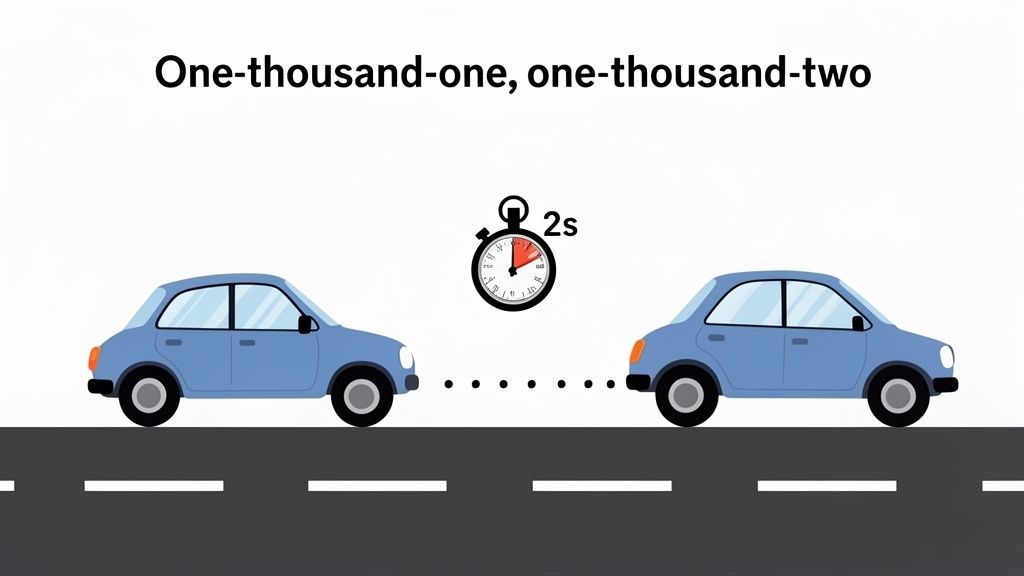
At its heart, the two-second rule is a straightforward counting technique anyone can use to check their following distance in good, dry weather. But it’s not just a random number; it’s a practical measurement based on the two things that matter most in an emergency: your reaction time and your car's braking distance.
When the car ahead slams on its brakes, your brain first has to see the danger, process it, and then signal your foot to move to the brake pedal. This is your perception and reaction time. Only after that does the car actually start slowing down. That two-second gap is designed to give you just enough room to handle both steps without a collision.
The Science Behind the Gap
There's a good reason the two-second rule is a cornerstone of every defensive driving course. It’s grounded in the realities of human reflexes and vehicle mechanics. The average driver's reaction time is about 1.5 seconds. The extra half-second gives your brakes a moment to bite and start slowing the car on a dry road.
This simple habit is incredibly effective. Studies show that maintaining a proper two-second gap can cut your risk of a rear-end collision by as much as 50%. It’s one of the most powerful safety habits you can build.
It's a principle taught by top driving schools because it turns a complicated physics calculation (speed, distance, and time) into a simple, repeatable action. It's a global standard, promoted by organizations like the World Health Organization in their road safety reports.
How to Measure the Two Second Rule
Putting this rule into practice is easy and becomes second nature once you get the hang of it. You don't need any special tools—just your eyes and a little bit of counting.
Here’s a quick guide to do it on the fly.
How to Measure the Two Second Rule Instantly
| Step | Action |
|---|---|
| 1. Pick a Landmark | Watch the vehicle ahead of you. As its rear bumper passes a fixed object on the side of the road (like a sign, a tree, or an overpass), pick that spot as your marker. |
| 2. Start Counting | As soon as the car ahead passes your chosen landmark, begin counting aloud: “One-Mississippi, Two-Mississippi.” |
| 3. Check Your Position | If your front bumper reaches the landmark before you finish saying "Two-Mississippi," you are following too closely. Ease off the gas and let the gap widen. |
This method works at any speed because the distance you travel in two seconds automatically increases as your speed increases, so the gap adjusts itself perfectly.
The Hidden Dangers of Following Too Closely
Driving bumper-to-bumper might feel like you’re getting ahead, but in reality, it's one of the riskiest things you can do behind the wheel. Following too closely, or tailgating, erases your safety buffer. It completely removes your margin for error.
A small tap on the brakes from the driver in front of you can instantly turn into a serious collision when you've left yourself no room—and no time—to react. You're essentially betting you can defy physics, and that's a bet you will eventually lose.
Tailgating and Distraction: A Deadly Combination
The danger gets a lot worse when you factor in modern distractions. Think about it: a quick glance at your GPS or a text message can take two seconds. At 60 mph, your car travels 176 feet in that tiny window of time. You just drove the length of half a football field, completely blind.
Without the cushion of the two-second rule, that brief moment of inattention is all it takes for a disaster to unfold. The open space in front of your car is your only real defense against the unexpected. Take it away, and a minor slowdown ahead can trigger a chain-reaction crash before you even look up. To see just how big of a role distraction plays, check out our guide on what causes most car accidents.
When a driver’s eyes leave the road for just two seconds, their odds of a crash double. This is a stark reminder of how quickly a safe situation can turn deadly without a proper following distance.
The statistics are sobering. Research from a comprehensive road crash analysis by Geotab shows that distracted driving is a factor in a staggering 80% of all collisions and 65% of near-misses. The problem is widespread, as about a third of drivers openly admit to ignoring the two-second rule, which directly contributes to the constant stream of preventable rear-end crashes we see every day.
Your Brain Needs More Time Than You Think
Here's a hard truth many drivers forget: your brain isn't a computer. It can't react instantly. When the car ahead of you slams on its brakes, a whole sequence has to play out before you even start slowing down.
- You See It: Your eyes spot the red brake lights.
- You Process It: Your brain identifies this as a hazard and decides to brake.
- You Act: Your brain finally sends the signal to your foot to hit the pedal.
This whole process—from seeing the danger to physically hitting the brake—takes the average driver about 1.5 seconds. Your car doesn't even begin to slow down until after that time has passed.
That's why the two-second rule is so critical. It builds in the time your brain and body need to actually react, stop the car, and prevent a collision that was entirely avoidable.
Adapting the Rule for Real-World Conditions
The two-second rule is your starting point for safe driving, but it's designed for a perfect world—think sunny days, dry asphalt, and light traffic. Let’s be honest, we rarely get those ideal conditions. It's better to think of the rule as a bare minimum, a foundation you need to build on when things get complicated.
When the weather turns or you're surrounded by different types of vehicles, two seconds just isn't enough. Rain, fog, or even just driving behind a massive truck requires a smarter, more flexible approach to your following distance.
This decision tree shows exactly what's at stake.
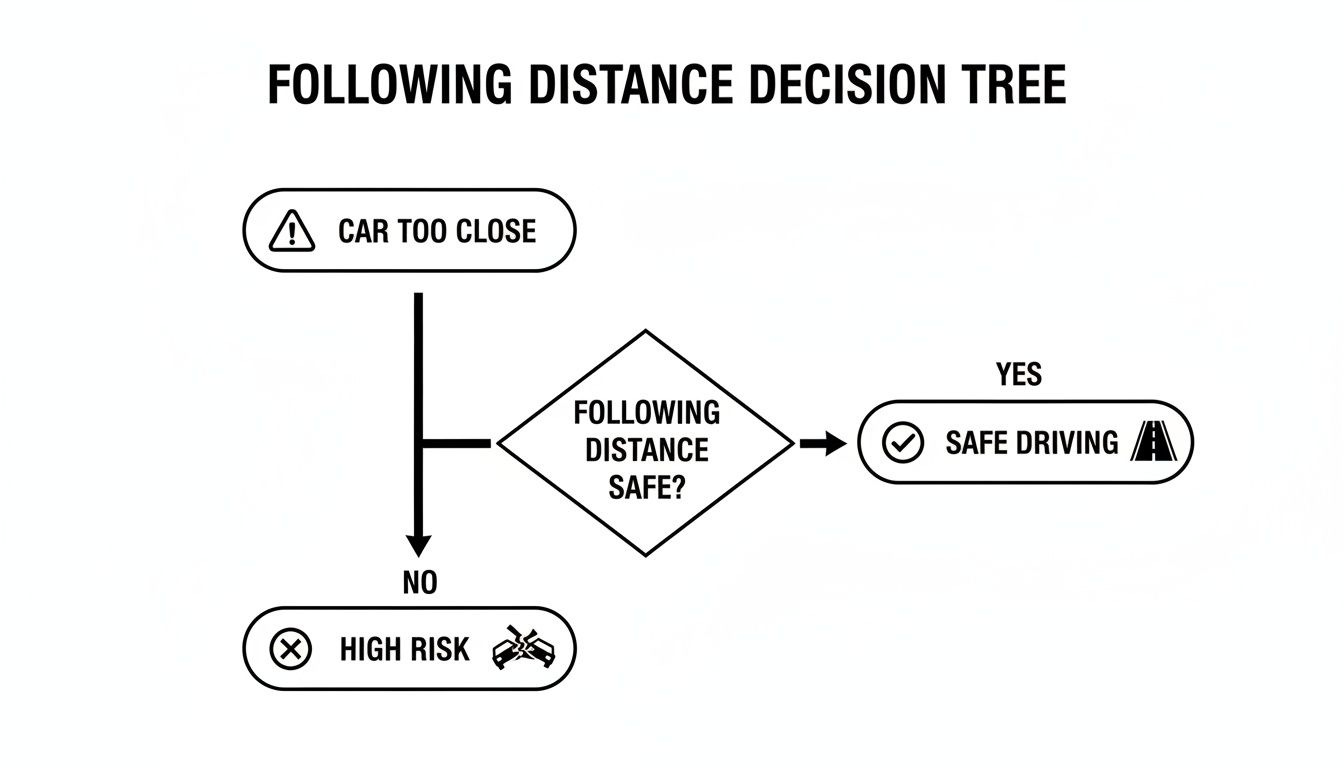
As you can see, leaving a proper space cushion is the one clear path to staying safe. Failing to adapt your following distance puts you on a collision course with a high-risk scenario you simply can't win.
Your Guide to Safe Following Distances
Knowing when to add more time to your count is one of the most important skills a defensive driver can have. This table breaks down how to adjust the two-second rule for the most common situations you'll face on the road.
| Driving Condition | Minimum Safe Gap | Why It's Necessary |
|---|---|---|
| Ideal Conditions (Dry roads, clear day) | 2-3 Seconds | This is your baseline for normal reaction and braking time. |
| Wet Roads or Light Rain | 4-5 Seconds | Water reduces tire grip, significantly increasing your braking distance. |
| Heavy Rain, Fog, or Snow | 6+ Seconds | Poor visibility and extremely slick roads demand a much larger safety buffer. |
| Driving at Night | 3-4 Seconds | Reduced visibility makes it harder to judge distances and see hazards ahead. |
| Following a Motorcycle | 4+ Seconds | Motorcycles can stop much faster than cars. This gap protects the rider. |
| Following a Large Truck/Bus | 5-6 Seconds | You need extra space to stay out of their blind spots and see the road ahead. |
| When You're Towing a Trailer | 5-6 Seconds | The extra weight drastically increases your own vehicle's stopping distance. |
Think of these as non-negotiable minimums. If you’re ever in doubt, the answer is always to add more space, never less.
Dealing With Poor Weather
Bad weather is the number one reason to ditch the basic two-second rule. When visibility drops and the road gets slick, you're fighting two battles at once: you need more time to react, but your car needs more distance to stop.
Here's how to think about it in practice:
- Wet Roads or Light Rain: Your new minimum is four seconds. Even a light drizzle can make the road surface greasy and unpredictable. Doubling your gap gives your tires a fighting chance to maintain traction when you hit the brakes.
- Heavy Rain, Fog, or Snow: Now you're in the five-to-six-second range, at least. In these conditions, you can barely see what's ahead of you, and the risk of hydroplaning or skidding is incredibly high. That extra time is your lifeline.
- Night Driving: Even on a perfectly clear night, your field of vision shrinks. It’s tougher to judge speed and distance in the dark, so bumping your gap to three or four seconds is just common sense.
A good rule of thumb is to add one extra second for every challenging condition you face. If it's dark and it's raining, a five-second gap is a much safer bet.
Handling Different Vehicle Types
The traffic mix around you absolutely changes the safety equation. A motorcycle doesn't behave like a semi-truck, and failing to account for that difference can get you into serious trouble.
For example, motorcycles are incredibly nimble and can stop in a fraction of the distance a car can. Following one too closely is a recipe for disaster for the rider.
- Motorcycles: Back off and give them a full four-second gap. This protects the rider if they have to brake hard and gives you plenty of time to react without causing a devastating rear-end collision.
- Large Trucks and Buses: Increase your distance to five or six seconds. This is non-negotiable. First, their stopping distance is massive. Second, if you're too close, you're completely invisible in their huge blind spots. Giving them space also gives you a better view of the road ahead, instead of just staring at their bumper.
- Towing a Trailer: If you're the one doing the towing, remember that all that extra weight is pushing you. Your stopping distance skyrockets. You need to follow the same five-to-six-second rule as if you were behind a big rig.
Understanding the physics behind why your car takes so long to stop is a cornerstone of defensive driving. You can learn more about calculating stopping distance in our guide to get a better handle on what’s really happening when you hit the brakes.
How Modern Technology Can Help You Keep a Safe Distance
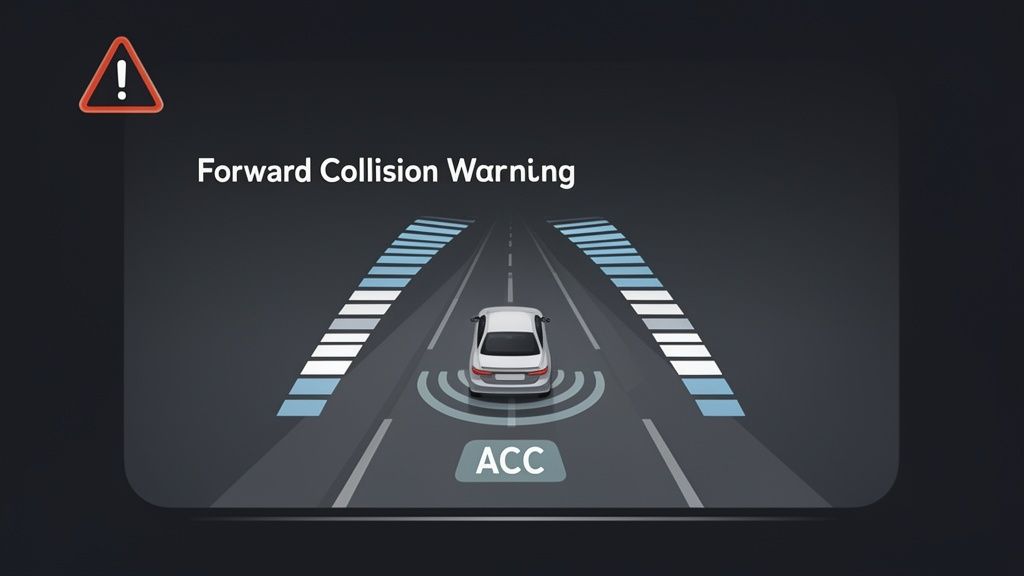
While nothing replaces an alert driver, the car you're driving is likely packed with technology designed to back you up. These driver-assist systems aren't there to take the wheel for you, but they can be an incredible safety net, constantly reinforcing the life-saving habit of the two-second rule.
Think of these features as a digital co-pilot that never gets tired or distracted. They are always monitoring the space around your vehicle, helping you maintain that crucial safety bubble. For a lot of drivers, this tech can make keeping a safe following distance feel almost second nature.
Your Car's Smart Safety Features
Two of the most helpful pieces of tech you'll find in modern cars are Adaptive Cruise Control (ACC) and Forward Collision Warning (FCW). They approach the problem from different angles, but both are aimed squarely at preventing rear-end collisions by managing the space ahead.
Adaptive Cruise Control (ACC): This is cruise control on a whole new level. Instead of just locking in a speed, ACC uses radar and cameras to monitor the car in front. It will automatically adjust your speed to keep a pre-set gap, which you can usually set for two seconds or more. If the car ahead brakes, your car brakes, too—all without you touching the pedals.
Forward Collision Warning (FCW): This system is your extra set of eyes. It continuously scans the road ahead and will scream at you with a beep or a flashing light if you're closing the gap to the car in front way too fast. That warning gives you the split second you need to slam on the brakes yourself.
These systems are brilliant because they directly counter the most common human errors, like a moment of distraction or just bad judgment, that lead to tailgating. They add a consistent, reliable layer of protection to every drive. And for even more ways technology can help, check out our guide on apps designed for safe driving.
How Technology Reinforces Good Habits
The real magic of this tech isn't just that it can save you from a crash. It actively trains you to be a better driver. By giving you constant, real-time feedback, these systems help you get a real feel for what a proper two-second gap looks like at 40 mph versus 70 mph.
This isn't just a hunch. A study from Vanderbilt University tested a radar tool called the CAN Coach. The system gave drivers live feedback on their following distance and the results were staggering. It helped them slash their average time-gap error by an incredible 73% and cut the variation in their following distance by 53%.
This is powerful proof that driver-assist features can help you master the two-second rule with a precision that’s hard to achieve on your own. You can read more about these technological findings to see just how much of a difference they can make.
At the end of the day, these systems are not a green light to zone out. They're powerful tools that work with you, helping you apply the simple, life-saving habit of keeping a safe following distance every single time you get behind the wheel.
What Happens When You Ignore the Two-Second Rule? Legal and Insurance Realities
Following the two-second rule isn't just a helpful tip from your driving instructor—it’s the law. Here in Florida, driving "more closely than is reasonable and prudent" is a moving violation called tailgating. That means your driving habits on the road are directly tied to your wallet and your license.
If you ignore this simple rule, you could find yourself with a pricey ticket and, even worse, points on your driving record. Under Florida Statute 316.0895, a police officer can pull you over just for failing to leave a safe gap, even if you don't cause a crash. It's a clear sign that the state considers tailgating a serious, preventable danger.
The True Cost of a Tailgating Ticket
A tailgating ticket hurts more than just your pride. Insurance companies see this violation, and especially the rear-end collisions it causes, as a massive red flag. They see a risky driver, and that translates directly to higher costs for you.
Just one at-fault accident from following too closely can make your insurance premiums shoot through the roof for years to come. Insurers base their rates on risk, and tailgating is one of the riskiest habits out there. When a crash happens because someone didn't leave enough space, knowing how to handle the aftermath, including potential insurance disputes, becomes absolutely essential. A single mistake can end up costing you thousands in higher premiums.
How to Protect Your Driving Record and Your Finances
The good news? If you get a ticket in Florida, you often have a way to minimize the damage. For most common moving violations, you can take a state-approved Basic Driver Improvement (BDI) course to keep the points off your license. This is a game-changer for keeping your insurance rates down.
When you complete a BDI course after a ticket, you can often prevent your insurance company from even finding out about it. It’s a smart move that helps keep your record clean and avoids the painful financial hit of being labeled a high-risk driver.
This isn’t just about scare tactics; it's about connecting the dots. Failing to use the two-second rule has real legal and financial consequences, but they are completely avoidable. To dig deeper into how tickets impact your policy, check out our guide on the link between points and insurance rates.
Ultimately, maintaining a safe following distance is one of your biggest responsibilities behind the wheel. It protects your safety, the safety of others, and your financial health.
Making the Two-Second Rule a Lifelong Driving Habit
Knowing about the two-second rule is one thing. Actually living it behind the wheel is something else entirely. For this crucial safety buffer to protect you, it has to become more than just an idea—it needs to become a reflex.
The goal is to burn this habit so deep into your driving instincts that you do it automatically, even when you're tired, distracted, or just cruising on autopilot. For new drivers, that means starting with good habits from day one. For the rest of us, it often means unlearning years of driving too close.
Simple Exercises for Building the Habit
The good news is, you don't need a special track or complex training to turn this rule into second nature. You just need to practice it consciously until it becomes unconscious.
Give these simple exercises a try on your next drive:
- Count Out Loud: It might feel silly at first, but actually saying "one-thousand-one, one-thousand-two" out loud is incredibly effective. It forces you to actively measure the gap instead of just guessing.
- The Stoplight Check: Every time you pull up behind a car at a light, ask yourself: "Can I see the pavement where their rear tires meet the road?" This simple check reinforces a safe stopping distance and keeps you mindful of the space in front.
- Play the Landmark Game: Turn it into a little game. Pick a sign, an overpass, or a tree up ahead. As the car in front passes it, start your count. Do this every few minutes, and soon enough, you'll be managing your distance without even thinking about it.
This isn't just a tip; it's a core principle of defensive driving. By maintaining that cushion, you aren't just protecting yourself—you're making the road a safer, more predictable place for every driver around you.
Ultimately, making the two-second rule a permanent skill means weaving it into a bigger commitment to safety. This is especially critical for professional drivers, as seen in guides on defensive driving for truck drivers, where managing space is non-negotiable. That simple two-second count is a promise you make to yourself, and everyone else, to get where you're going safely.
Answering Your Questions About the Two-Second Rule
Even a simple rule of thumb can get complicated on the open road. Let's tackle some of the most common questions and tricky situations drivers run into when trying to use the two-second rule every day.
Is the Two-Second Rule Realistic in Heavy Traffic?
It is, but you have to adapt it. In bumper-to-bumper, stop-and-go traffic, leaving a full two-second gap is just asking for someone to cut you off. The goal is always to leave a safe stopping distance, and that looks a little different when you're crawling along.
A better trick for slow traffic is this: always make sure you can see the pavement where the rear tires of the car ahead meet the road. It’s a simple visual check that guarantees you have at least some cushion if they slam on their brakes. When you're moving under 20 mph, a one-second gap is usually enough to work with.
What Do I Do if Someone is Tailgating Me?
First thing's first: stay calm. Don't tap your brakes or get angry. That only makes a dangerous situation worse. Your job is to manage the one thing you can control—the space in front of your car.
Gently take your foot off the gas and slowly increase your following distance from the car ahead of you. Open it up to four or five seconds. This creates a bigger safety buffer for everyone. It gives you more time to react to something happening up ahead, which in turn gives the tailgater behind you more time to react. If you get a safe chance, just move over and let them pass.
By adding space in front, you give yourself an escape plan. This proactive move protects you from being pushed into the car ahead by an aggressive driver behind you.
Does This Rule Change for an SUV or a Truck?
Absolutely. Think of the two-second rule as the absolute bare minimum for a standard sedan in ideal weather. Heavier vehicles like SUVs, pickups, or anything towing a trailer have way more momentum. They need a lot more room to come to a complete stop.
A good rule of thumb is to add at least one extra second of following distance for every 10 feet of vehicle length. So if you're in a big truck or pulling a boat, you need to be thinking more along the lines of a four or five-second rule.
At BDISchool, we believe that mastering defensive driving techniques is the key to lifelong safety. If you've received a traffic ticket in Florida, our state-approved BDI courses can help you avoid points and keep your insurance rates down. Enroll today at https://bdischool.com.