So, you’re wondering: what age can you get your license in Florida? Let’s get right to it. The short answer is that it’s a journey with a few key milestones. You can get a Learner’s Permit at 15, an Intermediate License at 16, and a full, unrestricted license when you turn 18.
This isn’t a one-and-done deal. Florida, like many states, uses a Graduated Driver Licensing (GDL) system. It’s a smart approach designed to ease teens into the driver’s seat safely.
Think of it like learning to swim. You don’t just jump into the deep end. You start in the shallows with an instructor right there, gradually building confidence and skill before venturing out on your own. The GDL program is the state’s way of being that instructor for new drivers.
The Three Stages of Getting Your License in Florida
Florida’s GDL program breaks the path to driving freedom into three clear phases. Each one comes with its own age requirements, rules, and privileges. Knowing these steps is the key to planning your road to independence.
- The Learner’s Permit (Age 15): This is your official start. With a permit, you can finally get behind the wheel to practice, but there’s a catch—you must have a licensed adult who is 21 or older in the front passenger seat at all times.
- The Intermediate License (Age 16): Once you’ve held your permit for a full year and logged enough practice time, you can level up. This restricted license lets you drive alone, but with important limits, especially on driving late at night or with other teens in the car.
- The Full, Unrestricted License (Age 18): At 18, the training wheels officially come off. The nighttime and passenger restrictions are lifted, and you’re granted full driving privileges.
This timeline gives you a great visual of how Florida structures the process, building safe habits one step at a time.
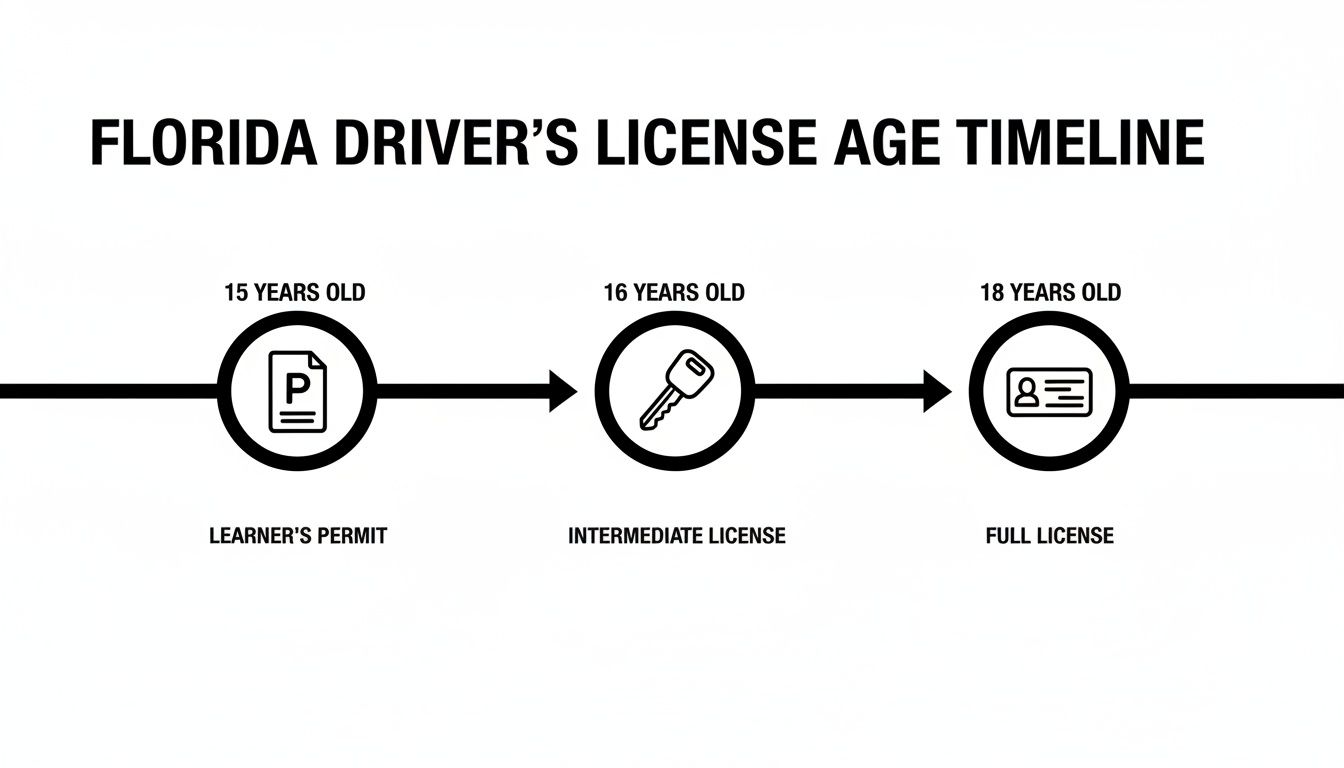
As you can see, each stage builds directly on the last, moving you from supervised practice at 15 to getting your own keys at 16, and finally to complete freedom at 18.
To make it even clearer, here’s a quick summary of the entire GDL journey.
Florida’s Graduated Driver Licensing (GDL) Stages at a Glance
| License Stage | Minimum Age | Key Requirements | Primary Restrictions |
|---|---|---|---|
| Learner’s Permit | 15 | Pass vision, hearing, and knowledge tests; complete TLSAE course. | Must drive with a licensed adult (21+) in the front seat. |
| Intermediate License | 16 | Hold permit for 1 year; 50 hours of supervised driving practice. | Nighttime driving and passenger limits apply. |
| Full License | 18 | No major traffic convictions. | All restrictions are lifted. |
This table shows how the system is designed to give new drivers the experience they need while minimizing risks.
The whole point of the GDL system is to ensure new drivers gain experience under the safest conditions possible. It keeps you out of higher-risk situations—like driving late at night or with a car full of friends—until you’ve had plenty of time to master the fundamentals.
This structured approach is proven to help drivers develop crucial defensive driving skills. If you want to get a head start, diving into the official state handbook is a great first step. For a user-friendly breakdown, you can also explore our guide on the Florida Driver’s Manual and what to focus on.
Now that you have the big picture, we’ll dig into the specific details for each stage in the sections ahead. We’ll cover everything from the required courses and documents to the exact restrictions you’ll need to follow.
The First Milestone: Getting Your Learner’s Permit at 15
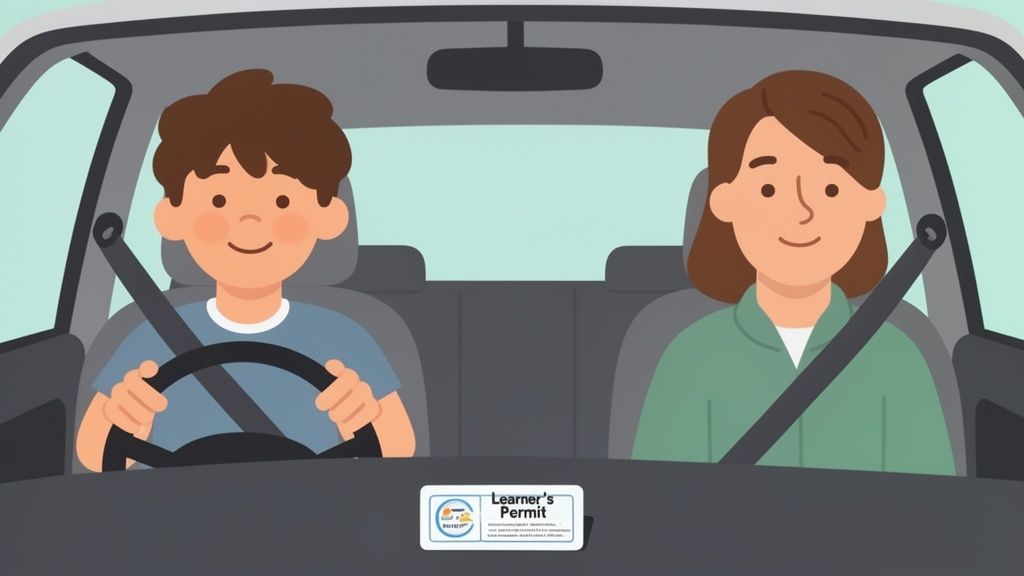
The journey to driving freedom in Florida kicks off right at age 15. This is when you can finally get your hands on a learner’s permit, which is your official ticket to start learning behind the wheel. It’s not just a piece of plastic; it’s the beginning of your on-the-road apprenticeship.
Think of it like a student pilot finally getting to co-pilot a plane. You’re at the controls, but there’s a seasoned expert right next to you, providing guidance and ready to take over if things get tricky. This structured, supervised practice is the whole point—it’s designed to help you build solid, safe driving habits from day one.
The Homework: What to Do Before You Go to the DHSMV
Before you can even think about walking into a Florida Department of Highway Safety and Motor Vehicles (DHSMV) office, you’ve got some required coursework to tackle. Florida makes sure every new driver clears two important educational hurdles first.
Your first assignment is the Traffic Law and Substance Abuse Education (TLSAE) course. This isn’t optional—it’s a mandatory 4-hour program that covers the essentials: Florida traffic laws, what road signs mean, and the very real dangers of driving under the influence.
Next, you have to pass the Class E Knowledge Exam. This is the official “permit test.” It’s a 50-question multiple-choice exam covering road rules and signs, and you’ll need to get at least 40 answers right to pass. The great news for teens under 18 is that you can complete both the TLSAE course and the exam entirely online with a state-approved provider.
The big idea here is that getting a permit isn’t just about passing a test. It’s about proving you’re serious about safety by getting educated before you ever start the engine.
With your courses done, it’s time to gather your documents for your trip to the DHSMV. Getting your paperwork in order ahead of time is the secret to a quick and painless visit.
- Proof of Identification: An original U.S. birth certificate or a valid U.S. passport works perfectly.
- Proof of Social Security Number: Bring your original Social Security card or a document like a W-2 form.
- Proof of Residential Address: You’ll need two items that show your current address, like mail from your bank or a school report card.
- Parental Consent: If you’re under 18, a parent or legal guardian has to sign a consent form.
These steps are absolutely crucial. For a complete rundown of what you’ll need, check out our guide to getting a Florida learner’s permit.
Rules of the Road with a Permit
Once you pass the tests, present your documents, and have your picture taken, you’ll walk out with a brand-new learner’s permit. This unlocks the ability to practice driving, but it comes with some very strict rules to keep everyone safe while you’re still learning.
The most important rule is about supervision.
You must always have a licensed driver who is 21 or older in the front passenger seat. This is non-negotiable. Driving alone with a learner’s permit is illegal and has serious consequences.
Florida also puts limits on when you can practice. For the first three months you have your permit, you can only drive during daylight hours. After that initial period, you can practice until 10 p.m. This phased approach lets you get comfortable on the road before tackling the challenges of driving at night.
Holding a learner’s permit is a huge responsibility. It’s the foundation for every driving skill you’ll develop. By following the rules and practicing consistently with your supervising driver, you’ll be well on your way to earning your intermediate license.
The Intermediate License: Your First Taste of Freedom at 16
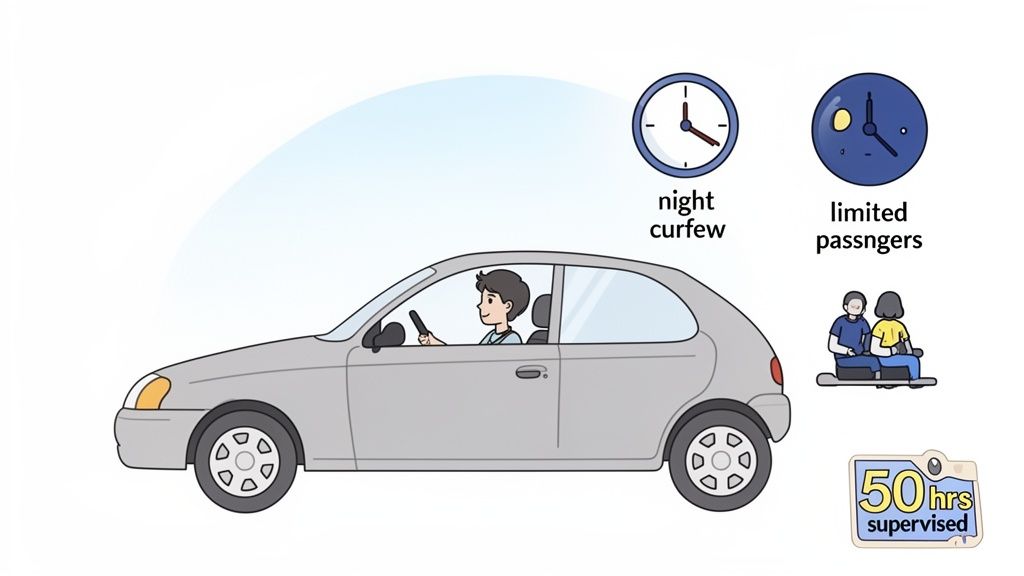
Turning 16 is a major milestone, especially after a full year of driving with a learner’s permit. This is the age when you can finally graduate to an intermediate license in Florida, moving from the co-pilot seat to driving completely on your own. It’s an incredible feeling—your first real taste of driving freedom.
Think of the intermediate license as driving with training wheels, but for rules instead of a bike. You’ve proven you can handle the car with someone next to you, so the state trusts you to go solo. But they’ve put some important safety guardrails in place to protect you while you build that crucial real-world experience.
Before you can get there, you’ll need to hit a few key benchmarks to prove you’re ready for the responsibility.
Meeting the Requirements for Your Intermediate License
To upgrade your permit, you have to show you’ve put in the time and effort. Florida wants to see not only that you’ve practiced but also that you’ve been a safe, responsible driver during your first year behind the wheel.
The requirements are straightforward but firm:
- You must be at least 16 years old.
- You need to have held your learner’s permit for one full year with a clean record—no traffic convictions.
- You must log a total of 50 hours of supervised driving practice.
- Of those 50 hours, 10 hours must be at night.
That nighttime driving requirement is no small detail. Driving after dark brings a whole new set of challenges, like dealing with headlight glare and spotting hazards in low visibility. Getting those hours in ensures you’ve got a solid foundation for handling tougher conditions.
The logic here is simple: consistent, safe practice creates competent, confident drivers. The state needs to see a clean record and a serious commitment to practice before letting you drive alone.
Once you’ve checked all these boxes, it’s time to schedule your on-road driving test. This is where you put it all together, showing an examiner you can safely operate a vehicle, follow traffic laws, and perform basic maneuvers like three-point turns and proper parking.
Understanding the Rules of Your New Freedom
Passing your driving test and getting that intermediate license is a huge accomplishment, but it comes with a new rulebook. While you can finally drive by yourself, Florida’s Graduated Driver Licensing (GDL) program places specific restrictions on 16-year-old drivers to help manage the most common risks.
These rules are all about nighttime driving and passengers, which are statistically the two biggest danger zones for new teen drivers.
Nighttime Driving Curfews:
- At 16 years old, you can’t drive between 11 p.m. and 6 a.m. The only exceptions are if you’re driving to or from work or if you have a licensed driver aged 21 or older with you.
- At 17 years old, the rules relax a bit. The curfew shifts to 1 a.m. to 5 a.m., with the same exceptions for work or supervised driving.
These curfews exist for a very good reason: data consistently shows that fatal crashes involving teens happen most often at night.
Passenger Restrictions:
The other major rule is about who you can have in the car with you. At 16, you are not allowed to drive with more than one passenger under the age of 21 unless they are part of your immediate family. This rule is designed to cut down on distractions, as studies show that crash risk skyrockets when teens drive with other teens in the car.
If you want a deeper dive into building these foundational skills, our Florida drivers education course is designed to prepare you for every stage of getting your license.
These rules might feel strict, but they are backed by years of research. Driving ages vary across the country, with some states offering permits at 14 while about 26% of states don’t grant a full license until 18. Florida’s graduated system—requiring 50 practice hours for an intermediate license at 16—is a proven approach to lowering the tragically high crash rates for drivers aged 16-19, which are three times higher than for adults. You can find more data on how GDL programs work in reports from trusted sources like the AAA Foundation for Traffic Safety.
The Final Step: Your Unrestricted License at 18
This is the moment you’ve been waiting for. Turning 18 is the final milestone in Florida’s Graduated Driver Licensing (GDL) journey. On your birthday, the training wheels come off, and you officially graduate to a full, unrestricted Class E driver’s license. All that practice and preparation are about to pay off.
You’ve completed the required courses, aced the tests, and logged your hours behind the wheel. Now, the state recognizes you as an adult driver, entrusting you with complete freedom and responsibility on the road.
What “Unrestricted” Really Means
That word—unrestricted—is a big deal. It signals the end of the GDL safety rules that have been a part of your life for the last couple of years. Once you turn 18, the passenger and nighttime driving limitations you followed as a 16- and 17-year-old simply vanish.
So, what does this newfound freedom look like?
- No More Curfews: You can finally drive whenever you need to, day or night. That means no more clock-watching for late-night study sessions or worrying about getting home from a friend’s house.
- No Passenger Limits: The rules about who can be in your car are gone. You’re free to drive with friends, siblings, and anyone else you choose.
And here’s the best part: this transition is automatic. There’s no extra test to take or paperwork to file on your 18th birthday. The restrictions just expire, and your intermediate license essentially becomes your full Class E license.
By the time you’re 18, the idea is that you’ve spent years building the judgment and real-world skills needed to handle complex driving situations without the state-mandated guardrails.
From Learning to Lifelong Responsibility
While the GDL rules are in your rearview mirror, the safe driving habits you’ve built are more critical than ever. Those 50 hours of supervised practice, including the 10 challenging hours you spent driving at night, were all designed to prepare you for this moment. Your ability to spot risks, tune out distractions, and make smart decisions is what will keep you—and everyone else—safe.
Florida’s approach of waiting until 18 for full driving privileges isn’t unusual. In fact, it aligns with a global focus on maturity and safety. 18 is the most common age for an unrestricted license worldwide, with over 120 countries—including Germany, Japan, and France—requiring drivers to reach adulthood before gaining full independence. This trend is backed by data showing that GDL systems are effective at reducing accidents among new, younger drivers. You can explore this detailed breakdown of country-by-country requirements to see how driving ages compare across the globe.
Even with a full license, the learning never really stops. Safe driving is a skill you have to maintain for life. After you turn 18, keeping a clean driving record is entirely up to you. If you ever get a traffic ticket, a Basic Driver Improvement (BDI) course can be a huge help in avoiding points on your license and keeping your insurance rates down.
Getting through all the steps, especially the final on-road exam, is a major accomplishment. If you’re still getting ready for that test, it pays to know exactly what to expect. Get a head start by reviewing our guide on acing the behind-the-wheel test. Successfully navigating this process proves you’re not just a licensed driver—you’re a safe and responsible one.
Why Florida’s Graduated System Works
At first glance, the multi-stage process for getting a driver’s license in Florida can seem like a lot of hoops to jump through. Why not just hand over a license at 16 and call it a day? The answer comes from decades of safety research and a simple, powerful idea: gradual exposure to risk builds safer, more confident drivers.
Florida’s Graduated Driver Licensing (GDL) system isn’t just bureaucracy for the sake of it. Think of it as a structured mentorship program for the road.
First, a teen learns the absolute basics with a learner’s permit, always under the watchful eye of an experienced adult. Next, they earn an intermediate license, which grants them the freedom of driving alone but with common-sense limits on high-risk situations, like late-night trips or driving with a car full of friends. This step-by-step approach gives new drivers crucial time to build real-world skills and judgment in lower-risk environments.
A Proven Life-Saving Strategy
At its core, the GDL program is designed to do one thing: save lives. And the data on this is crystal clear. By phasing in driving privileges, the system dramatically reduces crashes involving our newest and most vulnerable drivers.
The research consistently shows that GDL programs are one of the most effective tools we have for teen driver safety. The structure works by directly targeting the two biggest risk factors for young drivers: inexperience and immaturity. By limiting passengers and nighttime driving, the system minimizes common distractions and dangers while teens are still gaining thousands of miles of on-the-road experience.
The results speak for themselves. Strong GDL laws have been shown to reduce fatal crashes among 16- and 17-year-old drivers by an incredible 20% to 40%. It’s one of the most impactful public safety policies for teens ever put into practice.
This isn’t just about protecting the new driver, either—it makes the road safer for everyone. Each restriction, from supervised practice hours to curfews, is a deliberate layer of protection based on hard evidence. The system ensures that by the time a driver turns 18 and gets their full, unrestricted license, they’ve built a solid foundation of experience to draw from.
Florida’s Model in a Global Context
When you ask, “what age can you get your license?” the answer varies wildly around the world. But the safety principles behind the rules are surprisingly consistent. Florida’s model, which allows a permit at 15 and a full license at 18, fits right in with global best practices that balance a teen’s need for independence with the statistical reality of risk.
It’s no coincidence that a lower driving age often correlates with higher teen accident rates. This has led most countries to set the minimum age for a full, unrestricted license at 18. More than 50% of countries let teens start learning with a permit between 16 and 17, but a full license below 18 is rare outside of North America. Even in places like the UK, which allows supervised driving at 17, you typically have to be 18 to get an unrestricted license. This global consensus really underscores the value of a graduated approach, and you can learn more about how driving norms vary worldwide to see these safety strategies in action.
This structured learning is exactly what our programs at BDISchool are designed to support. Our FLHSMV-approved courses help new drivers meet state requirements and, more importantly, build the skills needed to navigate each stage of the GDL system safely. When you understand the “why” behind the rules, you’re much better equipped to make smart decisions for a lifetime of safe driving.
Answering Your Florida License Questions
The path to getting your Florida driver’s license can feel like a maze of rules, forms, and tests. It’s an exciting time, but it can also be a little overwhelming for both new drivers and their parents.
We get a lot of questions about the process, so we’ve put together clear, straightforward answers to the most common ones. Let’s clear up the confusion so you can focus on the road ahead.
Can I Take the Driver’s Permit Test Online in Florida
Good news—yes, you can. If you’re under 18, Florida lets you knock out two key requirements right from your computer: the mandatory Traffic Law and Substance Abuse Education (TLSAE) course and the Class E Knowledge Exam (your official permit test).
This is a game-changer. It means you can study and pass the test on your own time, from the comfort of your home. Once you’ve passed online, you just bring your completion certificate to the DHSMV, which makes your in-person visit that much simpler.
What Documents Do I Need to Get a Learner’s Permit
There’s nothing worse than getting to the DHSMV only to realize you’re missing a document. A little preparation here goes a long way and saves you a second trip. You’ll need to prove who you are and where you live.
Here’s a checklist to make sure you have everything in order:
- One Primary ID: This must be an original or certified copy, like a U.S. Birth Certificate or a valid U.S. Passport.
- Proof of Social Security Number: Your original Social Security card works best, but a W-2 form or a pay stub showing your full name and SSN is also acceptable.
- Two Proofs of Address: You need two separate documents with your current residential address. Think bank statements, school records, or utility bills.
- Parental Consent Form: For applicants under 18, a parent or legal guardian must sign the Parental Consent for a Driver Application of a Minor form. They can sign it there, or you can bring the form already notarized.
Pro Tip: Rules can change. Before you head out, it’s always smart to visit the official Florida Highway Safety and Motor Vehicles (FLHSMV) website to double-check their latest document requirements.
What Happens If I Get a Ticket with My Intermediate License
Getting a ticket with an intermediate license is a bigger deal than many new drivers realize. This license is essentially a test drive for full driving privileges, and a moving violation tells the state you might not be ready for the responsibility just yet.
If you’re convicted of a moving violation, it can delay your eligibility for a full, unrestricted license beyond the one-year mark. In some situations, a judge might even order you to take a driver improvement course to reinforce safe driving habits. It’s a serious reminder to be extra cautious during this phase.
For young drivers, understanding all their options is crucial. This includes knowing about specific insurance products like Temporary Car Insurance For Students Under 21 that can help manage short-term coverage needs.
Do I Still Need a Learner’s Permit If I’m Over 18
This is a common source of confusion, so let’s clear it up. If you’re 18 or older and getting your first license in Florida, you don’t have to hold your permit for a full year like younger drivers do. However, you do still have to get a permit first.
Think of it as a mandatory, but much shorter, apprenticeship. You’ll need to pass the vision, hearing, and knowledge exams to get your learner’s permit. Then, you must practice with a licensed driver who is 21 or older sitting in the front passenger seat. The key difference is that once you feel confident in your skills, you can book your road test—no waiting period required.
How Many Hours Do I Need to Practice Driving
For teen drivers, nothing replaces time behind the wheel. Florida law makes sure you get enough real-world experience before you’re allowed to drive solo.
Before you can even apply for your intermediate license at age 16, you have to log 50 hours of supervised driving. Your parent or guardian will need to certify that you’ve completed this time. Crucially, at least 10 of those 50 hours must be done at night. This isn’t just a number to hit; it’s designed to expose you to the unique challenges of night driving and make you a more prepared, well-rounded driver.
At BDISchool, our goal is to help you navigate every step of the licensing process with confidence. Our state-approved online courses, from the TLSAE to the permit test itself, give you the foundation you need to be a safe and responsible driver. Begin your journey to driving freedom by exploring our courses at https://bdischool.com.