Ever gotten a traffic ticket and wondered why it was such a big deal? The answer often comes down to one key distinction: was it a moving violation?
In Florida, a moving violation is any traffic offense that happens while your vehicle is actually in motion. Think of it as a penalty for breaking the rules of the road while you're actively driving—like speeding, running a stop sign, or making an improper turn.
This is a world away from a non-moving violation, which is a ticket you get when your car is parked or stationary. A classic example is a ticket for an expired registration sticker or parking in a no-parking zone. The car isn't going anywhere, but you've still broken a rule.
Defining a Moving Violation in Florida
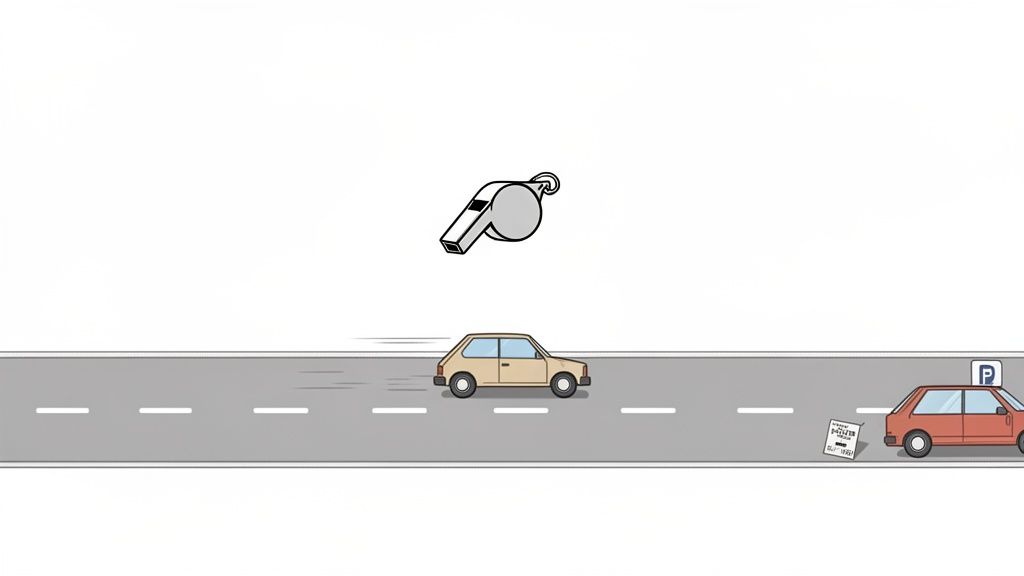
So, what’s the core difference? It really boils down to a simple question: was your car being driven when the infraction happened?
If the answer is yes, you're looking at a moving violation. The Florida Department of Highway Safety and Motor Vehicles (FLHSMV) takes these offenses far more seriously, and for good reason—they represent an immediate danger to other drivers, pedestrians, and property.
Think of it like this: a foul committed during a live play in a basketball game (a moving violation) directly affects the safety of the players and the game's outcome. A uniform violation for a player on the bench (a non-moving violation) is still a breach of the rules, but it doesn't endanger anyone on the court. That’s why Florida’s laws are designed to penalize actions that create real-time risk on the road.
To make this even clearer, here’s a quick comparison of the two.
Moving vs. Non-Moving Violations
| Violation Type | Vehicle Status | Common Example |
|---|---|---|
| Moving Violation | In motion | Speeding, running a red light, illegal U-turn |
| Non-Moving Violation | Stationary / Parked | Expired registration, parking ticket, broken taillight |
Understanding this table is the first step in knowing how to handle your ticket.
Key Characteristics of Moving Violations
It’s crucial to know what makes these violations different, because the consequences go way beyond just paying a fine. They can impact your driving record and insurance costs for years.
- Active Operation: The offense happens while the car is being actively driven. This covers everything from speeding and tailgating to failing to yield the right-of-way.
- Safety Risk: These actions are flagged as dangerous behaviors that significantly increase the chances of an accident.
- Point Assessment: A conviction for a moving violation almost always adds points to your driver's license. Rack up enough points, and you could face a license suspension.
- Insurance Impact: Car insurance companies see these violations as a red flag for risky driving behavior, which often leads to a jump in your premiums.
The bottom line is that the state focuses on penalizing actions that create immediate danger. A parking ticket is an annoyance, but an illegal lane change on the highway can cause a catastrophic accident.
To really get a handle on this, it helps to understand what isn't a moving violation. You can dig deeper into the other side of the coin in our guide on what is a non-moving violation. Making that distinction is the first step to figuring out your options and protecting your driving privileges.
What Are the Most Common Moving Violations in Florida?
Now that we’ve covered the basic difference between a moving and a non-moving violation, let's get into the real-world situations that usually end with flashing blue lights in your rearview mirror. These aren't just abstract rules on a page; they're common mistakes that can catch even the most cautious drivers off guard during a moment of distraction or a simple lapse in judgment.
At its core, a moving violation in Florida is any traffic law you break while your car is actively in motion. Think speeding, running a red light, or making an unsafe lane change. These are the infractions that add points to your driver's license and give your insurance company a reason to raise your rates. And it's happening more and more—traffic citations jumped by 5.6% statewide in just one recent year, which translates to a staggering 155,824 more tickets than the year before. You can dive into the numbers and see the full data on rising Florida traffic tickets.
Speeding Tickets
Speeding is, without a doubt, the king of moving violations. It’s also one of the most dangerous. Florida's penalties are tiered, meaning the consequences get much steeper the faster you go over the limit. A few miles over might just be a pricey inconvenience, but pushing it too far brings heavy penalties.
- 1-15 MPH Over the Limit: This will typically land you a fine and 3 points on your license.
- 16+ MPH Over the Limit: The fine gets bigger, and the points jump to 4.
- 50+ MPH Over the Limit: This isn't just a ticket anymore; it's considered reckless driving. You're facing a criminal offense with severe fines and a mandatory court date.
Speeding laws have nuances, so it pays to know the specifics. For a complete look at the rules, check out our in-depth guide to Florida speed limit laws.
Red Light and Stop Sign Violations
Running a red light or blowing through a stop sign is another all-too-common and high-risk offense. It doesn't matter if you intentionally pushed a yellow light or just did a "rolling stop" without coming to a complete halt—the state sees it as a serious failure to yield.
These violations are especially dangerous because they are a primary cause of "T-bone" collisions, which are some of the most devastating types of car accidents. Getting convicted for running a red light or stop sign will almost always add 3 points to your driving record.
Other Frequent Offenses
Beyond speeding and ignoring traffic signals, plenty of other actions behind the wheel can get you a moving violation ticket. They might seem like minor infractions at the moment, but they create unsafe conditions for everyone and the penalties can quickly add up.
To give you a better sense of what to watch out for, here's a quick rundown of some common violations and what they'll cost you in points.
Common Moving Violations and Typical Point Values
| Violation Type | Typical Point Value | Common Scenario |
|---|---|---|
| Speeding (1-15 MPH Over) | 3 | Driving 45 MPH in a 35 MPH zone. |
| Speeding (16+ MPH Over) | 4 | Clocked at 70 MPH in a 55 MPH zone. |
| Running a Red Light | 3 | Entering an intersection after the traffic light has turned red. |
| Improper Lane Change | 3 | Swerving into another lane without signaling or cutting someone off. |
| Following Too Closely | 3 | "Tailgating" the car in front, leaving no room to stop safely. |
| Careless Driving | 3 | Getting distracted by a phone and causing a minor fender-bender. |
| Failure to Yield | 3 | Not letting a pedestrian cross at a crosswalk or merging unsafely. |
Each of these violations tacks points onto your license, pushing you that much closer to a potential suspension. And you can be sure your insurance provider is keeping score, too.
How the Florida Driver's License Point System Works
Imagine your Florida driver's license starts with a perfect record. Each time you're convicted of a moving violation, the state adds points to that record. Think of them as black marks that tell the state you're a higher-risk driver, and they add up fast.
This system is more than just a way to keep track of tickets. The Florida Highway Safety and Motor Vehicles (FLHSMV) uses it to spot patterns of unsafe driving. One speeding ticket might not feel like a major issue, but every point brings you a little closer to some serious consequences.
Point Accumulation and License Suspension
Florida’s system is all about how many points you rack up within certain periods. If you hit a specific number of points too quickly, your license gets suspended—no questions asked. The more points you get in a short time, the longer you'll be off the road.
Here are the numbers that really matter:
- 12 points in 12 months = 30-day suspension
- 18 points in 18 months = 3-month suspension
- 24 points in 36 months = 1-year suspension
These aren't just warnings; they're automatic. The moment you cross one of these thresholds, the suspension kicks in. This is why keeping a close eye on your driving record is so important. If you're curious about the bigger picture, you can learn more about how long points stay on your license in our other guide.
This simple breakdown shows how just a couple of common mistakes can snowball.
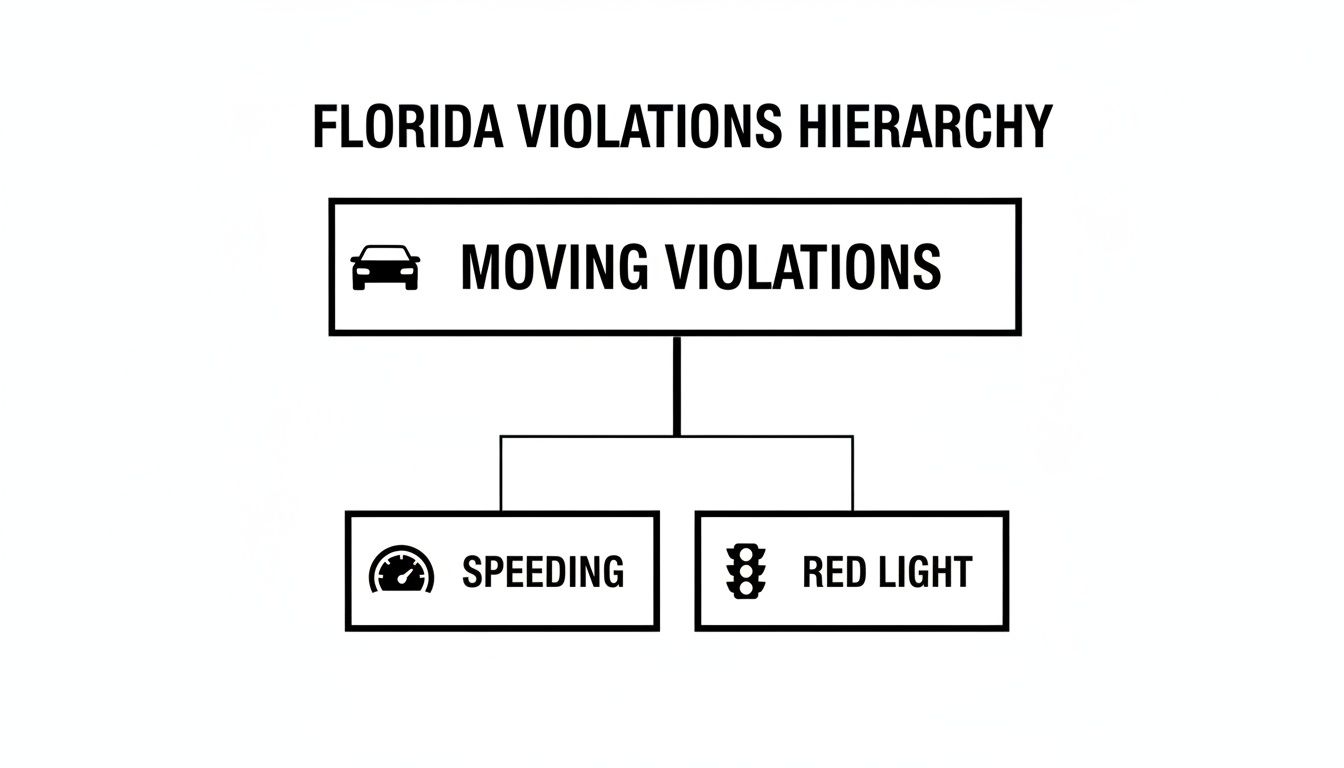
As you can see, a few speeding tickets or a red light violation here and there can put your license in serious jeopardy before you know it.
The Risk of Becoming a Habitual Traffic Offender
Stacking up points doesn't just lead to short-term suspensions. It can land you with the dreaded Habitual Traffic Offender (HTO) label. This is a far more serious classification that comes with a five-year revocation of your driver's license.
An HTO designation is typically for drivers who get 15 convictions for moving violations within a five-year span. It can also be triggered by just three serious convictions for offenses like DUI or driving with a suspended license.
Getting a handle on this system is the best way to protect yourself. It makes it crystal clear that a moving violation in Florida is never "just a ticket"—it’s a step that could lead to losing your freedom to drive. By taking every citation seriously, you can keep your record clean and stay safely on the road.
The Hidden Costs: How Violations Affect Car Insurance
Let's be honest, the fine printed on a traffic ticket is just the beginning of the story. The real financial sting comes later, showing up as a nasty surprise on your car insurance bill—an increase that can stick around for a very long time.
When you're convicted of a moving violation, your insurance company doesn't just see a one-off mistake. They see you as a higher-risk driver. To them, a speeding ticket or running a red light is a statistical signal that you're more likely to get into an accident down the road.
And when their perceived risk goes up, so does your premium. They simply pass that anticipated cost on to you.
How One Ticket Triggers Rate Hikes
Insurance companies are all about crunching numbers and assessing risk, and a moving violation is a massive red flag in their calculations. That one ticket often triggers an automatic review of your policy when it’s time for renewal.
Even a single minor speeding ticket can make your rates jump. If it’s something more serious, like careless driving or going way over the speed limit, you could be looking at a huge increase—or even find that your insurer won't renew your policy at all.
The thing to remember is that a traffic ticket isn't a one-time payment. It's a long-term financial headache that can cost you hundreds, or even thousands, in extra premiums over the three to five years it stays on your record.
This is exactly why just paying the fine is often the most expensive choice you can make.
Protecting Your Wallet and Your Driving Record
Thankfully, you're not powerless here. For many Florida drivers, the smartest move is to complete a state-approved defensive driving course. It's a proactive step that shows both the state and your insurer that you're serious about safe driving.
Taking a course like a Basic Driver Improvement (BDI) class brings two huge wins:
- No Points on Your License: If you're eligible, successfully finishing a BDI course means the state withholds the points from your license, keeping your official record clean.
- No Insurance Rate Hikes: Here’s the best part. Florida law actually forbids insurance companies from jacking up your rates because of a ticket if you complete a BDI course for it.
By spending a few hours in traffic school, you're not just brushing up on your driving skills; you're building a financial firewall between one bad moment on the road and your bank account. To really grasp the connection, you can learn more about how traffic ticket points affect insurance in our detailed guide. It’s a small investment that pays for itself over and over again.
What Are Your Options After Getting a Traffic Ticket?
So, you've got a traffic ticket. It’s a frustrating moment for any driver, but what you do next really matters. That piece of paper in your hand represents a fork in the road, and the path you choose will have a direct impact on your driving record, your insurance premiums, and your bank account.
Don't just react out of panic. In Florida, you have three main routes you can take. Let's walk through each one so you can figure out which move is best for you.
Option 1: Pay the Fine and Take the Points
This is the path of least resistance, and it's tempting. You just pay the fine, and you're done with it. Simple, right?
Not so fast. Paying that fine is the same as pleading guilty. You're admitting to the violation, and as a result, the state will automatically add points to your driver's license. That "easy" way out is often the most expensive in the long run because it almost guarantees your insurance rates will go up and pushes you closer to a possible license suspension.
Option 2: Head to Court and Fight the Ticket
Your second choice is to plead not guilty and take your chances in traffic court. This means showing up before a judge to argue why the ticket should be thrown out.
This can be a smart move, especially if you have a strong case—maybe the officer made a mistake, or the evidence against you just isn't there. If you win, the ticket disappears completely. But there's a flip side. If you lose, you could be on the hook for the full fine, court costs, and you’ll still get the points on your record. It’s a bit of a gamble.
Traffic tickets are incredibly common. Take red-light cameras, for example. In Pensacola, police recorded a staggering 29,907 potential violations in less than a year. This led to 14,366 actual citations and over $1.1 million in fines in just the first five months of the program.
If your ticket came from an accident, the situation gets more complicated. Knowing what to do right after a crash is critical. This guide on What to Do After a Car Accident can walk you through the immediate steps.
Option 3: Choose Traffic School to Avoid the Points
For most drivers, this is the golden ticket. By choosing to take a state-approved Basic Driver Improvement (BDI) course, you can keep the points from ever touching your license.
You'll still need to pay the court the fine for the ticket. However, once you complete the course, the state agrees to "withhold adjudication." In plain English, that means you aren't officially convicted of the offense, and the violation is essentially wiped from your public driving record.
This option is a game-changer for a few huge reasons:
- No Points on Your Record. This is the biggest win. It keeps your driving history clean and prevents you from inching toward a suspension.
- No Insurance Hikes. Florida law specifically forbids your insurance provider from jacking up your rates for a ticket if you complete a BDI course.
- Keep Your Safe Driver Status. You protect your reputation as a responsible driver, which can save you money for years to come.
Think of traffic school as a small investment to protect yourself from the much bigger financial hit of a sullied driving record. It's the most proactive way to handle a moving violation and keep your future costs down.
How Florida-Approved Traffic School Can Protect Your Record
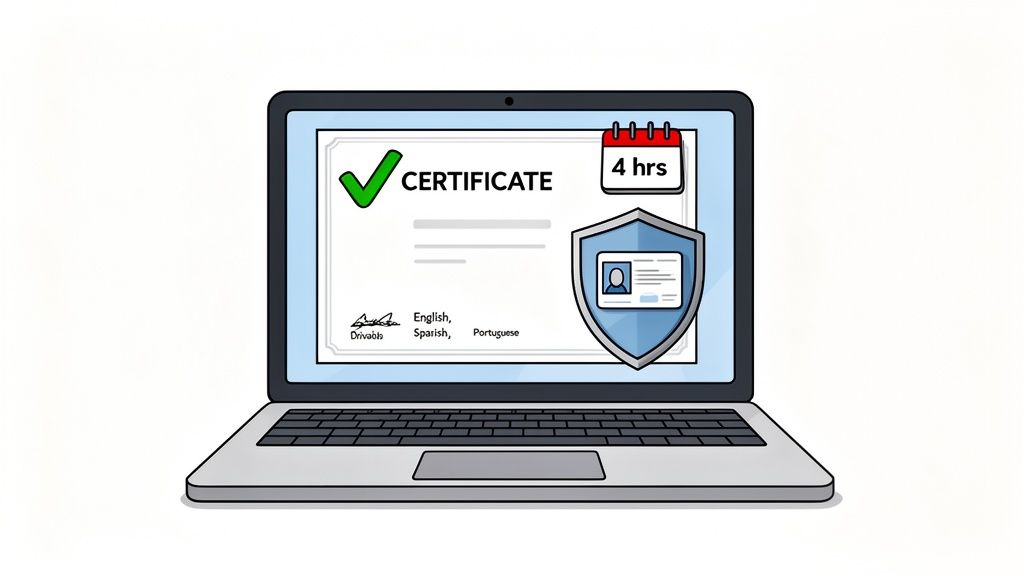
Getting a ticket doesn't have to mean points on your license and an insurance bill that makes you cringe. Florida drivers have a great option: elect to attend traffic school. It’s a proactive choice that puts you back in control, allowing you to sidestep the points and keep your driving record clean.
The most common path for this is the 4-hour Basic Driver Improvement (BDI) course. By choosing to take this course (if you're eligible), you effectively prevent the points from your ticket from ever hitting your record. Think of it as an eraser for a minor mistake, saving you from higher insurance premiums down the road.
Different Courses for Different Needs
Of course, not every situation is the same, so Florida offers a few different types of traffic school courses. It’s important to know which one fits your specific needs, whether you're trying to satisfy a court order or just looking to become a sharper driver.
- 8-Hour Intermediate Driver Improvement (IDI): A judge might order you to take this longer course if the violation was more serious or if you have a history of tickets.
- Aggressive Driver Course: This is a court-ordered, 8-hour program specifically for drivers who need to address issues with road rage or aggressive driving habits.
- Mature Driver Course: Designed for drivers 55 and older, this 6-hour refresher course doesn't just sharpen skills—it can also land you a nice discount on your car insurance.
These programs are more than just a way to deal with a ticket. They're a genuine opportunity to refresh your knowledge of traffic laws, learn new defensive driving techniques, and become more aware of risks on the road.
The Convenience of Online Learning
The best part? You can do it all from your own couch. Our courses are 100% online and self-paced, so you can fit them into your life, not the other way around. They work on any device and are available in English, Spanish, and Portuguese.
A huge number of drivers end up in these courses because of a heavy foot. In just one recent year, Florida law enforcement wrote a staggering 744,082 speeding tickets. In fact, over 42% of those tickets came from just five counties: Duval, Palm Beach, Hillsborough, Orange, and Broward. You can explore detailed insights on Florida speeding tickets to see the full breakdown.
Once you finish the course, we handle the paperwork. We report your completion certificate directly to the Florida Department of Highway Safety and Motor Vehicles (FLHSMV) for you. It’s a seamless way to protect your license and keep your insurance rates from going through the roof.
Your Top Questions About Moving Violations, Answered
Getting a traffic ticket can throw a wrench in your day, and the rules can be pretty confusing. Let's clear up some of the most common questions Florida drivers ask after getting cited for a moving violation.
Can I Take Traffic School for This Ticket?
Most of the time, yes. In Florida, you can usually choose to take a traffic school course for a basic, non-criminal moving violation to avoid points. But there are a few rules of thumb to keep in mind.
You're eligible if you haven't taken a traffic school course in the past 12 months. Also, there's a lifetime limit: you can only use this option five times total.
It's important to note that this option is off the table for anyone with a commercial driver's license (CDL), even if you were ticketed in your personal car.
How Long Will Points Haunt My Florida Driving Record?
When it comes to your license, points from a moving violation are actively counted against you for 36 months—that's a full three years from the conviction date. While those points eventually "expire" for suspension purposes, the violation itself can remain visible on your driving history for much longer.
This is exactly why keeping points off your record is such a big deal. Racking them up quickly leads to serious trouble. For instance, just 12 points within 12 months will get your license suspended for 30 days.
Do I Need to Let the Court Know I Finished Traffic School?
Absolutely. Taking care of the court's requirements is entirely on you. The process starts with telling the Clerk of Court in the county where you got the ticket that you're choosing the traffic school option. You'll also have to pay the fine at that time.
Once you complete a state-approved course, the school usually sends your certificate of completion to the Florida DHSMV electronically. However, it's still your job to make sure a copy gets to the Clerk of Court before your deadline. This final step is crucial for officially closing your case and getting the points dismissed.
Don't let one mistake mess with your driving record or your insurance premiums. BDISchool offers Florida-approved online courses that are quick, straightforward, and designed to fit your schedule. Protect your record and keep your rates low by enrolling today at https://bdischool.com.