Defensive driving isn't just a set of rules; it's a completely different way of thinking about what you do behind the wheel. It’s all about being proactive and anticipating trouble before it finds you, so you can make smart, preventative moves. You learn to control your vehicle and your space to avoid accidents, no matter what other drivers are doing or how bad the road conditions get.
This mindset shift is what turns you from a passive, reactive driver into a strategic one.
What Is Defensive Driving Explained
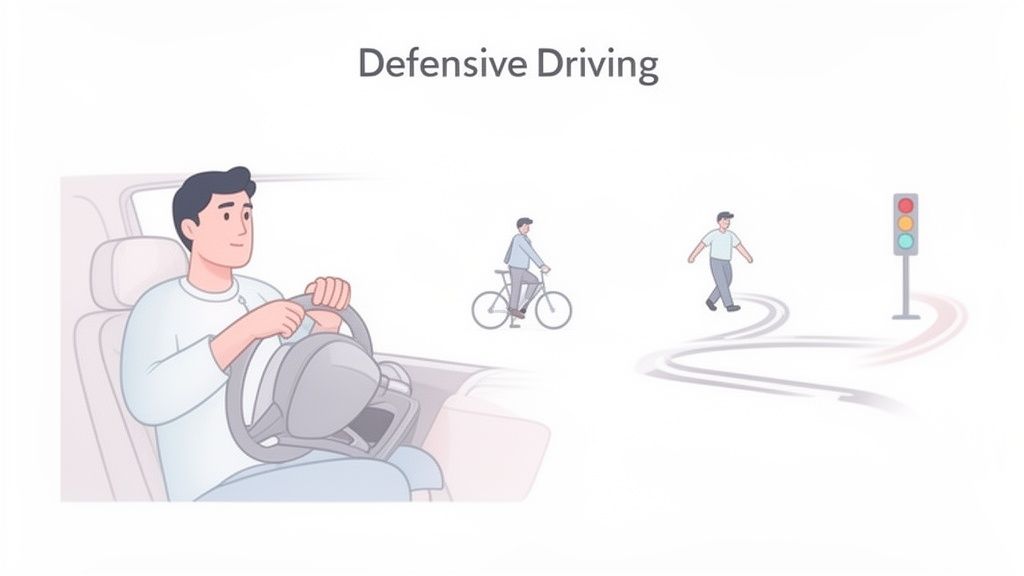
Think of it like playing chess on the highway. A novice player only reacts to their opponent's last move. An expert, however, is always thinking three or four moves ahead. That’s defensive driving. You’re constantly anticipating the cyclist who might swerve into your lane, the car next to you that drifts without a signal, or the sudden wall of brake lights just over the crest of a hill.
This isn't about being a timid driver. It's about being a prepared driver—someone who is always ready. The whole approach is built on a foundation of solid awareness, smart space management, and careful speed control.
The Core Mindset Shift
The real difference between just driving and driving defensively is your mindset. Standard driving is mostly about following the law—stopping at red lights, obeying the speed limit. That’s the bare minimum. Defensive driving takes it a crucial step further by working from a simple, powerful assumption: other drivers are going to make mistakes.
A defensive driver operates their vehicle in a manner that saves lives, time, and money, in spite of the conditions around them and the actions of others. It’s about expecting the unexpected and always having a plan.
This proactive outlook keeps you in the driver's seat, both literally and figuratively, even when things get chaotic. If you're looking to explore more about road safety, you can find additional driving insights on other expert blogs.
To break it down, here are the key ideas that form the backbone of defensive driving.
Core Principles Of Defensive Driving At A Glance
| Principle | What It Means In Practice |
|---|---|
| Awareness | Actively scanning the entire environment—ahead, behind, and to the sides. Knowing where other vehicles, pedestrians, and potential hazards are at all times. |
| Space Cushion | Maintaining a safe distance around your vehicle. This buffer gives you precious time and room to react if someone else makes a sudden mistake. |
| Anticipation | Looking ahead and predicting what other drivers might do, not just what they are doing. Seeing that "what if" scenario before it happens. |
| Control | Managing your speed and position to suit the current conditions. This includes slowing down for bad weather, sharp curves, or heavy traffic. |
These principles work together to create a safety net that protects you on the road.
The Real-World Goals Of Defensive Driving
When you boil it all down, the ultimate goal is to reduce your risk of a collision. Every time you get behind the wheel, you’re using these principles to protect yourself, your passengers, and everyone else sharing the road. This involves a few key objectives:
- Hazard Anticipation: You get good at spotting potentially dangerous situations long before they become emergencies. Think of a bouncing ball rolling into the street—a defensive driver immediately anticipates a child running after it.
- Collision Avoidance: This means actively using techniques like the 3-4 second rule for following distance to ensure you always have an "out" or a way to escape a bad situation.
- Total Situational Awareness: It’s more than just looking out the windshield. It's a constant, 360-degree scan of your surroundings, checking your mirrors, and being mindful of your blind spots.
Mastering these concepts takes practice, but it's a skill that pays dividends for a lifetime. Learning how to improve driving skills is an ongoing commitment that makes you a safer, more confident, and more prepared driver.
The Three Pillars Of Defensive Driving: Space, Speed, And Sight

You don't need a massive rulebook to master defensive driving. At its core, it all boils down to three simple, interconnected principles: Space, Speed, and Sight.
Think of them as the foundation of your entire safety strategy behind the wheel. When you get these right, you're not just reacting to traffic—you're proactively managing your environment. Each pillar supports the others, creating a system that puts you in control, no matter what other drivers are doing. Let's break down how to put them to work.
H3: Mastering Your Space Cushion
The first and arguably most important pillar is Space. The best way to think about this is to imagine an invisible safety bubble around your vehicle. Your job is to protect that bubble on all sides—front, back, left, and right. Why? Because space buys you the one thing you can't get back in an emergency: time.
To manage the space in front of you, the 3-4 second rule is your best friend. As the car ahead passes a fixed object (like a signpost or an overpass), start counting: "one-one-thousand, two-one-thousand…" You shouldn't reach that same object before you get to three. This simple habit ensures you have enough room to brake without a collision. You can get a deeper understanding by reading our guide on how to calculate stopping distance.
But space isn't just about what's ahead. It's an all-around concept:
- Ditch the Blind Spots: Don't hang out where other drivers can't see you, especially next to big rigs. If you can’t see the truck driver's face in their side mirror, they have no idea you're there.
- Keep Your Options Open: Whenever you can, position your car with an open lane next to you. This gives you a critical "escape route" if you need to swerve to avoid a sudden hazard.
- Handle Tailgaters Smartly: If someone's glued to your bumper, resist the urge to brake-check. The safest move is to gently ease off the gas to increase your following distance, encouraging them to pass.
H3: Adapting Your Speed to the Situation
The second pillar is Speed. This goes way beyond just obeying the posted limit. It’s about choosing a speed that is safe and appropriate for the actual conditions you're in right now. That number on the sign is the maximum for a perfect, sunny day—not a mandatory target.
A defensive driver knows the safest speed is one that guarantees complete control over the vehicle, regardless of weather, traffic, or how well you can see.
Think about it. A sudden Florida downpour makes the roads incredibly slick, so you naturally slow down. Gridlock on I-95 means crawling along, not trying to hit 65 mph. Driving at a safe, adaptable speed is common sense, but it’s a skill that needs conscious practice.
H3: Expanding Your Sight and Awareness
The final pillar is Sight, but it’s really about awareness. It’s the difference between just looking at the car in front of you and actively seeing the whole picture.
Top defensive drivers are constantly scanning their environment. They look 12-15 seconds down the road—that’s about a city block ahead, or a quarter-mile on the highway. This gives you a massive head start on spotting potential trouble, like a cluster of brake lights, a construction zone, or someone about to pull out into traffic.
This proactive scanning is a proven lifesaver. Skills like smooth acceleration and hazard spotting have contributed to a 3.1% nationwide drop in fatalities from speeding-related crashes from 2022-2023. As you can see from UC Berkeley's traffic safety report, these are the habits that make a real-world difference.
How Defensive Driving Prevents Florida's Most Common Accidents
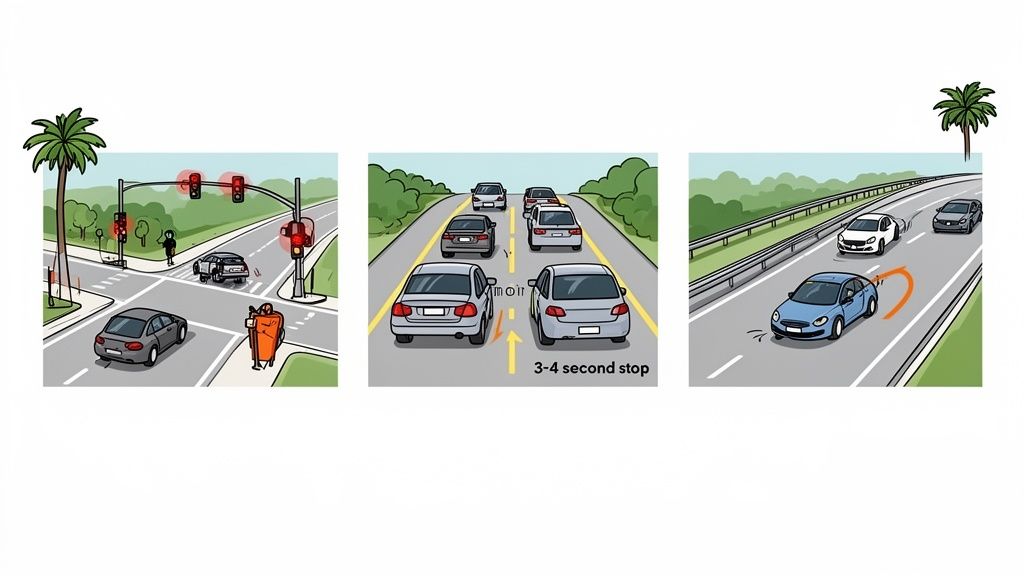
It’s one thing to learn the rules of defensive driving, but it’s another to see how they actually save you from a collision. These aren’t just abstract concepts; they are practical, real-world skills that directly counter the most common and dangerous accidents we see on Florida’s roads every day.
When you practice defensive driving, you’re essentially creating a safety buffer around your car, protecting yourself from the mistakes of others. You stop being a passive driver waiting for something to happen and become an active manager of your own safety. It's all about spotting the warning signs of a crash before it happens.
Side-Stepping Intersection Collisions
Intersections are notorious hotbeds for T-bone accidents. A typical driver sees a green light and just goes. But a defensive driver sees that same green light and thinks, "Proceed with caution."
Before even touching the gas, they do a quick scan—left, right, then left again—to make sure no one is about to blow through their red light. This simple two-second glance is a game-changer. It gives you the precious time needed to hit the brakes and avoid getting slammed by a driver who wasn't paying attention. You’re anticipating the hazard instead of just assuming everyone will follow the rules.
Defensive driving strategies directly address the primary factors contributing to collisions, helping drivers mitigate the risks by understanding the common causes of car accidents.
Avoiding Rear-End Crashes in Traffic
Anyone who has sat in Florida's bumper-to-bumper traffic knows it’s a breeding ground for rear-end collisions. Your best defense is simply leaving enough room in front of you.
By following the 3-4 second rule, you give yourself plenty of space and time to stop smoothly, even if the driver ahead slams on their brakes. A smart driver also looks two or three cars ahead. Spotting brake lights further up the road lets you ease off the gas early, which prevents a sudden stop and lowers the chance of the person behind you hitting you.
Preventing Lane-Change Incidents on the Highway
Changing lanes on a busy highway like I-95 or I-4 demands your full attention. Just checking your mirrors and flipping on your signal isn’t enough.
A defensive driver knows that mirrors have major blind spots. That’s why they physically turn their head to check that blind spot every single time before moving over. It's a simple habit that stops you from merging right into a car you never even saw.
This proactive approach is even backed up by modern car technology. Features like Blind Spot Detection have been shown to reduce lane-change crashes by 14% and cut the injuries from those accidents by 23%. These tools don’t replace good habits; they enhance them, adding one more layer of protection to your defensive driving toolkit.
The Financial Benefits Of Defensive Driving In Florida
Aside from making the roads safer for everyone, taking a defensive driving course is one of the smartest money moves you can make as a Florida driver. It's a small investment of your time that pays you back in very real, tangible ways.
We're not just talking about dodging the huge costs of a collision, like massive repair bills or medical expenses. This is about actively cutting your regular bills and shielding your driving record from expensive penalties. A few hours now can easily save you hundreds of dollars every single year.
Slash Your Auto Insurance Premiums
One of the most immediate perks you'll see is a drop in your car insurance bill. Many insurance companies in Florida will give you a nice discount for voluntarily completing a state-approved defensive driving course. This is especially true for programs like the Mature Driver course designed for drivers 55 and older.
Why would they do this? It's all about risk. Insurers know that drivers who have been trained in defensive techniques are statistically much less likely to get into an accident. When you finish a course, you're showing them you're a lower-risk driver, and they pass those savings on to you. These discounts often range from 5-10% off your annual premium. To see exactly how this works, you can learn more about how a defensive driving class can lower your insurance rates.
Avoid Points and Insurance Hikes After a Ticket
Getting a traffic ticket in Florida sets off a chain reaction of costs. The fine you pay upfront is only the beginning. The real financial pain comes from the points that get tacked onto your license, which can make your insurance premiums jump for years. Even a single ticket can result in a 20% or higher increase in what you pay.
This is where a Basic Driver Improvement (BDI) course is an absolute game-changer. If you get a non-criminal moving violation and are eligible, you can choose to take a state-approved BDI course to keep those points off your record entirely.
Think of a BDI course as a financial shield. For a small, one-time fee, you protect your driving record, prevent your insurance company from raising your rates, and maintain your status as a safe driver.
Taking this one simple step is a powerful way to stop the long-term financial bleeding from a minor driving mistake. Instead of paying hundreds—or even thousands—in extra insurance costs over the next three to five years, you make a small investment to keep your record clean. The return on that investment is massive and immediate.
The table below breaks down how different Florida courses offered by BDISchool can help you save money and improve your driving.
Florida Defensive Driving Course Benefits
| Course Type (BDISchool) | Primary Goal | Key Benefit |
|---|---|---|
| Basic Driver Improvement (BDI) | Point dismissal for a traffic ticket. | Avoids insurance rate hikes and keeps your driving record clean. |
| Mature Driver Course (55+) | Proactive driver safety education. | Qualifies for a mandatory auto insurance discount for up to 3 years. |
| Traffic Law & Substance Abuse (TLSAE) | First-time driver education. | A required step to get your Florida learner's permit. |
| Aggressive Driver Course | Court-ordered for aggressive driving. | Fulfills legal requirements and helps prevent future violations. |
Each course is designed to address a specific need, but they all share a common thread: making you a safer, more confident driver while providing significant financial advantages.
Choosing The Right Florida Defensive Driving Course For You
So, you get the idea of defensive driving, but which course is actually the right one for you? Florida has a few different state-approved programs, and each one is built for a specific purpose—whether you’re trying to make a ticket disappear or just want to snag a nice discount on your car insurance.
It might seem a little confusing at first, but it really boils down to one simple question: Why are you here? Did you get a ticket? Is a judge telling you to take a class? Or are you just being proactive about becoming a safer driver and saving some cash?
Once you know your "why," picking the right course is easy.
The 4-Hour Basic Driver Improvement (BDI) Course
This is the big one. The 4-Hour Basic Driver Improvement (BDI) course is what most people need. If you got a standard, non-criminal moving violation—think a basic speeding ticket or rolling through a stop sign—this is your solution for keeping points off your driving record.
Completing the BDI course also means your insurance company can’t legally raise your rates because of that specific ticket. Think of it as a small investment to keep your record clean and your premiums down. It's the fastest, most direct way to handle a common traffic ticket.
The 8-Hour Intermediate Driver Improvement (IDI) Course
For more serious violations, you'll likely be looking at the 8-Hour Intermediate Driver Improvement (IDI) course. This one isn't usually elective; it's typically for drivers who have been ordered by a judge to attend traffic school. It can also be a requirement if you've racked up too many points on your license in a short period.
The IDI course goes deeper, covering traffic laws and safe driving habits more thoroughly. It's designed to help drivers who have shown a pattern of risky behavior get back on track and satisfy court requirements.
Specialized Courses For Specific Needs
Florida also has a couple of other courses designed for very specific drivers and goals. These are less about fixing a recent mistake and more about proactive education.
- Mature Driver Course: If you’re 55 or older, this course is a fantastic way to brush up on your skills and get caught up on any new traffic laws. The best part? You get a state-mandated discount on your auto insurance for up to three years.
- Aggressive Driver Course: This is a court-ordered program for drivers cited for aggressive driving. The curriculum is focused on helping people manage their anger behind the wheel and unlearn the dangerous habits that put everyone at risk.
This flowchart breaks down the two most common reasons people sign up for a defensive driving course.
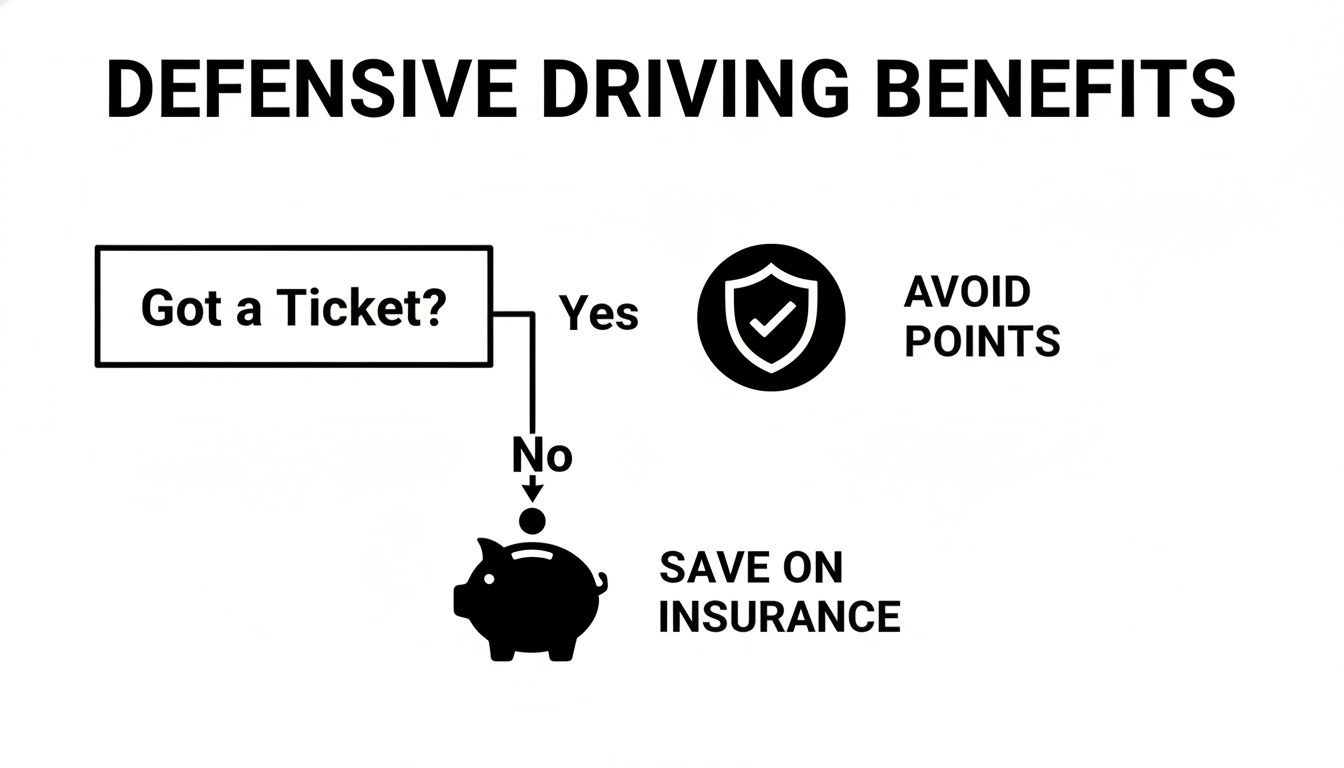
As you can see, whether you’re reacting to a ticket or looking for a way to save money, there's a clear path forward.
Picking the right course is more than just checking a box. It’s a genuine step toward making our roads safer. That defensive mindset really works, contributing to a 4.4% decrease in projected traffic fatalities in early 2024. Programs like BDI don't just help drivers dismiss points; they instill habits that lead to fewer crashes and lower insurance claims for everyone.
Ready to get started? You can check out a state-approved online defensive driving course in Florida and complete it from the comfort of your own home, completely on your own schedule.
Your Top Defensive Driving Questions Answered
So, you understand the what and why of defensive driving, but you probably still have some questions about how it all works in the real world here in Florida. Let's clear those up.
I've pulled together the most common questions we get from drivers just like you. Here are the straightforward answers you need.
How Long Does a Defensive Driving Course Take?
The time commitment really depends on which course you're taking. For most people trying to handle a ticket, you'll be taking the Basic Driver Improvement (BDI) course, which is a state-required 4 hours. If a judge ordered you to take a more intensive class, like the Intermediate Driver Improvement (IDI) course, that one is 8 hours.
But here's the best part: online courses are totally self-paced. You don't have to carve out a 4-hour or 8-hour block from your day. You can log in and out whenever you want, chipping away at the material in small chunks that actually fit your life.
Can I Really Do The Whole Thing Online?
Yes, you absolutely can. Our Florida-approved defensive driving courses are 100% online. From the moment you sign up, through all the lessons, and right up to the final exam, everything happens on your computer, tablet, or even your phone.
That flexibility is a game-changer. No need to drive to a stuffy classroom or rearrange your weekend plans. You can learn from your couch, on your lunch break, or whenever you find a quiet moment. After you pass, your completion certificate is processed and sent out electronically. It’s that simple.
Will This Course For Sure Get My Ticket Dismissed?
For an eligible traffic ticket, a state-approved BDI course is exactly what you need to keep points off your license. Once you finish the course and get your certificate, you just need to submit it to the Clerk of Court in the county that gave you the ticket.
Here’s how it works: Completing a BDI course means the state agrees to "withhold adjudication." In plain English, that means you aren't found guilty, no points are added to your license, and your insurance company can't jack up your rates because of that specific ticket.
The key is making sure you tell the court you elect to take traffic school before their deadline hits. As long as you follow their process, you’ll get the full benefit and keep that driving record looking clean.
How Often Can I Take a Defensive Driving Course in Florida?
The state has some clear rules on this. You can take a BDI course to dismiss a ticket once every 12 months.
There's also a lifetime limit: you can only use this option five times in total. Think of it as a valuable tool for those occasional "oops" moments, not a get-out-of-jail-free card. If you’ve taken a course in the last couple of years, it’s always a good idea to double-check your eligibility before you sign up.
Is It Worth Taking a Course Just For an Insurance Discount?
For a lot of drivers, especially those 55 and older, the answer is a huge "yes!" When you complete a Mature Driver course, Florida law requires your insurance company to give you a discount that lasts for three years. The money you save on your premium usually blows the low, one-time cost of the course out of the water.
Even if you're younger, it's worth a shot. Many insurance providers offer a voluntary discount for proactive drivers who complete a course. The best way to find out is to just call your agent and ask. It's a small investment in your safety that could easily lower your monthly bills.
Ready to protect your driving record, save money, and become a safer driver? BDISchool offers fully online, state-approved courses that are convenient, easy to follow, and designed for Florida drivers like you. Enroll today and take control of the road!