Ever felt your car suddenly go light and start to drift on a wet road? That terrifying, heart-in-your-throat moment is called hydroplaning.
It happens when a layer of water gets trapped between your tires and the road, lifting your car just enough to lose all traction. Your tires essentially become a set of water skis, making it impossible to steer, brake, or accelerate. Knowing what hydroplaning is—and what it feels like—is the first step to avoiding it.
The Danger of Skimming on Water
Think about skipping a flat stone across a pond. If you throw it with enough speed and the right angle, it glides across the surface instead of sinking. Hydroplaning works on the same basic principle, but it's your car doing the skipping.
Your tire treads are designed with deep grooves to act like channels, pushing water out from under the tire so the rubber stays in contact with the pavement. But when you hit a puddle too fast, those channels get overwhelmed. They can't clear the water away quickly enough.
Instead, a wedge of high-pressure water builds up in front of the tire, lifting it right off the road surface. Suddenly, you have a total loss of grip. The steering wheel will feel alarmingly light, and your vehicle might start to pull to one side or even spin. It’s a frightening situation that can happen in a split second, often without any warning.
Key Factors in Losing Control
Several ingredients have to come together to create this perfect storm for losing control. The most common culprits are:
- Vehicle Speed: The faster you drive, the less time your tires have to scatter the water. Speed is the biggest factor by far.
- Tire Condition: Worn-out treads and low tire pressure are a recipe for disaster. Bald tires have no channels to clear water, making hydroplaning almost inevitable.
- Water Depth: It doesn't take a flood. A patch of standing water as shallow as one-tenth of an inch is all it takes for a car to lose contact with the road.
This isn't just a theoretical problem. A staggering 70% of all weather-related crashes in the U.S. happen on wet pavement, and hydroplaning is a major reason why. You can learn more about how rain impacts road safety and its challenges.
Understanding these risks is fundamental to defensive driving. Acknowledging that your vehicle can lose contact with the road is the first step toward adopting safer habits in wet conditions.
This is especially critical for us here in Florida. We're all used to those sudden afternoon downpours that can quickly flood our flat roads. Mastering defensive driving techniques, like the ones taught in a BDISchool course, gives you the tools to see these dangers coming and react the right way, keeping you in control no matter what the weather throws at you.
The Simple Science Behind Losing Your Grip
To really understand hydroplaning, you have to get a feel for the physics at play. It's this understanding that takes away the mystery and gives you the power to prevent it. Think of your tires on a wet road. When you're stopped, the car's weight easily pushes through the water, keeping the rubber firmly planted on the pavement. But once you start moving, the whole game changes.
Your tire's tread isn't just for looks; it's a complex system of channels designed to do one crucial job: pump water out from under the tire. As you drive through rain, these grooves work like tiny aqueducts, clearing a path for the "contact patch"—that small patch of rubber that’s actually touching the road at any given moment.
But there's a catch. Those channels can only move so much water, so fast. The faster you drive, the less time your tires have to do their job. Water starts to build up in front of the tire, creating a wedge that lifts the rubber right off the asphalt.
The Tipping Point of Traction
This building pressure is the critical moment. Once the force of that water wedge pushing up on the tire overpowers the vehicle's weight pushing down, you start to hydroplane. Your tire is no longer touching the road at all. It's literally surfing on a thin, dangerous film of water.
In that instant, you lose any ability to steer, brake, or accelerate. Why? Because there's zero friction between your tire and the road surface. It's a complete and total loss of control, and it happens far more easily than most people think.
The scariest part about hydroplaning is how suddenly it happens. One second you're driving, completely in control. The next, you're just a passenger in a car that isn't listening to you anymore.
This concept map breaks down the three key ingredients that cook up this dangerous situation.

As you can see, it's the interplay between your speed, the depth of the water, and the condition of your tires that dictates your risk. If any one of these factors is off, your chances of losing grip shoot way up.
The Dangerous Trio: Speed, Water, and Tires
Let's look at how each of these elements adds to the problem. Imagine them as three dials; turning any of them up brings you closer to a skid.
- Speed: This is the big one. The faster you go, the more powerful that water wedge becomes and the less time your tires have to clear a path.
- Water Depth: You don't need a flood to lose control. It takes as little as one-tenth of an inch of water on the road to cause some cars to completely lose traction.
- Tire Condition: This is your first line of defense. Worn-out treads with shallow grooves simply can't channel enough water away. On top of that, low tire pressure can change the shape of your tire, making it even harder to slice through the water on the road.
By actively managing these three factors—slowing down, watching for puddles, and keeping your tires in good shape—you’re taking apart the recipe for hydroplaning before it can even start.
Are You Driving at a Higher Risk?
Not all wet roads are created equal, and not every rainy drive carries the same level of danger. A few key factors can dramatically increase your chances of hydroplaning, turning a simple commute into a white-knuckle experience. When you understand these variables, you can size up your own risk and make smarter, safer choices from the driver's seat.
Think of it this way: your speed, your tires' condition, the amount of water on the road, and even your vehicle's weight are all dials on a control panel. Turn any one of them up too high, and you're practically inviting a loss of traction. It’s rarely just one thing, but how all these elements come together at that specific moment.
Your Driving Speed
Of all the factors, speed is the big one. It's the single most critical element in causing a hydroplaning event.
The faster you go, the less time your tire treads have to do their job—which is to squeegee water out from under the tire. Go fast enough, and the tire simply can't keep up. Instead of cutting through the water to the pavement, it starts to skim on top of it like a water ski.
While there’s no magic number, the risk of hydroplaning starts climbing dramatically above 35 mph. Push it past 50 mph on a wet road, and you're essentially handing over a massive amount of control, even if you have great tires.
Slowing down is the most powerful move you can make. It gives your tires the time they need to grip the road and gives you a fighting chance to react to what’s ahead.
Your Tire Condition
Your tires are your only connection to the road. Their condition is everything when it comes to preventing a skid. Two things matter most here: tread depth and inflation pressure.
Worn-out treads have lost their ability to channel water away. And if your tires are under- or over-inflated, their shape gets distorted, making them much more likely to lift right off the pavement.
There's a classic trick to check your tread depth: the "penny test."
- Grab a penny and stick it into a few of the tread grooves on your tire.
- Make sure you place it with Lincoln’s head pointing down into the tread.
- Can you see the top of Abe's head? If so, your treads are shot. They're below the safe minimum of 2/32 of an inch.
Seeing Lincoln's whole head is a crystal-clear signal that your tires are a hazard in wet conditions and need to be replaced immediately. For more advice on this and other crucial checks, our guide on Florida vehicle maintenance covers all the essentials.
This diagram shows you exactly what happens to your tire's contact patch as your speed increases on a wet road.
As you can see, the patch of rubber actually touching the road shrinks fast, robbing you of grip and control.
Water Depth and Vehicle Weight
The amount of water on the road is obviously a huge factor. You don't need a flood to be in trouble; it only takes about 1/10th of an inch of standing water to cause a car to completely lose traction.
Lighter vehicles are also at a higher risk. They just don't have the mass pushing the tires down against the road, which makes it much easier for water pressure to lift them up and send them sliding.
Research has shown that hydroplaning is a factor in roughly 20% of traffic accidents during bad weather across the globe. The recurring culprits? Vehicle speed, water depth, and tire pressure. The expert advice is clear: try to stay under 31 mph on wet roads, especially if your tires are in good shape. You can dig deeper into the science behind these hydroplaning dynamics in a detailed study. By getting ahead of these risks, you stay in command.
Your Best Defense Is Proactive Prevention
When it comes to hydroplaning, the best way to handle it is to make sure it never happens in the first place. This isn't about luck; it's about developing a few smart, deliberate habits that act as your shield when the roads get slick. Think of it as the core of defensive driving—you see the risk coming and take simple steps to sidestep it long before it becomes a real threat.
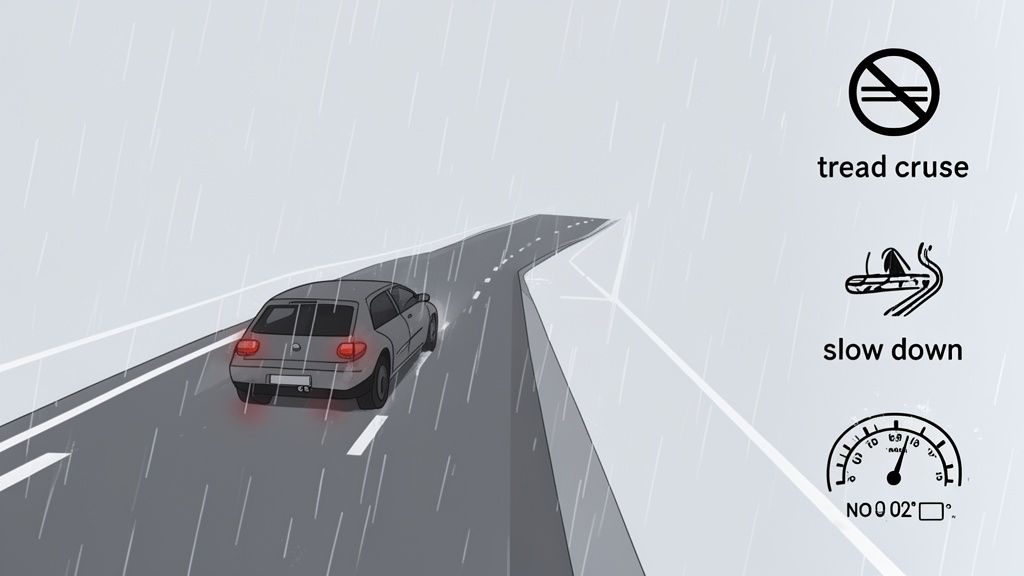
These preventative steps are the same fundamental principles we teach in driver safety courses, all designed to build the right instincts. By making a few conscious adjustments to how you drive in the rain, you can massively reduce your chances of ever feeling that terrifying loss of control.
Smart Driving Habits For Wet Roads
Your first line of defense is always your own behavior behind the wheel. When the skies open up, it’s time to shift your mindset. Your goal isn't just to get to your destination anymore; it's to get there safely.
A few simple adjustments can make all the difference:
- Reduce Your Speed Immediately: The moment rain starts, ease your foot off the gas. Dropping your speed by just 5-10 mph below the posted limit gives your tires a much better chance to stay connected to the pavement.
- Increase Following Distance: Wet roads mean it takes a lot longer to stop. Double your usual three-second following distance to at least six seconds. This cushion gives you a crucial buffer to react if the car ahead slams on its brakes.
- Avoid Cruise Control: This is a feature you should never use on wet surfaces. If you start to hydroplane, cruise control will keep trying to maintain speed, which can cause your wheels to spin even faster and turn a minor slip into a major skid.
Your Tires Are Your First Defense
Beyond how you drive, the condition of your vehicle—and specifically your tires—is a huge factor. Your tires are engineered to grip the road, but they can't do their job if they aren't in good shape. Performing a few essential car maintenance tasks, especially regular tire checks, is non-negotiable for wet-weather safety.
Make these checks part of your routine:
- Check Tire Pressure Regularly: When your tires are properly inflated, they hold their optimal shape and can slice through water much more effectively. Get in the habit of checking the pressure at least once a month.
- Monitor Tread Depth: Remember, those grooves in your tires are what channel water away. Use the penny test to make sure your tread is above the 2/32 of an inch safety minimum. Driving on bald tires in the rain is just asking for trouble.
Here's a pro tip: Following in the tracks of the vehicle ahead of you can be a surprisingly effective tactic. The car in front has already pushed a good amount of water out of the way, creating a slightly drier path for your tires to follow.
To help you remember these key points, here's a quick checklist you can mentally run through before and during a rainy drive.
Hydroplaning Prevention Checklist
This table summarizes the most important actions you can take to keep yourself safe on wet roads.
| Action Item | Best Practice |
|---|---|
| Reduce Speed | Drive 5-10 mph below the speed limit as soon as it starts raining. |
| Increase Follow Distance | Keep at least a six-second gap between you and the car ahead. |
| Disable Cruise Control | Turn it off to maintain full manual control over your vehicle's speed. |
| Check Tire Pressure | Ensure tires are inflated to the manufacturer's recommended PSI monthly. |
| Inspect Tread Depth | Use the penny test to confirm tread is deeper than 2/32 of an inch. |
| Drive in Tire Tracks | Follow the path of the vehicle in front of you on very wet roads. |
These simple, repeatable actions are the foundation of proactive safety. By combining smart driving decisions with diligent vehicle care, you create multiple layers of protection that keep you firmly in control, no matter how hard it’s raining. For a deeper dive into these and other life-saving techniques, you can explore our detailed guide on how to avoid car accidents.
How to Regain Control When Your Car Starts to Skid
It happens in a flash. The steering wheel suddenly feels light as a feather, and the car isn't responding like it should. You're no longer driving; you're just along for the ride. When your car starts to hydroplane, your gut reaction might be to slam the brakes or jerk the steering wheel, but that's a recipe for disaster.
The real key to getting through it safely is to stay calm and make deliberate, gentle moves.
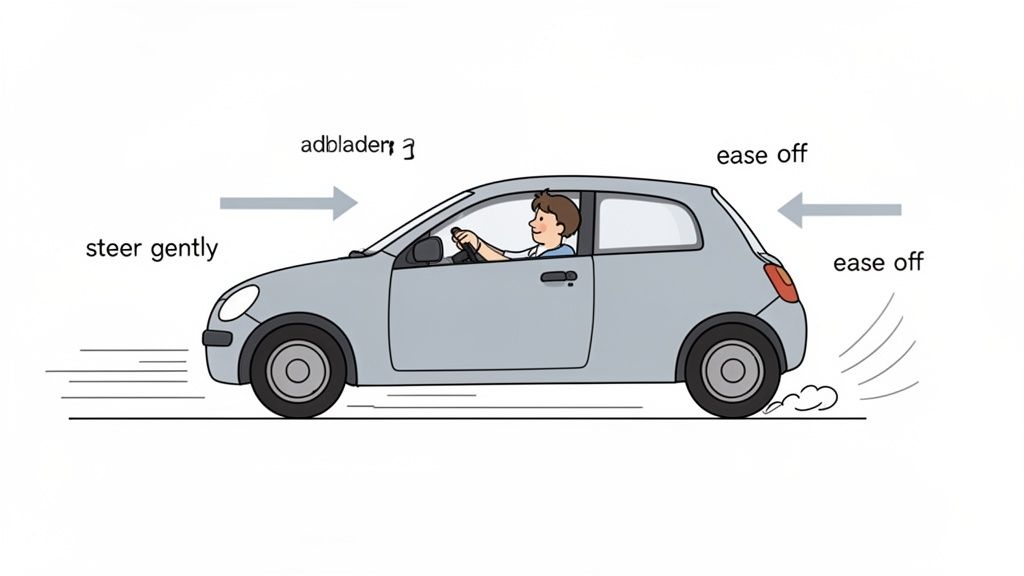
Panic is the enemy in this situation. The right actions might feel completely wrong at the moment, but they are exactly what your car needs to slow down and let the tires find pavement again.
Step-by-Step Recovery Guide
If you feel your vehicle start to lose traction on a wet road, you have to act fast. These steps need to become muscle memory, the kind of instinct that driver safety courses work hard to build.
Don’t Panic, and Don't Brake: Your first impulse will be to stomp on the brake pedal. Fight it. Hard braking will just lock the wheels, making the skid much worse and completely removing your ability to steer.
Ease Your Foot Off the Accelerator: Smoothly take your foot off the gas. You want the car to slow down on its own, gradually. This gives the tires a chance to push the water away and reconnect with the road surface.
Steer Gently Toward Where You Want to Go: This is the most crucial part, often called "steering into the skid." If the back of your car is sliding out to the right, you need to make a small, gentle steering correction to the right. If it's sliding left, steer left. This helps line your front tires up with the direction the car is actually moving.
Avoid Overcorrecting: Small, smooth adjustments are all you need. If you yank the wheel, you risk snapping the car back the other way into an even more violent skid.
The second you feel the tires bite into the road again, you'll know. At that point, you can carefully straighten the wheel and apply the brakes gently if you need to. The whole terrifying experience might only last a few seconds, but how you react in those seconds changes everything.
Why These Steps Work
It all comes back to the physics we talked about earlier. When your tires are literally floating, any sudden, aggressive action—like hitting the brakes or wrenching the wheel—just adds to the chaos.
Gently easing off the gas is the single most effective way to scrub off speed without locking the wheels. It gives the treads a fighting chance to channel the water away and re-establish that critical patch of contact with the road.
Understanding why this works is what separates a lucky driver from a skilled one. It’s about knowing how your car responds to your inputs, especially when things go wrong. For a closer look at the forces involved, our guide on how to calculate stopping distance dives deeper into the principles that make these defensive driving techniques so effective. Knowing what to do in an emergency isn't luck; it's training.
Why Florida Drivers Face Unique Wet Weather Challenges
Driving in the rain is one thing. But navigating a sudden Florida downpour? That’s an entirely different beast. Our state's unique climate and geography create a perfect storm for hydroplaning, making it a constant and serious threat for anyone on the road.
Florida is famously flat. Unlike states with rolling hills that help with natural drainage, our landscape doesn't give heavy rain many places to go. When one of our notorious summer thunderstorms dumps inches of rain in just a few minutes, it pools up fast, turning roads into shallow lakes—prime territory for hydroplaning.
The Perfect Storm of Florida Roads
That poor drainage is a huge factor, but it’s not the only problem. Think about Florida's high-traffic corridors in cities like Miami, Orlando, and Tampa. Years of heavy traffic literally polish the asphalt smooth, wearing down the texture that your tires need to grip the road, even when it's dry.
Now, add a sudden deluge to that slick, polished pavement. The combination of standing water and a smooth surface creates an environment that’s more like an ice rink than a road. This is exactly why a simple afternoon shower can turn your daily commute into a white-knuckle experience, drastically increasing the odds of losing control.
A detailed analysis confirmed that the southern United States is a major hotspot for rainfall-induced hydroplaning. The research found that about 22% of at-risk road sections show a growing trend in annual occurrences. For drivers in high-traffic areas, this points to an even riskier future. You can see the full data by reading the research on road infrastructure hydroplaning risks.
Navigating Florida’s Specific Hazards
This is precisely why state-approved defensive driving education is so critical for us here in Florida. A course from BDISchool goes beyond generic advice because it’s designed with our specific challenges in mind. It gives you practical, real-world strategies for handling the hazards you’ll actually face on our roads.
Here’s what really makes a difference:
- Recognizing Danger Zones: You'll learn how to spot low-lying areas and roads known for poor drainage before you're in trouble.
- Adjusting for Climate: There's a big difference between a steady drizzle and a sudden, intense downpour. You'll understand how to adjust your driving for Florida's specific weather patterns.
- Managing High-Traffic Conditions: The course teaches you proven techniques for keeping a safe distance when visibility plunges and the roads get slick.
Mastering skills built for our local environment helps you drive with far more confidence and control. For a deeper dive, check out our guide on driving in the rain in Florida; it’s packed with tips you can use today. This knowledge isn't just about passing a test—it's about empowering you to anticipate and handle the very real risks that make hydroplaning a serious concern across our state.
Answering Your Top Questions About Hydroplaning
Even when you know the basics, a few specific questions always pop up about hydroplaning. Let's clear the air and tackle some of the most common ones I hear from drivers. Getting straight answers is the best way to feel confident and prepared when you're driving on slick roads.
This is your quick FAQ for staying safe when the skies open up. The goal here is to give you practical, no-nonsense information you can use right away.
At What Speed Does Hydroplaning Happen?
There's no single magic number, but the danger really starts to creep in around 35 mph. That's a lot slower than most people think.
Of course, that’s just a baseline. If your tires are bald or there's a ton of standing water on the road, you could lose grip at even lower speeds. The risk shoots up the faster you go. Once you hit 50 mph on a wet road, your tires are in a serious battle to push water out of the way. Your best bet is always to ease off the gas as soon as the rain starts.
Will All-Wheel Drive or Four-Wheel Drive Stop Me From Hydroplaning?
This is a huge and dangerous myth. The short answer is a hard no. AWD and 4WD systems are fantastic for getting you going on slippery surfaces like gravel, ice, or snow by sending power to all the wheels. They help with acceleration traction.
But hydroplaning isn't about acceleration; it's about a total loss of grip. When your tires are floating on a film of water, it doesn't matter how many wheels are spinning. They're not touching the road.
Think of it this way: Hydroplaning is the great equalizer. It completely bypasses the benefits of even the most advanced drivetrain. It's a pure physics problem—when there’s no contact with the road, there's no control, period.
How Can I Tell if My Tires Are Safe for the Rain?
Your tires are your single most important line of defense against hydroplaning. You need to keep an eye on two things: tire pressure and tread depth.
- Pressure: Get a simple tire gauge and check the pressure regularly. The right number isn't on the tire itself; it's on a sticker inside your driver's side door jamb. Underinflated tires are a major risk factor.
- Tread Depth: Grab a penny for this classic trick. Stick it in one of the tread grooves with Lincoln's head facing down. If you can see the top of his head, your tread is worn down to 2/32 of an inch or less. That’s below the legal minimum, and it's time for new tires, no question.
Does a Driver Safety Course Actually Help With This?
It absolutely does. A good defensive driving course isn't just about learning rules; it's about building reflexes and changing how you see the road. You learn to spot hazards before they become emergencies, truly understand how your car reacts in bad weather, and practice the right moves until they become second nature.
This kind of training transforms you from a reactive driver—who just responds to what happens—into a proactive one who is always a step ahead. That proactive mindset is the key to handling anything the road throws at you, especially the risk of hydroplaning.
At BDISchool, our Florida-approved courses are built to develop these exact skills. We want you to feel confident and safe behind the wheel, no matter the weather. Find out more about our state-approved Basic Driver Improvement course and how it can help you at https://bdischool.com.