It's a simple question with a critical answer: When should you flip on your headlights? The short version is from sunset to sunrise and anytime visibility is poor—think rain, smoke, or fog. Following that one guideline will keep you safe and on the right side of the law.
The Unmistakable Times to Use Your Headlights in Florida
Knowing when to use your headlights isn't just a friendly suggestion; it's a core rule of the road backed by law. Think of your headlights as your car’s way of saying, "Here I am!" It’s how you make sure everyone else sees you, long before they can make out the shape of your vehicle. Driving without them is like trying to navigate a busy sidewalk with the lights out—it's just asking for trouble.
Florida law is crystal clear on this. You are legally required to turn on your headlights from sunset until sunrise. This isn't just for total darkness; it covers those tricky twilight hours at dawn and dusk. During these times, the fading light plays tricks on our eyes, making it incredibly difficult to spot a moving car against a dimming background.
When Visibility Takes a Nosedive
Beyond just the time of day, Florida law is firm about using your headlights whenever conditions make it hard to see. This rule applies 24/7, no matter what the clock says.
Here are the big ones:
- Rain: If your windshield wipers are on, your headlights must be on. This is a non-negotiable, black-and-white rule, even for those short-lived Florida downpours.
- Fog: A thick blanket of fog can slash your sight distance to almost nothing. Your headlights are your best tool for piercing through that haze and letting others know you're there.
- Smoke: Whether it's from a wildfire or a controlled burn, smoke creates a low-visibility wall that demands the use of headlights.
This handy flowchart breaks down the decision-making process into a simple visual guide.
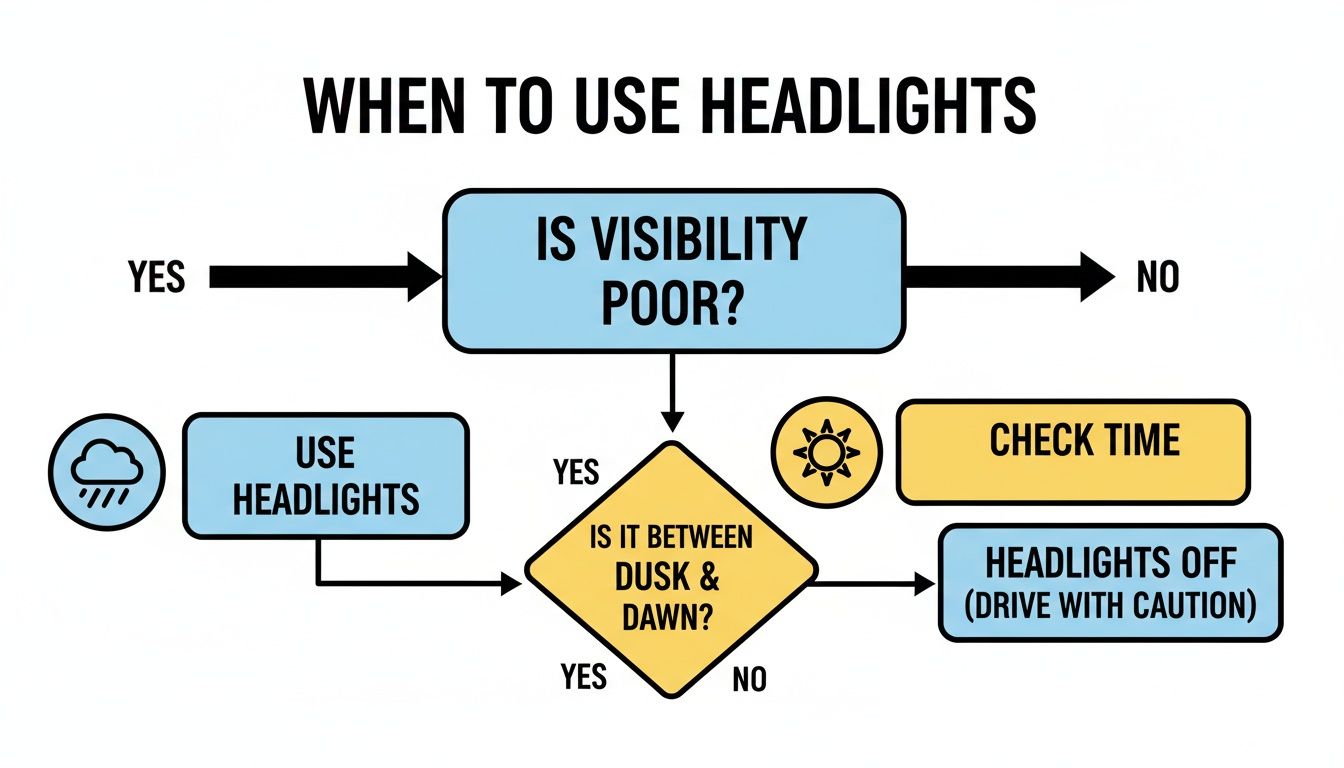
As you can see, poor visibility from conditions like rain automatically means your lights need to be on.
It's not just a Florida thing. All 50 states require headlights from sunset to sunrise. Most also legally require them when visibility drops below a certain point, typically 500 to 1,000 feet. Florida's laws are right in line with these common-sense safety standards.
To get a feel for how these guidelines work in practice, here is a quick reference table.
Florida Headlight Usage Quick Guide
This table summarizes when headlights are not just a good idea but a legal necessity in Florida.
| Condition | Legal Requirement (Florida Law) | Safety Recommendation |
|---|---|---|
| Nighttime | Required from sunset to sunrise | Always use low beams; use high beams on empty, dark roads. |
| Rain | Required whenever windshield wipers are in use | Essential for visibility, even in light drizzle. |
| Fog/Smoke | Required when visibility is significantly reduced | Use low beams to reduce glare and improve what you can see. |
| Dusk/Dawn | Legally part of the "sunset to sunrise" rule | Turn them on early, as ambient light is very deceptive. |
| Tunnels | Required in posted tunnels | Turn on before entering to give your eyes and other drivers time to adjust. |
This isn't just about following rules; it's about making smart, defensive decisions every time you get behind the wheel.
The bottom line is simple: If you have even a shadow of a doubt about whether other drivers can see you, turn on your headlights. It’s a free, proactive safety measure that could prevent a devastating collision.
Ultimately, getting these habits right is what makes a responsible driver. For a complete deep dive into all the state's traffic regulations, the best place to go is always the official Florida driver's manual. It’s the definitive source to keep your knowledge sharp and up-to-date.
Why Daytime Headlight Use Is Your Best Defensive Move
While the law lays out the bare minimum for when to use your headlights, the smartest drivers know a secret: being visible isn't a part-time job. It’s a full-time commitment.
Turning on your headlights during the day, even when the sun is shining, is one of the most powerful defensive driving tactics you can use. It’s not about seeing the road better; it’s about making sure everyone else sees you.
Think of your car on a busy road like a small boat on a huge lake. Without a light, it just blends into the background of waves and shoreline. But flip on a light, and that boat instantly pops. Your headlights do the exact same thing for your car, cutting through the visual noise so other drivers, cyclists, and pedestrians can’t miss you.
This concept is so effective that most new cars come standard with Daytime Running Lights (DRLs). These are lower-intensity lights that switch on automatically whenever the car is on, all with the single goal of making you more conspicuous in daylight.
Making Yourself Seen Proactively
Even if your car isn't equipped with automatic DRLs, you can get the same powerful benefit just by manually turning on your low beams. It's a simple flick of a switch that changes your vehicle from a passive object fading into the scenery to an active, unmistakable presence. This is the very heart of defensive driving—acting first to prevent a collision before it can even start.
And this isn't just a gut feeling; the numbers prove it works.
Research consistently shows that using headlights in broad daylight slashes the risk of certain collisions. A major analysis of daytime running light studies revealed that cars without standard DRLs had a crash rate 1.73 times higher than cars that had them.
Why such a big difference? Because headlights are designed to catch the human eye. They make it far easier for other people to judge your speed and distance, which is critical at intersections, during lane changes, or when someone is about to pull out into traffic.
The Small Habit with a Big Impact
Getting into the habit of driving with your lights on is a tiny change that delivers a huge safety payoff. It costs nothing and takes a split second, but it completely changes how other people on the road perceive your car.
Here’s why it’s so critical:
- It fights "inattentional blindness." This is a real phenomenon where other drivers might look right at you but not truly see you because their brain dismisses your car as part of the background.
- It helps in tricky lighting. Your car can seem to vanish and reappear when driving through shadows cast by trees, overpasses, or tall buildings. Headlights keep you visible.
- It gives others more time to react. By making you visible from farther away, you give everyone around you more precious seconds to notice you and respond, especially at highway speeds.
Ultimately, flipping that switch is a simple statement that you are taking control of your own safety. You’re ensuring you are seen, acknowledged, and accounted for by everyone sharing the road.
Mastering Your Low and High Beams for Night Driving
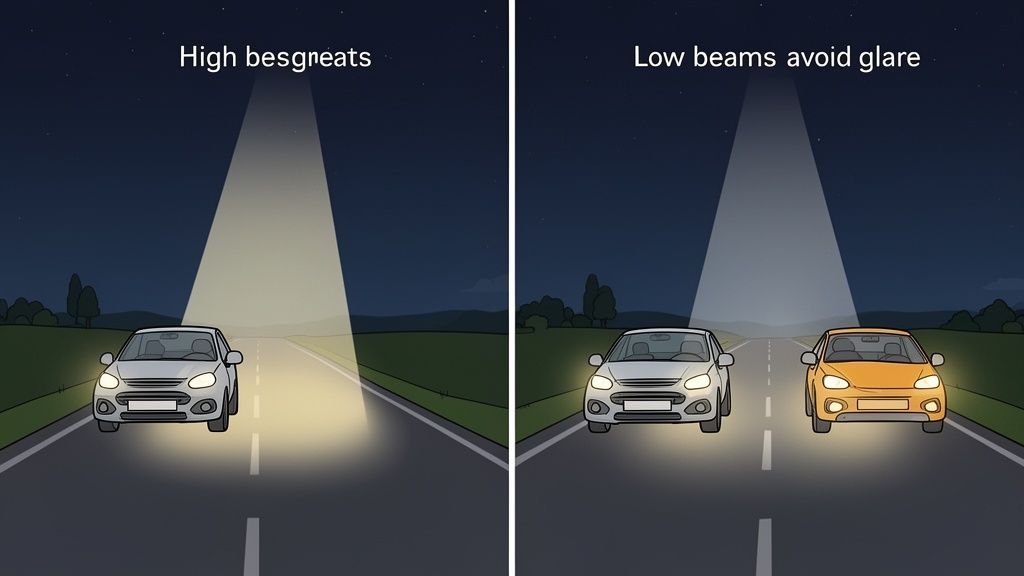
Driving at night isn't just about flipping a switch—it's about actively managing what you can see. Your low and high beams are two distinct tools for two very different jobs, and knowing when to use each is crucial for staying safe after the sun goes down.
Think of it like this: your low beams are for walking through a crowded room, lighting up what's immediately in front of you without bothering anyone. Your high beams are for scanning a wide-open, empty field, giving you the biggest possible view.
Your low beams are your go-to for most night driving. They're designed to light up the road for about 160 to 300 feet without shining into the eyes of oncoming drivers. This is the setting you'll use in town, in traffic, or when you're following another car.
High beams, on the other hand, are built for long-range visibility, casting a beam 350 to 500 feet or even farther. They are absolutely essential on dark, rural roads where you need as much time as possible to spot hazards like deer, pedestrians, or debris on the pavement.
The Danger of Outrunning Your Headlights
Have you ever heard the term "outrunning your headlights"? It’s a very real and very dangerous situation that happens when your car is moving too fast for you to stop within the distance illuminated by your headlights. At highway speeds, it's easier to do than you might think.
Many people overestimate how far their low beams actually reach. In reality, most low-beam systems only provide enough light for safe driving up to about 40–50 mph. Go any faster on a dark road without your high beams, and you're essentially driving into the unknown.
Research from the Insurance Institute for Highway Safety backs this up, finding that vehicles with good-rated headlights are involved in 19% fewer nighttime single-vehicle crashes. It’s a stark reminder of how much proper lighting matters.
A good rule of thumb to live by: If you can't see far enough ahead to react and stop safely, you're driving too fast for your headlights. Slow down, or if the road is clear, switch to your high beams.
To help you decide which beam to use and when, here’s a quick comparison:
Low Beams vs High Beams: When to Use Each
Knowing the right tool for the job makes all the difference. This table breaks down the ideal situations for using your low and high beams.
| Feature | Low Beams | High Beams |
|---|---|---|
| Primary Use | City driving, traffic, following other cars | Dark, rural, or empty roads |
| Illumination Distance | 160–300 feet | 350–500+ feet |
| When to Use | In populated areas, bad weather (rain/fog) | On unlit roads with no other traffic |
| When to Avoid | On completely empty, dark highways | When approaching or following other cars |
Ultimately, choosing the right beam is about maximizing your own visibility without compromising the safety of others.
When to Switch Between Beams
Becoming a pro at toggling between high and low beams is a skill that makes the road safer for everyone. The rules are simple and mostly come down to courtesy and common sense.
Here’s when you need to make the switch:
- Approaching another car? Dim your high beams when you are within 500 feet of an oncoming vehicle. That’s roughly the length of one and a half football fields.
- Following another car? Switch to your low beams when you’re within 300 feet of the vehicle ahead of you. This prevents your lights from reflecting into their rearview mirror and causing a blinding glare.
Making these quick adjustments ensures everyone can see clearly. For more great advice, you can explore these detailed night driving tips. And since staying alert is just as important as seeing clearly, you might also find these best ways to stay awake while driving helpful for those long nighttime journeys.
Navigating Florida's Unique Driving Conditions
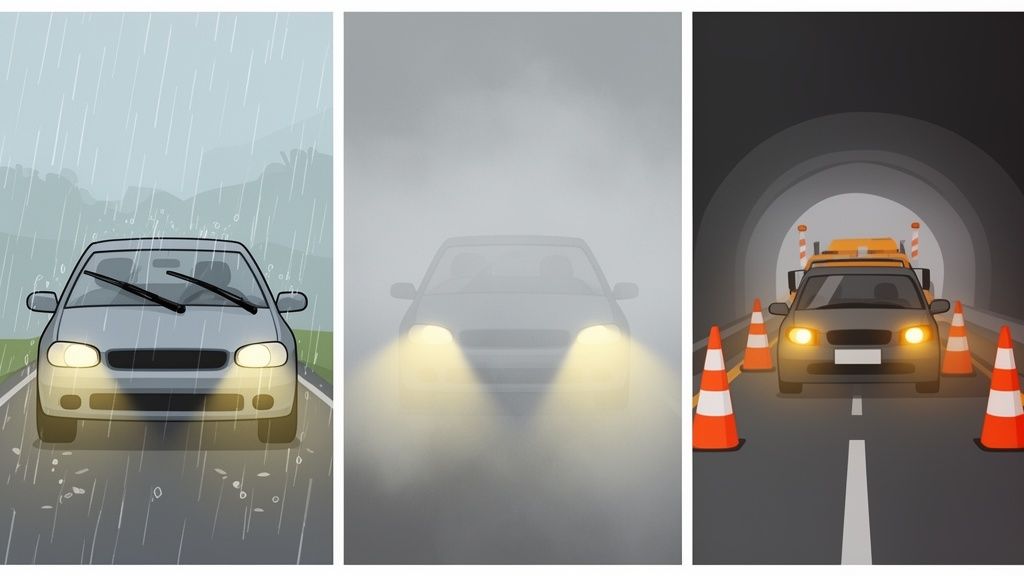
Anyone who's driven in Florida knows the weather can turn on a dime. One minute it's blue skies, the next you're in the middle of a torrential downpour or a dense patch of fog. These conditions demand more than just flipping on your lights at sunset; you have to know how to react to what the road throws at you.
There's one rule every Florida driver must commit to memory: wipers on, lights on. It’s not a suggestion—it's the law. The second you need your windshield wipers, even for a light mist, your headlights need to be on, too. This isn't just about you seeing the road; it's about the driver behind you seeing your taillights through the blinding spray.
This simple habit is one of the single most effective things you can do to stay safe. If you want to get more prepared for our sudden storms, check out our guide with more essential driving in the rain tips.
Handling Fog and Smoke Like a Pro
When you hit a wall of fog or smoke, your gut reaction might be to blast it with your high beams. That’s a natural instinct, but it’s also one of the worst things you can do. High beams shoot light upward, which just reflects off the millions of tiny water droplets in the fog, creating a blinding wall of white. You actually see less.
The right move is to immediately switch to your low beams. They cast their light down onto the road, lighting up the pavement and lane lines directly in front of you, underneath the worst of the fog.
Think of it like trying to read a book in a dusty room. Shining a bright flashlight directly at the pages kicks up a cloud of dust that obscures the words. But angling the light from the side illuminates the text without the distracting glare. Your low beams work the same way in fog.
This simple switch keeps you from blinding yourself and gives you the visibility you need to react to what's ahead.
Special Zones Where Lights Are Always On
Weather isn't the only factor. Florida has specific zones where your headlights are mandatory, no matter how bright and sunny it is. These are areas where visibility is a known challenge, and being seen is just as important as seeing.
Keep an eye out for these situations and be ready to turn on your lights:
- Tunnels: Driving from bright sunlight into a dark tunnel can cause a moment of temporary blindness. Flipping on your headlights before you enter helps your eyes adjust faster and, more importantly, makes your car immediately visible to other drivers already inside.
- Work Zones: Construction areas are a mess of cones, barriers, machinery, and people. Your headlights cut through that visual chaos and help you stand out, keeping road crews and other drivers safe.
Knowing when you should use your headlights in these unique Florida situations is just as crucial as remembering to use them at night. Every scenario is a different puzzle, and your headlights are the key to solving it safely.
Of course. Here is the rewritten section, focusing on a natural, human-written tone and adhering to all your requirements.
Common Headlight Mistakes and How to Avoid Them
Knowing the rules is one thing, but putting them into practice is another. Even the best drivers can slip into bad habits, and when it comes to headlights, these simple mistakes can compromise your safety and get you pulled over. Let's walk through some of the most common slip-ups I see on the road so you can make sure you're not making them.
One of the easiest traps to fall into is forgetting your lights during dawn and dusk. Your own eyes have adjusted to the low light, so you feel like you can see just fine. The problem is, your car becomes a gray silhouette against a gray background, making you practically invisible to everyone else. Another classic mistake is relying on Daytime Running Lights (DRLs) in the rain. Sure, you have lights on up front, but DRLs often don't turn on your taillights, leaving you completely dark to any car behind you.
And please, never drive with only your parking lights on. It’s illegal for a reason. Those tiny lights are designed to make a parked car visible, not an active one. They do almost nothing to help you see the road and don't provide nearly enough light for other drivers to see you properly.
Forgetting the High Beam Etiquette
High beams are fantastic for lighting up a dark, empty road, but they’re a menace when used around other people. Leaving them on by accident is more common than you'd think, and it’s incredibly dangerous. When you blast an oncoming driver with that intense glare, you're causing temporary blindness—a split second of disorientation that can easily lead to a serious crash.
In Florida, the law is crystal clear: you must dim your high beams within 500 feet of an approaching vehicle and within 300 feet of a car you're following. This isn't just about being polite; it's a critical safety rule and a traffic violation.
You need to build the muscle memory to switch them off the instant you see another car's headlights or taillights. It should be an automatic reflex for safe night driving.
The Hidden Dangers of Poor Maintenance
Even if you do everything right, your equipment can fail you. There are two big maintenance issues that often get ignored until it's too late.
- Misaligned Headlights: A small fender-bender or even just years of bumpy roads can knock your headlights out of alignment. If one points too high, it's just as blinding as a high beam. If it points too low, you're not seeing nearly as much of the road ahead as you should be.
- Burnt-Out Bulbs: Driving with one headlight out—the "one-eyed bandit"—is illegal and doubles your risk. It cuts your own visibility in half and makes it incredibly difficult for oncoming traffic to judge your speed and distance. They might even mistake your car for a motorcycle until it's dangerously close.
Ignoring these rules can cost you. We're talking fines, points on your license, and maybe even a hike in your insurance rates. A quick walk around your car to check that your lights are clean, aligned, and working is a simple habit that pays off every single time you get behind the wheel.
Common Questions About Florida Headlight Laws
Let's tackle some of the most common questions Florida drivers have about using their headlights. Think of this as a quick-reference guide to handle those specific, "what-if" situations you encounter on the road.
Getting these details right isn't just about following the rules—it's about building the confidence that makes you a safer, more predictable driver.
Are My Daytime Running Lights Enough When It Rains?
Absolutely not. It’s a common mistake, but relying on your Daytime Running Lights (DRLs) during a rainstorm is a recipe for trouble. DRLs are much dimmer than your actual headlights and, critically, they usually don't turn on your tail lights. This means you're practically invisible to any driver behind you.
Florida's "wipers on, lights on" rule is crystal clear: you must use your full low-beam headlights. This ensures you’re seen from the front and the back, which is essential for safety when visibility drops.
Remember, the whole point is to be seen from every angle, not just from the front.
Can I Really Get a Ticket for Using High Beams Wrong?
Yes, you definitely can. Improperly using your high beams isn't just rude; it's a traffic violation because it can temporarily blind other drivers, creating a genuinely dangerous situation for everyone on the road.
Florida law is very specific about when to dim your brights:
- You must switch to low beams when you’re within 500 feet of an oncoming car.
- You also have to dim them when you're within 300 feet of a vehicle you're following.
What Should I Do if One of My Headlights Burns Out?
Get it fixed immediately. Driving with only one headlight is illegal in Florida, but more importantly, it slashes your ability to see the road at night and makes your car much harder for others to see.
Think about it from another driver's perspective: a single headlight in the dark can easily be mistaken for a motorcycle. This causes other drivers to misjudge your vehicle's width and distance, which can lead to a serious collision.
At BDISchool, our mission is to make Florida's roads safer, one driver at a time, through clear and practical education. Whether you've gotten a ticket or simply want to sharpen your skills, our state-approved courses are designed to help. You can learn more about our programs and get started today at https://bdischool.com.