Maryland law requires you to notify the Motor Vehicle Administration of your address change within 30 days of moving. That update is separate from USPS mail forwarding and voter registration updates.
You’ve unpacked the boxes, changed the utilities, and probably updated your bank account. Then an MVA renewal notice goes to your old home, or you arrive at an election location that no longer matches your record. That’s the problem with treating a move as one address-change task. Maryland uses separate systems for driver licensing, vehicle records, voter registration, mail delivery, and federal agencies.
The safest approach is to use the 30-day MVA deadline as your anchor, then complete vehicle, voter, USPS, and federal updates as separate tasks. The timing traps matter most when you’re a commercial driver, your license is nearing expiration, your street has been renamed, or an election is approaching.
Updating Your Maryland Driver’s License Address
Maryland law requires drivers to notify the MVA of a new address within 30 days of moving. The notice must be made in writing and include your former address, new address, and the identifying number on your Maryland license, according to the Maryland MVA address-update guidance.
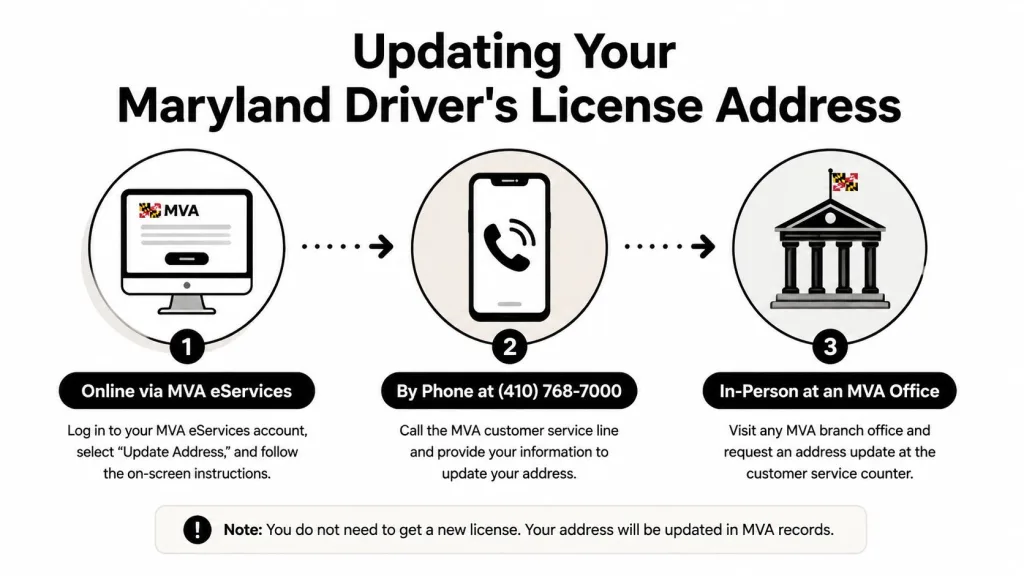
The MVA allows several practical channels. Choose the one that fits your license type and expiration timing rather than assuming every mover can use the same method.
Select the right MVA channel
- Online through myMVA: This is usually the quickest option for a standard license when the license won’t expire within 12 months. Have your myMVA credentials available and enter the former and new addresses carefully.
- Self-service kiosk: Maryland lists kiosks as another way to submit an address update. This is useful when you want an official self-service channel without waiting for a branch appointment.
- In person at an MVA office: Use an office when your license category, expiration timing, documentation, or address situation prevents an online update. Bring your Maryland license or other identifying information and be prepared to confirm the old and new addresses.
The MVA says it will mail a Change of Address card to the new address after processing. Keep that card with your moving records. It gives you a useful document trail if a future notice goes to the wrong place or you need to show that you completed the update.
Practical rule: Submit the MVA update as soon as your new residence is established. Waiting until the deadline creates avoidable risk, especially if you discover that your license type requires an office visit.
Standard license holders should check expiration timing before starting an online request. A license expiring within 12 months may block the online route, so plan for an MVA office instead. Commercial driver’s license holders face a stricter rule, covered below, and shouldn’t rely on a generic online checklist.
If you need a more focused walkthrough of the same issue, use this Maryland driver license change of address guide. The important point is simple: USPS forwarding doesn’t satisfy the MVA requirement, and changing your voter record doesn’t replace it.
Vehicle Registration and Title Address Updates
Updating your Maryland driver’s license address does not automatically complete the vehicle-registration or title update. Maryland treats those records as a separate administrative task, and the distinction matters because renewal notices, registration correspondence, and enforcement mail can still go to your former residence.
The Maryland statute requires a registered vehicle owner who moves from the address shown on the application or registration card to notify the MVA of the former and new addresses within 30 days. Review the Maryland vehicle-registration address statute when you’re dealing with a registration record that hasn’t been corrected.
Use a separate vehicle-record workflow
For title and registration records, the MVA says you can usually correct the address through myMVA, during another MVA transaction, or by contacting the agency through an available service channel. Don’t assume that one successful license update has synchronized every vehicle record attached to your name.
A reliable sequence is:
- Update the driver or identification record.
- Open the vehicle record in myMVA or contact the MVA about the title and registration.
- Confirm that the new address appears on each applicable record.
- Save confirmation details with your vehicle documents.
Dealer and tag-and-title entities can process an address change before a title or registration transaction, but only when you already have a valid Maryland-issued driver’s license or MVA-issued identification card showing a Maryland address. The address change must happen first, followed by the title or registration transaction.
If you’re unsure which vehicle record belongs to a plate or need to organize information before contacting an agency, a Maryland tag lookup tool can help you identify the relevant vehicle details. It isn’t a substitute for an MVA update, but it can make record-checking less confusing.
Keep title problems separate from address problems. For example, if you’re also dealing with a missing ownership document, consult this resource on a lost car title in Florida, but don’t treat title replacement guidance as proof that your Maryland address record is current.
Maryland Voter Registration Address Change
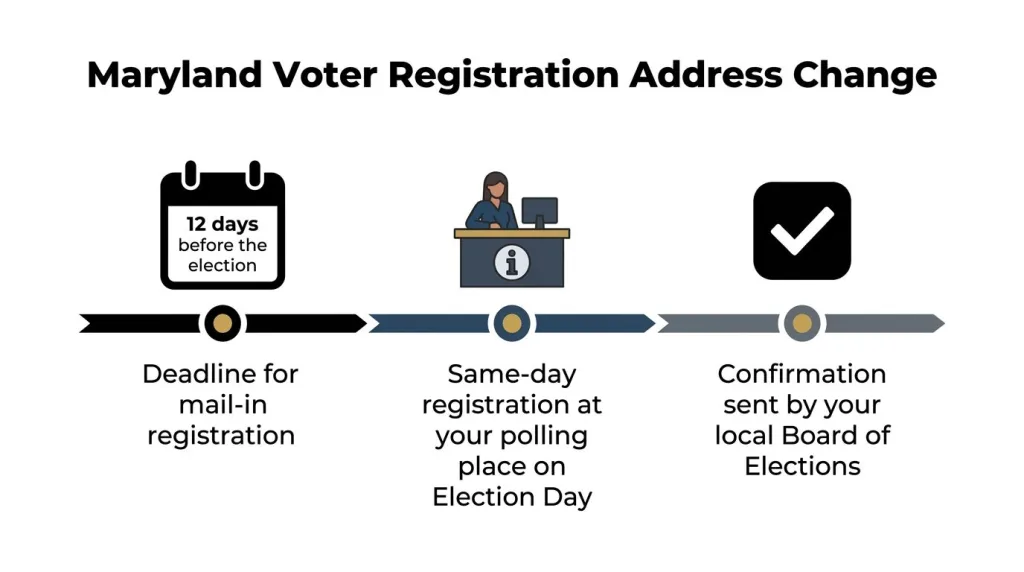
Maryland voter registration has its own deadline, and it arrives sooner than many movers expect. To have a new address processed before an election through the standard route, Maryland advises voters to submit an online registration or signed notice at least 21 days before Election Day, as explained by the Maryland State Board of Elections address guidance.
That deadline is separate from the MVA’s 30-day rule. A person who moves shortly before an election may comply with the MVA requirement and still face a voter-record problem if the election cutoff has passed.
Choose a voter update method
Maryland accepts address changes online, in writing, in person, or through the MVA. Local boards are expected to enter received updates into the statewide voter list on an expedited basis, but you should still verify your record independently instead of assuming the systems updated at the same time.
The MVA may route information to election officials unless the resident opts out. That connection is useful, but it doesn’t eliminate the need to check the voter record, especially after a county-to-county move.
If the update isn’t processed before the 21-day cutoff, your options and polling location can change. You may need to vote provisionally or use the polling place associated with the old record, while early-voting and Election Day assignment depends on the updated county record.
Changing your address doesn’t by itself remove you from Maryland’s statewide voter list. The state uses additional confirmation and voting-history conditions before removing a voter for an address issue.
Maryland’s voter rules provide that a voter won’t be removed for changing address unless the voter confirms an out-of-state move, or fails to respond to a confirmation notice and also doesn’t vote across the next two general elections. That protection doesn’t solve the practical problem of arriving at the wrong polling place, so submit early and verify.
For a visual explanation of the process, watch the following resource after reviewing your new county information:
USPS Mail Forwarding and Federal Agency Notifications
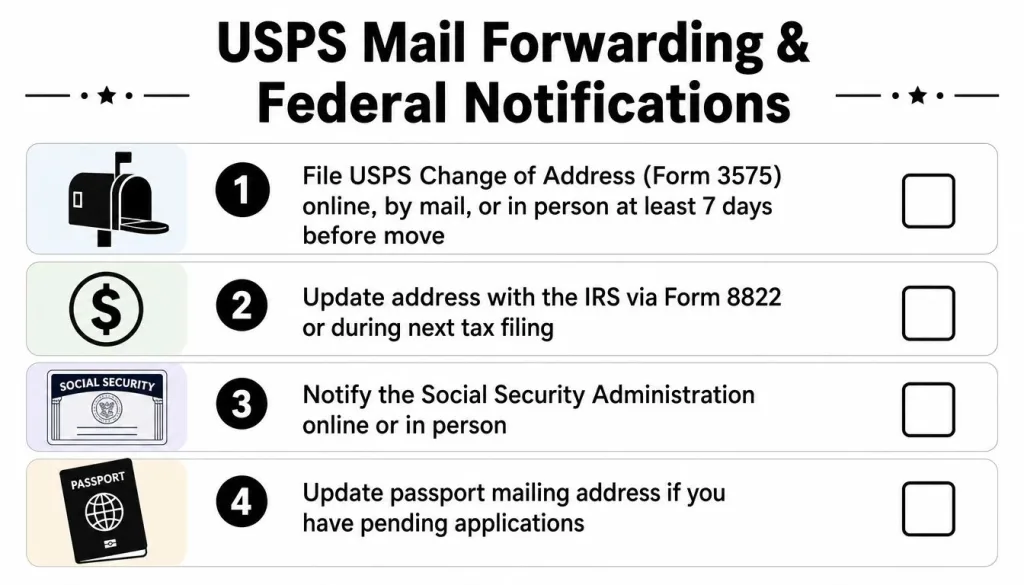
USPS forwarding is a mail-delivery service, not a replacement for state record updates. The official USPS process requires identity verification online and carries a $1.25 fee, while filing in person at a Post Office is free with photo identification and PS Form 3575, according to the Maryland address-change process overview.
Set up forwarding, then update senders
File the USPS request before the move whenever possible. Forwarding gives mail a path to your new home, but it doesn’t change the address held by the IRS, Social Security Administration, insurers, banks, or licensing agencies.
Use the online option if you can complete identity verification and want a digital submission. Choose the Post Office route if you prefer the free in-person process with photo ID and PS Form 3575. Be cautious with third-party services that charge for a task available through USPS.
Federal records deserve direct attention:
- IRS: Update the IRS through Form 8822 or during your next tax filing. Keep the submission with your tax records.
- Social Security Administration: Update your address through the SSA’s available online or in-person service.
- Benefits and immigration records: Notify the federal agency responsible for any active benefit, immigration, or related case.
- Passport applications: If you have a pending application, update the mailing address with the passport agency handling it.
Utilities, banks, employers, health insurers, auto insurers, and subscription services should follow the government updates. Confirm the billing address separately from the residential address when a provider uses both.
The best sequence is practical: arrange USPS forwarding, complete government records, notify financial and insurance providers, then check incoming mail for several billing cycles. Any letter that still arrives at the old address identifies a sender you haven’t updated.
Common Mistakes and Edge Cases to Avoid
Generic Maryland moving checklists miss the situations that change the correct procedure. The biggest error is assuming that every driver can submit the same online form and that one update automatically fixes every record.
Commercial drivers need a different plan
CDL holders must go to an MVA office within 30 days of initiating an address change, according to the Washington County road checklist. Don’t wait until the final days of the general compliance window to discover that your commercial license requires an in-person visit.
Standard license holders should also check expiration timing. An online update may be available when the license won’t expire within 12 months, but an approaching expiration can require an office visit instead.
Street and lane renaming projects create another unusual exception. The Washington County checklist says some residents should wait at least 60 days before changing an address for non-emergency purposes. Follow the local project’s direction, but act immediately when an emergency, safety, or legal need requires accurate information.
Separate the records that people routinely combine
- Voter registration isn’t vehicle registration: A voter update doesn’t satisfy the MVA’s vehicle-record requirement.
- An MVA update may route election data: That doesn’t guarantee the election record is processed in time or that every voter wants the automatic route.
- A USPS request doesn’t update state records: Mail forwarding only redirects delivery.
- A new address on one MVA record isn’t proof of another: Check your license, title, and registration records separately.
If your move involves a CDL, a near-expiration license, or an official road-renaming project, choose the service channel before you submit anything.
People also confuse address corrections with lost-document procedures. If you’re replacing a missing credential, use a resource such as this guide to a lost driver’s license in Florida only for the document issue. Maryland address compliance still requires the appropriate MVA record update.
Your Maryland Address Change Checklist and Next Steps
A successful change of address in Maryland is a sequence, not a single submission. Put the deadlines in your calendar, save every confirmation, and check each record instead of trusting the word “updated” on one system.
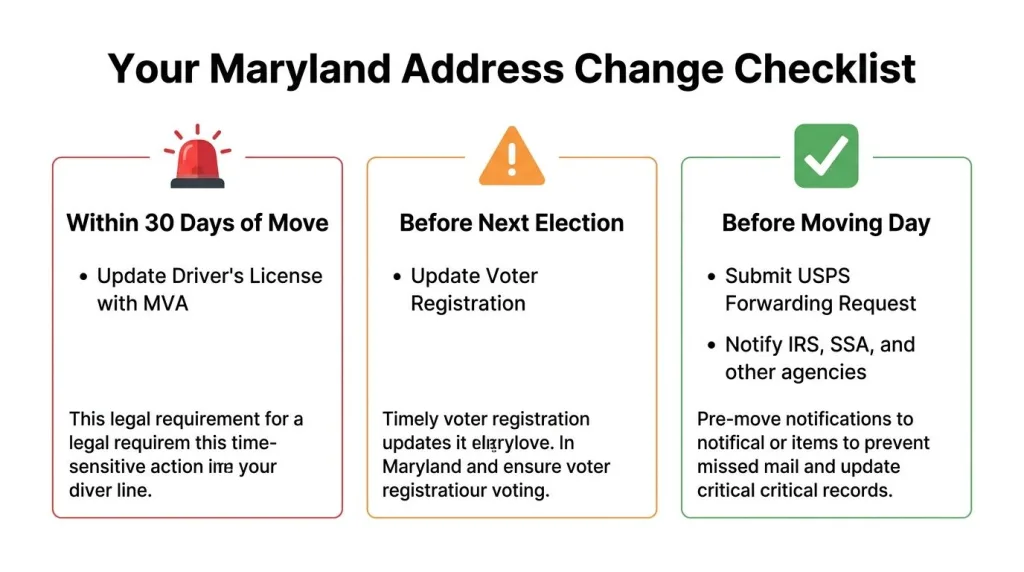
Prioritize the work by consequence
Before moving day
- Submit the USPS forwarding request.
- Notify utilities, banks, insurers, employers, and healthcare providers.
- Gather your Maryland license, vehicle records, and myMVA credentials.
Within 30 days of moving
- Notify the MVA of the former and new addresses.
- Complete the separate title and registration address update.
- Use an MVA office if you’re a CDL holder or your license-expiration timing blocks the online route.
Before the next election
- Submit the voter address change at least 21 days before Election Day for standard processing.
- Verify your county record and polling location.
- If the deadline has passed, prepare for the possibility of provisional voting or an assigned location connected to the old record.
If you’re still deciding where to settle, compare practical relocation factors with this guide to choosing between Virginia and Maryland. Once you’ve moved, use a preparation guide such as what to bring to the DMV before an office appointment.
New Maryland residents should also learn the driving rules that affect daily decisions, not just update paperwork. Driver education and defensive driving courses can help you understand local traffic laws, strengthen safe-driving habits, and approach Maryland roads with more confidence.
BDISchool offers online driving courses designed for practical driver improvement, including Basic Driver Improvement, Intermediate Driver Improvement, and Mature Driver courses. Visit BDISchool to choose a self-paced course and start building stronger driving knowledge in English, Spanish, or Portuguese.