You don’t start worrying about your driving skills when the road is dry, traffic is light, and everything goes as planned.
You worry when the rear tires slip in heavy rain, the steering suddenly feels vague, and you realize your license never taught you what to do next. Or when brake lights flash on a crowded Florida highway and your foot hits the pedal hard, but your brain hesitates for half a second too long.
That gap matters. A driver’s license proves you met the minimum standard. It doesn’t mean you’re ready for the moments that cause crashes.
An Advanced Drivers Academy fills that gap. It gives drivers something basic driver’s ed rarely delivers: real-world readiness, sharper hazard recognition, and a better understanding of how a car behaves when things go wrong.
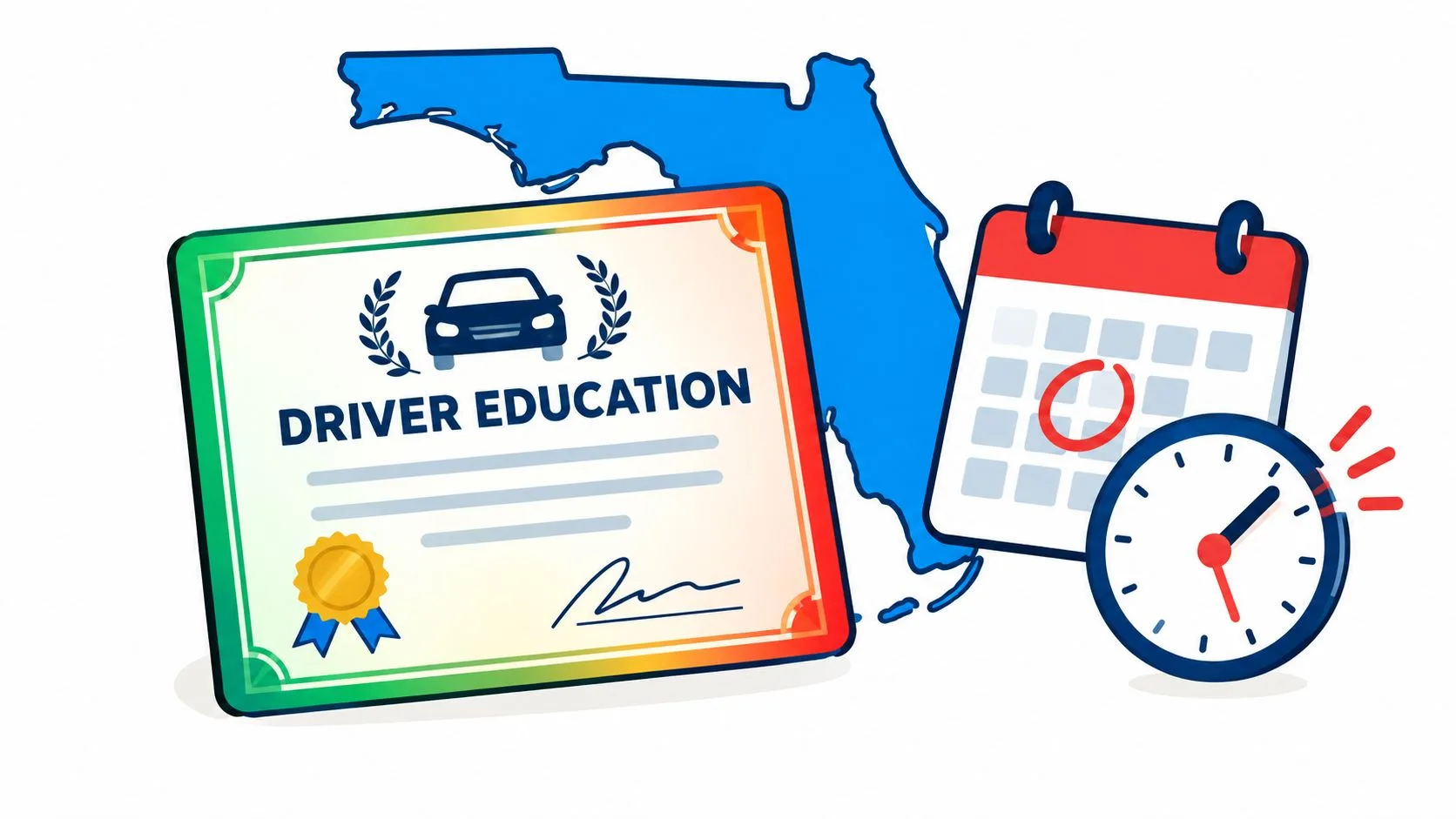
For some people, that means safety training beyond the basics. For others, it means choosing the right Florida-approved online course after a ticket so they can protect their record. Those are not the same goal, and too many drivers confuse them.
Beyond the License Your First Real Driving Test
A lot of drivers remember their first real scare more clearly than their road test.
It might be a sudden lane change on I-95. It might be a wet on-ramp where the car starts to drift wider than expected. It might be the first time your teen calls after driving home in a storm, sounding calm, but just shaken enough to make your stomach drop.

That’s the moment people realize something important. Passing the licensing test and being prepared for a real emergency are two different things.
Why the standard license isn’t the finish line
Basic driver education teaches rules, signs, lane position, and basic traffic behavior. It should. Those fundamentals matter.
But the road doesn’t wait for ideal conditions. Rain, panic braking, distracted drivers, bad merges, and sudden obstacles force split-second decisions. If a driver has never practiced emergency responses in a structured way, they usually fall back on instinct. Instinct is unreliable when the car starts sliding.
Practical rule: If a skill matters most during panic, it needs practice before panic.
That’s where an advanced drivers academy earns its value. The point isn’t to make someone drive aggressively or like a race driver. The point is to build calm, repeatable control under pressure.
Who benefits most right away
Three groups usually need this most:
- Teen drivers: They know the rules, but they often haven’t built real emergency-handling habits yet.
- Parents of new drivers: They want more than a permit and a hope.
- Adults returning to driving or adjusting to Florida traffic: They need confidence that’s based on skill, not self-talk.
A good advanced program changes the conversation from “I hope I react correctly” to “I’ve practiced this before.”
That’s the essential first test of driving. Not parallel parking. Not a turn signal check. It’s whether you can stay composed when the car doesn’t do what you expected.
What an Advanced Drivers Academy Actually Teaches
It’s often assumed advanced training is just more defensive driving.
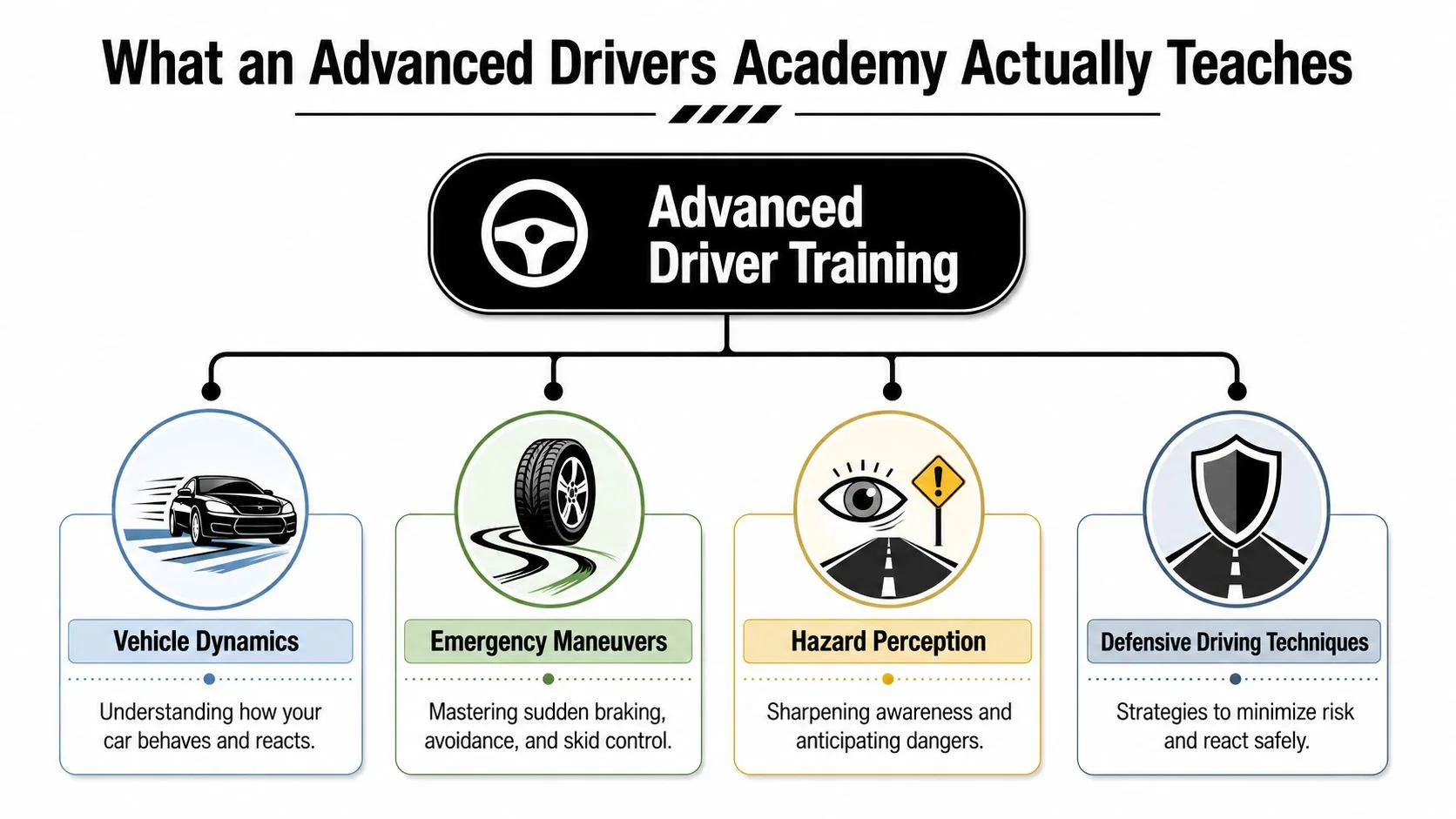
It isn’t. The most important difference is vehicle dynamics. Advanced driver training programs are not just “more defensive driving”; their most critical function is teaching vehicle dynamics, including how a car behaves under skid, ABS braking, or emergency lane changes, which basic driver’s ed routinely skips.
The skills most drivers never formally learn
An advanced drivers academy teaches drivers what the car is doing underneath them, not just what the law says they should do.
That usually includes:
- Skid control: Understanding what to do when traction drops and the car starts to slide.
- ABS braking technique: Learning how anti-lock braking feels and how to brake hard without making things worse.
- Emergency lane changes: Moving around an obstacle without overcorrecting.
- Hazard perception: Spotting trouble early enough to avoid needing a heroic reaction.
These aren’t luxury skills. They’re survival skills.
A lot of drivers also overlook setup. Seating position, hand position, mirror use, and sight lines directly affect reaction quality. Before working on advanced maneuvers, drivers should ensure a safe seat belt fit and proper driving position so the body stays stable and responsive during sudden inputs.
Why this training feels different
Basic education asks, “Do you know the rule?”
Advanced training asks, “Can you control the car when the rule isn’t enough?”
That’s why hazard recognition matters so much. If you want to sharpen the decision-making side of safer driving, this hazard recognition training resource is worth reviewing alongside any skills-based instruction.
Here’s a useful visual overview of how these ideas connect in practice:
The best drivers don’t wait until the emergency to figure out how their vehicle behaves.
What this means on the road
A driver who’s practiced emergency braking responds differently than a driver who has only heard about it.
A driver who understands weight transfer, traction loss, and visual targeting is less likely to freeze, stomp the wrong input, or oversteer into a second problem. That’s the entire point of advanced instruction. It builds a response pattern you can use when conditions get ugly.
Find Your Florida-Approved Driving Course Today
A driver gets a ticket on Monday, searches for “advanced driving course” on Tuesday, and signs up for the wrong class by Wednesday. That mistake costs time, money, and sometimes the chance to protect a clean driving record.
Use the goal to choose the course.
If you want better vehicle control in a real emergency, you need skills-based advanced training. If you need to satisfy Florida requirements after a citation, reduce points risk, meet a court order, or qualify for an insurance benefit, you need a state-approved traffic course. Those are different products built for different problems.
Match the course to the reason you’re enrolling
Basic Driver Improvement fits drivers trying to protect their record after an eligible ticket. Florida requires you to make that election quickly after a citation, so waiting around is a bad plan.
Intermediate Driver Improvement fits drivers who were ordered into a longer corrective course. This is not a basic refresher. It is for a more serious compliance need.
Aggressive Driver Course fits drivers whose issue is behavior, judgment, or repeated risky choices. A technical lesson will not fix impatience, tailgating, or hostile decision-making. The right course has to address the actual cause of the problem.
Mature Driver Course fits older drivers who want a practical refresher and may qualify for an insurance discount. Under Florida Statute 627.0652, drivers age 55 or older can take a refresher course for mandatory insurance discounts.
Florida online driving course comparison
| Course Name | Duration | Primary Goal | Best For |
|---|---|---|---|
| Basic Driver Improvement (BDI) | 4-hour | Avoid points after an eligible citation | Drivers who recently received a moving violation |
| Intermediate Driver Improvement (IDI) | 8-hour | Meet court or administrative requirements | Drivers ordered to complete a more in-depth program |
| Aggressive Driver Course | 8-hour | Correct risky driving behavior | Drivers cited for behavior-related violations |
| Mature Driver Course | 6-hour | Refresh safety awareness and support insurance discount eligibility | Drivers age 55 or older |
If you want to compare approved options side by side, review these Florida-approved traffic school online courses and pick the one that matches your reason for enrolling.
The filter I recommend
Ask one question first. “Am I trying to become safer, satisfy a requirement, or do both?”
- Safety: Choose true advanced driver training with real crash-avoidance practice.
- Citation and point protection: Choose BDI if you are eligible and act within the required timeframe.
- Court or DMV requirement: Choose IDI or the exact course ordered.
- Behavior correction: Choose the aggressive driver course.
- Insurance discount at 55+: Choose the mature driver course.
A lot of confusion disappears once you stop treating every driving course like it does the same job.
Pick the course that solves the problem in front of you. Then, if you also want stronger emergency skills, add advanced training for that separate goal.
Who Should Enroll in an Advanced Driving Course
The right answer depends on the driver sitting in the seat.
Some people need confidence. Some need compliance. Some need both. The mistake is assuming all driver education serves the same purpose.
Parents of teen drivers
If you’ve handed keys to a teenager, you already know the stress. You’re not worried about whether they can start the car. You’re worried about what happens when traffic compresses, rain starts, and another driver makes a bad move.
The Ohio Traffic Safety Office notes that closed-course advanced driver training teaches crash avoidance mechanics such as skid recovery and ABS exercises, specifically to address the leading causes of teen crashes by training neuromuscular responses before real-world exposure.
That’s a strong argument for advanced training when a teen already has the basics but hasn’t yet built the reactions.
Adults who feel rusty or uneasy
A lot of adults drive with quiet tension.
They avoid highways, hate heavy rain, grip the wheel too hard, and second-guess every merge. They don’t need shame. They need guided repetition and better understanding of what the vehicle is doing.
For some, a skills-based course is the answer. For others, especially older adults who want a practical refresher, a driving course for seniors can help rebuild awareness and structure without making the experience feel intimidating.
Busy professionals with a ticket and no spare time
This group usually doesn’t need inspiration. They need efficiency.
If you received a citation, want to stay compliant, and don’t have hours to spare sitting in a classroom, an online state-approved course makes sense. It lets you handle the requirement without disrupting work, family, or travel.
Here’s the useful distinction:
- Safety-focused driver: Prioritizes advanced skill building.
- Compliance-focused driver: Prioritizes the right online traffic school course.
- Dual-goal driver: Needs both, but should solve the deadline issue first if a citation is involved.
That last point matters. If you’ve got a legal or administrative deadline, handle that immediately. Then go beyond the minimum.
The Lifelong Benefits of Advanced Driver Training
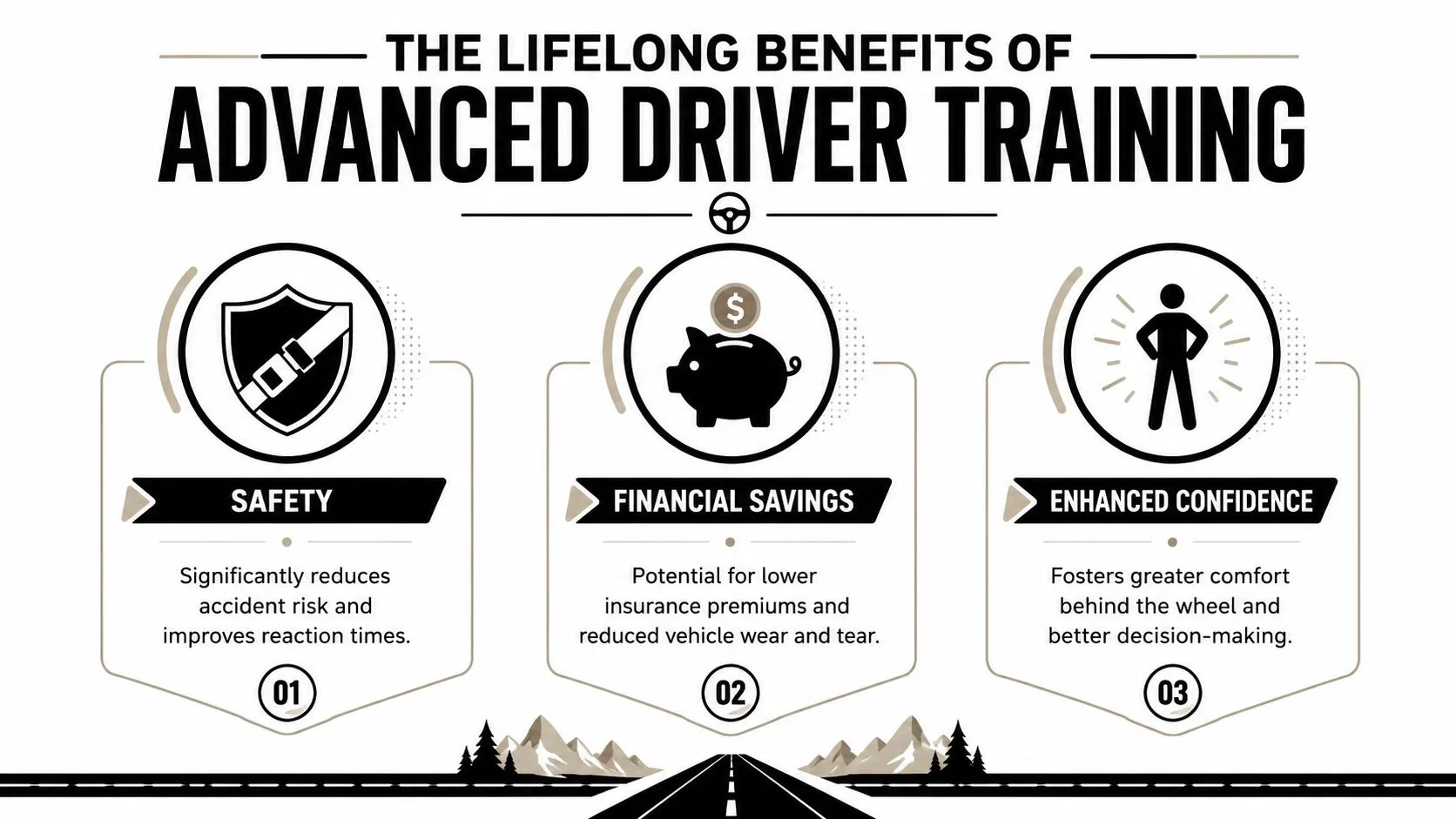
Advanced training pays off in three ways. Safety, money, and peace of mind.
Most drivers understand the safety argument. Fewer think through the financial and long-term ownership side of the decision.
Better safety margins
A controlled study found that teens in an ADT program had statistically significant improvements in crash avoidance techniques, including skid recovery and emergency braking, compared to a control group in a study of 785 enrolled teens.
That matters because the road rarely rewards average reactions. Better braking decisions, steadier steering, and earlier hazard recognition give drivers more room to recover from someone else’s mistake.
Smarter financial outcomes
Crash avoidance has an obvious financial upside. Fewer incidents mean fewer repairs, fewer claims headaches, and less chance of turning a small mistake into a long insurance problem.
If you’re buying another vehicle for a new driver or replacing an older one, it also helps to check used car accident history before committing. Safer driving and smarter vehicle selection belong together.
For drivers focused on lowering ongoing costs, a practical next step is learning how to lower car insurance rates through approved courses, cleaner records, and fewer costly mistakes.
More confidence without false bravado
Good training doesn’t make drivers cocky. It makes them calmer.
That’s a major difference. Calm drivers scan earlier, brake more smoothly, and make cleaner choices under pressure. They don’t confuse panic with action.
Key takeaway: Confidence built on repetition is safer than confidence built on luck.
The long-term value is simple. You’re not paying for a certificate alone. You’re paying for better decisions in moments that can affect your family, your car, your insurance costs, and your record.
How to Enroll in Your Course in Minutes
Your deadline usually becomes real at the worst time. A ticket is sitting on the counter, work is busy, and you still need to figure out whether you need point reduction, a court-required class, or actual crash-avoidance training.
Handle that first. The right course depends on the result you want.
Step 1 Choose the course by goal
Start with the problem in front of you.
If you got a Florida ticket and your goal is to keep points off your license, choose a Florida-approved BDI course and make your election on time. If the court ordered a specific class, take that exact class. If you want better emergency handling, skid recovery, braking judgment, and hazard response, enroll in a true advanced driving program. Those are different outcomes, and mixing them up wastes time.
Parents make this mistake often. They assume any course with “defensive” or “advanced” in the title will cover both safety training and compliance. It will not. Pick the course that matches the requirement, then add skill training if you want better real-world protection.
Step 2 Register online
Registration is usually the easy part.
Choose the course, create your account, confirm your details, and start from your phone or computer. That matters when you’re juggling childcare, a work schedule, or a court-related deadline.
Some drivers are also trying to protect their record and cut long-term vehicle costs at the same time. If that’s your situation, review these practical ways to save on insurance while you decide which course solves the immediate problem.
Step 3 Complete it on a realistic schedule
A self-paced course works well because drivers do not all have the same schedule or reading pace.
Many online programs offer instruction in English, Spanish, and Portuguese. That gives drivers a clearer path to finish correctly, without struggling through material in the wrong language. After completion, the provider typically handles certificate reporting through its own system.
My recommendation is simple. If you know which course you need, enroll today. Waiting creates missed deadlines, more stress, and avoidable damage to your driving record.
Advanced Drivers Academy FAQs
Is an advanced drivers academy the same as a defensive driving or BDI course
No. They solve different problems.
An advanced drivers academy focuses on skill, especially crash avoidance, vehicle control, and emergency response. A BDI course is a Florida-approved compliance course for eligible drivers dealing with citations and point prevention.
Which course should I take if I got a ticket in Florida
Take the course that matches your legal situation, not the one with the most appealing name.
If you’re eligible and your goal is avoiding points after a moving violation, BDI is usually the right fit. If a court ordered a different course, follow that requirement exactly.
Will an advanced driving course remove points from my license
Not by itself.
Skills-based advanced training and point-related traffic school are often confused, but they are not interchangeable. If your goal is point dismissal or compliance, choose the appropriate Florida-approved traffic school course.
Are online courses a weaker option than in-person classes
Not for compliance goals.
If you need a Florida-approved course to satisfy a requirement, a quality online program gives you flexibility, state-approved content, and a simpler way to finish on your schedule. If your goal is emergency car control, though, hands-on instruction is the better match.
What about mature drivers and insurance discounts
Older drivers have a clear use case.
Florida law allows drivers age 55 or older to complete a refresher course focused on accident prevention for insurance discount eligibility. That’s one of the few cases where the benefit is tied directly to a specific age group and course type.
Do these courses help anxious drivers
Yes, but the right course matters.
If the anxiety comes from poor confidence in real traffic decisions, a refresher or compliance course can help rebuild structure. If the anxiety comes from fear of losing control in a sudden event, skill-based advanced training is usually the better answer.
How do I know if I need safety training, compliance training, or both
Ask one question first. What problem needs solving now?
- Ticket or court issue: Start with the approved compliance course.
- Fear of emergencies or lack of confidence: Start with advanced skill training.
- Both: Handle the deadline-sensitive legal requirement first, then invest in deeper skill development.
That sequence saves trouble and makes the second course more valuable.
If you’re ready to protect your record, meet a Florida requirement, or refresh your driving knowledge with a state-approved course, BDISchool is the practical next step. You can review the available courses at BDISchool courses or DriverEducators course options and start the one that matches your exact goal today.