Your teen is probably asking the same question over and over now. “When can I get my permit?”
If you’re the parent, you’re likely thinking something slightly different. “What exactly do we need to do, and how do I make sure my kid starts the right way?”
That’s where online drivers ed makes sense. For Florida families, the smartest path isn’t guessing your way through state rules or waiting until the last minute. It’s taking the required online course early, understanding the permit steps clearly, and pairing that course work with serious practice behind the wheel.
Why Online Drivers Ed Is the Smart Choice for Florida Teens
Florida teens want freedom. Parents want safety.
A good online course gives both sides something they need. Teens get a flexible way to start learning from home, and parents get a structured first step instead of trying to explain every traffic law at the kitchen table.
The safety case is strong
Formal driver education matters. A University of Nebraska-Lincoln study on teen driver education tracked over 150,000 teen drivers across eight years and found that teens who completed driver’s education were 75% less likely to receive a traffic ticket and 24% less likely to be involved in a fatal or injury accident compared to teens without formal instruction.
That should get every parent’s attention.
Online learning also fits real life better than old-school classroom scheduling. Teens can study after homework, before practice, or on a weekend afternoon. That matters because consistency beats cramming. When students can revisit lessons, take quizzes at their own pace, and absorb the rules in smaller chunks, they’re usually less overwhelmed.
Practical rule: Don’t treat drivers ed like a box to check. Treat it like the foundation for every mile your teen will drive after that.
Convenience is not the same as cutting corners
Some parents still worry that online means watered down. I don’t agree.
A strong online course can make the classroom portion easier to complete and easier to review. It lets teens slow down when a topic is confusing and move faster when a topic is familiar. That’s better than sitting in a room and pretending to follow along.
Here’s why I recommend starting online:
- It fits teen schedules: School, sports, part-time jobs, and family life already fill the calendar.
- It reduces friction: No driving across town for every classroom session.
- It encourages review: Students can revisit road signs, right-of-way rules, and defensive driving concepts before the permit exam.
- It creates a cleaner process: Families can move from enrollment to course completion without a lot of paperwork confusion.
Parents who also want to understand possible savings can review this insurance discount for drivers ed overview.
Start before the pressure starts
The biggest mistake I see is waiting until a teen is already impatient. Then everything feels rushed. That’s when families miss documents, misunderstand state rules, or leave exam prep too late.
Start early. Learn the rules. Complete the state-approved online course. Then move into permit testing and supervised driving with a plan.
Your Florida Learner’s Permit Checklist
Florida’s permit process is manageable when you stop treating it like a mystery.
The state has a sequence. Follow it in order, and the whole thing gets easier. Miss one requirement, and you create delays for no good reason.
The first legal requirement
As of August 1, 2025, Florida law requires teens ages 14½ to 17 to complete the state-approved 6-hour Driver Education Traffic Safety (DETS) course before applying for a learner’s permit, under Florida permit requirements and FL Statute 322.1615.
That’s the new starting point for teens in this age group. Not the older TLSAE path for permit eligibility. The DETS course.
What to gather before you go
Parents should collect the required items before scheduling anything. Waiting until the last minute is how permit-day turns into reschedule-day.
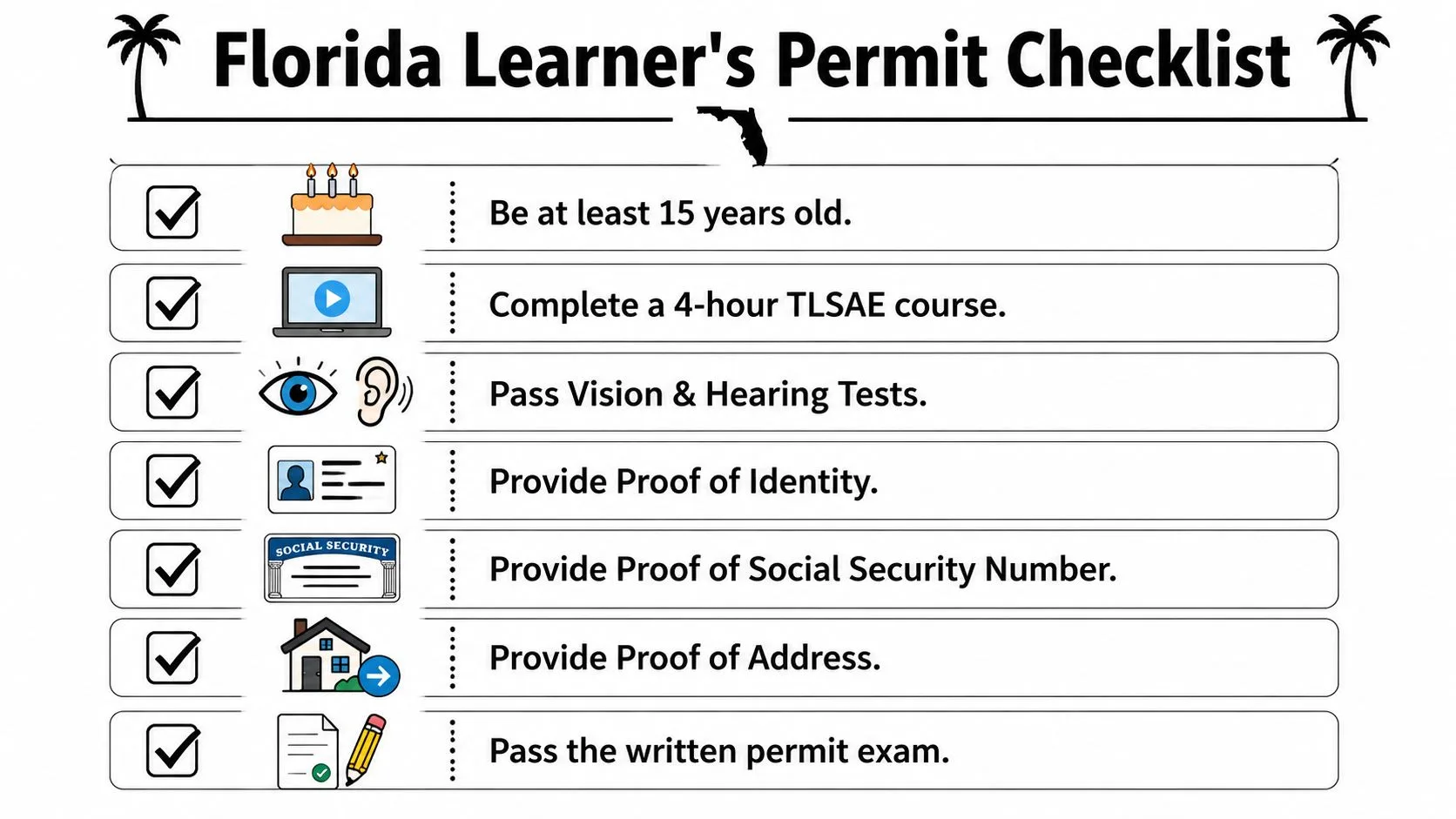
Use this checklist:
- Age readiness: Your teen needs to meet Florida’s age requirement for permit application. For the legal course requirement above, teens can start within the state’s defined age range for DETS eligibility.
- Course completion: Finish the required state-approved DETS program first.
- Identity documents: Bring proof of identity that matches the student’s legal information.
- Social Security proof: Have documentation ready for the teen’s Social Security number.
- Address proof: Florida residency documents need to be current and consistent.
- Vision and hearing readiness: The in-person testing step is simple for most teens, but it’s smart to understand what’s being checked.
If you want a plain-language walkthrough of vision expectations, this driving vision standards guide is a helpful read before your visit.
Parents make this process easier when they check every document twice and make sure names and addresses match across records.
The checklist that prevents most delays
A clean permit application usually comes down to preparation, not luck.
Here’s the version I give families:
- Confirm your teen is in the eligible Florida teen age group.
- Enroll in and complete the required DETS course.
- Prepare identity, Social Security, and address documents ahead of time.
- Make sure your teen is ready for the permit exam and basic screening steps.
- Bring a parent or guardian if required for the application process.
For a more detailed breakdown of the state process, review these Florida learner’s permit requirements.
One thing parents often miss
The course is only one part of readiness. Your teen also needs to be calm, organized, and able to handle the testing environment.
If your child gets anxious, don’t frame permit day as a huge high-stakes event. Frame it as one step in a longer process. That keeps the pressure down and helps them focus.
Navigating Your Online Driver Education Course
Your teen logs in after dinner, knocks out one lesson, and suddenly the permit process feels real instead of overwhelming. That matters, because Florida teens do better when learning is steady, clear, and tied to real driving decisions, not crammed into one stressful weekend.
A strong online course keeps that momentum going. It teaches the rules, shows how they apply on actual roads, and gives teens time to absorb one skill at a time. For parents, that means less guesswork and fewer last-minute problems.
What the course should feel like
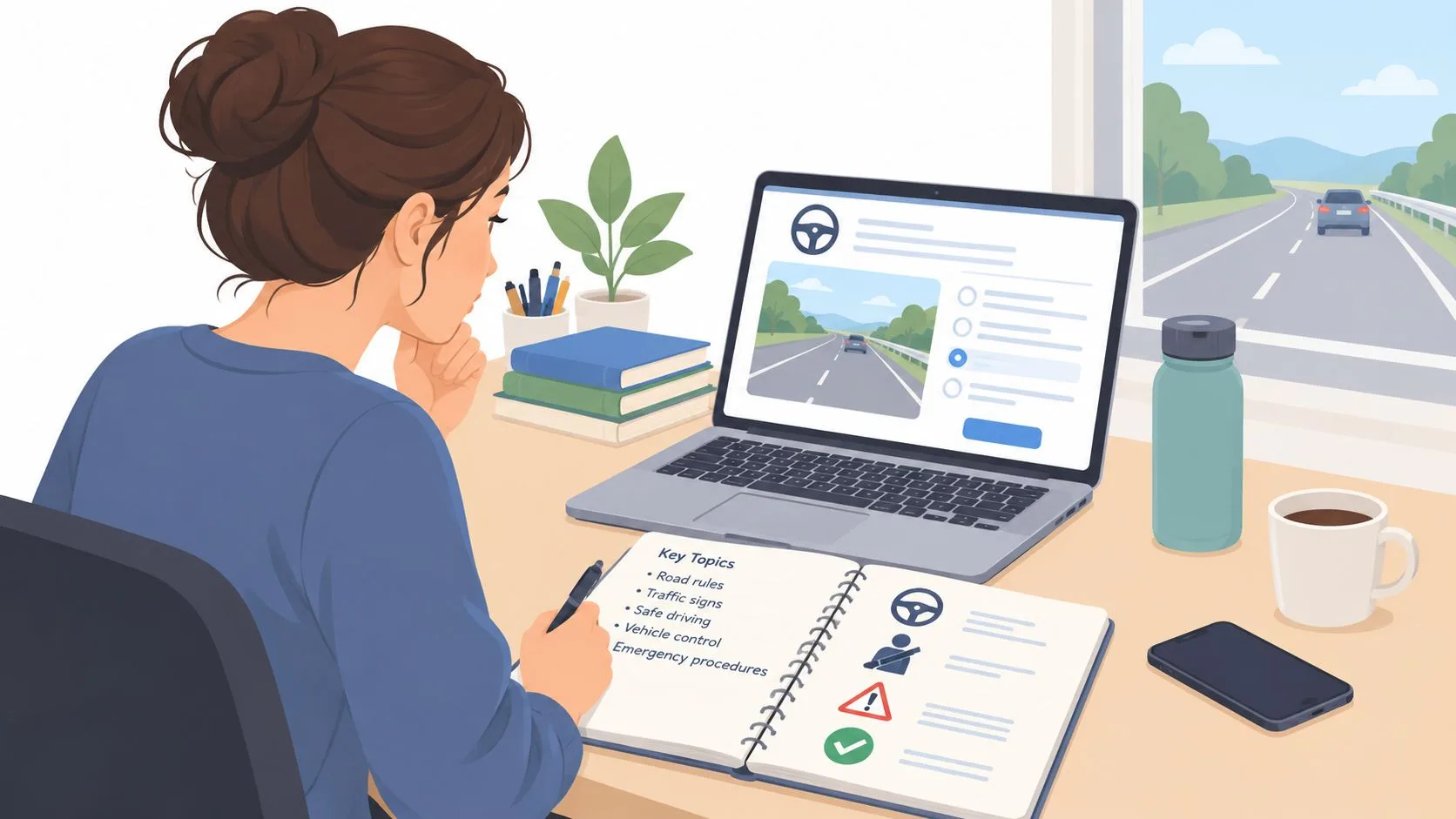
A Florida teen should be able to sign in on a phone, tablet, or computer and pick up right where they left off. One lesson might cover signs and pavement markings. The next might cover right-of-way, space management, or how to spot a risky situation before it turns into a crash.
That format works because teens learn better in shorter sessions they can repeat.
The best courses also do more than quiz definitions. They show situations a new driver will face, such as busy intersections, lane changes, school zones, and sharing the road with cyclists and pedestrians. That is what helps a student connect the rule to the choice they will make behind the wheel later.
Study for understanding, not speed
Florida’s permit exam rewards students who understand the material. It punishes students who rush.
According to the Florida drivers ed and permit exam guide, teens must score at least 80% on the Class E Knowledge Exam. Set that as the standard from day one.
“Study until the answers make sense, not until they look familiar.”
If your teen misses a question about stopping distance, right-of-way, or signs, stop and fix it right then. Do not let confusion pile up across five more modules. That habit is the difference between a teen who merely finishes the course and one who is actually ready for the permit test.
The routine I recommend
Parents ask me the same question all the time. How do we get through the course without dragging it out or turning it into a fight?
Use this plan:
| Study habit | Why it works |
|---|---|
| Complete one or two modules per session | Keeps attention sharp and reduces careless mistakes |
| Review missed questions immediately | Fixes weak spots before they become patterns |
| Write down signs, right-of-way rules, and penalties | These topics cause trouble on the permit exam |
| Study at the same time of day when possible | Builds a routine and makes completion easier |
Consistency beats marathon study sessions.
If you want to know what proof of completion looks like after the course is done, read this online driving certificate guide for Florida students.
What parents should pay attention to
Watch pace and attitude.
A teen who races through every screen is usually trying to get it over with. A teen who pauses, replays a section, or asks why a rule exists is learning in the way that leads to safer driving.
Keep your role simple. Ask specific questions after a lesson. Ask what they learned about four-way stops. Ask who has the right-of-way when two cars arrive together. Ask what mistake caused the biggest risk in the scenario they just completed.
That short conversation turns screen time into real preparation. It also gives your teen a safer foundation before they ever start practicing on Florida roads.
From Course Completion to Learner’s Permit
Finishing the online course feels like the big milestone. It isn’t the last step.
It’s the step that enables the next ones.
What happens after the course
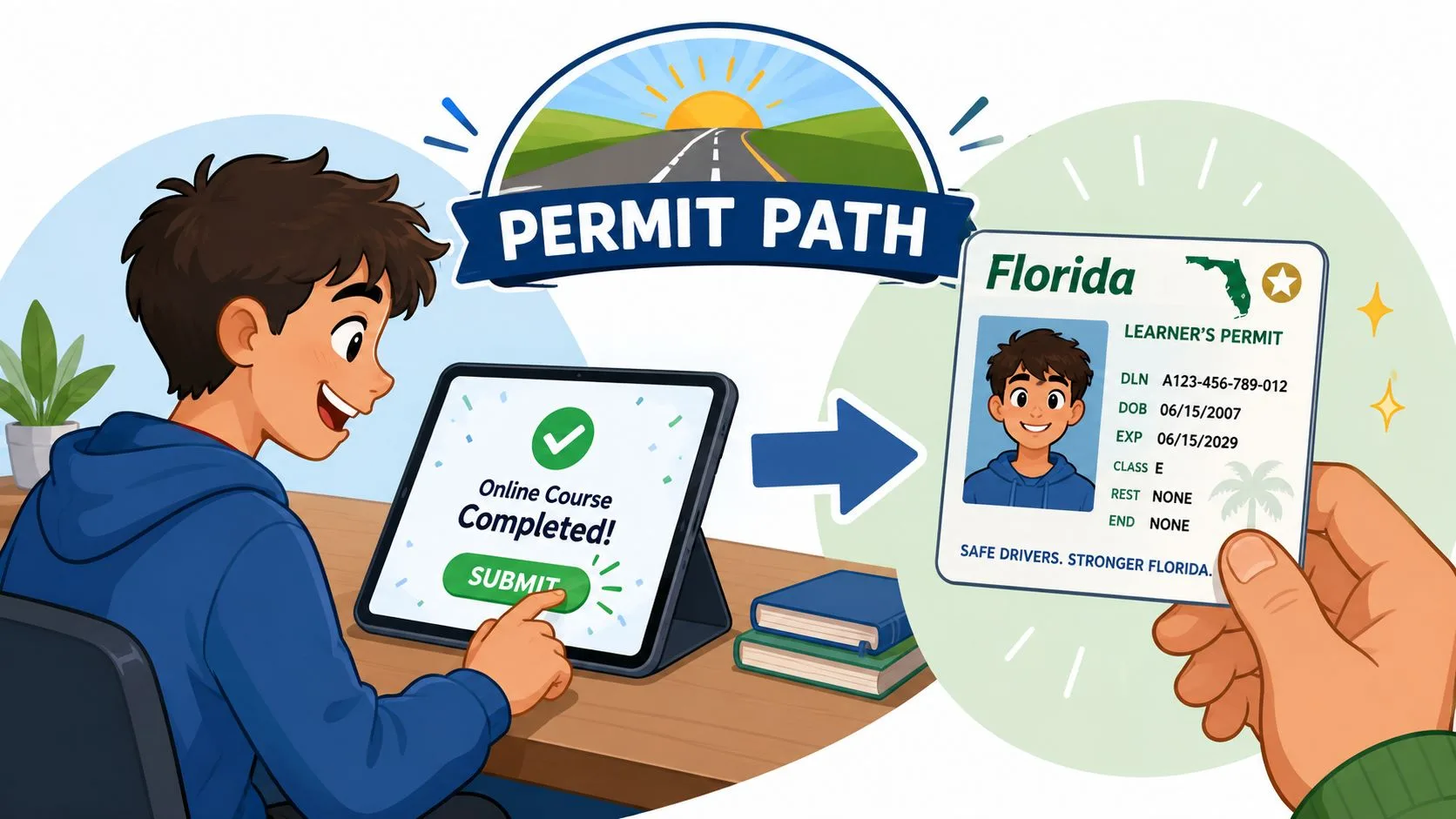
Once your teen completes a state-approved online course, the next priority is making sure that completion is properly recognized and that the permit testing process moves forward smoothly.
Families often get tripped up here because they assume they’ll need to print stacks of forms or carry around course paperwork forever. Usually, the process is cleaner than that with approved providers, especially when reporting is handled electronically and the course record is transmitted to the state system.
After that, the focus shifts to the permit exam and the final in-person requirements to receive the physical learner’s permit.
The in-person part still matters
Even if much of the learning happens online, the permit itself still requires an in-person step. Florida teens should expect to complete the required vision and hearing checks and finalize permit issuance at the appropriate service location.
That’s normal. Online drivers ed handles the classroom side. The state still needs to verify the student in person before putting a permit in their hands.
Here’s a quick way to think about the path:
- Finish the required online course
- Complete the permit testing step
- Prepare documents for the office visit
- Pass the required in-person screening
- Receive the learner’s permit
This short video gives a useful look at the permit path and what families should expect next.
Don’t misunderstand the permit stage
A learner’s permit is not a quick layover before full independence.
Florida requires minors to hold a learner’s license for 12 months or until age 18, whichever comes first, before becoming eligible to move on to a full driver’s license.
Key takeaway: The permit period is where safe habits are built. Don’t race through it.
That holding period is a good thing. It gives teens time to practice in different traffic situations, build consistency, and make mistakes with supervision instead of alone.
What families should do right after permit day
The smartest families don’t celebrate the permit and then pause for weeks. They start the driving routine immediately.
Do this in the first few days:
- Set a practice schedule. Put sessions on the calendar.
- Pick easy locations first. Quiet neighborhoods and empty lots work well.
- Keep each drive focused. Work on turns, braking, scanning, and lane position before tackling everything at once.
- Track progress. Notice what feels solid and what still needs work.
That’s how the online course turns into actual driving skill.
Mastering Behind The Wheel Practice
A Florida learner’s permit matters most after the photo is taken and the celebration ends. That’s when your teen starts building the habits that keep them calm, alert, and predictable in real traffic.
Online drivers ed teaches the rules. Supervised practice turns those rules into actions your teen can repeat without freezing up or guessing.
Why supervised practice matters so much
Parents sometimes assume the hard part was passing the permit exam. It wasn’t. The hard part is helping a new driver spot problems early, judge space correctly, brake smoothly, and stay focused while the road gets busy.
That takes repetition with an adult who stays calm and gives clear direction. Florida’s permit period gives families time to do this the right way, and you should use that time fully instead of rushing toward the license date.
A smart way to build skill
Don’t make every drive a random mix of everything at once. Pick one goal per session and raise the difficulty gradually.
Use this order:
- Parking lots and low-pressure spaces: starting, stopping, steering control, backing up, parking, and mirror checks
- Quiet neighborhood roads: turns, right-of-way, lane position, stop signs, and scanning for kids, pets, and parked cars
- Everyday town driving: traffic lights, busier intersections, lane changes, speed control, and reading other drivers
- Harder conditions: rain, night driving, unfamiliar routes, and heavier multilane traffic
Short drives work better than long stressful ones. Twenty focused minutes beats an hour of overloaded practice.
How parents should coach
Talk less. Time your comments better.
Give instructions early and keep them short. “Check your left mirror.” “Brake sooner.” “Hold your lane.” Long speeches during a turn only make teens miss the next thing they need to do.
Then review the drive after you park. Be specific. Point out one thing your teen did well and one thing to repeat next time. That keeps practice productive instead of turning it into an argument.
A written log helps more than parents expect. Track where you drove, what skill you practiced, and what still needs work. Patterns show up fast. If your teen handles neighborhood turns well but gets rushed at busy intersections, you know exactly what to practice next.
If you want a clear picture of what instructors look for later, read this behind-the-wheel test guide. It gives families a practical way to focus practice on the skills that usually matter most.
What good practice actually looks like
Good practice is calm, repetitive, and specific. It is not one dramatic drive on a crowded road with constant corrections.
Your teen should leave each session knowing exactly what improved. That confidence matters. Safer drivers are built one controlled session at a time, which is why starting with a state-approved online course is such a smart move. It gives teens the rules first, then lets families spend practice time applying them instead of trying to teach everything from scratch.
If your teen gets nervous with quizzes, a few rounds of online study tests can also help reinforce signs, rules, and situational judgment between drives.
Your Top Questions About Online Drivers Ed Answered
Parents and teens usually ask the same practical questions near the end. Good. That means you’re close to getting started.
Here are the answers that matter most.
Can my teen take the course on a phone or tablet
Usually, yes. Most modern online courses are designed to work across common devices so teens can study wherever it makes sense.
That said, I still prefer a laptop for longer sessions. Bigger screens reduce distraction and make it easier to read, review, and stay organized.
Is online drivers ed enough by itself
No. It handles the classroom learning.
Your teen still needs supervised practice and the in-person permit steps. That’s not a flaw in online learning. That’s how safe driver training should work.
What if my teen struggles with tests
That’s common. Nervous test-takers often do better when they use repeated low-pressure practice instead of one long cram session.
For extra review, tools like online study tests from DMV Quizlets can help students get more comfortable with quiz-style learning before the official exam.
How long should a teen take to finish the course
Fast enough to keep momentum. Slow enough to remember the material.
If a teen drags the course out forever, they forget earlier lessons. If they rush through it in a blur, they usually need to relearn key topics before testing. A steady pace wins.
What should parents do while the teen is enrolled
Stay involved, but don’t hover.
Ask what was covered in each lesson. Quiz your teen on signs, right-of-way, and defensive choices in normal conversation. Then connect those discussions to actual practice once the permit is issued.
What’s the biggest mistake families make
Waiting too long to start.
The second biggest mistake is assuming the permit is the goal. It isn’t. The goal is a teen who knows the rules, respects risk, and can drive calmly without needing constant correction.
Is drivers ed online for teens actually worth it
Yes, if the course is state-approved and the family takes the practice phase seriously.
Online drivers ed for teens works best when it removes scheduling headaches, gives the student a clear learning path, and supports the work that happens later in the car.
If you want the easiest way to start, enroll with BDISchool. You can review available courses through BDISchool courses or DriverEducators course options, then pick the Florida-approved program that fits your teen’s next step. Start now, get the required course done the smart way, and move toward the permit process with less confusion and more confidence.