The text from your teen says, “Can we finally do my permit this month?” Or maybe you’re the adult who has put it off for years and has decided now is the time to stop relying on rides, apps, or coworkers. That first step feels exciting, but it also tends to come with a flood of questions. Which course do you need? What changed for teens? Do you take the test online or at the office? What documents count?
Florida doesn’t make this process hard on purpose. It makes it structured because learning to drive on busy roads takes preparation. The good news is that once you understand the sequence, the whole path gets much less stressful.
Your First Step to Driving Freedom in the Sunshine State
A learner’s permit is where driving freedom starts. For a teen, it often means the first legal practice drive through the neighborhood, the first parking lot lesson, and the first real sense of independence. For a parent, it’s usually a mix of pride and nervous glances toward the passenger-side brake that doesn’t exist.
Florida is a busy place to learn. By 2023, Florida’s total licensed drivers reached 17,018,351, and in 2022 the state saw a record influx of over 583,200 people obtaining their first Florida driver’s license, which is one reason it helps to start with solid habits and a clear plan from day one, according to Florida driver migration and license data.
Why the permit matters
A permit isn’t just a permission slip. It’s the supervised stage where new drivers learn how to scan intersections, judge speed, check mirrors, and stay calm when traffic gets messy. Those skills don’t come from reading alone. They come from repetition, correction, and time behind the wheel with the right restrictions.
Teens and adults follow different paths, which is where a lot of confusion begins. Teens have age-based rules under Florida’s Graduated Driver Licensing system. Adults have a more direct route, but they still need to complete the required education and show up with the right documents.
A permit works best when you treat it as practice time, not as a shortcut to the license.
One question to answer first
Before anything else, figure out which age category applies to you. That single detail controls the course requirement, whether parental consent is needed, and what restrictions will apply once the permit is issued. If you need a quick age-based overview, this Florida permit age guide is a useful starting point.
When families get stuck, it’s usually not because the steps are impossible. It’s because they start in the wrong order. The rest of this guide keeps it simple so you can move through the Florida drivers permit process one piece at a time.
Are You Eligible for a Florida Learner’s Permit?
Eligibility sounds simple until you hit the course rules. Florida draws a clear line between teen applicants ages 15 to 17 and adult applicants 18 and older. The documents overlap in some ways, but the education requirement is different, and the 2025 teen course change has made many families second-guess what they need.
Florida Learner’s Permit Requirements Teens vs. Adults
| Requirement | Teen Applicant (15-17 years old) | Adult Applicant (18+ years old) |
|---|---|---|
| Minimum age | Must be at least 15 | Must be at least 18 |
| Required pre-permit course | DETS for most under-18 applicants after the 2025 rule change | DATA/TLSAE course |
| Parental consent | Required | Not required |
| Identity documents | Required | Required |
| Social Security documentation | Required | Required |
| Florida residency proof | Required | Required |
| Vision and hearing screening | Required | Required |
| Knowledge exam | Required | Required |
| Permit required before full license | Yes, as part of the teen path | Optional for some adults |
That table gives you the short version. The details below are where people usually get tripped up.
Teen applicants ages 15 to 17
If you’re a teen seeking a drivers permit in florida, the state expects you to begin with formal education before you ever show up for the permit test. You must also be old enough to apply, have the right identity and residency documents, and get parental consent.
The biggest source of confusion is the course requirement. A key point of confusion is the August 1, 2025 shift from TLSAE to the 6-hour DETS course for teens. Applicants under 18 who completed TLSAE before this date are exempt if they get their permit within one year. Otherwise, DETS is mandatory, as outlined in Florida learner’s permit requirement guidance.
What that 2025 change means in plain English
If your family started the process before August 1, 2025, you may be in the exemption group. If your teen completed TLSAE before that date and gets the permit within one year, that earlier course can still count.
If not, the teen needs DETS, not TLSAE.
That’s where many parents make a costly mistake in time, not necessarily money. They sign a teen up for the older course, assume they’re ready, and only discover later that the certificate won’t qualify.
Practical rule: If the applicant is under 18 and starting fresh after the August 1, 2025 change, verify the teen is taking DETS, not the adult TLSAE course.
Adult applicants age 18 and older
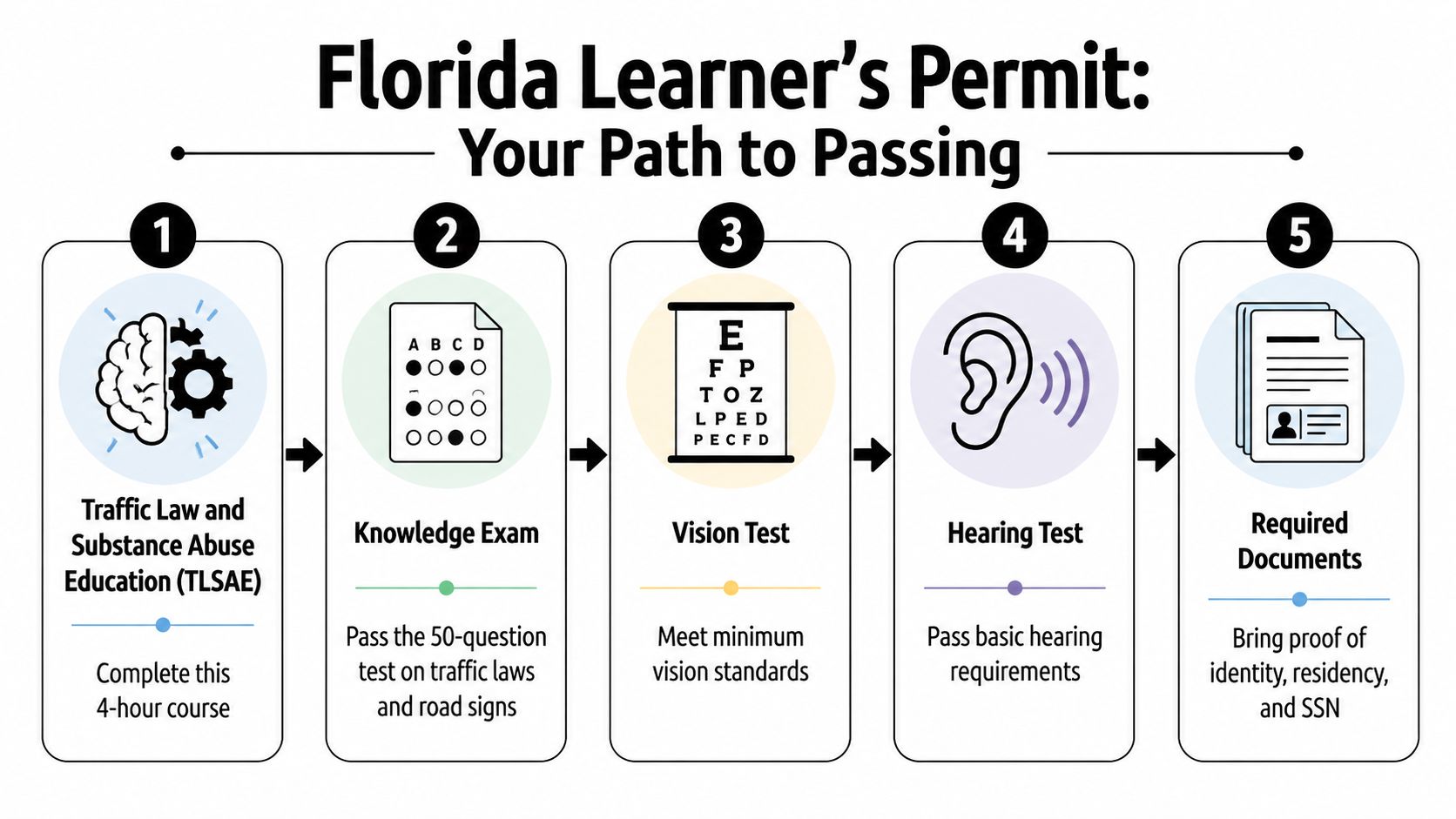
Adults have a simpler process. If you’re 18 or older and applying for the first time in Florida, you generally complete the 4-hour DATA/TLSAE course, study for the Class E Knowledge Exam, and gather your Real ID-style documents for the licensing office.
Adults don’t deal with the teen permit holding period rules in the same way, and they don’t need parental consent. That said, adults often underestimate the paperwork side. The office visit is where many applications slow down because a name doesn’t match across documents, an address is outdated, or the residency proof doesn’t meet the standard.
A simple eligibility checklist
Before you book anything, make sure this list is true for you:
- You meet the age rule: Teens must be at least 15. Adults must be 18 or older.
- You know your required course: Teens and adults do not always take the same class.
- Your documents match: Names, addresses, and identifying details should be consistent.
- You have residency proof: Florida wants evidence that you live in the state.
- A parent is ready to sign if needed: This matters for minors and can delay the appointment if overlooked.
If you want a practical document-and-requirement checklist before moving forward, this permit requirement checklist for Florida applicants can help you organize everything in advance.
Where people often get confused
Three things cause the most trouble.
First, people mix up course completion with permit approval. Finishing a course doesn’t place the permit in your hand. It only clears one requirement.
Second, families assume every under-18 applicant follows old TLSAE rules. That’s no longer safe to assume because of the DETS change.
Third, adults sometimes think a permit is always mandatory before a license. For adults, the path can be more flexible, but the knowledge exam, vision screening, and document requirements still matter.
Once eligibility is clear, the process gets easier. Most of the stress comes from uncertainty, not from the actual tasks.
Passing Your Courses and Exams with Confidence
A lot of families reach this point and feel the pressure rise. The permit process suddenly seems like a stack of tests instead of a clear path. The good news is that each piece has a specific job, and once you know what each one is checking, the process feels much more manageable.
For teens taking DETS
This is one of the biggest Florida permit questions right now. Many parents still know the older TLSAE name, while teens are hearing about DETS. For under-18 applicants, that course change can create real confusion in 2025 unless you check the current requirement before signing up.
DETS asks more of you than just clicking through slides. It includes core topics like road signs, traffic laws, safe driving habits, and the risks tied to alcohol and drugs. The course final also counts. Teens need to pass that final before they can move ahead.
A simple way to look at it is this. The course teaches the rules. The knowledge exam checks whether you can use them.
That difference trips people up.
Some students treat DETS like background noise while they text, snack, or open another tab. Then the identity checks pop up, the final arrives, and the course feels harder than expected. Staying present saves time and stress. At BDISchool, we tell students to treat the course like a real class period, not like a playlist running in the corner.
For adults taking DATA or TLSAE
Adults usually take the 4-hour DATA or TLSAE course, depending on their licensing path. It is shorter than the teen course, but shorter does not mean trivial. It covers impairment, Florida traffic law, and the habits that keep a new driver from making expensive or dangerous mistakes.
Adult students often benefit from tying each rule to a real scene on the road. A right-of-way rule sticks better when you picture a four-way stop. Following distance makes more sense when you picture wet pavement on a summer afternoon. That kind of study works better than memorizing lines without context.
The Class E Knowledge Exam
The written exam worries people more than it should. Florida’s driver license handbook explains what the test covers, and the questions come straight from the same subjects you are supposed to study. Nothing is hidden. The challenge is recall under pressure.
Expect questions in four main areas:
- Road signs: what they mean, what shape or color signals, and what action you should take
- Traffic laws: yielding, turning, lane use, speed rules, signals, and legal duties
- Safe driving practices: spacing, scanning, hazard response, and defensive habits
- Impairment and risk: alcohol, drugs, distraction, and judgment behind the wheel
Florida requires a passing score, so guessing your way through is a weak strategy. A better approach is to build enough familiarity that the correct answer looks familiar right away.
A study routine that actually works
Students often ask for a shortcut. There really is a better answer than cramming. Use a repeatable routine that builds memory in layers, the same way you would practice a sport or an instrument.
Read the Florida Driver Handbook with purpose
Do not stop at signs. Spend time on right-of-way, signals, lane rules, and sharing the road.Break study time into short sessions
Twenty focused minutes usually beats one long, tired cram session.Use practice questions after you review the material
That helps you confirm what you know instead of turning the test into random trial and error.Study your missed questions carefully
A missed question points straight to the rule you do not fully understand yet.
If you want extra repetition before the official exam, BDISchool’s Florida DMV permit practice test is a practical way to spot weak areas early.
One more instructor tip. Road signs fool students who rely on memory from sitting in the passenger seat. Seeing a sign and being tested on its exact meaning are two different skills.
Mistakes that cause avoidable retakes
Good students still miss on the first try for a few predictable reasons.
One is overconfidence. Riding in a car for years does not automatically teach the legal details behind yielding, lane position, or stopping distance.
Another is studying only the easy material. Signs feel familiar, so students stay there too long and neglect traffic laws and judgment questions.
A third problem is treating the course final like a formality. For teens in DETS, the final is a real checkpoint. Give it real attention.
Vision and hearing screening
Many applicants focus so hard on the written side that they forget Florida also checks basic vision and hearing. This part is usually straightforward, but a little preparation helps.
Bring your glasses or contacts if you use them. If your prescription has changed and you already know it, handle that before your appointment. It is much easier to solve that at home than at the counter.
Stay calm enough to show what you know
Test nerves are normal. Even prepared students can miss easy questions when they rush.
A steadier routine helps:
- Get normal sleep the night before
- Eat something light before you go
- Arrive early so you are not flustered
- Read each question carefully
- Pause when a question feels tricky, then return with a clear head
You do not need perfect scores at every step. You need clear preparation, steady attention, and the right course for your age group, especially with the 2025 TLSAE-to-DETS change creating confusion for so many Florida families.
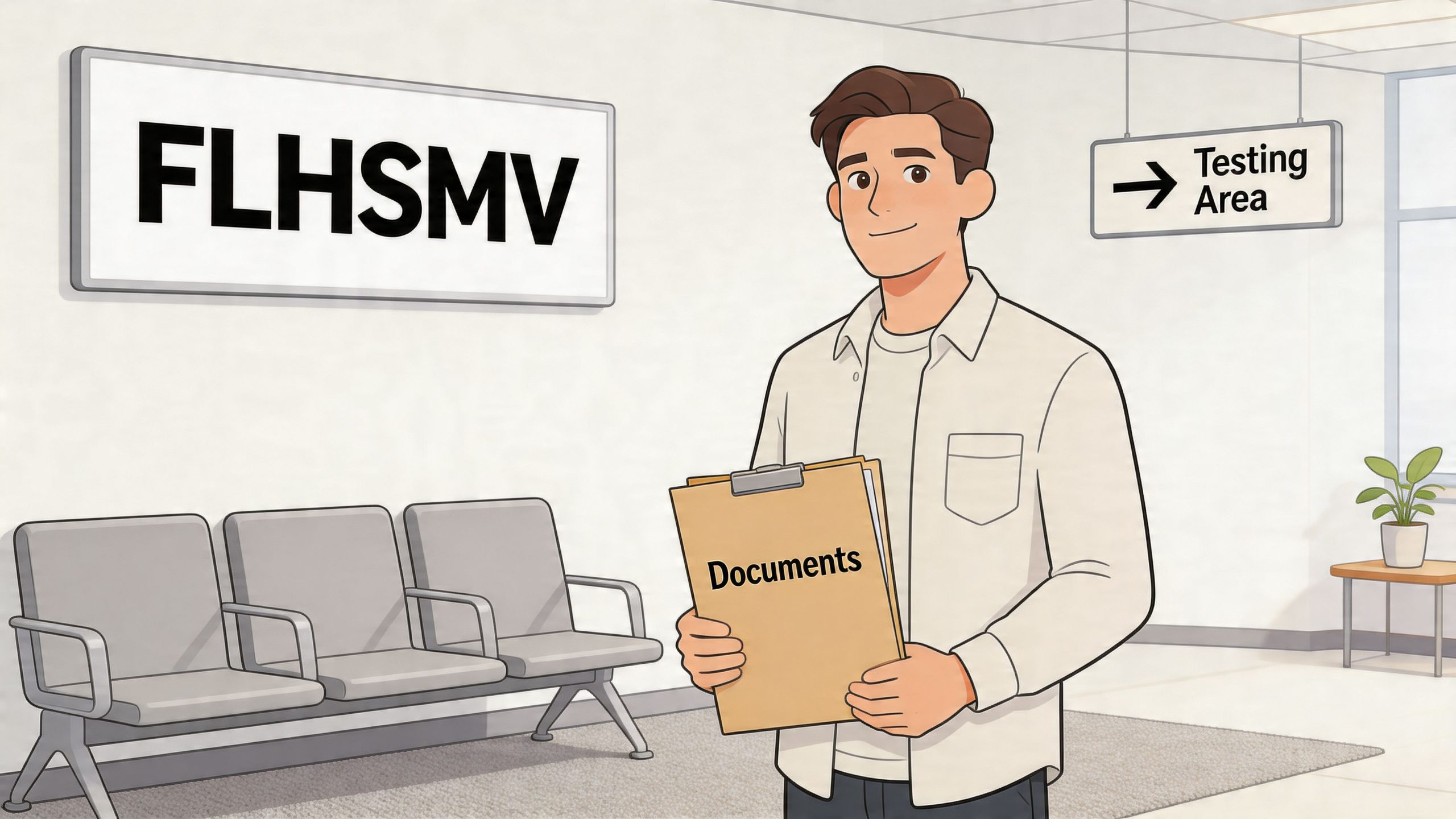
Your FLHSMV Appointment What to Bring and Expect
For many applicants, the licensing office is the part that feels the most intimidating. It helps to think of it less like a big test day and more like a document check plus a few required screenings. If you show up prepared, the visit is usually much smoother than people expect.
The biggest reason people get delayed
Adults often do well on the written side, but paperwork causes real trouble. According to Florida first-license guidance for adults, adults often have a higher first-pass rate on the knowledge exam, but mismatched or incomplete REAL ID documents account for up to a 15% rejection rate at FLHSMV offices.
That doesn’t mean the office is trying to make life difficult. It usually means one of these problems showed up:
- Name mismatch: Your birth certificate, Social Security record, or proof of residency doesn’t match exactly.
- Old address: You brought mail or records with a previous Florida address.
- Wrong document type: The paper looks official but doesn’t meet the office requirement.
- Teen missing consent paperwork: The parent is present, but the form issue still slows things down.
What to bring in your folder
Bring originals or accepted forms of each document category. Keep them in one folder so you’re not searching through a backpack at the counter.
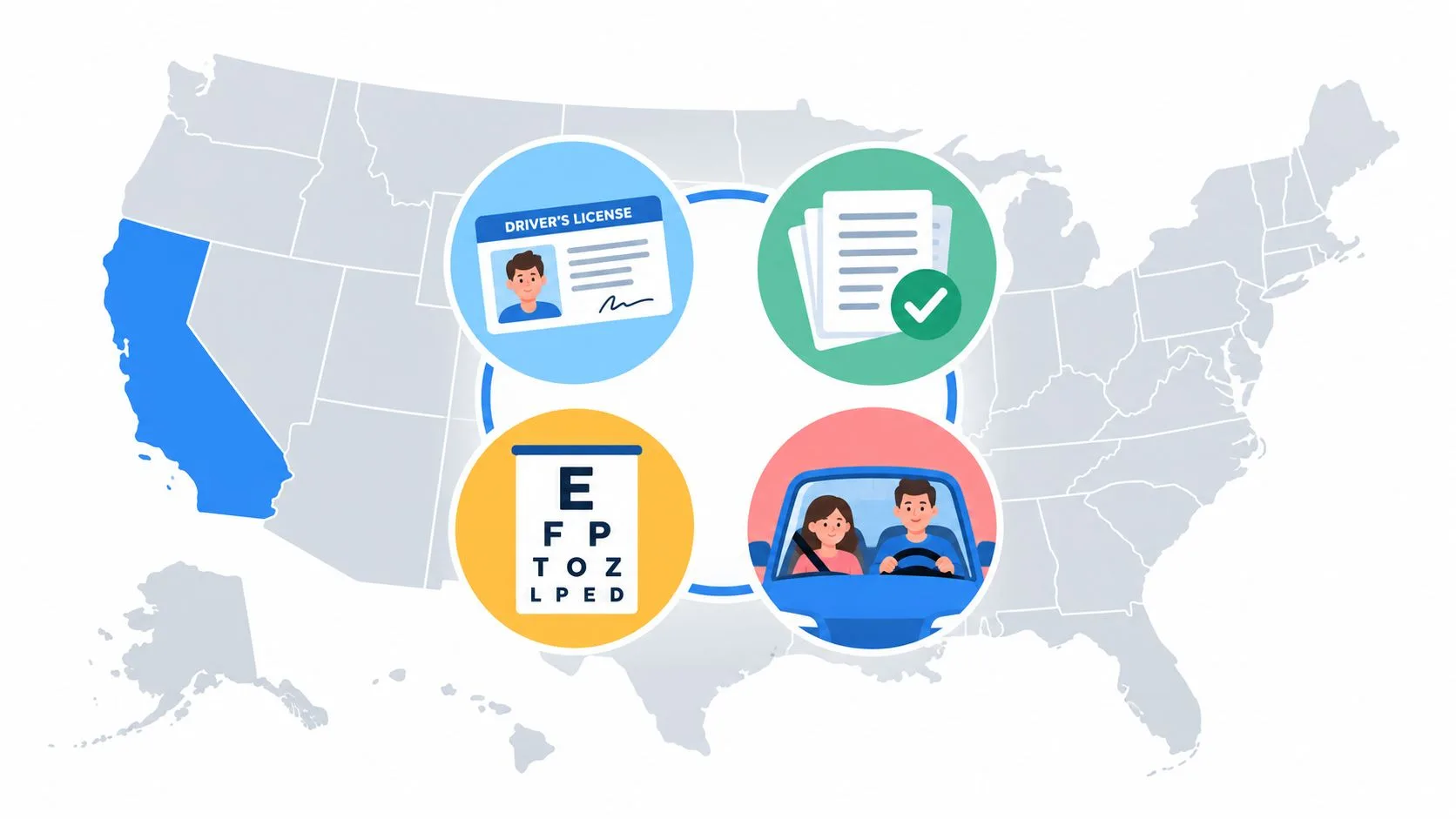
A practical checklist includes:
- Proof of identity: Common examples include a U.S. passport or birth certificate.
- Proof of Social Security Number: A Social Security card or other accepted record.
- Proof of Florida residency: Bring two items that show you live in Florida, such as a utility bill, lease agreement, or bank statement.
- Parental consent if you’re under 18: Don’t assume this can be skipped because a parent drove you there.
- Course completion confirmation: If your course or certificate reporting applies to your appointment, make sure your completion is properly recorded.
If you want a simple pre-appointment checklist, this Florida DMV document guide is a handy way to double-check your folder before leaving home.
What the appointment usually feels like
Most applicants move through the same basic pattern.
You check in, wait for your turn, hand over your documents, and answer basic verification questions. The clerk reviews what you brought and makes sure your records align with what Florida requires.
After that, you may complete the vision and hearing screening if it hasn’t already been handled as part of your visit flow. Then comes the photo, any remaining administrative steps, and the issuance of the permit if everything is approved.
Bring more organization than confidence. A neat folder beats a good memory every time.
A quick look at the office experience
Some people feel better when they can preview the setting before they go. This short video gives a useful sense of what an office visit may involve.
Small moves that make the day easier
You don’t need special tricks. You need fewer preventable problems.
- Schedule rather than walk in: An appointment can save a long wait and reduce stress.
- Check names character by character: Middle names, suffixes, and spelling matter.
- Don’t staple random extras together: Keep the folder clean so the clerk can review documents quickly.
- Wear your corrective lenses if you use them: Don’t risk a screening issue over something easy to control.
- Bring the teen and the parent prepared: If either person is confused about the process, the counter is not the ideal place to sort it out.
Once the office approves everything, you walk out with more than a permit. You walk out with a clear legal starting point for supervised driving.
Rules of the Road Learner’s Permit Restrictions
The permit is exciting, but it comes with boundaries for a reason. These rules aren’t there to frustrate teens or make parents enforce a long list of technicalities. They are there because beginner drivers need a safer practice environment while judgment and car control are still developing.
The core permit restriction
If you’re driving on a Florida learner’s permit as a teen, you must have a licensed driver who is at least 21 years old in the front passenger seat. That’s the rule that matters every single time the car moves.
The supervising adult isn’t just there to satisfy a legal requirement. That person is your second set of eyes, your calm voice at a difficult intersection, and your backup when traffic gets confusing.
Time limits that matter
Florida also limits when permit holders can drive. During the first part of the permit stage, driving is limited to daylight hours. After that, the allowed window expands. These limits are part of the Graduated Driver Licensing system and are meant to reduce the hardest driving conditions early on.
That’s especially important for new drivers who haven’t yet built consistent scanning habits, speed judgment, and hazard awareness after dark.
Why Florida is strict
These restrictions are tied to real safety concerns. In recent Florida crash reporting discussed by FLHSMV-focused coverage, the state recorded over 700,000 total crashes in one year, with a significant portion involving teenagers, often due to distraction. The GDL system exists to reduce risk during the period when a new driver is most vulnerable.
That changes how you should look at permit rules. They’re not punishment. They’re protection.
The safest permit driver is usually not the boldest one. It’s the one who keeps practicing the basics without trying to act experienced too soon.
What good supervised practice looks like
Not all practice drives are equally useful. A teen can spend a lot of time in the car and still avoid the situations that build real skill.
The best practice usually includes a mix of:
- Quiet neighborhood driving: Great for starts, stops, mirrors, and basic turns.
- Busier roads in daylight: Helps with lane changes, traffic flow, and signal timing.
- Parking lots and parking spaces: Builds low-speed control and steering accuracy.
- Night driving later in the process: Important because permit holders need nighttime practice as part of the path toward the next stage.
Parents often ask when to move from easy roads to harder ones. The answer is when the teen can do the basics consistently without reminders every few seconds.
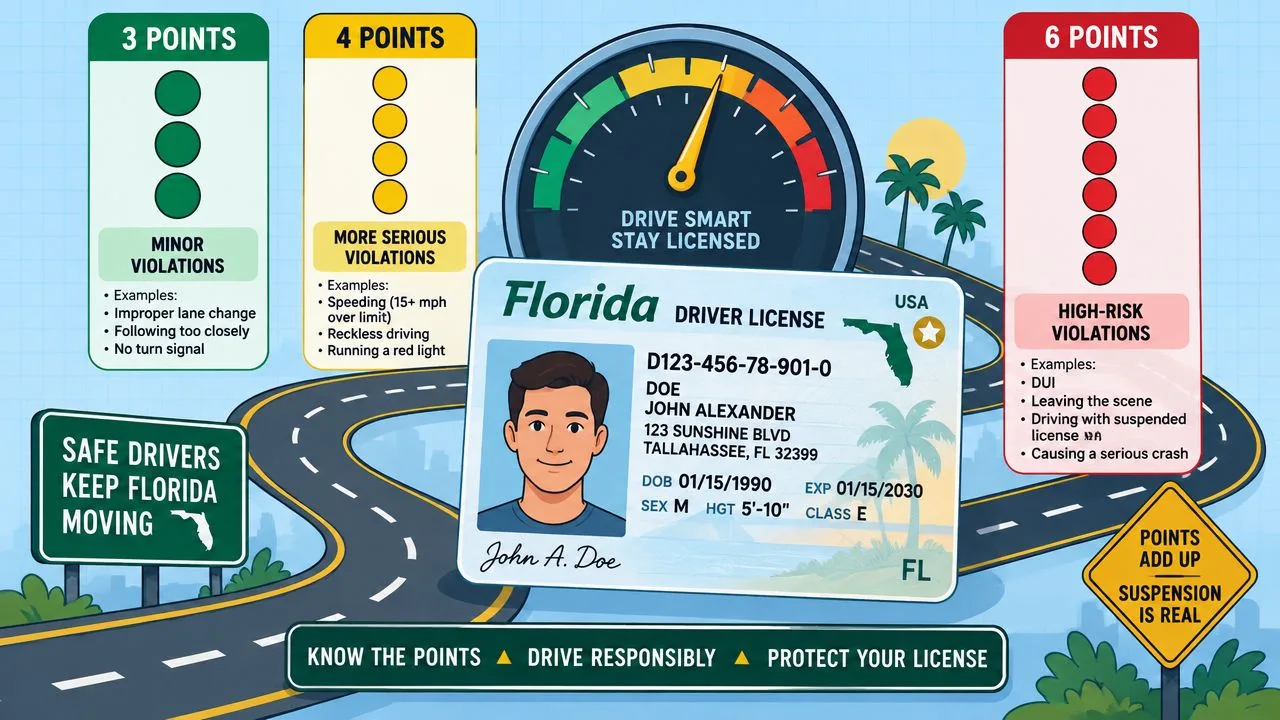
Violations can slow the path forward
One traffic mistake can do more than create a stressful conversation at home. For teen drivers, staying violation-free matters because the permit stage is tied to later licensing progress.
That’s why it helps to treat the permit period like a training phase, not like “almost having a real license.” Every supervised drive is building a record of habits. Careful stops, complete mirror checks, and no phone distraction all count more than showing off confidence.
A family rule that helps
Many families benefit from adding house rules that are stricter than the legal minimum. Keep the phone out of reach. Keep music low. Have the supervising adult give directions early, not at the last second. Drive the same route a few times before adding more variables.
The permit phase works best when everyone treats it seriously. Teens get safer. Parents get less anxious. And the transition to the next license step becomes much smoother.
Your Next Steps Toward a Full Florida Driver’s License
Once the permit is in hand, the goal shifts from eligibility to readiness. At this stage, steady practice matters more than speed. You’re not trying to race to a license date. You’re trying to become the kind of driver who can handle traffic without constant correction.
The milestones that come next
For teen drivers, Florida requires 50 hours of supervised driving, including 10 hours at night, before moving forward. The permit also has to be held for the required period, and traffic convictions can interfere with progress.
A driving log helps more than many families expect. It turns vague memories like “we’ve practiced a lot” into a clear record of what’s been done and what still needs work. If all the hours came from the same easy neighborhood route, that’s a sign the teen still needs broader practice.
What to practice before the road test
The road test isn’t just about whether the car stays moving. It’s about whether the driver shows control, awareness, and judgment. That means the practice should include:
- Smooth braking and acceleration
- Consistent mirror checks
- Proper turns and lane positioning
- Parking and backing
- Staying calm when directions come quickly
Some teens are technically capable but still too flustered under pressure. In those cases, more routine driving with a calm adult usually helps more than another week of reading.
Think beyond the first license
A full license is a milestone, not the finish line. Safe driving is something people keep learning. New drivers may later need help after a citation, after a court order, or as a refresher if their confidence drops. Florida drivers also turn to improvement courses at different stages of life, including options tied to point reduction, court requirements, or insurance-related benefits.
That long view matters. The best driver education doesn’t stop once someone passes a test. It keeps building judgment, patience, and good habits over time.
Common Questions About the Florida Driver’s Permit
A lot of permit questions show up right at the end of the process, usually when a teen is ready to click “book appointment” and a parent wants to make sure nothing gets missed. That is normal. Florida’s permit steps are manageable once you separate the online parts from the in-person parts and keep the 2025 course change in mind.
What happens if I fail the knowledge test
You can retake it, but give yourself time to fix the weak spots first. If signs, right-of-way, or parking rules tripped you up, go back to those sections and study them like you would a missed skill in practice. A shaky turn does not get better by doing the same turn the same way, and the knowledge test works the same way.
The goal is not just to pass on the next try. The goal is to understand the rules well enough that they make sense once you are in the driver’s seat.
I moved to Florida with an out-of-state permit. Can I transfer it
Treat this as a case-by-case situation. Florida may look at your age, your identity documents, your residency proof, and what type of permit you held in the other state.
Parents often assume a learner’s permit transfers like a regular license. That is where confusion starts. Before you make plans, confirm the details directly with the licensing office so you know what Florida will accept and what still has to be completed here.
Is everything online now
No. Some education steps can be done online through an approved provider, but the permit itself is not fully an online process. You still need to complete the state’s in-person parts, such as document review and vision or hearing screening.
This is also where the 2025 change matters for teens. Many families still look for the TLSAE course because they have heard that name for years. For teen permit applicants, the newer DETS requirement is the point to verify before enrolling so you do not spend time on the wrong class. BDISchool helps cut down that confusion by offering Florida-approved courses built around the current process, so families can choose the right step the first time.
How much does the permit process cost
Costs depend on the course you need, state licensing fees, and whether you must retake any part of the process. The material discussed earlier mentions a $10 post-test fee tied to the knowledge exam in some situations.
That is why I tell families to budget for the full path, not just one checkpoint. Course fee, testing-related charges, and the licensing office fee can add up if you have to repeat a step. Checking current pricing before you register saves frustration later.
If you’re ready to get started, BDISchool offers Florida-approved driver education and traffic school courses built for real life. Whether you need help with first-time driver education, a flexible online class, or a course after a violation, their programs are designed to make the process clearer, calmer, and easier to complete from home.