The day is on your calendar, and the nerves usually start before the test itself. It’s common to practice turns, stops, and parking, but then realize the Florida driving test involves much more than just driving around the block. Missing paperwork, a bad brake light, or confusion about what the examiner expects can derail an otherwise solid test day.
That’s why a good florida driving test checklist needs to cover more than one category. You need your documents ready, your vehicle legal and safe, your test skills sharp, and your mindset steady enough to drive the way you practiced. When those pieces come together, the test feels far more manageable.
I’ve seen students walk in stressed because they only studied maneuvers. I’ve also seen careful drivers get postponed because the car wasn’t ready. This guide brings everything into one place so you can prepare in the same order the state will evaluate you, from identity and eligibility to inspection, knowledge, driving skill, and calm decision-making.
Use it like a final run-through. Put your papers in one folder. Check the car before appointment day. Practice the specific actions Florida examiners look for. Then show up knowing you didn’t leave your success to chance.
1. Valid Government-Issued Photo ID and Proof of Residency Documents
Most test-day problems start at the counter, not in the car. If the licensing office can’t confirm who you are or where you live, you may not even get to the driving portion of your appointment.
Bring a valid government-issued photo ID and proof of Florida residency. Think in practical terms. If an examiner asks for identity and address verification, you want clean, current, original documents ready to hand over without digging through your bag.
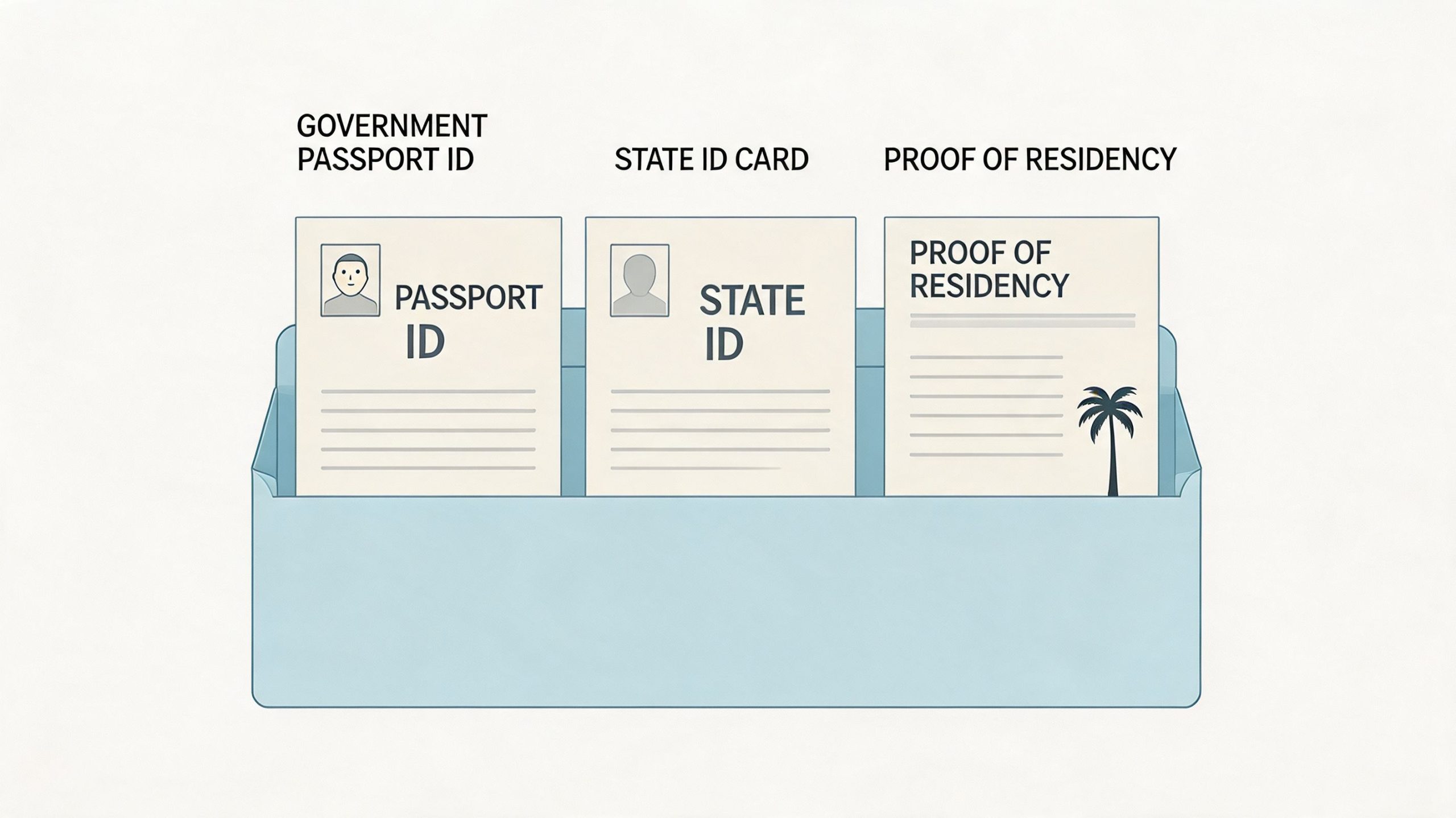
What to gather before appointment day
Common identity documents can include a passport, state ID card, military ID, or an out-of-state driver’s license if that applies to your situation. For residency, people often use things like lease paperwork, utility bills, mortgage statements, or official government correspondence that shows a current Florida address.
The safest approach is simple. Gather more than the minimum you think you’ll need, then review the current document guidance before your appointment using BDISchool’s what to bring to the DMV guide.
Practical rule: Put every required document in one folder the night before. Don’t rely on memory when you’re already dealing with test nerves.
A recent mover runs into this problem a lot. They’ve practiced driving but still have old mail going to a previous address. In that case, update one or two important records before scheduling, so your documents tell one consistent story.
Small document mistakes that cause big delays
Expired IDs are easy to miss. So are name mismatches, damaged documents, and photocopies that an office won’t accept when originals are expected. If your appointment is coming up soon, check every date and spelling now.
A neat folder helps more than people think. When you hand over exactly what’s needed, you look prepared, and you lower your own stress level. That calm matters because the florida driving test checklist starts long before the engine turns on.
A good habit is to do a quick “counter rehearsal” at home. Pretend the clerk says, “ID and proof of residency, please.” If you can produce both in seconds, you’re on the right track.
2. Completed Application for Driver License
The application isn’t exciting, but it’s one of the most important parts of your florida driving test checklist. If it’s incomplete or inaccurate, the rest of your preparation may not matter that day.
Florida’s driver license application asks for personal details, address information, and other identifying data. This is paperwork where small mistakes can create surprisingly large delays, especially if the information doesn’t match your supporting documents.
Fill it out slowly, not quickly
A lot of applicants rush the form because it feels administrative. That’s backwards. Driving skills are hard to fake, and so is clean paperwork. Take your time with your legal name, address, Social Security information if requested, and any medical or eligibility questions.
If English isn’t your first language, give yourself extra time and ask for clarification before you submit anything. A calm, accurate application is better than a fast one with corrections scribbled all over it.
Here’s a real-world example. A first-time adult driver may know how to drive well but still write an old apartment number out of habit. If that address doesn’t match the residency proof they present, they may get pulled into an avoidable delay.
Habits that make the application easier
- Use the current version: Don’t rely on an older saved copy or a screenshot from someone else.
- Match every document: Your application should mirror the spelling, address, and identifying details on the records you’re bringing.
- Keep a backup copy: Save or print your completed form so you can reference it if a question comes up.
- Answer truthfully: Medical and legal questions aren’t guesswork. If you’re unsure, pause and verify.
Students often benefit from guided prep because they can ask basic questions without feeling embarrassed. That’s one reason some new drivers use licensing support materials from driving schools before their test date. The point isn’t to make the paperwork complicated. It’s to keep simple mistakes from becoming barriers.
A clean application tells the office that you’re organized, detail-oriented, and ready to move through the licensing process without confusion.
If you haven’t completed your form yet, do it well before appointment week. That gives you time to correct errors while you’re calm, not while you’re standing in line.
3. Social Security Number Verification and Background Check Clearance
This part feels invisible because you don’t “study” for it the way you study signs or right-of-way rules. Still, it matters. Florida verifies identifying information, and licensing issues tied to your record can interrupt the process if they haven’t been resolved.
For many applicants, this step proceeds smoothly because their information is accurate and their status is clear. But if you’ve had a suspension, an out-of-state issue, or confusion connected to your name or number, it’s smart to address that before test day.
When to double-check your record
You don’t want your first clue about a problem to come at the service window. If you’ve ever had a revoked or suspended license, outstanding traffic matters, or a mismatch in personal records, look into it ahead of time.
A returning driver often falls into this category. Maybe they moved, had an old ticket years ago, or let a previous license lapse. They may assume everything is fine until the system says otherwise.
Use common sense here. If there’s any reason to think your record might need review, give yourself extra lead time instead of scheduling at the last minute.
How to avoid preventable issues
- Verify your number carefully: A single wrong digit can create a frustrating mismatch.
- Be honest on forms: Omissions usually create more trouble than disclosure.
- Resolve open issues first: Suspensions and related legal problems are much easier to handle before you test.
- Keep course records handy: If you completed required traffic school or related programs, save proof for your files.
This is also where adult applicants sometimes get tripped up by assumptions. They think prior issues won’t matter because the current appointment is “just a driving test.” In practice, licensing is tied to legal eligibility, not just driving ability.
If you’re worried about your status, don’t guess. Confirm it early and fix what needs fixing while you still have time.
Think of this item as pre-clearance. You’re making sure the state can say yes before you invest more energy into the final appointment. That’s not stressful preparation. It’s smart preparation.
4. Proof of Insurance and Vehicle Registration Documentation
A test appointment can fall apart before the engine starts. You arrive ready, the examiner asks for the car’s paperwork, and a missing insurance card or expired registration stops the process on the spot.
That is why this part of the florida driving test checklist deserves its own check, separate from your license documents. Your driving skills matter, but the vehicle also has to be legally allowed on the road for the test.
Florida requires the vehicle used for the road test to be registered and insured. The Florida Department of Highway Safety and Motor Vehicles explains the state’s required coverages on its Florida insurance requirements page. For test day, the practical takeaway is simple. Bring a car with current registration and proof of insurance that matches Florida rules.
What the examiner is checking
The examiner is confirming that the vehicle can legally be driven in Florida. This step works like checking a boarding pass before a flight. If the paperwork is missing or outdated, the trip does not begin.
Keep the registration and insurance card together in one easy-to-reach place, such as the glove box, center console folder, or a document sleeve. Handing them over quickly sets a calm tone. Searching through receipts, fast-food napkins, and old service papers does the opposite.
Borrowed cars create the most confusion.
A teen may practice all week in a parent’s SUV, then learn on test morning that the insurance card was replaced months ago and never put back in the vehicle. If you are not testing in your own car, ask to see the documents several days early. That gives you time to fix a problem instead of discovering it in the parking lot.
A simple document routine
Use this short check the night before your appointment:
- Confirm the registration is current. Look at the expiration date, not just the card’s presence.
- Confirm proof of insurance is in the car. A policy that exists at home does not help if you cannot show it.
- Match the vehicle to the paperwork. The plate, make, or vehicle details should clearly belong to the car you are bringing.
- Use the same car you practiced in if possible. Familiar controls reduce mental clutter.
- Keep papers organized in one spot. Good drivers prepare the car the same way they prepare themselves.
This small routine removes a surprising amount of stress. It also supports the kind of proactive vehicle performance strategies that make test-day preparation more reliable, especially if you are using a family vehicle that several people drive.
This guide pulls together the parts applicants often check separately. Your personal documents, your car’s legal paperwork, the vehicle’s physical condition, the driving maneuvers, and your mental preparation all affect whether the test starts smoothly. Handle this item early, and you give yourself one less thing to worry about when the examiner walks up to the window.
5. Safe Vehicle Pre-Test Inspection and Maintenance Standards
You can arrive with every document in order and still lose your test slot because the car is not ready. That catches many first-time drivers off guard. The examiner is not only checking how you drive. The examiner is also checking whether the vehicle is safe enough to enter traffic.
Florida’s road test begins with a vehicle inspection. The state expects a roadworthy car with working safety equipment, usable mirrors, proper lights, a horn, brakes, tires in safe condition, and enough fuel to complete the exam. The Florida driver’s manual study resource is a helpful place to review the same safety expectations and basic equipment rules before test day.
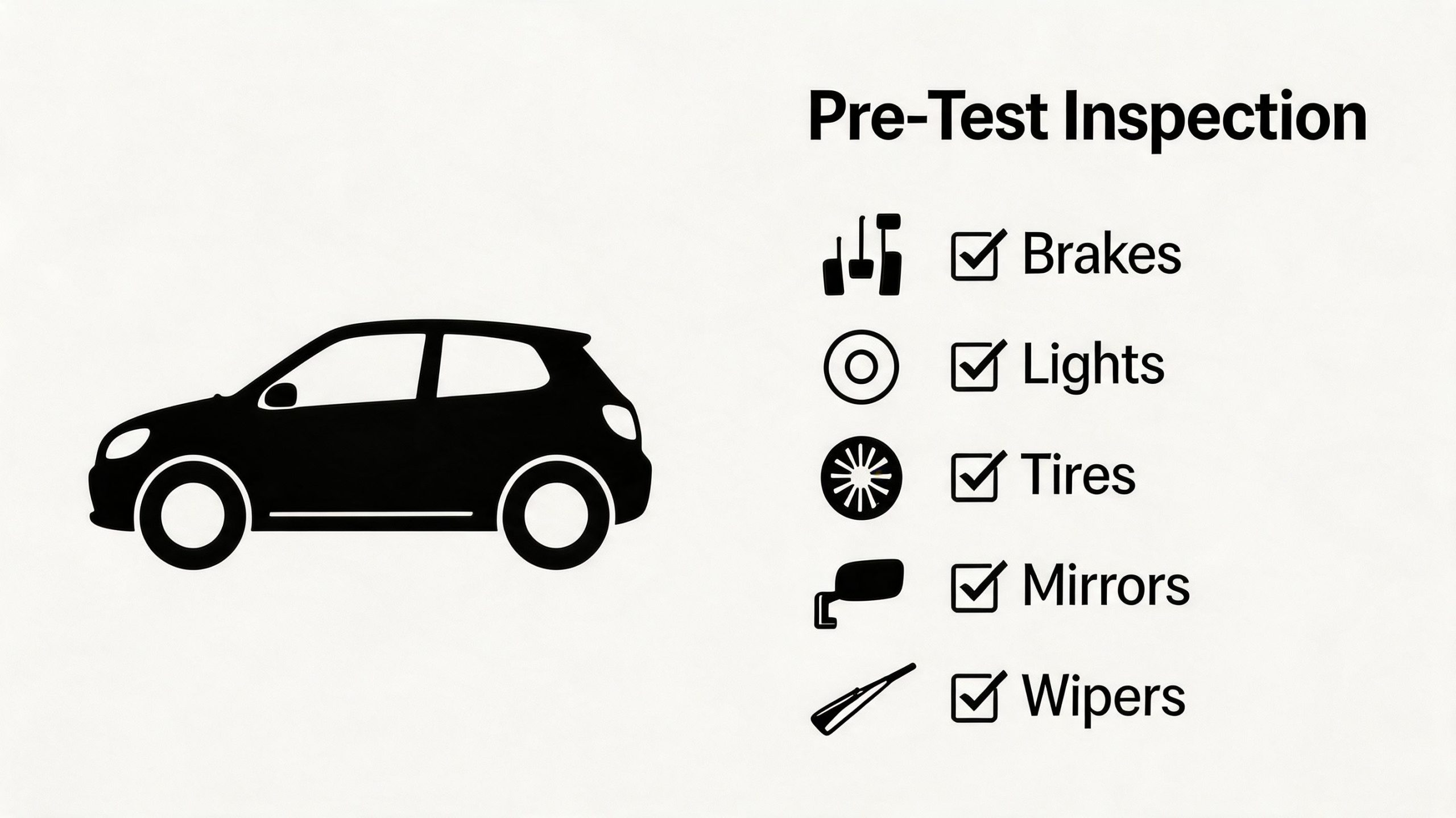
What the examiner notices first
Treat the inspection like the opening minute of a job interview. If the car gives the impression that something is broken, the drive may not even begin.
Small defects matter here because they affect safety directly. A weak brake light makes it harder for other drivers to react. Worn wipers matter in Florida because a clear sky can turn into heavy rain fast. A sticky door lock or seatbelt problem also raises a simple question for the examiner: is this vehicle safe to use for a test?
Borrowed cars create extra risk. A family member may tell you the car is fine because they have adapted to its quirks. You need a stricter standard than “fine.” You need “reliably safe today.”
A practical check you can do the day before
Use a helper if possible and test the car in the same calm, methodical way you would check answers before turning in an exam.
- Lights and signals: Turn on headlights, brake lights, and both turn signals. Confirm each one works and is easy to see.
- Horn and brakes: Press the horn and test the brake pedal response in a safe area. Both should work right away.
- Mirrors and glass: Clean the windshield and mirrors so your view is clear from every normal driving angle.
- Wipers and washer fluid: Run the wipers and make sure they clear the glass instead of smearing it.
- Tires: Look for obvious low pressure, damage, or very worn tread.
- Seatbelts and doors: Buckle every required belt and open the doors from inside and outside.
- Fuel level: Start with enough gas to finish the appointment without stress.
One sentence can save you a canceled test: if any item feels questionable, choose a different car.
For a broader maintenance habit beyond exam day, this article on proactive vehicle performance strategies is useful as a general vehicle care reference.
The value of this all-in-one checklist is that it connects the parts many applicants separate. Your paperwork gets you to the appointment. Your vehicle condition gets you onto the course. Your driving skill and mental control carry you through the rest. When you check the car early, you remove one of the easiest test-day failures before it has a chance to shake your confidence.
6. Written Knowledge Test Preparation and Traffic Law Comprehension
You arrive at the testing center with every document ready and the car in good shape, then a question about right-of-way or a regulatory sign slows you down. That is why this part of the florida driving test checklist deserves the same attention as paperwork and vehicle inspection. A license test works like building a house. If the rules are shaky at the base, every driving decision above them gets harder.
Florida’s knowledge exam checks whether you can read the road before you ever start the engine. Expect questions on traffic laws, signs, pavement markings, and safe-driving judgment. The official state reference for those topics is the Florida Driver License Handbook from FLHSMV, and BDISchool’s Florida driver’s manual study guide can help you review the same material in a more organized way.
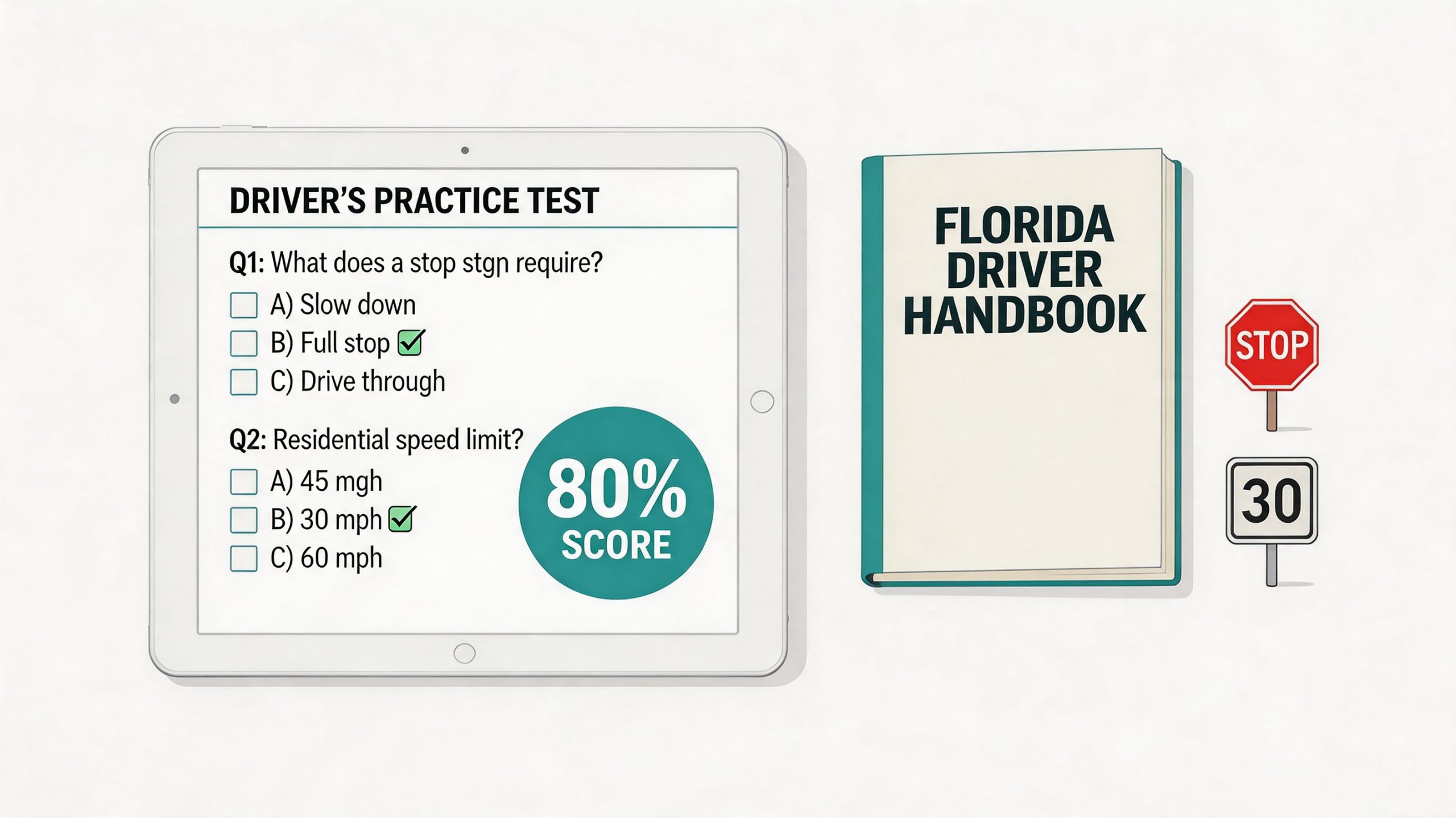
Memorizing isolated answers is risky. The safer approach is to connect each rule to a real driving situation.
For example, a stop sign question is rarely only about the shape or color of the sign. It may test whether you know who goes first, where to stop, or when a complete stop is still required even if the road looks empty. Students often miss these questions because they studied symbols but not decisions.
Focus your study time on four areas:
- Road signs and signals: Know warning, regulatory, guide, and construction signs, plus common traffic lights and lane-control signals.
- Right-of-way rules: Study intersections, four-way stops, pedestrians, school buses, and emergency vehicles.
- Safe spacing and speed choices: Review following distance, stopping distance, and how weather or visibility changes your judgment.
- Florida-specific laws: Pay close attention to seat belts, school zones, work zones, phone use, and DUI-related rules.
A simple study method helps. Read a rule, say it in your own words, then attach it to a driving scene you can picture from daily life. That process turns a fact into a usable habit.
If a topic keeps tripping you up, do not keep rereading the same paragraph and hoping it sticks. Slow down and sort the confusion into smaller parts. A yield sign question, for instance, may be testing gap selection, scanning, and right-of-way all at once. Breaking it apart makes the rule easier to remember under pressure.
Use practice questions carefully. They are good for checking readiness, but the handbook should stay your main source because it explains the reason behind the answer. This guide’s value is that it does not treat the written test as a separate chore. It connects the knowledge exam to the documents you bring, the vehicle standards you meet, the road maneuvers you practice, and the mental control you need on test day.
One strong habit before the exam is to keep an error log. Each time you miss a question, write the rule you missed and one real-world example beside it. That gives you a short, targeted review sheet instead of a pile of random missed answers.
Students who understand the law usually look calmer during the rest of the licensing process. They are not guessing. They are applying rules they already understand.
7. Practical Driving Skills Demonstration and Road Test Competencies
You have your documents, your vehicle is ready, and the written rules make sense. Now comes the part many students worry about most. An examiner sits beside you and watches whether your driving habits match what a safe Florida driver should do in real traffic.
A road test is a short drive, but it works like a spot check in a classroom. The examiner is not looking for perfection in every second. The examiner is checking whether you can control the vehicle, follow directions, notice hazards, and make safe choices without coaching.
Practice the skills the test is built around
Your practice sessions should match the skills you may be asked to show. That usually includes turning, stopping smoothly, backing up with control, parking, choosing the correct lane position, and handling common low-speed maneuvers such as a three-point turn.
Treat each skill like a small routine with clear steps. For a three-point turn, for example, the job is not just turning the wheel. You also need to signal, check for traffic, judge space, move slowly, and keep the car under control the whole time. Students often struggle because they practice the steering part and forget the observation part.
That pattern shows up in several test maneuvers. A quick stop tests braking control and awareness. Straight-in parking tests speed control, alignment, and judgment. Right turns and left turns test lane choice, scanning, and timing.
What the examiner is really watching
Many point losses come from habits that are technically present but too weak to see. If you glance at a mirror or side street so lightly that the examiner cannot tell you checked, it may look like you did not check at all.
Focus on four visible driving habits:
- Observation: Check mirrors, intersections, and side areas early enough to show awareness.
- Control: Use the gas pedal, brake, and steering wheel with steady inputs.
- Compliance: Obey signs, signals, pavement markings, and verbal instructions.
- Positioning: Stay centered in your lane and place the car accurately during turns and parking.
A good practice drive is specific. Pick one skill at a time, repeat it several times, then add the next one. That works better than taking a long casual drive and hoping all the test items improve on their own.
If you want a step-by-step review of common road test mistakes and scoring concerns, BDISchool’s how to pass the driving test in Florida guide can help you organize your practice.
A common mistake pattern
Here is what happens often on test day. A student drives comfortably through a neighborhood, approaches an intersection, signals correctly, and begins the turn. Then the student misses a clear left-right scan for cross traffic or pedestrians. The turn itself is fine, but the safety check was too subtle or too late.
That is why this checklist ties skill practice to test-day habits. It is not enough to know the maneuver. You need to perform it in a way the examiner can clearly evaluate.
A video walkthrough can also help you visualize what calm, organized test driving looks like.
If nerves start tightening your focus, use one simple reset before you pull away or after a minor mistake. Box Breathing gives you a fast way to slow your breathing and steady your attention. That matters because one small error does not fail a test by itself. Panic after the error is what often creates the next two problems.
Drive the next moment well. That is what the examiner needs to see.
8. Defensive Driving, Hazard Avoidance, and Mental Preparation
You are halfway through the road test, then a car ahead brakes near a crosswalk, a pedestrian steps closer to the curb, and your mind starts racing. That moment is what this part of the florida driving test checklist is for. A passing drive depends on more than turning, stopping, and parking. It also depends on whether you notice problems early, leave yourself options, and stay calm enough to make clear decisions.
Defensive driving works like creating a buffer around the car. Time, space, and awareness give you room to solve small problems before they turn into test-ending mistakes. Examiners watch for that buffer constantly. They want to see that you scan ahead, check mirrors with purpose, and avoid surprising other drivers.
Start by building a repeatable pattern. Before you move, set your seat, mirrors, and steering position so your body feels settled instead of cramped. Once the car is in motion, keep your eyes working in a loop: far ahead, mirrors, side areas, then back to the road ahead. That loop helps you catch changes early and keeps your attention from getting stuck in one place.
An intersection is a good example. A nervous driver often stares at the signal and misses the bigger picture. A prepared driver checks the light, the crosswalk, the lane position of nearby cars, and whether traffic ahead is backing up into the intersection. The turn or stop usually goes better because the driver saw the whole scene, not just one part of it.
Calm driving looks ordinary, and that is usually a sign of control.
If you want extra practice with that kind of road awareness, BDISchool’s defensive driving tips for hazard awareness and safer decisions give you focused ways to improve before test day.
Mental preparation matters for the same reason. Stress narrows attention. It can make a simple lane change feel rushed or cause you to forget an obvious mirror check. Treat your pre-test routine like setting the stage before a performance. Sleep enough the night before, eat something light that will not leave you distracted, and arrive early enough that you are not carrying parking-lot stress into the examiner’s first impression.
Breathing helps because it gives your body a clear signal that you are safe. If your chest feels tight or your hands start gripping the wheel too hard, use Box Breathing before the test or after a minor mistake. The goal is not to get rid of every nerve. The goal is to keep your thinking clear for the next decision.
Use this short test-day check:
- Scan early and often: Let your eyes lead the car instead of reacting at the last second.
- Keep space around you: Following distance gives you more time to brake smoothly and less need to panic.
- Signal before the maneuver: Show your plan early so the examiner can see your judgment and other drivers can respond.
- Remove distractions: Silence your phone and clear away anything that pulls your eyes or hands off the driving task.
For teens, supervised practice is where this all starts to feel natural. Florida requires logged practice with an adult, including nighttime driving, as noted earlier in this guide. Those hours matter because hazard awareness is learned through repetition. The more often you practice scanning, spacing, and calm recovery, the less likely nerves are to take over on test day.
This is what makes an all-in-one checklist useful. Documents get you to the appointment. A safe vehicle gets you on the course. Driving skills help you complete each maneuver. Defensive habits and mental preparation hold the whole test together.
8-Point Florida Driving Test Checklist Comparison
| Requirement / Component | 🔄 Implementation Complexity | ⚡ Resource Requirements | ⭐📊 Expected Outcomes | 💡 Ideal Use Cases | ⭐ Key Advantages |
|---|---|---|---|---|---|
| Valid Government-Issued Photo ID and Proof of Residency Documents | Low, collect originals, ensure dates and acceptability | Low–Moderate, time to obtain/renew ID or proof of residency | Verifies identity/residency; enables test eligibility; fraud prevention | All applicants prior to scheduling the driving test | Multiple accepted document types; quick in-person verification |
| Completed Application for Driver License (DHSMV Form 80) | Moderate, many required fields, medical and SSN sections must be accurate | Low, time, internet access; possible physician input for medical questions | Standardized applicant record; reduces DMV wait when pre-submitted | First-time applicants, renewals, multilingual applicants | Official standardized form; online and multilingual options |
| Social Security Number Verification and Background Check Clearance | Moderate–High, federal DB checks and potential record corrections | Moderate, 1–3 weeks processing; access to records; possible legal steps | Confirms eligibility; can disqualify ineligible applicants; detects fraud | Applicants with prior violations, interstate transfers, those with unclear records | Protects public safety; consistent statewide eligibility screening |
| Proof of Insurance and Vehicle Registration Documentation | Low–Moderate, obtain active insurance and matching registration | Moderate, insurance premiums, registration fees; digital or paper proofs accepted | Ensures test vehicle is legal and insured; prevents test cancellation | Applicants using personal/test vehicle; new vehicle owners | Legal protection during testing; digital proofs simplify presentation |
| Safe Vehicle Pre-Test Inspection and Maintenance Standards | Moderate, pre-test checks and potential repairs required | Moderate–High, mechanic fees, parts, scheduling inspection | Reduces mechanical failures; improves safety and test eligibility | Older or rarely driven vehicles; before final test scheduling | Prevents test-day cancellations; promotes reliable vehicle operation |
| Written Knowledge Test Preparation and Traffic Law Comprehension | Moderate, study Florida Driver Handbook and practice tests | Low–Moderate, study time (weeks), practice tests; multilingual materials | Demonstrates knowledge of laws/signs; pass requirement (80%) for licensing | First-time drivers, non-native speakers, those needing refreshers | Immediate results, abundant official practice materials, multilingual support |
| Practical Driving Skills Demonstration and Road Test Competencies | High, real-world performance under examiner evaluation | High, 30–50 practice hours recommended, vehicle access, instructor time | Confirms actual driving ability; immediate pass/fail; identifies skill gaps | Applicants ready for licensing or needing hands-on validation | Real-world assessment with examiner feedback; direct safety relevance |
| Defensive Driving, Hazard Avoidance, and Mental Preparation | Moderate, ongoing practice, mental skills training | Low–Moderate, courses, practice sessions, time for mental prep | Improves hazard recognition, reduces test anxiety and crash risk | Test-anxious drivers, those seeking long-term safety improvements | Enhances examiner perception, transferable skills, possible insurance discounts |
Beyond the Test Your Journey as a Safe Florida Driver
Passing the test is a big milestone, but it isn’t the finish line. It’s the start of driving without someone constantly coaching, correcting, or reminding you what to check. That’s why the best florida driving test checklist doesn’t just help you pass once. It helps you build habits you’ll keep using after the examiner steps out of the picture.
If you pass, take that win seriously. You earned it by preparing your documents, checking your car, practicing the right maneuvers, and keeping your nerves under control. Then keep doing those same things in regular driving. Safe drivers don’t rely on luck. They rely on routines.
If you don’t pass the first time, it doesn’t mean you’re incapable or unsafe forever. It usually means one or two areas need more focused practice. Maybe your observation at intersections wasn’t clear enough. Maybe your parking control needs work. Maybe anxiety made you rush. Those are workable problems.
The examiner’s feedback matters because it points to the exact habits to tighten up before the next attempt. Treat it like coaching, not judgment. Good drivers improve by identifying errors accurately and repeating the correct behavior until it becomes automatic.
This is also where continuing education can be useful beyond the licensing moment. Some drivers need help with defensive habits. Some need to refresh traffic law knowledge after time away from driving. Some are managing a citation, trying to reduce points, or looking for an insurance discount through an approved course. In those situations, a Florida-approved online school can be a practical next step.
BDISchool is one relevant option. It offers FLHSMV-approved online courses in English, Spanish, and Portuguese, including Basic Driver Improvement, Intermediate Driver Improvement, the Aggressive Driver Course, and the Mature Driver Course. Those programs are relevant for drivers who need point reduction support, court-related education, or a general safety refresher after getting licensed.
The bigger lesson is simple. A license gives you permission to drive. It doesn’t remove the need to stay alert, legal, patient, and prepared. Keep your documents current. Maintain your vehicle. Review the rules when you feel rusty. Practice defensive driving even when nobody is scoring you.
That mindset is what turns a nervous applicant into a reliable Florida driver. The test just confirms a snapshot of your readiness. Your daily decisions afterward shape the driver you become.
If you want flexible help with Florida driving requirements, traffic school, or defensive driving education, BDISchool offers state-approved online courses that you can take on your own schedule.