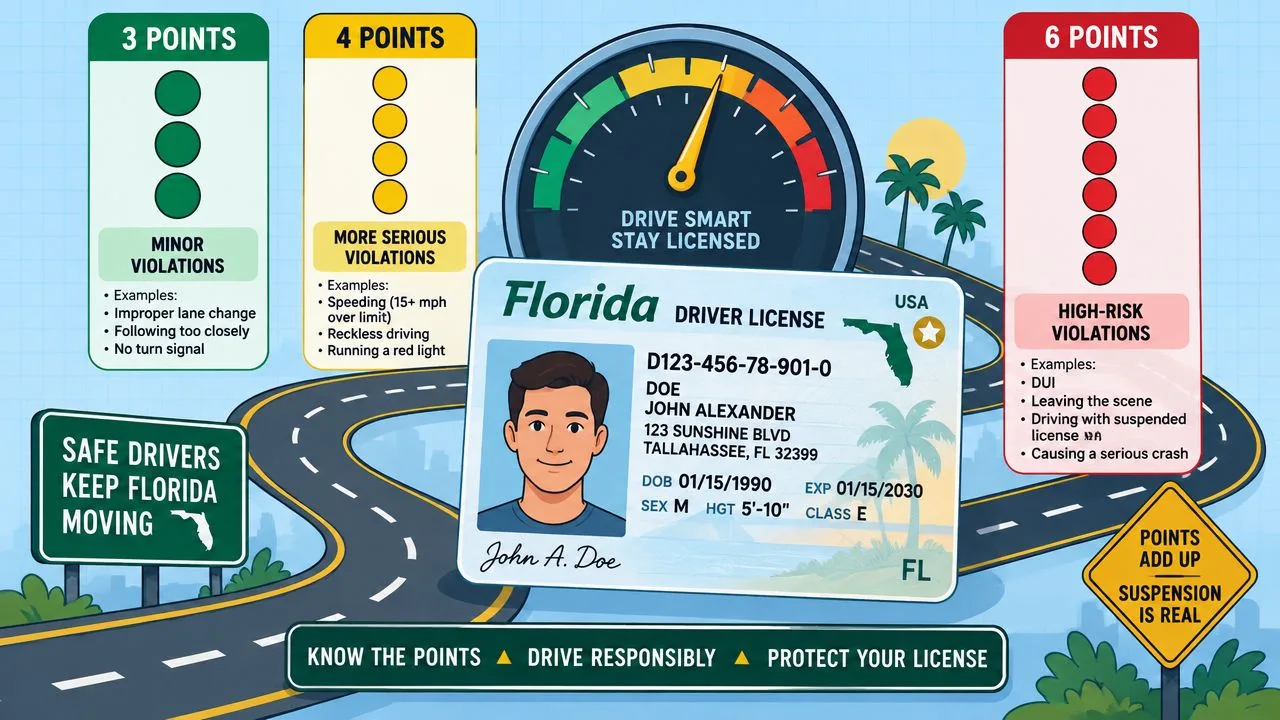
Your kid is at the kitchen table, the permit appointment’s circled on the calendar, and now everybody’s asking the same question, “Do we still need the online course?” In Florida, the answer changed. If your teen is under 18, you don’t just wing it anymore, you need a state-approved driver education course before the learner’s license gets issued, and that’s why families are suddenly scrambling to sort out FLVS Driver’s Ed and the rest of the pipeline.
The smart move is to treat this like a real timeline, not a vague someday project. FLVS has been at this for more than 20 years, and it says more than 900,000 students have completed Driver Education through the program, so this isn’t some experimental workaround, it’s the default option most parents hear about first, especially now that the 2025 rule change has tightened the path to a license. If you want the clean version of what changed in Florida driving law, start with this Florida law update breakdown.
The New Rule That Changes Everything in 2026
A lot of parents still talk like it’s 2019. They assume the process is simple, wait until 16, show up, take the test, get the permit, and move on. That thinking gets families into trouble now, because Florida’s rule for under-18 drivers puts the course ahead of the learner’s license, not after a casual practice period.
That changes the order, and families feel it fast. If your teen is 15 or 16 and you wait until the last minute, you are not just delaying paperwork, you are delaying the whole licensing sequence. The certificate needs to be ready when the state is prepared to issue the learner’s license, so the family needs a plan, not just good intentions.
FLVS is usually the first name parents hear because it has been operating for more than 20 years. That history matters, but the point is simpler. Florida families already use online school systems, so an online driver education requirement does not feel strange, it feels like the state just moved the finish line forward. If you want a clean breakdown of the Florida law update that changed the sequence, read that first and then map your teen’s schedule around it.
Practical rule: if your teen is under 18, treat driver education like any other deadline-driven school requirement, not a flexible bonus activity.
Families who used to wait and see now need to choose a course path early. The state changed the order of operations, and that leaves no room for guessing.
What FLVS Driver’s Ed Is
Florida Virtual School is a public, state-funded online school, and its Driver Education course is one of the free options available to Florida residents. FLVS was founded in 1997, which puts it among the longest-running online public-school driver education offerings in the country, and that track record matters because families want a provider that has already lived through plenty of Florida rule changes. FLVS also says more than 900,000 students have completed Driver Education since the course began, which is the kind of usage that usually comes from a program families keep choosing.
The course is part of the state-approved Driver Education Traffic Safety (DETS) path, and the Florida Department of Highway Safety and Motor Vehicles lists FLVS as an approved Internet provider for that program. Finish the course, and the student gets an official completion certificate, the document that matters when the rest of the licensing process starts.
If you are comparing course formats, keep the distinction clear. FLVS Driver’s Ed is the classroom piece, not the whole driving education experience. It gives students the required knowledge base, but it does not replace real practice behind the wheel, and that is where a lot of families misread the process.
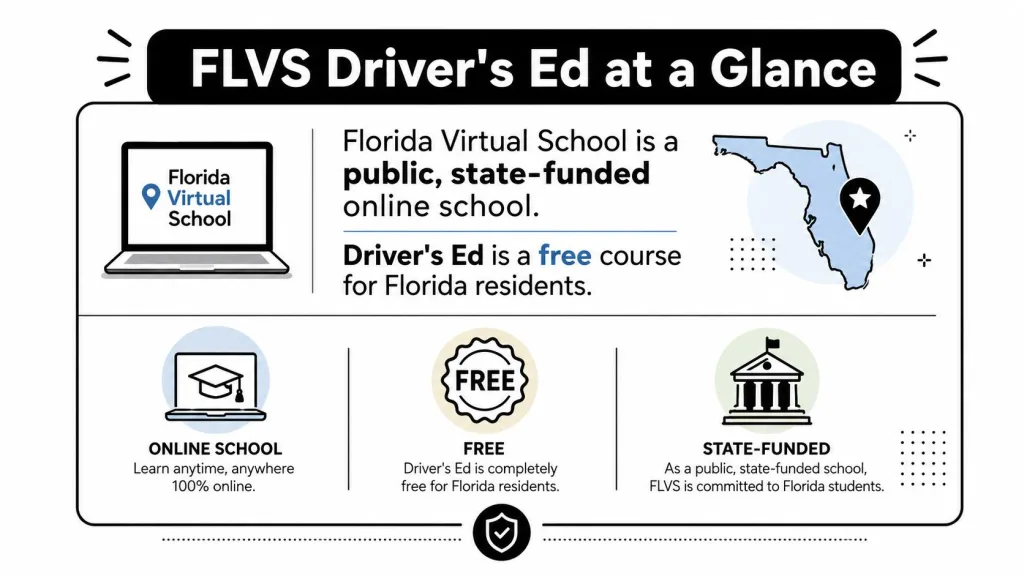
The parent-friendly summary is the one people repeat for a reason. It is free, online, and self-paced, but not instant.
For a clean overview of the online format, the course page for Driver’s Ed online is useful background, especially if you are comparing how different Florida programs present the same required content. Parents who want a clearer breakdown of what the software includes should look at the course tools and structure before they choose a path.
What’s Inside the Course Curriculum
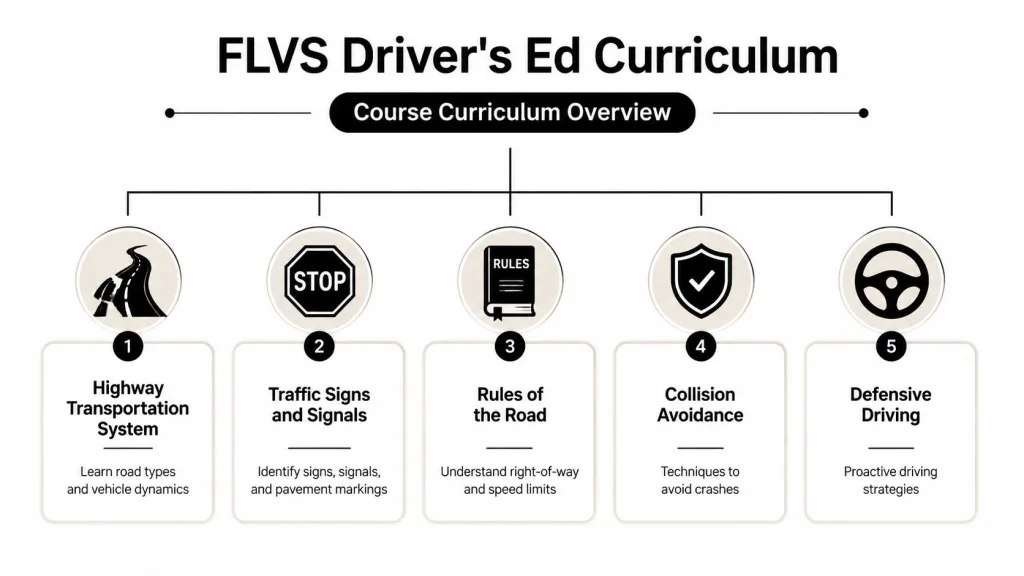
FLVS stops feeling generic once you look at the curriculum. The state outline is specific, and that is a plus, because Florida roads punish vague training. Students are not just learning “safety.” They are learning the Highway Transportation System, traffic signs, rules of the road, collision avoidance, defensive driving, right-of-way at intersections, drowsy driving, DUI, distracted driving, vehicle controls, space cushion, night driving, trip planning, and emergency handling.
The course maps to real driving decisions
Parents make the same mistake over and over. They assume these modules stay abstract. They do not. A lesson on right-of-way at intersections turns into a decision at a four-way stop. Also on space cushion turns into how your teen follows traffic on a wet road without tailgating. Another lesson on night driving matters because Florida teens do not just drive in daylight on a test route, they drive outside the test route, where glare, fatigue, and bad judgment show up fast.
The class also lines up with the Class E Knowledge Exam, which is the next gate in the process. That is the point parents should care about most, because the course is not there to entertain a student or pad a transcript. It is there to build the exact knowledge the state expects the driver to show before moving ahead.
For parents who want a digital learning platform that handles course structure and related training tools cleanly, what the software includes is a useful way to think about the kind of functionality people expect from modern online education systems.
The course teaches the exact mechanics Florida students must master.
That is the right mindset. If a module does not help your teen answer the knowledge exam or handle a real road situation, it is not filler, it is preparation.
Bottom line: if you want a course that aligns with Florida’s license expectations, this one is built for that purpose, not just for general road-safety talk.
Who Needs It, Age Rules, and How to Enroll
The cleanest way to think about eligibility is in three buckets. First, under-18 drivers who need the course for the learner’s license path. Second, adults 18 and older who may still need driver education for a court, an insurance request, or their own licensing path. Third, out-of-state teens who are moving into Florida and need to check whether their situation fits the state’s rules before they start.
Start with the age and residency question
If your teen is under 18, don’t wait to see what the DMV says later. Start by confirming Florida residency, because FLVS is for Florida residents, and then make sure the student is ready to work through the online course before the learner’s license appointment. That order matters because the state process doesn’t care how close you were to finishing, it cares whether you’re finished.
Then line up the rest of the checklist
FLVS says students must pass the Class E Knowledge Exam, a vision and hearing test, and provide the required identification documents. Florida’s graduated licensing rules also require minors to complete 50 hours of supervised driving, including 10 hours at night, and to have no traffic convictions during that supervised period before moving up to a driver license.
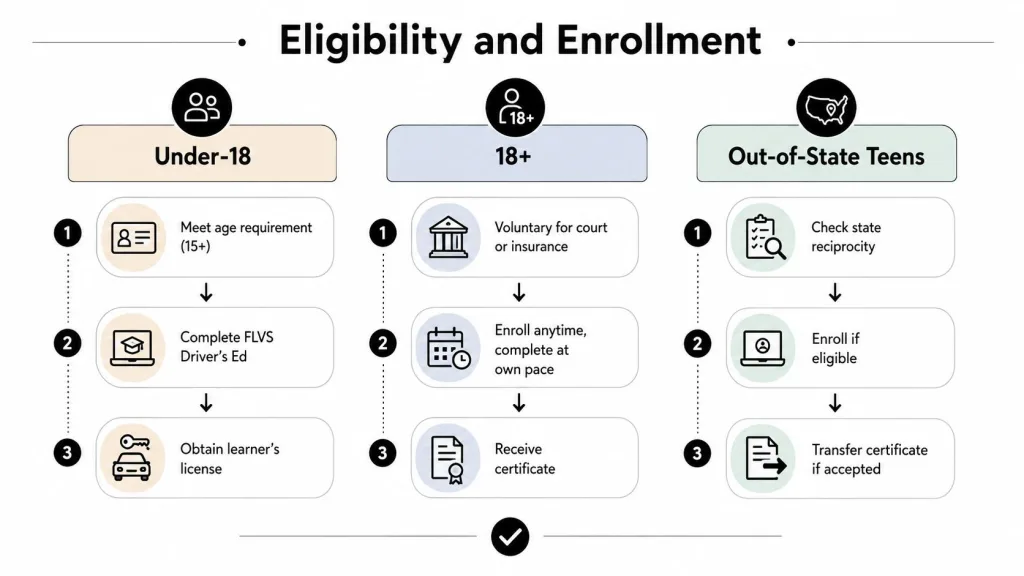
The enrollment flow is straightforward once you stop overthinking it. Create an FLVS account, verify Florida residency, choose a start date, complete the online modules, and then move into the licensing steps through FLHSMV.
For families who want a private-school version of the same kind of digital enrollment flow, the online driving certificate process is worth reviewing because it shows how certificate-based completion usually works in a structured course path.
Online Modules vs Behind-the-Wheel Time
A parent signs up for FLVS thinking the hard part is the online class. Then the real work starts. The course covers the classroom side, while behind-the-wheel training sits in a separate lane, and families need to treat them that way from the start. The Florida Safety Council’s process lays out the order clearly, the online course comes first, the certificate moves the student into the next phase, and behind-the-wheel lessons are scheduled after that through a participating Florida driving school.
| Component | Provider | Format |
|---|---|---|
| Driver education course | FLVS | Online modules, quizzes, final exam, completion certificate |
| Behind-the-wheel lessons | Participating Florida driving school | In-car instruction |
| Parent supervised driving | Parent or guardian | Logged practice hours |
| Licensing test steps | FLHSMV | Knowledge and document checks |
That table is the part most parents need to see, because it shows where the time goes. FLVS only handles the seat-time and certificate side. The family still has to manage the 50 supervised hours, and that is where the calendar starts filling up fast.
The behind-the-wheel piece is its own problem to solve. If you want a clear breakdown of that step, start with the behind-the-wheel test page and then decide whether your teen is ready for in-car instruction or still needs more practice with a parent first.
If you’ve ever wondered how tech can help explain all the little in-car steps, the in-car voice assistants guide shows how much modern driving now involves more than steering and braking, even though the teen course itself stays focused on licensing basics.
Here’s the honest version. FLVS is one leg of a three-leg journey. You still need online course completion, logged parent practice, and a separate behind-the-wheel setup before the process feels finished.
Practical rule: if you only budget time for the online course, you are underplanning.
How It Stacks Up Against Private Florida Courses
FLVS and private Florida-approved courses are not the same product, and parents waste time when they pretend they are. FLVS is free for Florida residents and designed for teens who can move through a school-style course with parent support. Private providers like BDISchool and DriverEducators.com serve a different job, especially when the timeline is tight or the need is tied to a ticket, court order, or insurance requirement.
| Criterion | FLVS | Private Florida-Approved Courses |
|---|---|---|
| Cost | Free for Florida residents | Paid |
| Speed | Self-paced, but still module-driven | Usually faster enrollment and a shorter path to certificate |
| Certificate turnaround | Electronic and reported to FLHSMV | Electronic and reported to FLHSMV |
| Language support | English-primary | English, Spanish, Portuguese |
| Best fit | Teens with flexible schedules and a parent who can log hours | Adults needing point dismissal, insurance discounts, court-ordered BDI or IDI, or a tighter timeline |
That’s the honest split. FLVS works when the family can absorb the pace and handle the supervising-driver piece. Private courses make more sense when the goal is speed, a specific adult requirement, or less friction at registration.
I’d say this bluntly at the counter. If you’re a parent with a teen and you’ve got time to manage the process, FLVS is fine. If you’re an adult trying to solve a deadline, a citation, or a court issue, stop forcing a teen-style school course to do an adult traffic-school job.
Where Families Get Stuck and How to Avoid It
Most headaches start with bad timing. Families wait too long, the certificate isn’t ready by license day, and then everyone acts surprised when the appointment doesn’t work out. The fix is boring but effective, start early and build backward from the date you want the license step to happen.
The common failure points
- Starting too late: The cause is simple, the family treats the course like an afterthought. The fix is to begin the course 6 to 8 weeks before the target license date.
- Assuming online means complete: The cause is thinking FLVS replaces practice driving. The fix is to schedule behind-the-wheel lessons separately and keep the parent log going.
- Arriving without documents: The cause is waiting until the DMV step to check paperwork. The fix is to pre-stage ID, vision, hearing, and residency documents before the appointment.
- Underestimating the supervised hours: The cause is treating the 50 hours like a loose suggestion. The fix is to log practice consistently, including the 10 night hours.
- Misreading self-paced as instant: The cause is assuming online equals immediate completion. The fix is to treat the course like a real school requirement with completion checkpoints.
If you want a quick checklist you can put on the fridge, use this one. Start the course early, confirm the behind-the-wheel provider is FLHSMV-listed, and gather every document before license day. That takes the drama out of the process.
Your Next Step and Which Course to Pick
If your student is 15 to 17, you’ve got a parent who can log the hours, and your timeline is relaxed, choose FLVS Driver’s Ed first. It’s the right fit for the school-based path, and it gets the online seat time done before you move into the separate driving steps.
If you’re an adult with a moving violation, a court order, an insurance requirement, or you just need this handled quickly, skip the teen-style path and enroll in a private Florida course instead. The practical options are BDISchool and DriverEducators.com, where you can choose courses such as Basic Driver Improvement, Intermediate Driver Improvement, Aggressive Driver Course, or Mature Driver Course.
The decision is simple. Pick the path that matches your deadline, register today, and finish before the next ticket or the next license milestone.
BDISchool offers Florida-approved online driver courses for adults and families who need a clear, fast path to completion. If FLVS isn’t the right fit for your schedule, visit BDISchool and choose the course that gets you to the finish line without extra delay.