$158 is the Florida red-light camera notice amount, and it comes with 0 points on your license. The cheap part is the number printed on the envelope, the expensive part is everything that happens if you wait, miss deadlines, or turn it into a bigger record problem.
You’re probably opening that notice at the kitchen table, wondering whether this is just a nuisance or a real headache. Treat it like a real headache. The ticket itself is only the first bill, because late charges, collections pressure, insurance questions, and repeat-offender fallout can make the true running a red light camera ticket cost a lot higher than the headline amount. If you want to keep the damage contained, move fast and read the notice like it matters, because it does.
What a Red Light Camera Notice Costs in Florida
The first number people notice is the dollar amount, and in Florida that figure is usually $158 for a red-light camera notice, with 0 points on the license. That is the part most drivers focus on, then they relax too soon. A civil notice looks minor, so they assume paying it ends the problem.
The smarter move is to examine the full financial impact from the moment the envelope arrives. A red-light camera notice is a civil penalty against the vehicle owner, not the same kind of case as an officer-issued moving violation under Florida law. The state uses this process to collect revenue efficiently, which is why the initial cost appears smaller than the actual total expense if you delay or ignore it.
Practical rule: Don’t judge a camera ticket by the first number you see. Judge it by what happens if you ignore it, miss the deadline, or let it sit until the balance grows.
That is where drivers get burned. There is the base notice, the response deadline, the cost of delay, and the risk of extra administrative trouble if the case goes unresolved. If you care about what this does to your insurance, read the insurance tips from Mai & Associates and handle the notice quickly, because the premium headache often shows up after the payment, not before it.
If you want the cleanest read on whether the citation is treated like a moving offense or a mailed civil notice, start with this explanation of a moving violation in Florida. That distinction matters because it changes what the ticket can do to your record, your wallet, and how much time you lose dealing with it.
The lesson is simple. The envelope is not the whole bill. It is the first charge in a process that stays manageable if you act right away, or turns into a more annoying expense if you sit on it.
How a Camera Ticket Differs From a Moving Violation
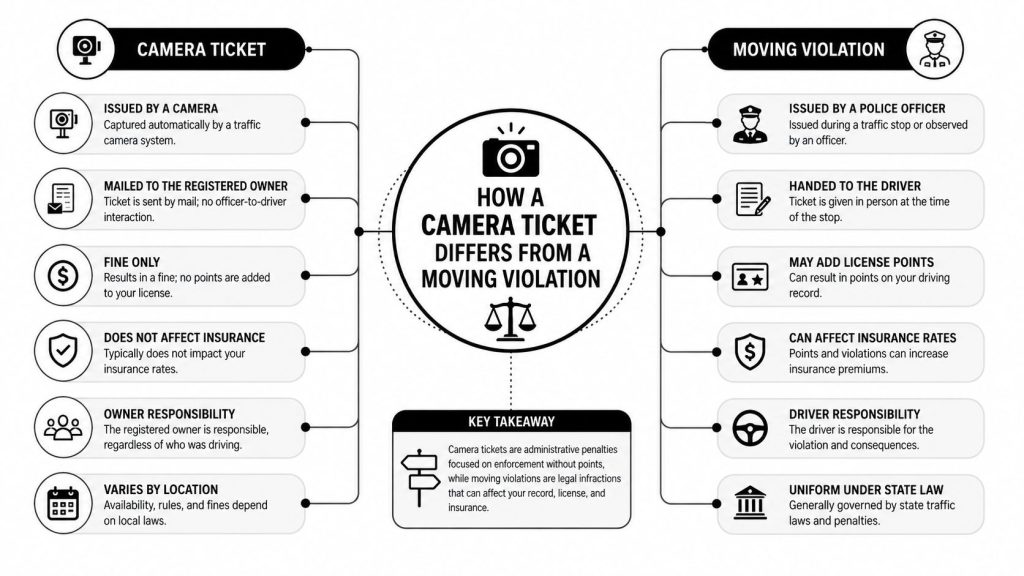
A camera ticket and a moving violation are not the same animal. That distinction drives the whole strategy, because one follows the vehicle owner, while the other follows the driver who was stopped or cited by an officer.
Who gets the notice
In a camera case, authorities mail the notice to the registered owner. That matters when the car was borrowed, leased, rented, or driven by someone in the household who wasn’t the person opening the envelope.
Florida drivers who want the legal definition should read the state-specific explanation of a moving violation in Florida. A camera notice usually has no roadside interaction, no stop, and no officer deciding the case on the spot.
Why points matter more than people think
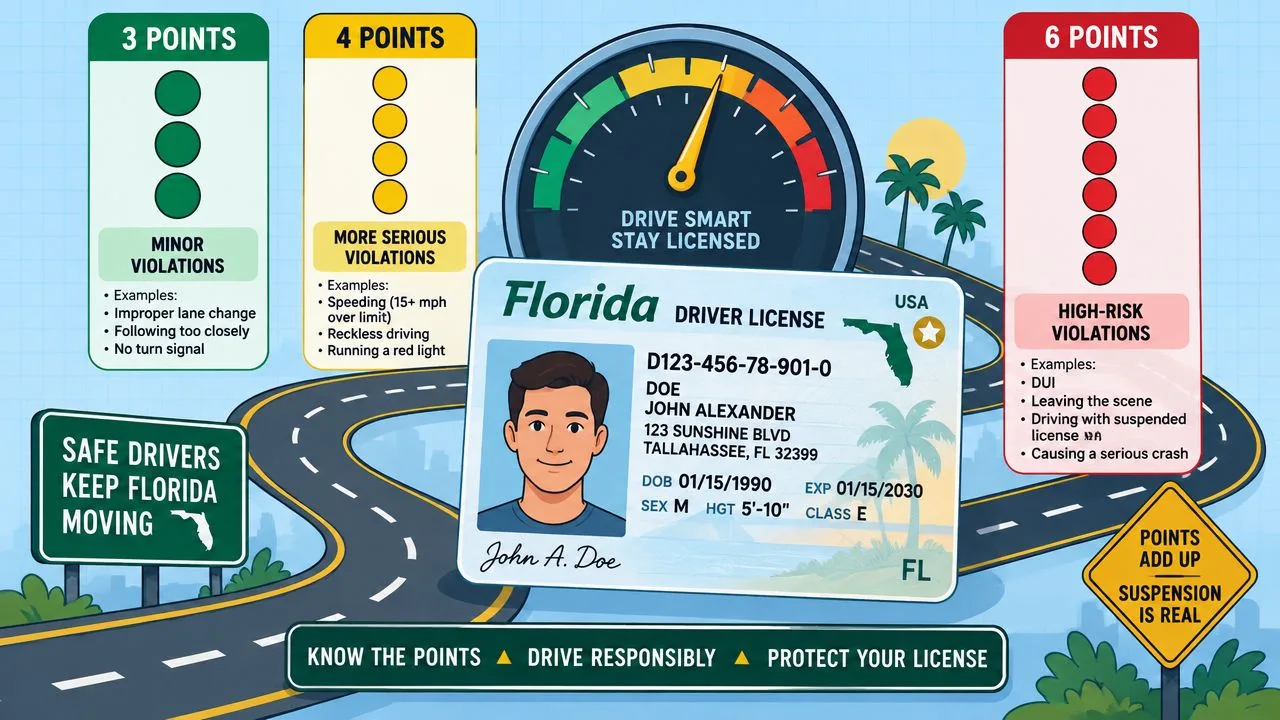
The difference is what the ticket does to the driving record. A camera notice in Florida is generally a civil fine with no points, while an officer-issued moving violation can bring points, court costs, and insurance consequences. That’s why two tickets that look similar on paper can lead to very different outcomes in the world.
A driver who confuses a camera notice with a moving violation usually makes the wrong decision first. That first mistake often costs more than the ticket itself.
If you’re deciding whether to pay, contest, or take a course, start with one question. Is this a mailed camera notice or an officer-issued citation? If it’s the camera notice, your immediate goal is containment. If it’s a moving violation, your immediate goal is protecting the record.
Red Light Camera Costs Across Major Jurisdictions
Open the envelope and you see one number. That is the trap. Drivers focus on the headline amount and overlook the full bill that comes later, allowing a red light camera ticket cost to grow into a much bigger expense once fees, penalties, and local rules add to the total.
| Jurisdiction | Base Fine | Late or Added Fees | Driver Points |
|---|---|---|---|
| Florida | $158 | Added charges can grow the balance if ignored | 0 for the camera notice |
| New York City | $50 | $25 penalty if unpaid after 30 days | 0 |
| California | About $100 | Can rise to roughly $490–$550 after mandatory surcharges and county fees | Varies by enforcement type |
| Toronto | $260 set fine | $60 victim fine surcharge, $8.25 plate-access fee | Not presented like a U.S. points case |
| Oregon | Up to $1,000 | Higher local exposure depending on the violation | Varies by local enforcement |
New York City’s flat $50 camera violation and Florida’s $158 notice show how civil systems can keep the base amount low while still enforcing the rule (NYC camera program). Florida drivers who want a local breakdown should also look at the Tampa red light camera guidance at BDISchool’s Tampa red light cameras page, because the practical cost is never just the number printed on the notice. California is the cautionary example, because the sticker price can balloon after mandatory state and county charges (Consumer Shield comparison).
Toronto is useful because its total is already fee-inclusive, with $260, a $60 victim fund surcharge, and an $8.25 plate-access fee (Toronto red light cameras). Ontario shows the same idea in even plainer form, since its total is $325 made up of a $260 fine, a $60 victim fine surcharge, and $5 in court costs (Ontario ticket cost breakdown).
The takeaway is blunt. Florida’s $158 is not the floor for every state, and it is not the ceiling either. If you drive across state lines, or you recently moved, do not assume the fine structure follows one national template. It does not.
Deadlines, Late Fees, and the Cost of Waiting
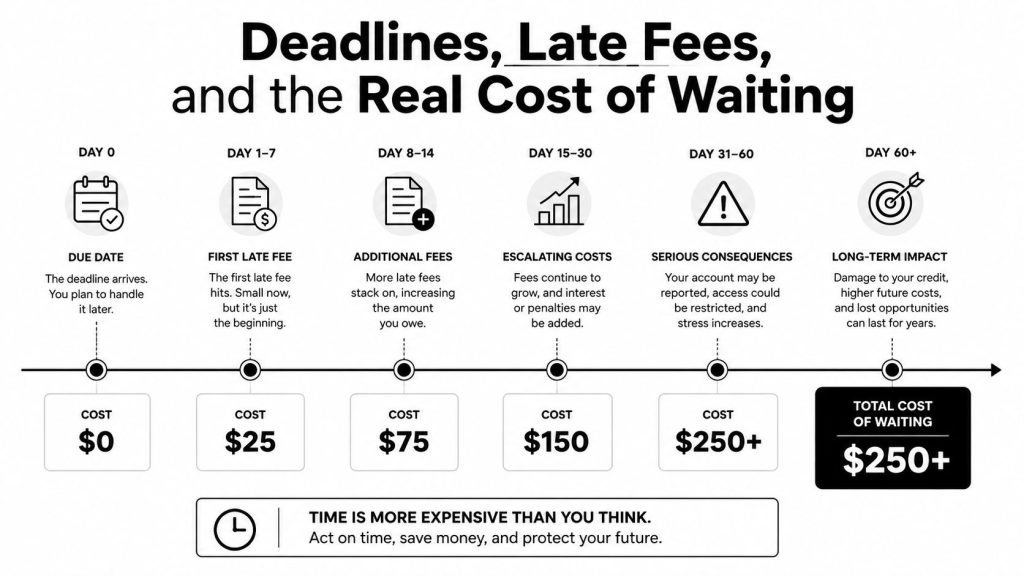
Waiting is where a cheap notice turns stupidly expensive. In Florida, the useful clock starts the moment you open the envelope, not when you feel like dealing with it.
What happens inside the 30-day window
Florida’s camera notice process gives you a response window, and ignoring it triggers added penalties. New York City’s review materials show a $25 penalty if a camera notice is not responded to within 30 days, and Florida’s process follows the same basic rule, if the owner does nothing, the amount keeps moving upward (NYC camera program review).
The original notice remains the original notice, but ignoring it can quickly increase the balance, and a second notice can raise the amount to about $262 (Florida red light ticket overview).
At that point, you are no longer dealing with a small civil annoyance. You are dealing with a self-inflicted fee problem.
The choices you have
Your options are plain. Pay the notice, request the available hearing process, or submit the paperwork that shifts responsibility if someone else was using the vehicle. The right choice depends on who drove the car, whether the authorities correctly linked the plate to the car, and whether they properly issued the notice.
If you want to understand how long the government has to keep pushing the issue, read the statute of limitations on traffic tickets. Do not use that as a reason to stall. Use it to understand that deadlines cut both ways.
The cheapest resolution is usually the one you make before the ticket starts growing teeth.
The lesson is simple. A camera notice is manageable on day one, annoying on day thirty, and a bad decision after that. Handle it fast or pay for the delay.
How to Contest a Red Light Camera Ticket Successfully
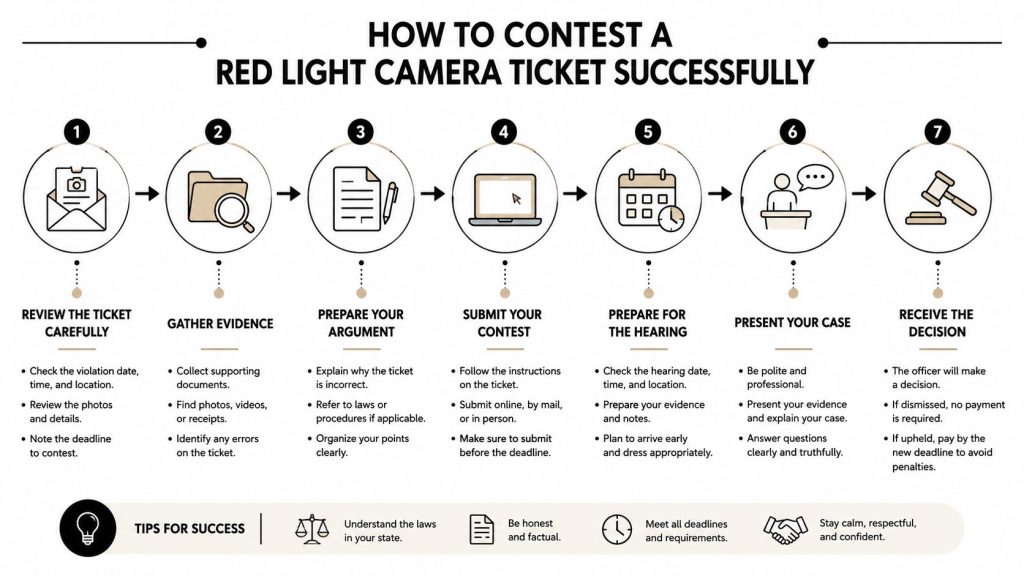
A camera notice is contestable, but only if you treat it like a paperwork fight, not a rant. Judges and hearing officers do not care that you felt rushed, annoyed, or believed the intersection had a poor design. They care about proof, procedure, and whether the notice can survive scrutiny.
What strengthens your case
Start with the facts that can change the outcome. Bad signage, a blocked view, a camera record problem, or a paperwork issue tied to the car’s ownership can matter. If someone else was driving, the affidavit process can also move responsibility to the right person.
Weak claims waste time. “I didn’t know the camera was there” is not a defense. “I was only a little past the light” is not a defense either, because the system is built around the recorded violation, not your version of the moment.
Contesting without gambling everything
Request the hearing and handle the education side at the same time. That is the smarter move for a lot of Florida drivers, because a clean hearing request and a state-approved course can work together instead of competing with each other.
If your case is weak, a course gives you a practical fallback. If your case is strong, the course still helps you keep a simple notice from turning into a bigger administrative headache. That is the kind of move that saves real money, because the envelope you opened does not just carry a fine, it can lead to fees, insurance trouble, points, and wasted time. A Florida-approved course like the Florida Basic Driver Improvement course online gives you a concrete way to contain the damage while you sort out the ticket.
Why a Florida BDI Course Pays for Itself
A Florida-approved Basic Driver Improvement, or BDI, course is the most useful move most drivers can make after a traffic notice, because it gives you a concrete way to protect the record instead of hoping the problem goes away. BDISchool offers a Florida Basic Driver Improvement course online at this course page, and that matters because convenience is part of the strategy when time is already working against you.
What the course actually does
For eligible moving violations, BDI is the course that helps drivers address points and conviction consequences. It’s also the cleaner choice when a court requires traffic school, because the process is meant to resolve the citation without turning it into a long-term licensing mess.
BDI is not the same thing as wishful thinking. It is a formal defensive-driving option, and in Florida’s system that makes it a serious tool, not a last-minute gimmick. If you’re facing repeat problems or a tougher court order, the 8-hour Intermediate Driver Improvement or 8-hour Aggressive Driver options exist for deeper correction, while the shorter BDI course is the common first move.
Why I’d take the course early
Drivers lose money when they wait to see what happens. They also lose time, and time matters when the notice has a deadline attached to it. The cleanest move is to enroll early, complete the work, and report your certificate correctly so you don’t have to chase to chase paperwork later.
Don’t buy the myth that paying the ticket is the simplest choice. The simplest choice is the one that stops the ticket from multiplying into a record problem.
For busy drivers, online delivery is the whole point. A self-paced course in English, Spanish, or Portuguese is easier to finish than a courthouse run after work, and that convenience keeps people from missing the window entirely. If you want one action that contains the fallout, this is it.
Your Step-by-Step Action Plan After the Notice
Open the notice and read every line before you do anything else. Check the owner name, the response deadline, and whether the case is a camera notice or a sworn officer-issued citation.
Then decide your lane. Pay it if the notice is valid and you just want it closed, contest it if the facts give you a real defense, or submit the ownership paperwork if someone else should be responsible. If the case is eligible for school, enroll right away, finish the course, and keep the completion proof in your records.
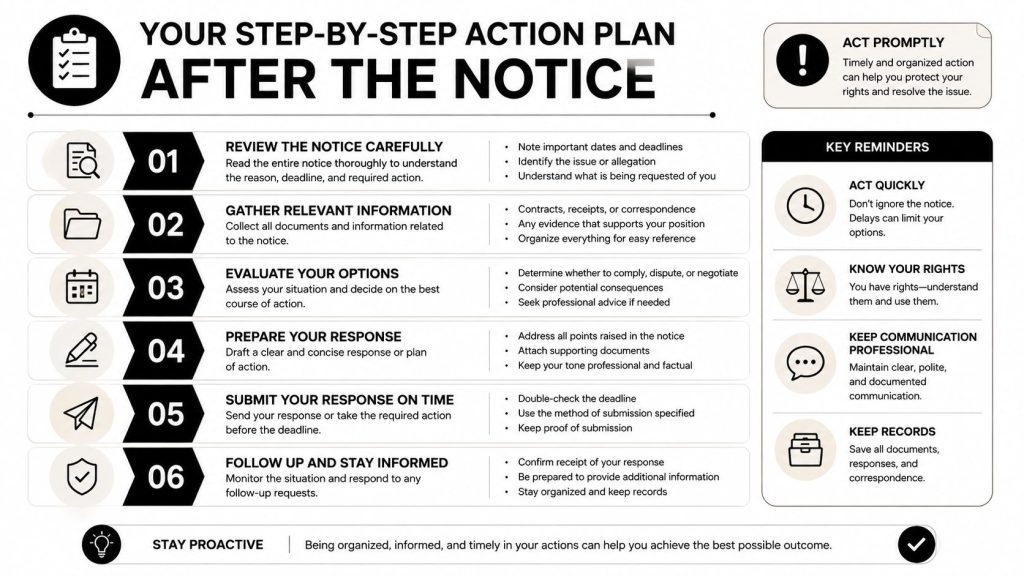 If an officer issued the notice, if the violation adds points to your license, or if the court has already ordered a specific response, bring in a traffic attorney instead of guessing. That’s the line where do-it-yourself turns into expensive mistake territory.
The rule is simple. Respond inside the window, protect the record, and don’t hand the system extra money by ignoring paper that already landed in your mailbox.
Frequently Asked Questions About Red Light Camera Tickets
Who pays if the car was borrowed or leased? The registered owner usually gets the notice, even if they weren’t the driver. If someone else was responsible, handle the ownership paperwork fast.
Do camera tickets affect insurance? A camera notice with no points is less likely to move premiums directly, but the risk comes from the record, the follow-up, and any officer-issued violation tied to the same event.
Can a Florida-approved BDI course help? Yes, for eligible cases, it’s the most practical way to protect the driving record and keep the problem from spreading into a longer-term headache.
How long does the notice matter? Long enough to hurt you if you ignore it. The response window is the part that matters most, because delay is where penalties and administrative trouble start.
If you want to keep this from becoming a bigger bill than it already is, handle it now. Visit BDISchool to look at the Florida-approved courses, choose the one that fits your notice, and get the certificate process moving before the deadline does the damage for you.