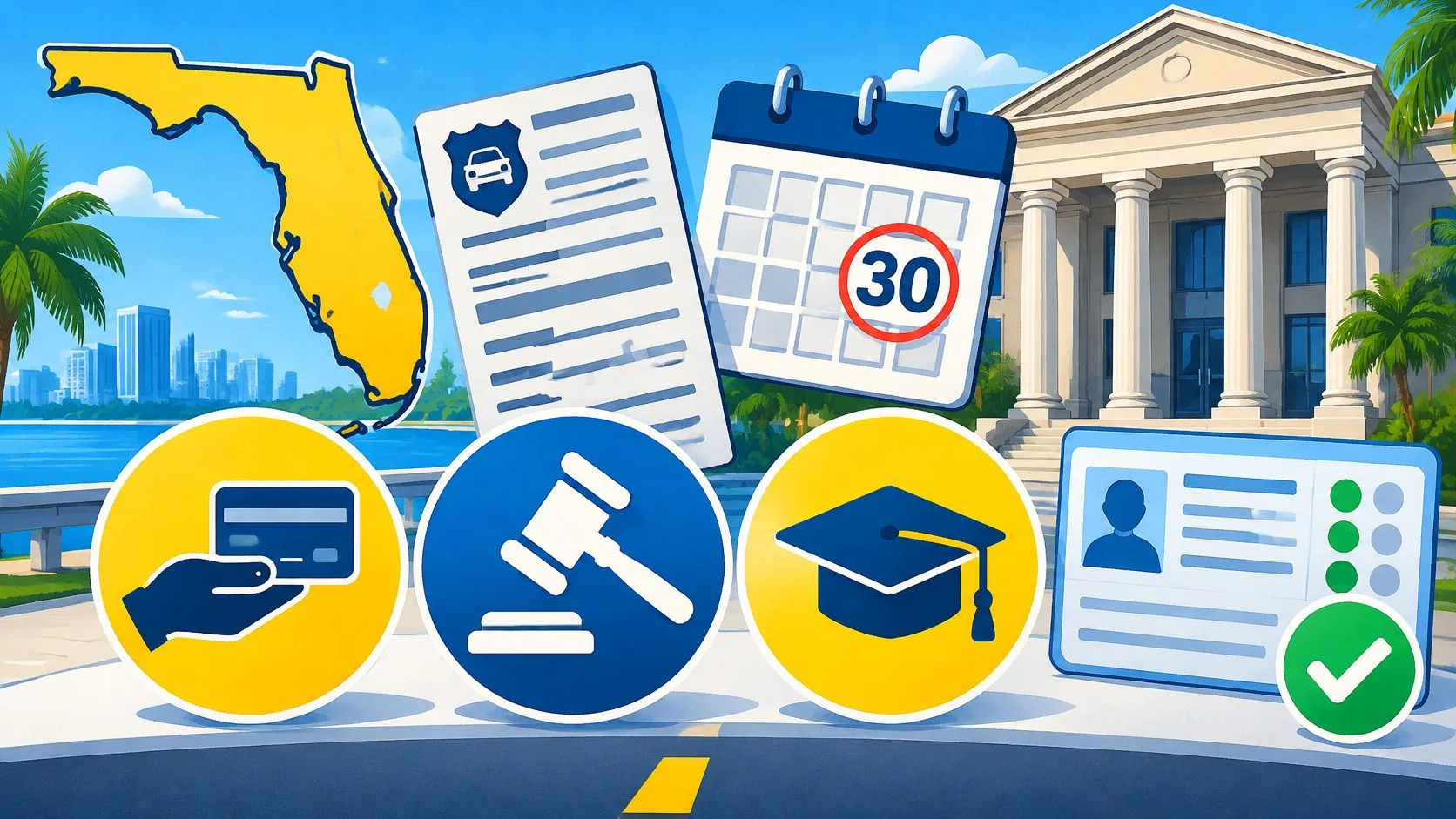
A Florida speeding ticket generally brings a warning at 1 to 5 mph over the limit, a $25 base fine starting at 6 mph over, and a $250 base fine at 30 mph or more over, with most school zone fines doubled. Those numbers only cover the ticket itself, not the points or insurance costs that can follow.
That distinction matters because speeding in Florida is not a rare, minor problem. Florida recorded 3,138 traffic fatalities, including 360 fatalities in crashes classified as speeding-related, approximately 11% of all Florida traffic deaths, according to NHTSA's 2024 state table. Officers and courts therefore treat your speed band, your location, and your record seriously.
Treat every citation as three separate costs. You have the fine printed on the ticket, the points that may go on your license, and the premium your insurer may charge later. One decision, made before the deadline on your citation, can control all three.
Florida Speeding Fines by Miles Over the Limit
Find your speed band first. That's the fastest way to know what you're dealing with, because Florida's base fine rises as your speed above the posted limit rises. Don't guess from what a friend paid in another county or from an older ticket.
Under Florida Statutes §318.18, driving 1 to 5 mph over generally results in a warning, 6 to 9 mph over carries a $25 fine, 10 to 14 mph over carries $100, 15 to 19 mph over carries $150, 20 to 29 mph over carries $175, and 30 mph or more over carries $250. A citation for up to 5 mph over in a legally posted school zone carries a $50 fine instead of a warning, and fines for speeding in a school zone or designated school crossing are doubled.
The Fine Ladder at a Glance
| Miles over the limit | Base fine | School zone amount |
|---|---|---|
| 1-5 mph | Warning | $50 fine |
| 6-9 mph | $25 | $50 |
| 10-14 mph | $100 | $200 |
| 15-19 mph | $150 | $300 |
| 20-29 mph | $175 | $350 |
| 30 mph or more | $250 | $500 |
Use the table in order. First, subtract the posted limit from the speed listed on your citation. Second, check whether the officer marked a school zone or designated school crossing. Third, remember that court costs and fees are added on top of the base fine, so the amount you pay will be higher than the ladder amount.
Worked Example for a School Zone
Say you're cited for 52 mph in a 35 mph school zone. You're 17 mph over, which places you in the 15 to 19 mph band. The base fine for that band is $150, and the school zone doubles it to $300 before added costs and fees.
Practical rule: Location can matter as much as speed. Read the location box on your citation before you assume the base fine is your total.
Drivers often focus only on the miles over the limit and miss the school zone marking. That's an expensive reading error. If you're unsure which limit applied on that road, review Florida's speed limit rules and compare them with the road, time, and location written on your ticket.
Don't pay until you've checked those details. Paying quickly may feel responsible, but it can close off options that affect points and insurance. Your first job is simple. Confirm your band, confirm the location, and write down the deadline. Then decide how to respond with the full cost in view, not just the fine.
Points and License Suspension Thresholds
Points attach to your driving record, not to your wallet. You can pay a fine in full and still carry the points afterward. That's why a ticket that looks cheap on the day you pay it can become expensive months later.
The Florida Highway Safety and Motor Vehicles point schedule lists ordinary speeding as 3 points, speeding more than 50 mph over the lawful or posted speed as 4 points, and speeding that results in a crash as 6 points. It also states that 12 points within 12 months triggers a 30-day license suspension, 18 points within 18 months triggers a 3-month suspension, and 24 points within 36 months triggers a 1-year suspension.
How Points Stack
| Trigger | Points or suspension | What it means |
|---|---|---|
| Ordinary speeding | 3 points | Standard moving violation |
| Speeding more than 50 mph over | 4 points | Higher-level speeding violation |
| Speeding that results in a crash | 6 points | Crash-linked violation |
| 12 points within 12 months | 30-day license suspension | First suspension threshold |
| 18 points within 18 months | 3-month license suspension | Repeat-violation threshold |
| 24 points within 36 months | 1-year license suspension | Serious accumulation threshold |
Now run the math on a common pattern. Two ordinary speeding tickets add 6 points. Add one speeding violation that results in a crash, worth another 6 points, and you're at 12 points inside 12 months. That combination reaches the first suspension threshold.
That's how drivers get surprised. They judge each ticket in isolation and call it minor. The state doesn't look at your record that way. It looks at the accumulation over time, and several so-called minor tickets can stack into a suspension.
Count Before You Respond
Total your current points before you answer a new citation. If you're already carrying points, a new ordinary speeding ticket matters more than it would for a driver with a clean record. Read the license suspension point thresholds and place yourself on the scale before you choose.
Points also affect money beyond the fine. Insurers review violations and driving records when they price policies, so points can influence what you pay even while your license remains valid. Protecting your record protects both your driving privilege and your budget.
Don't ask, "Can I afford this fine?" Ask, "Can my record afford these points?" The second question gives you the better decision.
What a Speeding Ticket Does to Your Insurance
Your insurer prices risk from your driving record. A moving violation tells the company that you're more likely to file a claim, so it may raise your premium at renewal. That's the third cost of a ticket, and it's often the largest one.
There's no single increase that applies to every Florida driver. Your carrier will consider the violation, your prior record, your policy, and its own rating rules. Two drivers with the same ticket can see different results, which is why you shouldn't rely on a neighbor's renewal notice as your forecast.
A Simple Cost Comparison
Use a hypothetical example to see the scale. You pay a $150 ticket, then your premium rises by $25 a month for three years. That increase adds $900 over the period, making the premium cost six times the fine itself.
Even if your increase is smaller, the logic holds. A fine is paid once. A premium increase repeats month after month, so a modest monthly change can overtake the amount written on the citation.
Check Your Policy Before the Deadline
Call your insurer or review your policy documents now, while you still have choices.
- Ask about reporting: Ask whether the citation will appear in the record your insurer reviews.
- Ask about a surcharge: Ask whether this violation triggers a surcharge and how long it lasts.
- Compare real costs: Put the expected premium increase beside the fine and any eligible traffic school cost.
- Decide before time expires: Make your choice before the deadline on your citation, because your response affects whether points are added.
Our guide to points and car insurance helps you frame those questions for your carrier. Don't wait for a renewal letter to learn the answer. By then, the deadline that controlled your record may already have passed.
The point isn't to panic about insurance. It's to price the whole ticket before you pay any part of it. Once you compare the fine with the possible premium effect, the value of protecting your record becomes much easier to see.
Dangerous Excessive Speeding and Criminal Penalties
Some drivers assume every speeding case ends with a payment and points. Florida law says otherwise. At extreme speeds, you're no longer handling a routine ticket. You're facing a separate offense with court exposure.
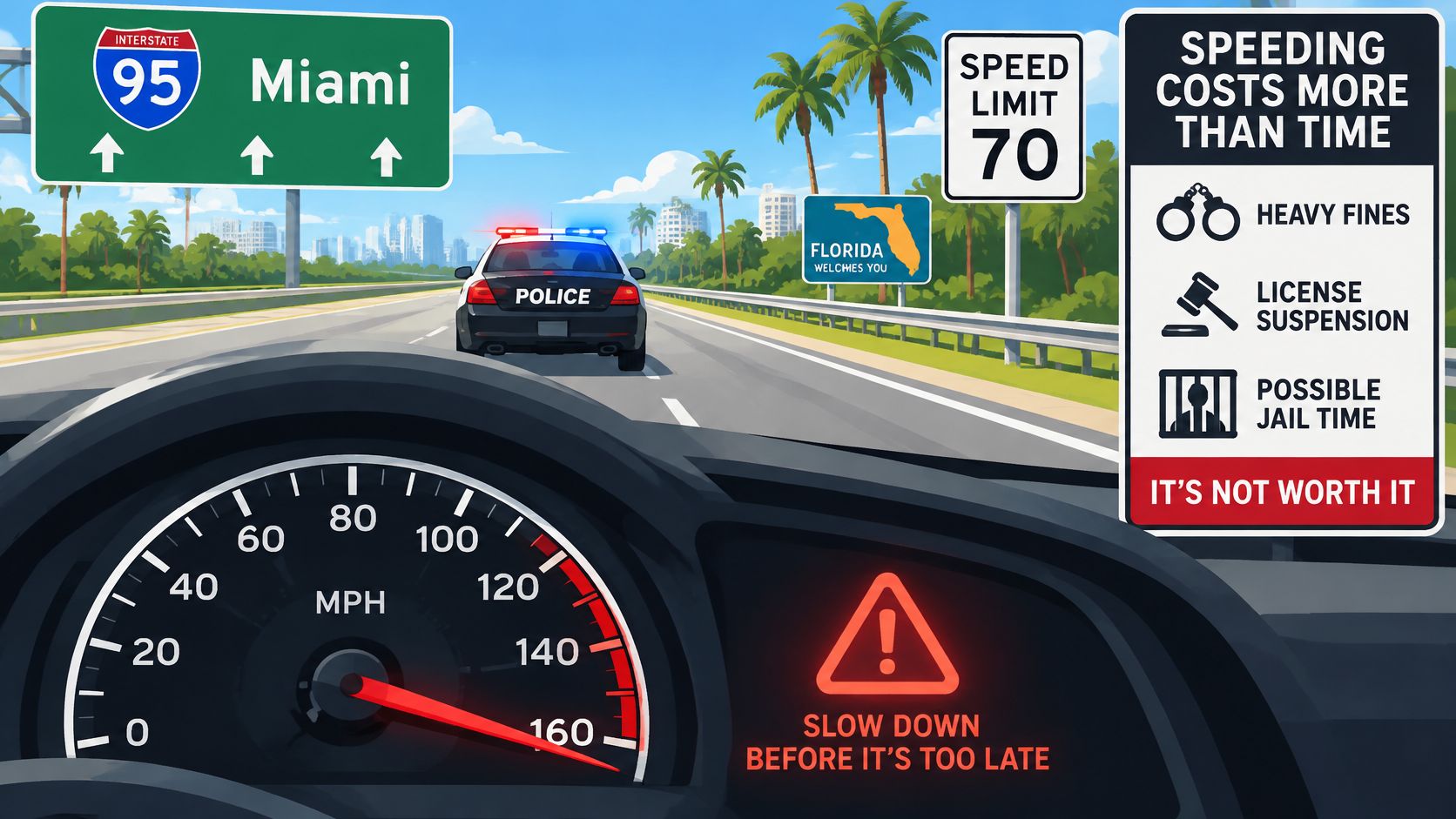
The roadside stop below shows the moment an ordinary drive can turn into a serious legal problem.
The Two Thresholds
Under Florida Statutes §316.1922, dangerous excessive speeding applies when a driver travels at least 50 mph over the posted limit, or travels at 100 mph or more in a manner that threatens people or property or interferes with another vehicle's operation. A first conviction may result in up to 30 days in jail, a $500 fine, or both, while a second or later conviction may result in up to 90 days in jail, a $1,000 fine, or both. If a subsequent conviction occurs within five years of a prior conviction, the driver's privilege must be revoked for at least 180 days and no more than one year.
Think of an ordinary ticket as a receipt you settle and move past. This offense is a court case. A judge, a hearing, and possible jail time replace the simple pay and go routine.
For example, 85 mph in a 35 mph zone is 50 mph over the limit. That meets the first threshold. You don't need a crash for the charge to become serious.
The short video below gives you a visual reminder of how quickly speed narrows your reaction time and options.
If You're Charged
Act like it's a criminal traffic case from day one, because that's how the court will treat it.
- Read the exact charge: Confirm the statute and the speed alleged on your citation.
- Protect the court date: Put it on your calendar, arrange time away from work, and never miss it.
- Get legal advice early: Speak with a Florida criminal traffic attorney before your first hearing.
- Preserve your notes: Write down the road, traffic, weather, and anything the officer said during the stop.
Plain advice: Don't try to talk your way out of an extreme-speed charge at the clerk's window. Get counsel, show up prepared, and treat every deadline as final.
School Zone Cameras and Mailed Speeding Notices
A notice in your mailbox is not junk mail, and it's not automatically the same thing as a ticket handed to you by an officer. Open it the day it arrives. The date on that notice starts a clock you can't afford to miss.
Florida permits speed detection systems in qualifying school zones, including installations on state roads when authorized. Under Florida Statutes §316.0776, automated enforcement can apply to speeding more than 10 mph over the school-zone limit during specified periods around breakfast, the start of school, and the end of school, or during the school session for certain speed-limit violations. A notice must generally be sent to the vehicle's registered owner within 30 days, and the recipient has 30 days after the notice date to pay the penalty or submit an authorized affidavit.
Notice Versus Citation
The first document is a mailed civil notice sent to the registered owner. A uniform traffic citation is a different step. If you ignore the notice and miss the response window, the matter can escalate into court fees, added costs, and issuance of that citation.
That difference matters for parents, shared family cars, and out-of-state drivers. The registered owner receives the notice even if another person was driving. If someone else was behind the wheel, use the authorized affidavit process described in the notice instead of telling yourself the ticket belongs to them.
Respond in Four Steps
- Check the notice date: Count your response window from that date, not from the day you happen to open the envelope.
- Confirm the details: Compare the location, time, vehicle, and plate with your own records.
- Choose your response: Pay the penalty or submit an authorized affidavit within the stated period.
- Calendar the deadline: Set a reminder several days early and keep proof of whatever you send.
Also check the mailing address on your vehicle registration. Parents whose children drive a family car and drivers who've recently moved are especially vulnerable to missed notices. A correct address gives you the full response window. An old address can waste it.
Don't ignore a school zone camera notice because no officer stopped you. The process begins by mail, but inaction can turn it into a court matter. Respond on time, keep copies, and treat the envelope with the same urgency you'd give a citation handed through your window.
Common Defenses and When They Hold Up
"I wasn't going that fast" is an argument, not a defense. A defense holds up when you bring evidence a judge can examine. If you plan to contest a ticket, prepare for a hearing and build your proof before you get there.
Drivers raise the same categories again and again. Some can work when the records support them. Others collapse as soon as the officer produces documentation and you have nothing but your memory.
Defenses Drivers Raise Most Often
- Uncalibrated device or untrained operator: Ask whether the radar, lidar, or other measuring device was properly maintained and whether the officer was trained to use it. Maintenance logs and certification records are the evidence that tests this claim.
- Obstructed or missing sign: Photograph the posted limit sign from the driver's approach, showing branches, trucks, construction equipment, or other obstructions. Take wide shots and close shots, and note the date and time.
- Inaccurate speed reading: Challenge a faulty speedometer claim or an officer's pace estimate with repair records, calibration proof, dashcam footage, or location data where available.
- Emergency driving: Bring records that prove a genuine emergency required your speed. A vague claim that you were in a hurry won't carry the same weight.
- Wrong vehicle or driver: Use dashcam video, toll records, witness statements, work records, or vehicle details to show the cited car or driver was misidentified.
Gather evidence while it's fresh. Save dashcam or phone video before it is overwritten. Photograph signs before road crews move them. Write down witness names before you forget who was with you.
Weigh Evidence Against the Cost of Losing
A conviction can add points and affect insurance. Contesting a weak case doesn't make it strong, and missing your court date can make the outcome much worse. Compare the quality of your proof, not the strength of your frustration, with what a loss would cost your record.
Our guide on fighting a speeding ticket in Florida lays out the practical preparation. Use it to decide whether your evidence justifies a hearing. If your proof is thin, be honest about that now, while other options may still be open.
Bring records, photos, footage, and witnesses the court can test. Confidence alone doesn't rebut a speed measurement.
The right question is not whether you dislike the ticket. It's whether you can prove a specific problem with the stop, the device, the sign, the identification, or the circumstances. If the answer is yes, organize it. If the answer is no, choose a response that protects your record instead of gambling on a hearing.
Choose the Option That Protects Your Record
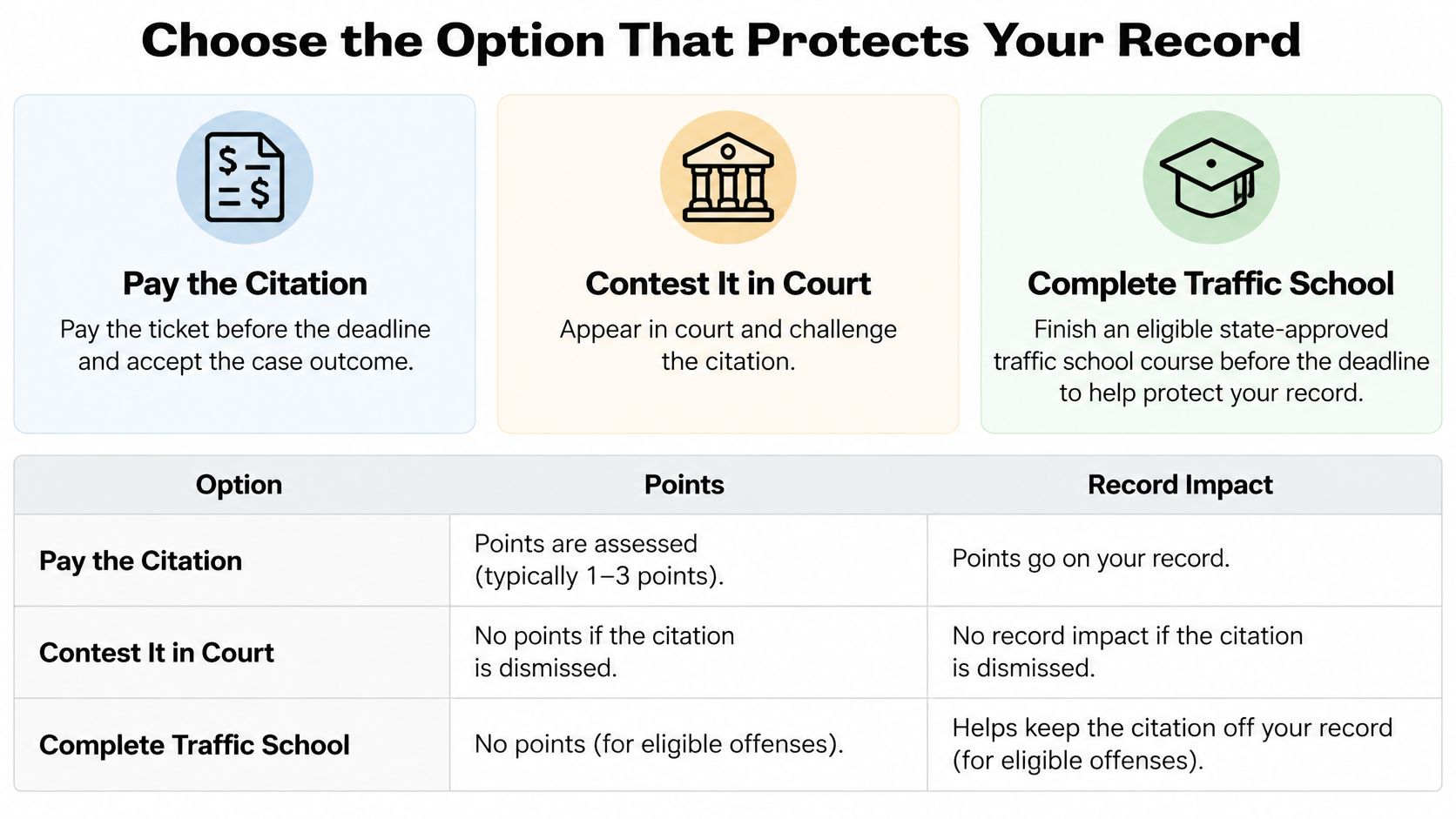
You have three broad paths. Pay the citation, contest it in court, or complete an eligible state-approved traffic school course before the deadline. For many drivers with a recent moving violation and no strong defense, the course is the option I'd recommend first.
The comparison below puts the record consequences side by side.
| Option | Points impact | Insurance impact | Best for |
|---|---|---|---|
| Pay the citation | Points added (3 for ordinary speeding) | Possible rate increase | Drivers with few prior violations |
| Contest in court | Points added only if convicted | No increase if you win, possible increase if convicted | Drivers with strong, documented evidence |
| Basic Driver Improvement course (Florida Four-Hour Traffic School) | Points avoided | No rate increase due to the moving violation | Drivers with a recent moving violation |
Decision Checklist
- Confirm your deadline: Read the citation date and check whether you're eligible for a driver improvement course.
- Compare consequences: Weigh the points and insurance impact of each option against the evidence you have.
- Register early: Enroll before any court or traffic school deadline on your citation.
- Keep proof: Save your completion certificate and any confirmation you receive.
Florida's Basic Driver Improvement Course, also called Florida Four-Hour Traffic School, is designed for drivers who received a moving violation. The course helps drivers avoid points on their driver license, and completing it results in no insurance rate increase due to the moving violation.
Start at our Florida courses page or DriverEducators courses before the deadline on your ticket. Confirm your eligibility before enrolling, because the course is available only to drivers who meet the state's conditions. Ask your carrier about your policy as well, then register while the choice is still yours.
Paying the fastest bill isn't always the cheapest outcome. Choose the option that protects your license, your record, and your premium together.
If you've received a moving violation, BDISchool offers Florida's Basic Driver Improvement Course so eligible drivers can act before points and insurance consequences set in. Visit today, check your eligibility, and register for the course that fits the deadline on your citation.