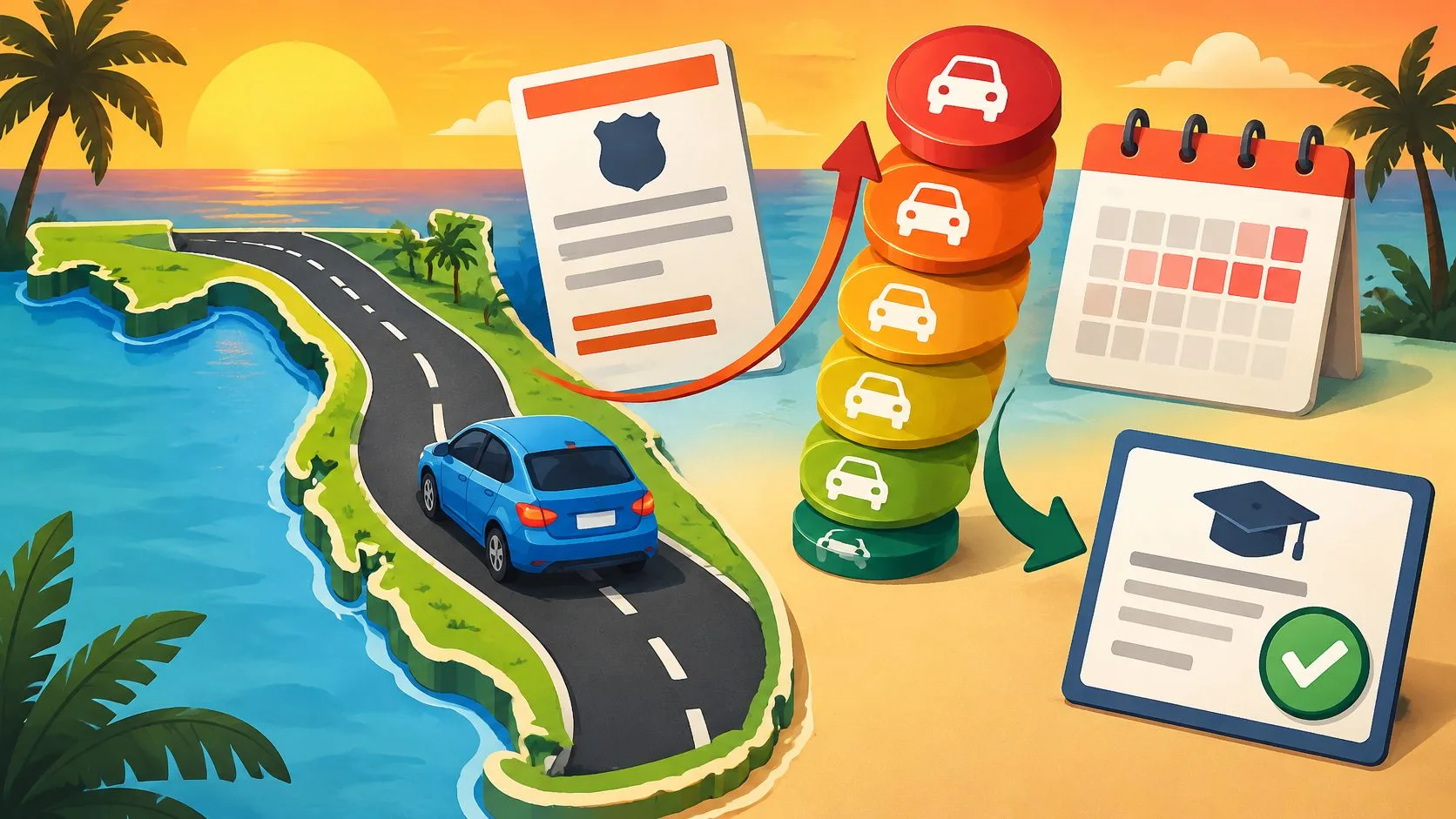
You’ve got a Florida traffic citation on the counter, a payment notice on your phone, and several traffic-school websites promising an easy fix. Before you choose the cheapest class, check what your citation requires. An approved driver education course only helps when it matches your legal purpose, your eligibility, and the court’s instructions.
The right move is to identify the course, confirm approval, and handle the election before you start studying. Buying a course isn’t the same as electing traffic school with the court.
Which Approved Driver Course Matches Your Situation
A wrong election can cost you the traffic-school option and leave you facing points. Choose by legal purpose first, then compare course length, delivery method, and price.
Florida separates first-time licensing education from courses used to address citations, court orders, or license problems. The Florida driver-improvement statute establishes the election framework, including the 30-day election window for an eligible citation.
Florida approved driver courses by situation
| Course | Who Needs It | Length | Deadline or Election | Main Result |
|---|---|---|---|---|
| Basic Driver Improvement (BDI) | Eligible non-criminal moving violation | 4 hours | Elect within 30 days of citation | No points, adjudication withheld, 18% citation-fee reduction |
| Intermediate Driver Improvement (IDI) | Court-ordered or deeper safe-driving training | 8 hours | Set by court order | Court compliance |
| Aggressive Driver Course | Habitual offenders involved in road rage | 8 hours | Set by court order | Court compliance and behavior change |
| Mature Driver Course | Drivers aged 55 or older | 6 hours | Complete and submit under insurer requirements | Insurance discount set by each insurer |
| Traffic Law and Substance Education | First-time Florida license applicants | Required licensing-course hours | Before applying for a license | Licensing requirement |
| Driver Education Traffic Safety | Eligible drivers under 18 with no prior license elsewhere | 6 hours | Before applying for a license | Licensing requirement |
BDI is aimed at drivers who recently received a moving violation. It isn’t a substitute for an explicitly ordered IDI, Aggressive Driver, or Advanced Driver Improvement course. If your paperwork says ADI, a suspension-related requirement, or a behind-the-wheel assessment, follow that designation rather than selecting the shortest available class.
Our guide to defensive-driving course hours helps you compare time commitments after you’ve identified the correct category.
Match the paperwork before enrolling
Keep your citation and any court order beside you. Check these details:
- Citation and offense: Confirm whether the violation qualifies for an elective course.
- License status: Identify any suspension, reinstatement condition, or licensing requirement.
- Court instructions: Note the designated course, completion deadline, and filing method.
- Additional obligations: Check for fines, fees, or an assessment that the certificate won’t replace.
Local court instructions control your deadlines and documentation. Course completion alone doesn’t settle a separate payment or filing obligation.
Vehicle repairs are separate, too. If a damaged restraint system is part of your situation, you can find answers about seat belt repairs from Safety Restore while arranging the appropriate inspection or repair.
Find your row before you register anything. If the notice doesn’t clearly match a row, have the clerk identify the required course category first.
What State Approval Means for Your Course
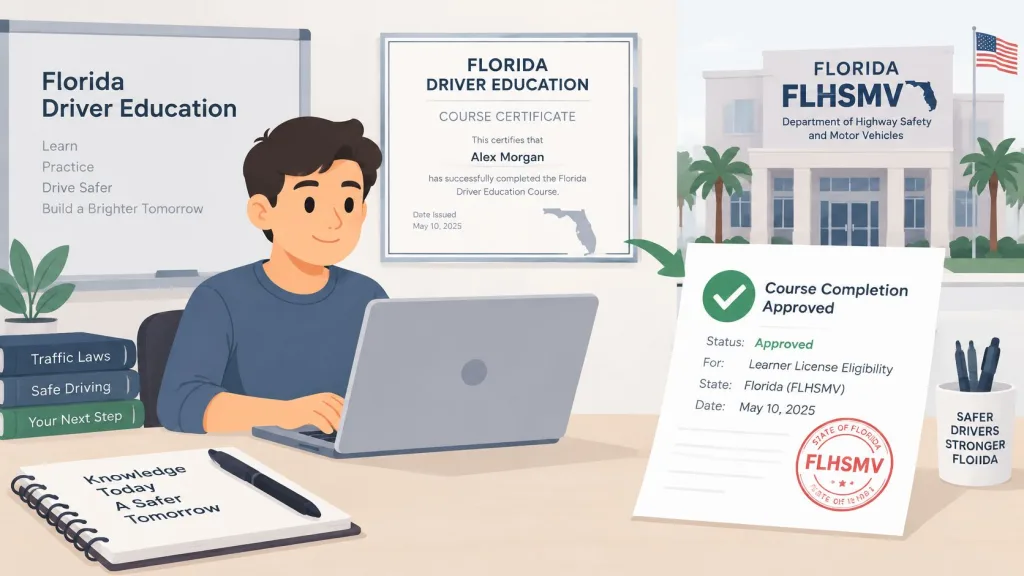
A course is state-approved when the Florida Department of Highway Safety and Motor Vehicles, or FLHSMV, authorizes it for its designated use. Approval is a legal status, not a decorative badge on a checkout page.
The FLHSMV provider-approval guidance requires driver-improvement courses to receive department approval and incorporate its minimum curriculum requirements. Online and distance-learning providers must also demonstrate their course to the department.
Approval applies to the course you’re taking, not to the general subject of safe driving.
The approval checks that matter
- Jurisdictional authorization: The department has approved the school to provide the relevant Florida course.
- Curriculum conformity: The lessons satisfy the department’s requirements for that course category.
- Verifiable completion reporting: The completion record can be checked and used for its intended administrative purpose.
These checks answer different questions. A well-designed curriculum doesn’t establish authorization, and an attractive certificate doesn’t establish that a court will accept it for a particular order.
We’re a Florida HSMV-approved Basic Driver Improvement school, and our course meets the department’s requirements. Its state approval covers Florida courts and counties, but you still need the correct course category and an eligible case.
Approval isn’t interchangeable acceptance
Say your court order requires an aggressive-driving program. A generally related defensive-driving class might cover some similar material, yet still fail to satisfy the order because it isn’t the designated program.
The same distinction applies to licensing education. Don’t assume a citation course fulfills a first-time applicant’s education requirement merely because both teach traffic laws.
Practical rule: Match the official listing to the purpose on your paperwork, not just to the provider’s name.
Check for citation disposition, licensing, or court compliance as appropriate. A claim such as certified, recognized, or accepted isn’t enough without the corresponding authorization.
How to Verify a Course Is Approved Before You Pay
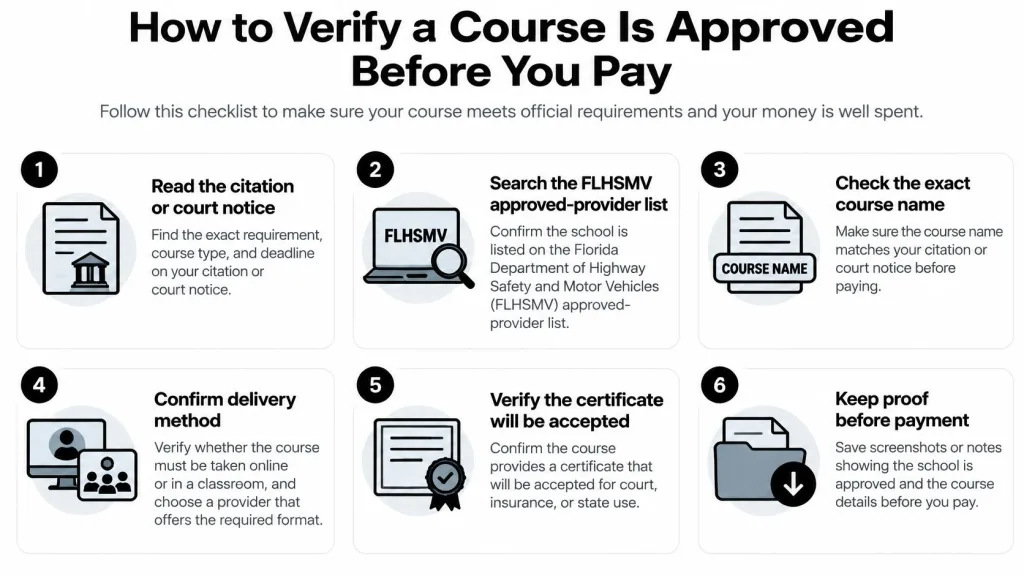
Verify before you pay. Keep your citation open while checking the provider, and record the election date separately from the course-completion deadline.
The FLHSMV education-course guide says eligible drivers must elect BDI within 30 days and generally may use the option only once every 12 months, subject to a lifetime maximum. The clerk should confirm your eligibility before you enroll.
Use this verification sequence
Read the citation or court notice. Identify the exact requirement, course category, election deadline, and completion deadline so you don’t confuse enrollment with court action.
Search the appropriate FLHSMV approved-provider listing. Find the school under the course category you need, rather than relying on a provider’s approval graphic.
Match the course and delivery method. Compare the provider name, course title, instructional length, and online or classroom format against the listing and your court’s directions.
Confirm eligibility with the clerk. Ask the clerk to check your election history, any applicable lifetime limit, and whether your particular citation qualifies.
Check reporting and record retention. Confirm where completion is reported and what you must file yourself; we report completion directly to FLHSMV and retain pertinent student course and completion information for at least seven years.
Review your registration information before payment. Our form asks for your name, driver license information, and email address because those details generate your completion certificate.
Keep this checklist beside your citation while you compare the listing and registration page.
Save evidence of your checks
Save the listing information, the court’s instructions, and your registration confirmation. If the clerk gives you case-specific directions, record the date, the office you contacted, and what you were told.
You should be able to explain your selection in a sentence: this listed provider offers the designated course, in the permitted format, for my eligible case. If you can’t, resolve the mismatch before purchasing.
A confident sales page doesn’t replace an official listing or the clerk’s eligibility check.
Don’t spend the remaining election period comparing small differences between websites. Once the course and your eligibility are confirmed, make the required court election and schedule the coursework.
What an Approved Course Can Protect on Your Record
Properly electing and completing approved BDI for an eligible citation can prevent a conviction and points. That’s the practical reason to handle the court process correctly, not collect a certificate.
The FLHSMV driver-improvement FAQ explains that adjudication is withheld, no points are assessed, and the eligible civil penalty or citation fee receives an 18% reduction, although applicable court costs still apply.
Understand the record outcome
Adjudication withheld means you aren’t convicted of the covered violation for record purposes. It doesn’t mean you can ignore the citation, skip court charges, or treat your completion certificate as proof that every case obligation is settled.
Keep the distinction between the violation and its points outcome clear. Our explanation of Florida traffic citation points can help you understand why the correct election matters to your license record.
The benefit comes from completing the eligible process. Merely opening a course account doesn’t establish that the court has withheld adjudication.
Insurance protection has exceptions
Under the FLHSMV BDI guidance, an insurer generally may not add a premium, cancel coverage, or issue a non-renewal solely because of the covered infraction when adjudication is withheld and no points are assessed; exceptions include a second infraction within 18 months, a third within 36 months, or speeding more than 15 mph over the limit.
Check those exceptions against:
- Your driving history: Review other infractions rather than considering this citation in isolation.
- The alleged speed: Compare the citation’s recorded speed with the posted limit.
- The insurer’s stated reason: Protection tied to a covered infraction isn’t a promise that your total premium can never change.
Say an insurer changes your premium for a reason unrelated to this citation. Course completion doesn’t automatically invalidate that separate reason.
Keep your completion certificate and the court’s disposition together. If an insurer asks about the incident, you’ll have the documents needed to distinguish a covered withheld-adjudication outcome from an ordinary conviction.
Special Cases for Mature Drivers, Teens and Court Orders
Mature drivers, first-time teen applicants, and court-ordered drivers need different paperwork. Identify the organization that must accept your completion before choosing a class.
Use the categories below to connect your situation with the document you’ll need.
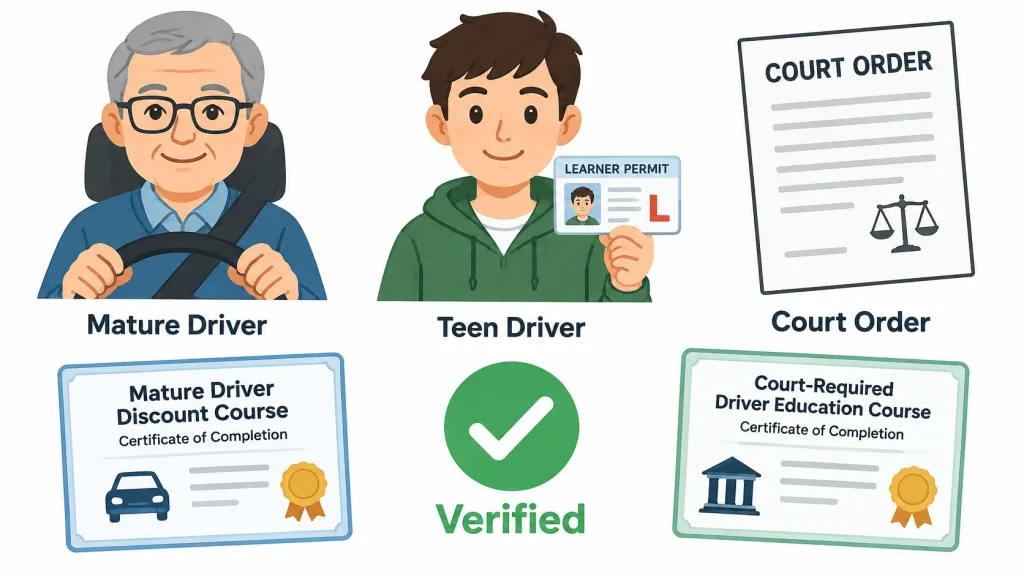
Mature drivers seeking an insurance discount
Drivers 55 or older may complete an approved Mature Driver Discount course and submit the certificate to their insurer; the FLHSMV driver-improvement schools guide says the discount typically lasts three years, subject to insurer conditions.
Florida doesn’t set the discount amount. Your insurer determines the amount, eligibility conditions, and documentation, including conditions concerning a crash for which the insured driver is cited.
Get the insurer’s submission instructions before enrolling. Your key document is the completion certificate submitted to the insurer, not a traffic-school election filed with a court.
Teens applying for a first license
Eligible teen applicants need the licensing pathway appropriate to their age and prior-license history. Keep the education record with the application paperwork, and don’t substitute a moving-violation course.
Coursework should support supervised practice, not replace it. NHTSA’s review of pre-licensure driver education finds inconsistent long-term crash reductions from education alone and cautions against using courses to accelerate graduated-licensing stages.
Drivers following a court order
The court order determines the designated program and filing requirements. Use our guide to court-ordered traffic school to understand the distinction between an ordered program and an elective citation course.
Your completion document may be only part of compliance. Keep proof of paid fines and fees, submit the required certificate, and confirm the court received what it requested.
Before registering, write down your group, the receiving organization, and the required document. That simple note prevents choosing an insurance course for a court obligation or a citation course for licensing.
What Happens During and After Your Course
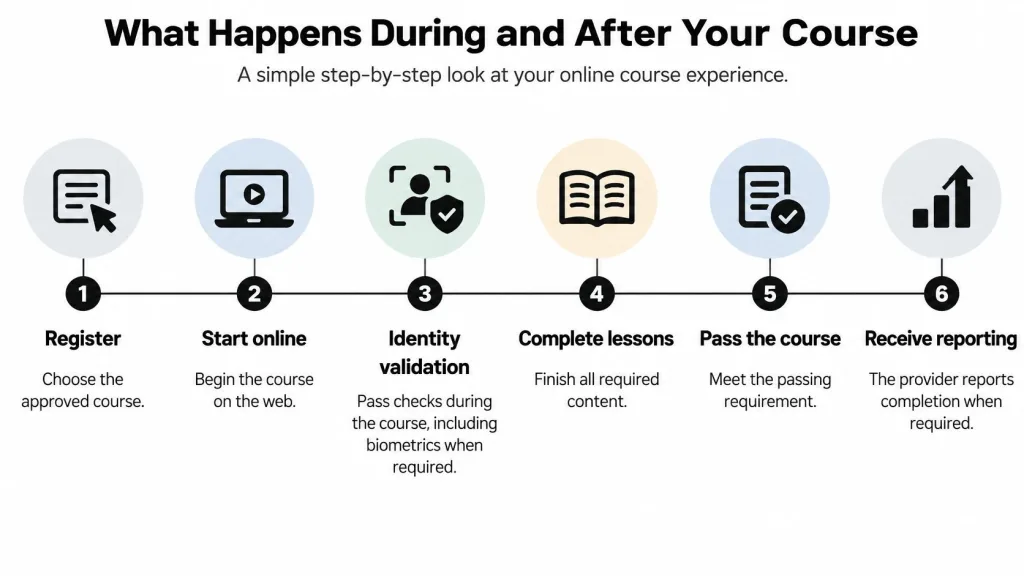
The online process runs from registration through verified completion and reporting. Allow time for the lessons, identity checks, assessments, and your own filing obligations.
Enter your name and license details consistently with your court record. A typo at registration can create an avoidable certificate problem later.
Follow the course sequence
- Register: Select the correct course and enter your identifying details.
- Complete identity validation: Pass the required checks during the course, which can include biometrics, security questions, or other required methods.
- Work through the modules: Finish all required instructional content rather than jumping straight to the exam.
- Pass required assessments: Meet the course guidelines for in-course assessments and the final exam.
- Receive the electronic certificate: Save the document after successful completion.
- Complete reporting and submission: The school reports completion directly to FLHSMV; you must also follow the court’s or insurer’s submission instructions.
This timeline shows the online workflow.
Close the paperwork loop
We’re required by Florida HSMV to retain pertinent student information about course study and completion for at least seven years. Still, keep your own certificate where you can retrieve it without contacting the school.
For court filing, follow our guide on how to submit a Florida traffic-school certificate alongside your clerk’s case-specific instructions. State reporting and court submission are different administrative tasks, so don’t assume one automatically completes the other.
Keep a complete record: Save the course title, completion date, certificate number, receiving court or insurer, and submission confirmation together.
Check for acknowledgment rather than relying only on a sent email. If the receiving office identifies a missing document or mismatched detail, address it while you still have time before the applicable deadline.
Common Questions About Approved Driver Education Courses
Can I get a refund?
Yes, if you request cancellation within 30 calendar days of purchase, including weekends and holidays, and haven’t completed the course or obtained a certificate. No refund is issued after all modules are completed or completion is reported to FLHSMV, for failing the final exam or other required assessments, or because the course expired.
Refund requests are made by email and must include your full name, address, signup date, and reason for cancellation.
What happens if my certificate is voided?
Unpaid chargeback fees can invalidate your completion certificate. If those fees aren’t paid within five business days of notification, the corresponding certificate is voided, and the court or Florida Department of Motor Vehicles is notified with the chargeback documentation.
Don’t assume a certificate you previously downloaded remains valid after a chargeback dispute. Resolve the notification directly and retain the resulting account correspondence.
What do approved courses teach?
Our curriculum covers Florida traffic laws and practical defensive-driving decisions. Topics include safe following distances, right-of-way rules, distracted and aggressive driving, impaired-driving prevention, and crash avoidance.
- Apply the rules: Understand who should yield and how to recognize developing conflicts.
- Manage space and attention: Practice decisions that preserve room to react.
- Change risky behavior: Recognize how impatience, impairment, and distraction affect driving choices.
The useful outcome isn’t just remembering an exam answer. It’s knowing what to do differently when another driver brakes suddenly, traffic merges, or frustration starts affecting your judgment.
What if the election window has already passed?
The elective option is forfeited when the applicable election deadline is missed, and points may be assessed. Contact the clerk about your case rather than buying a late course and assuming it will count.
Use the citation date and the court’s instructions to establish your next action. A school’s enrollment confirmation doesn’t authorize an extension or reverse the court’s eligibility decision.
Register for an Approved Course Before Your Deadline
If you recently received a moving violation, handle the election deadline before it passes. Confirm with the clerk that your citation is an eligible non-criminal moving violation and that your election history permits the option.
Then register for Florida’s Basic Driver Improvement Course, also called Florida Four-Hour Traffic School, through our course registration page. The course is four hours, fully online, and self-paced, so you can organize the required work around your schedule.
Make registration count
- Complete the court election: Follow the clerk’s procedure separately from purchasing the course.
- Enter accurate details: Use your name, driver license number, and email carefully so the completion certificate is generated correctly.
- Plan the finish: Leave time for assessments, certificate delivery, and court submission.
Drivers comparing other course categories can review the DriverEducators course lineup before choosing the program their paperwork requires.
After passing, send proof of completion to the court as instructed and keep a copy for your records or insurer. Registering starts the coursework; the court election preserves the eligible option. Take care of both rather than treating one as a substitute for the other.
BDISchool offers Florida-approved online Basic Driver Improvement education for eligible drivers addressing moving violations. Visit BDISchool to choose the appropriate course, register, and begin while you still have time to meet your court’s requirements.