BDI is 4 hours, IDI is 8 hours, the Aggressive Driver Course is 8 hours, and the Mature Driver Course is 6 hours. The required count depends on the Florida trigger on your citation, court order, or license application, so choosing by course name or shortest duration can send you down the wrong path.
What are you trying to satisfy: a moving-violation election, a court order, an insurance request, or a first-license application? Those situations can call for different courses, deadlines, and proof of completion, even when the hour counts look similar. Match the requirement on your paperwork first, then register for the course that fits it.
Course Hours at a Glance and Who Each Course Fits
Choose by the requirement on your paperwork, not by the shortest course. The hours below show what each option is designed to address; a similar duration does not make courses interchangeable.
| Course | Hours | Best for | Florida link |
|---|---|---|---|
| Basic Driver Improvement (BDI) | 4 | Drivers with a recent moving violation | Point and insurance relief when elected within 30 days |
| Intermediate Driver Improvement (IDI) | 8 | Court-ordered drivers and those needing more than a basic traffic-law review | Follow the timing set in the court order |
| Aggressive Driver Course | 8 | Drivers whose court or licensing requirement names aggressive-driver education | Confirm the requirement with the court or FLHSMV |
| Mature Driver Course | 6 | Drivers aged 55 and over seeking an insurance discount | Submit the completion certificate to the insurer |
BDI fits a driver with an eligible noncriminal moving violation who wants to elect point relief. It covers Florida traffic laws, safe following distances, and right-of-way. A driver with a speeding citation may choose BDI if the citation and court process allow the election. Completing the course does not make that election for you.
IDI fits drivers whose court order specifies an intermediate course or who need more instruction than a basic traffic-law review. Topics include impaired-driving prevention, crash avoidance, and how attitude affects driving decisions. Its 8 hours serve a different purpose from BDI’s 4 hours, so follow the course name on the order rather than substituting a shorter option.
The Aggressive Driver Course addresses behavior and responsibility, including repeated tailgating and confrontational driving. Choose it when the court or licensing authority requires aggressive-driver education and the course name matches the requirement. If your paperwork specifies Advanced Driver Improvement, an aggressive-driver course may not meet that requirement.
The Mature Driver Course is a refresher for eligible older drivers seeking an insurance discount. Under Florida’s motor-vehicle insurance statute, insurers’ filed rate plans must provide an appropriate premium reduction for eligible principal operators aged 55 or older who complete an approved accident-prevention course. The statute authorizes a discount of up to 10 percent, unless credible data supports another amount. Send the completion certificate to your insurer to request the discount.
Match the paper, not the number. Read the reason on your citation, court order, or license application, then choose the course that satisfies it. The same number of hours can serve different requirements, and the deadline depends on the trigger.
Florida Hour Requirements by Situation
The trigger on your citation, court order, or license application decides the required course, so the number on a course page isn’t the answer.
| Driver situation | Required course | Hours | Deadline or timing |
|---|---|---|---|
| Routine noncriminal moving violation, electing point relief | Basic Driver Improvement (BDI) | 4 | Elect within 30 days of the citation date |
| Adult, first Florida license, never licensed elsewhere | Traffic Law and Substance Abuse Education (TLSAE) | 4 | Complete before applying for the license |
| Under 18, first license, never licensed elsewhere, on or after Aug. 1, 2025 | Driver Education Traffic Safety (DETS) | 6 | Complete before applying for the license |
| At fault in three crashes within three years | Advanced Driver Improvement: 12 classroom hours plus 4 behind-the-wheel hours, followed by an extended road test | 16 minimum before testing | Complete within 90 days of conviction |
| Court-ordered driver | Course named in the court order; may be Intermediate Driver Improvement (IDI) or Advanced Driver Improvement | 8 for BDISchool IDI; 12 classroom hours for the three-crash Advanced Driver Improvement requirement | Timing set by the court order |
| Habitual offender, suspended license, or road-rage history | Aggressive Driver Course or Advanced Driver Improvement | 8 for Aggressive Driver Course; 12 classroom hours for the three-crash Advanced Driver Improvement requirement | Confirm with court or FLHSMV |
| Driver aged 55 or older seeking insurance discount | Mature Driver Course | 6 | Send completion certificate to insurer |
The BDI, TLSAE, and DETS rows all involve classroom-style education, but they aren’t interchangeable. BDI addresses an eligible citation and point-relief election; TLSAE is for an adult first-license application; DETS is for a qualifying under-18 first-license application. The course that fits depends on the event and the driver’s history.
For a court-ordered course, read the order closely. If it specifies an 8-hour IDI, review the 8-hour court-ordered traffic school course and confirm that its course name matches the order. If the paperwork names Advanced Driver Improvement, don’t infer a duration from the word “advanced.” Confirm the specific requirement with the court or FLHSMV.
Only the BDI row has the 30-day election window shown here. The three-crash requirement follows a separate 90-day clock from conviction, and the combined 16 hours do not include the extended road test. A court order or suspension can override what you might assume is the default course.
Before enrolling, check the document in hand, confirm the course and deadline with FLHSMV or the court, then register. In particular, confirm the timing for an aggressive-driver requirement directly with the authority that ordered it.
Why Hours Rise and What Counts Toward Compliance
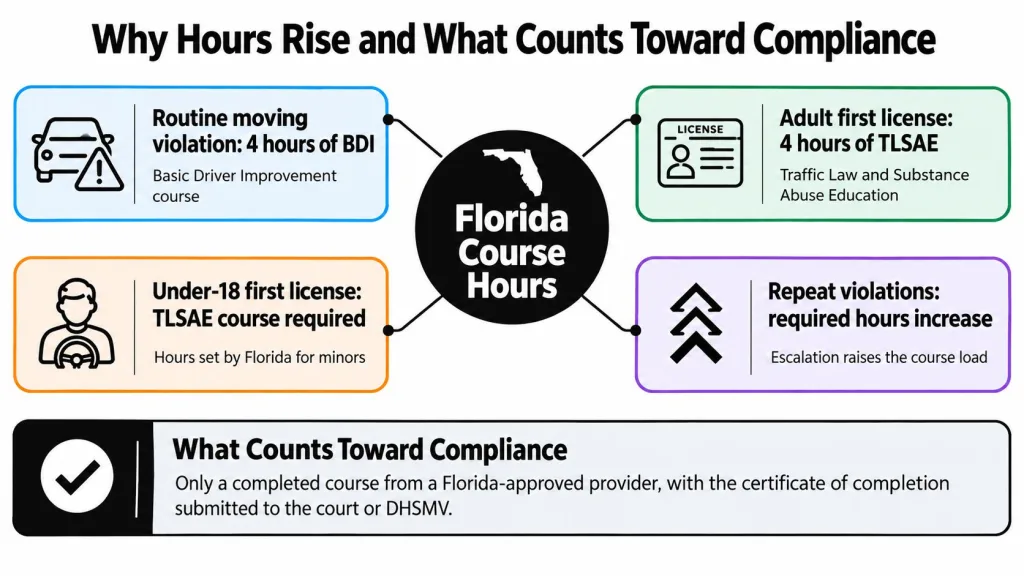
The legal trigger determines the required hours. A routine moving violation may call for 4 hours of BDI, while an adult applying for a first Florida license may need 4 hours of TLSAE. A driver found at fault in repeated crashes faces a different requirement: 12 hours of Advanced Driver Improvement, 4 hours of behind-the-wheel training, and an extended driving test. Florida’s driver-improvement program information describes the three-crash threshold as three at-fault crashes within three years and outlines the advanced course and practical-training requirements.
The three-crash requirement totals a minimum of 16 instructional or practical hours before testing time. Those hours reflect the driver’s history and the need to assess practical skills. The completion deadline is 90 days from conviction. Section 322.095 sets out the requirements and consequences of missing that deadline.
Separate course time from the rest of compliance
- Course content counts. Complete the instructional duration for the course your citation, court order, or license application requires.
- Breaks don’t count as instruction. TLSAE requires four hours of course content, excluding up to 30 minutes of breaks.
- Enrollment tasks aren’t lessons. Registration, payment, and administrative steps don’t add instructional time.
- Driving practice and testing are separate. Behind-the-wheel training and the extended road test aren’t included in classroom course hours.
BDI applies to eligible noncriminal moving violations. A suspended license, habitual traffic-offender status, or court order may instead require Advanced Driver Improvement. Check the document that triggered the requirement and confirm the course with FLHSMV or the court before paying. The three-crash path includes practical training and a road test, not just an online class.
Choosing by course name alone can send you to the wrong program. Match the hours to the requirement on your paperwork, then confirm the deadline with the authority that issued it. For road-safety guidance relevant to commercial drivers, read about safer following distances for trucks. If your paperwork calls for an Aggressive Driver Course, BDISchool describes its 8-hour Aggressive Driver Course; confirm that the course name matches the referral.
How to Elect a BDI Course Within 30 Days
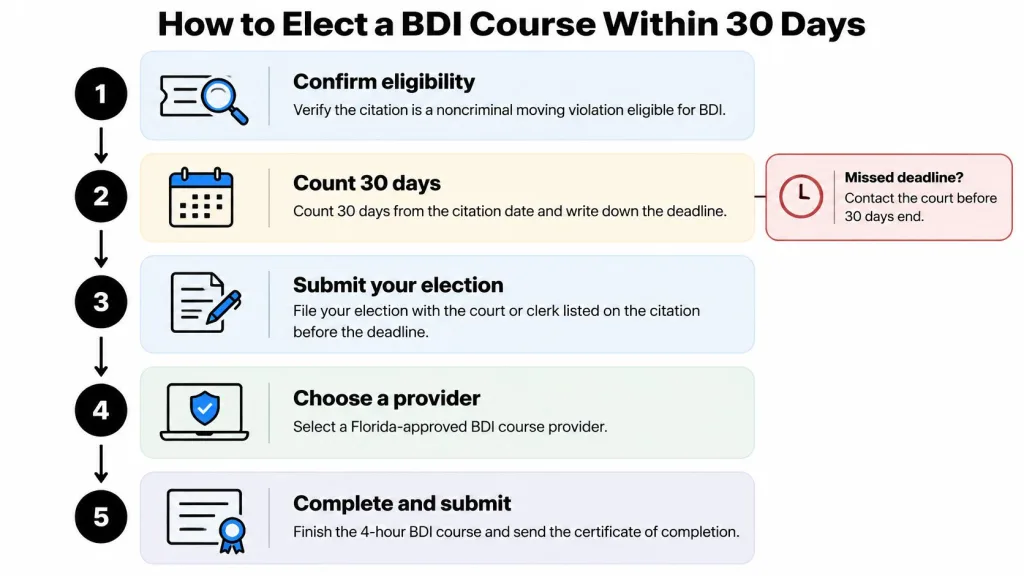
A BDI election is voluntary, but it has a strict deadline and a required order of steps. Florida requires drivers seeking point relief to elect within 30 days of the citation date, notify the clerk in the county where the citation was issued, and pay the required election fee before taking the course. The course must be approved by FLHSMV, so don’t treat enrollment alone as an election. Check the state’s approved BDI provider information before paying.
Confirm that the citation is eligible. Check that it’s a noncriminal moving violation and that BDI is an available election for your situation. Assuming every ticket qualifies can lead you to take a course that doesn’t resolve the citation.
Write down the deadline. Count 30 days from the citation date and note the last day to make the election. Don’t wait until the final days, when a missed notice or unanswered question may be harder to fix.
Notify the clerk. Contact the clerk of court in the county where the citation was issued and complete the election process. Enrolling before notifying the clerk can waste time and leave your citation unresolved.
Pay the election fee. Follow the clerk’s directions for the required fee and keep proof of payment. Don’t assume course registration includes this court-related step.
Register for an approved course. Choose an FLHSMV-approved BDI provider, such as BDISchool’s 4-hour course, after confirming your election. The approval check matters because course completion alone can’t substitute for an eligible election.
Finish and keep your certificate. Complete the course and save the certificate with your citation records. Keep a copy even if the provider reports completion electronically, so you can respond if the court needs proof.
Hours for Teens and First-Time Florida Drivers
A first Florida license isn’t the same as a traffic-school requirement after a citation. Applicants under 18 who’ve never held a license in another state, country, or jurisdiction must complete the 6-hour Driver Education Traffic Safety (DETS) course before applying, beginning August 1, 2025. Adults in the comparable first-license category generally need the 4-hour Traffic Law and Substance Abuse Education (TLSAE) course, unless an approved alternative applies. FLHSMV explains the age-based requirements and alternatives in its DETS guidance for Florida applicants.
The course-hours phrase can mislead families if it’s treated as one statewide answer for every driver. A teen’s first-license education, an adult’s first-license education, and BDI after a citation serve different purposes. Choose by the license application or citation trigger, not by the course that happens to have fewer hours.
Check a teen’s previous course before paying
An under-18 applicant who completed TLSAE on or after August 1, 2025 generally needs DETS unless enrolled in a specified Florida Department of Education or DELAP alternative. Parents should confirm whether the teen’s completed course qualifies before registering for another one. If you’re helping a teen study, the online driving course for teens can help you identify the learning option, but verify that it satisfies the specific first-license requirement.
The same check matters for people who’ve recently moved to Florida and never held a license elsewhere. Their prior driving experience doesn’t necessarily eliminate a Florida first-license course requirement. Confirm both license history and course eligibility with FLHSMV before applying.
Before a teen enrolls, use this checklist:
- Confirm license history. Has the applicant ever held a license in another state, country, or jurisdiction?
- Identify the purpose. Is the course for a first license, a citation, a court order, or an insurance request?
- Match the correct program. For a qualifying applicant under 18, confirm the DETS requirement and any recognized alternative.
- Keep the certificate. Save the completion proof with the applicant’s license records.
Study materials are available in English, Spanish, and Portuguese, which can help families review course content in a language they’re comfortable using. Don’t enroll based on the words “driver education” alone. Confirm the required course name for the applicant’s age and history first.
Scheduling, Breaks and Session Questions
You may be able to complete a course across multiple sittings. The required instructional hours still apply, but providers may let learners divide them into sessions. Check the provider’s rules before planning your schedule.
For online courses, count course instruction, not registration or promotional material. TLSAE requires four hours of content, with up to 30 minutes of breaks excluded from that minimum. A federal defensive-driver program accepts classroom, self-instructional, and online formats when the programs meet its content and completion-control requirements, as described in the USDA APHIS defensive-driver policy.
BDISchool describes its courses as fully online and self-paced, so students can study across multiple sittings on a suitable device. That flexibility does not change a court or licensing deadline. Before starting, check whether the court order, clerk, or insurer sets a completion window. Plan your sessions to finish by that deadline, and confirm unclear requirements with the court or FLHSMV before beginning.
Proof of Completion and Where to Send It
Download your certificate as soon as you finish the course, then save a copy with the citation number or case documents. The right recipient depends on why you enrolled; sending a certificate to the wrong place doesn’t satisfy the requirement.
For a BDI election, submit proof as directed by the clerk of court in the county where the citation was issued. Make sure the election has already been made within the required deadline. If you need to check the filing process, follow this guide on how to submit a Florida traffic-school certificate.
For a court-ordered course, send completion proof to the court or recipient identified in the order. Use the course name printed there, and ask the court if it requires a particular form of submission. Don’t assume that an electronic report to a state agency automatically fulfills a separate court instruction.
For a Mature Driver Course, send the certificate to your insurer to request the discount. Florida law provides for an appropriate premium reduction for an eligible principal operator aged 55 or older who completes an approved accident-prevention course, and authorizes a discount of up to 10 percent unless credible data supports another amount. Include your policy number and ask the insurer to confirm the discount in writing.
For the three-crash requirement, keep your completion record with the license application or the FLHSMV submission. Before sending documents, verify the recipient, method, and any additional paperwork the court or agency expects. Save a copy of everything you submit.
Questions to Settle Before You Enroll
What if the 30-day BDI window has passed?
Contact the clerk of court in the county where the citation was issued. Ask what options remain for your citation, and do not assume that enrolling in a course changes the deadline.
Are online courses accepted in Florida?
BDISchool courses are fully online and self-paced, with certificates reported electronically to FLHSMV. Before registering, confirm that the provider and course are approved for the requirement you need to meet.
The delivery format does not determine whether a course satisfies a legal requirement. For Florida compliance, check that the course matches the requirement shown on your paperwork.
Does a court order override the course hours I expected?
Yes. Follow the course named in the order, and confirm its exact name with the court before enrolling in IDI or Advanced Driver Improvement. An 8-hour course is not automatically a substitute for another program with a similar name.
Can I study in Spanish or Portuguese?
Yes. BDISchool materials are available in English, Spanish, and Portuguese. Choose the language you understand best, then make sure you have registered for the correct Florida course.
Choose based on the reason for enrolling: BDI for an eligible moving-violation election, IDI when required by a court order, the Mature Driver Course for an insurance-discount request at age 55 or older, or a DETS-compliant course for an eligible under-18 first-license application. If your paperwork names a different course, confirm the match with the court or FLHSMV before registering.
BDISchool offers self-paced online Florida traffic courses, including BDI, IDI, Aggressive Driver, and Mature Driver options. Match the course to your citation, court order, or license application, then visit BDISchool to review the available options and register.