You’re holding a speeding citation, your friend says their ticket wasn’t expensive, and the payment portal is already open. Say yours alleges 17 mph over the limit in Orange County. Before you click Pay, check the speed, the county instructions, and whether you can elect traffic school.
A speeding ticket in Florida has separate consequences for money, points, and your driving record. The fine bands and point bands don’t line up, school doesn’t erase the citation, and paying first can close an option you would rather have used.
Florida Speeding Fines and Points by Speed
Match the citation to the speed band, not to someone else’s bill. Under Florida Statutes section 318.18, the ordinary base civil schedule runs from a warning for 1–5 mph over through the dollar amounts shown below; school-zone and designated-school-crossing violations generally receive enhanced fines.
The FLHSMV Basic Driver Improvement guide separates ordinary speeding points at 15 mph over or less, 3 points, and more than 15 mph over, 4 points. That creates the important split inside the same fine band.
Florida speeding fines and points by how far over the limit
These are base civil amounts, not checkout totals. The crash and school-eligibility qualifications matter just as much as the dollar column.
| How far over | Base civil fine | Points if convicted | What changes the row |
|---|---|---|---|
| 1–5 mph | Warning in most cases | Usually none if no citation | $50 in a legally posted school zone |
| 6–9 mph | $25 | 3 | School zone or school crossing generally doubles the fine |
| 10–14 mph | $100 | 3 | School zone or school crossing generally doubles the fine |
| Exactly 15 mph | $150 | 3 | Still the 15-or-less point band |
| 16–19 mph | $150 | 4 | Same fine band as 15 mph, higher points |
| 20–29 mph | $175 | 4 | School zone or school crossing generally doubles the fine |
| 30 mph or more | $250 | 4 | BDI election is barred; school zone may double the fine |
| Unlawful speed with a crash | Fine from the speed band | 6 | Confirm with the clerk before assuming school is available |
For the hypothetical Orange County citation, locate the alleged excess speed in the table. Don’t substitute the vehicle’s recorded speed for the amount over the posted limit.
The fine and point columns answer different questions. Two drivers can owe the same base fine while facing different point consequences, so checking only the dollar amount is a poor way to choose a response.
The clerk’s total is the amount that matters
Court, county, and administrative charges can sit on top of the scheduled civil fine. Ask the clerk for the itemized total for your citation, including the amount due if you elect school.
A contested case also isn’t limited to the ordinary scheduled amount: Florida Statutes section 318.14 permits a civil penalty of up to $500 when an infraction is proven, or up to $1,000 for unlawful speeding in a school or construction zone. Don’t confuse that ceiling with the base amount printed in the schedule.
Practical rule: Circle your speed row, mark any school-zone or crash allegation, and get the clerk’s actual total before choosing how to respond.
If the posted limit or location is unclear, use our guide to Florida speed-limit laws to identify what needs closer review. Keep the citation beside you and confirm the current statute and county instructions rather than relying on an old ticket screenshot.
Pay School or Court for This Ticket
For an ordinary eligible citation you accept, consider Basic Driver Improvement before straight payment. Basic Driver Improvement, or BDI, is the approved traffic-school election that can protect your license from new points when you follow the required process.
Court is a different choice. Request a hearing when you have a genuine dispute about the alleged violation, not because you dislike the amount due.
Use this comparison before submitting money.
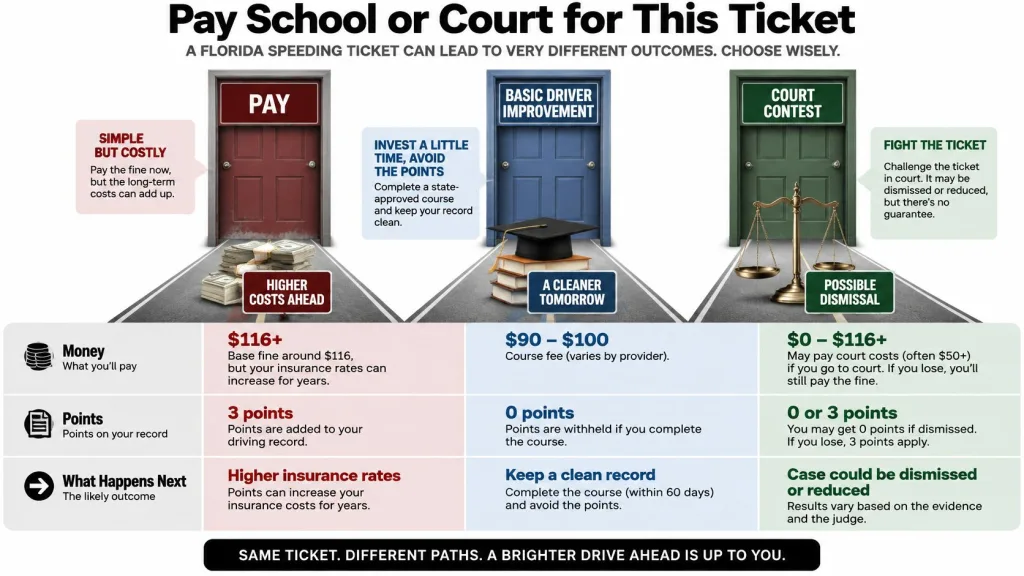
Pay, plead, BDI, or contest a Florida speeding ticket
The FLHSMV points and suspensions guide lists 3 points for ordinary speeding, 4 for speeding more than 15 mph over, and 6 when unlawful speed results in a crash; a properly completed eligible BDI election prevents point assessment and reduces the applicable civil penalty by 18%.
| Option | What you pay | Points | Record result | Choose it when |
|---|---|---|---|---|
| Pay the citation | Full base fine plus court and county costs | 3, 4, or 6 | Conviction that counts toward suspension | School is unavailable or the election was already used |
| Plead guilty or no contest without a withholding | Ordinarily the base fine plus costs, subject to the court’s disposition | 3, 4, or 6 if adjudicated guilty | Conviction that counts toward suspension | You accept the ticket and school is closed |
| Elect approved BDI | Civil penalty reduced 18%, plus clerk election fee, course fee, and applicable costs | None after successful compliance | Adjudication withheld; disposition can still be kept | Eligible noncommercial ticket, elected and finished on time |
| Contest in court | No violation penalty if dismissed; court-imposed penalty if you lose, plus time and possible counsel | None if dismissed; applicable points if adjudicated guilty | Whatever the court rules | Real doubt about speed, signage, identity, or procedure |
A no-contest plea isn’t a substitute for a recorded school election. If a judge orders a particular disposition, follow that order rather than assuming the payment table controls every hearing outcome.
Calculate license risk before convenience
Florida’s suspension thresholds are 12 points within 12 months, up to 30 days; 18 within 18 months, up to 3 months; and 24 within 36 months, up to 1 year, under the FLHSMV suspension schedule linked above. Obtain your driver record and compare the citation’s potential points with the applicable rolling periods.
Say your record already contains recent points. The right question isn’t whether you can afford this fine, but whether accepting more points puts your license at risk.
Before choosing, collect:
- Your driver record. Use actual posted dispositions, not memory.
- The clerk’s election instructions. Ask whether school remains available before making an ordinary payment.
- Your evidence. Preserve relevant photographs, documents, and notes if you intend to contest.
Our Florida traffic-ticket guide can help you organize the response. Don’t pay while you’re still deciding: payment can constitute your election rather than merely holding your place.
What Stays on Your Driving Record
No points does not mean no ticket. A successful school election changes how the citation is resolved, but it doesn’t promise an empty driving history.
The FLHSMV traffic-citations guidance distinguishes payment, school election, and adjudication withheld; it also explains that school-election records can remain for decades, while an unsuccessful or incomplete course can produce a clerk-of-court adjudication entry. Read your record as a disposition history, not just a point counter.
Does traffic school remove the points?
A properly completed, eligible election prevents points from being assessed for that citation. That’s different from removing points already attached to unrelated convictions.
Don’t purchase a course expecting it to clear your entire record. The clerk must connect the election and completion to the specific case you’re resolving.
Is adjudication withheld?
Yes, after a successful statutory election. Withholding adjudication means the case is resolved without the guilty adjudication that ordinary payment produces.
Consider two drivers cited for the same alleged speed. One pays without electing school and receives a conviction with the applicable points; the other completes a valid election and receives a withheld disposition without points.
The second driver achieved the statutory benefit. Neither driver should assume the underlying event has disappeared.
Keep these questions separate: Were points assessed? Was adjudication withheld? What disposition remains visible?
Can an insurer or employer still see the case?
Don’t assume withholding makes the case invisible. What someone can obtain and how they may use it are separate questions from whether FLHSMV assessed points.
That distinction matters when you’re answering insurance applications, employment forms, commercial-driving questions, or immigration paperwork. Read the wording carefully, particularly whether it asks about citations, convictions, or withheld adjudications.
For help organizing those questions before speaking with qualified counsel, LegesGPT’s AI legal assistant can be a starting point. Don’t treat an automated explanation as a court ruling or individualized legal advice.
Our explanation of whether speeding tickets stay on your record also helps distinguish the ticket from its point consequences.
How do you verify the final result?
Check the county case, not just your inbox. A completion certificate proves you finished the course; it doesn’t, by itself, prove the clerk applied that completion correctly.
- Match the case number. Confirm the certificate and citation identify the same proceeding.
- Check the disposition. Look for the recorded completion and expected resolution.
- Resolve an open case. Contact the clerk with your certificate if the completion hasn’t been applied.
Save the clerk’s confirmation with your certificate. That documentation is more useful than assuming an automated message settled everything.
How to Elect Basic Driver Improvement on Time
Elect with the clerk, then complete the approved course. Enrollment alone doesn’t tell the court that you selected the school option.
The FLHSMV education-courses guidance requires an eligible driver to elect within 30 days after receiving the citation, pay the election fee to the issuing county’s clerk, and complete an approved course. Treat the receipt date as your starting point and put the election deadline on your calendar immediately.
This process map separates the court action from course registration.
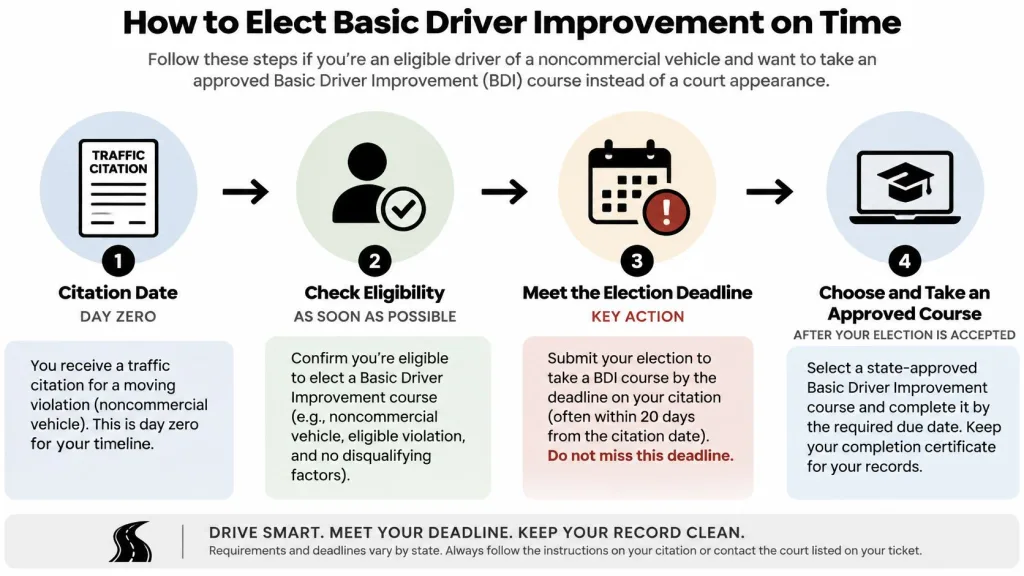
Follow the citation through completion
Read the entire citation. Identify the issuing county, alleged speed, crash notation, appearance instructions, and response method. Skipping the appearance language can lead you to select an option the case doesn’t permit.
Confirm eligibility before sending money. Ask the clerk whether this citation and your driving history qualify for a voluntary BDI election. Under Florida’s traffic-infraction statutes, citations alleging 30 mph or more over the posted limit are excluded, along with other statutory categories.
Record the election with the issuing county. Use the clerk’s specified portal, form, or other accepted method and pay the required election amount. Save the receipt showing that you elected school, not merely that you paid something.
Enroll in the correct approved course. Select Basic Driver Improvement, commonly called four-hour traffic school, rather than a different driver-improvement program. Copy the county’s completion deadline into your calendar before starting.
Finish the coursework and required assessments. Starting a lesson or reaching the last screen isn’t the same as successful completion. Leave time to resolve an access problem or an unfinished assessment before the court deadline.
Verify reporting and case closure. Keep the electronic certificate, confirm required reporting to FLHSMV, and check that the clerk received and applied the completion. Follow the county’s submission instructions even if the provider reports electronically.
A Miami-Dade citation and a Leon County citation may use different portal steps and completion instructions. Follow the issuing clerk’s requirements, not the process a friend used elsewhere.
Separate the election date from the completion date
The election deadline and course-completion deadline are different obligations. Write both down, along with any certificate-submission requirement.
If the clerk’s date arrives before a provider’s general course-access period ends, the clerk’s deadline controls your case. Access to unfinished lessons doesn’t extend a court deadline.
Use this video alongside the written instructions, not in place of your clerk’s requirements.
Before you put the citation away, check the case online or call the clerk. Ask directly whether your election, payment, and completion have all been recorded and whether anything remains outstanding.
Mistakes That Close the School Option
A clean driving record doesn’t override an excluded citation, and recent school use can block another election. Check both the offense and your election history before buying a course.
Florida Statutes chapter 318 excludes speeding 30 mph or more above the posted limit from this election. Florida’s election rules also limit use to once in a 12-month period and eight times over a lifetime, effective July 1, 2024.
Use this checklist before committing to the school route.
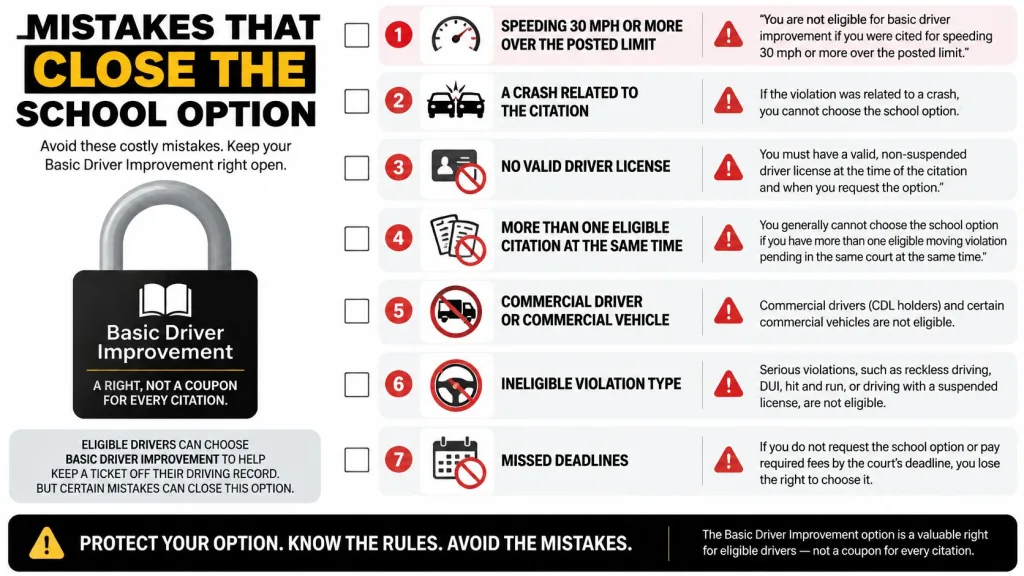
Don’t assume willingness equals eligibility
Don’t enroll around an exclusion. A course provider can teach you safer driving, but it can’t authorize a statutory election the clerk cannot accept.
Commercial driver-license holders cannot use driver-improvement school to avoid points. Don’t assume driving a personal vehicle changes that restriction.
Don’t estimate your prior election date. Check the actual record. “Last year” isn’t precise enough to establish eligibility, especially when your citation date, election date, and completion date differ.
Our guide to how often you can take traffic school explains the questions to resolve before you register.
Don’t confuse mandatory education with a voluntary election
A court can require driver education without granting the same result as a voluntary point-avoidance election. Read the order and ask what completion will accomplish in that particular case.
Crash allegations, school-zone citations, and construction-zone cases deserve a clerk check rather than an automatic assumption. Enhanced penalties and school attendance aren’t interchangeable legal outcomes.
If an exclusion may apply, stop and ask the clerk before spending the course fee.
Don’t let a valid course become an invalid response
These are procedural failures, not defects in the lessons:
- Paying first. You may record a different response before requesting school.
- Enrolling without electing. The provider’s registration record doesn’t replace the clerk’s election record.
- Finishing late. A legitimate certificate doesn’t excuse missing the county deadline.
- Leaving assessments incomplete. Attendance without successful completion doesn’t earn the withholding.
- Ignoring an open case. An unanswered citation can progress toward default and license suspension.
If you discover a missed deadline, contact the clerk immediately. Don’t finish a course and assume the certificate will repair the case.
The practical safeguard is simple: get eligibility confirmed, retain the recorded election, and verify that completion reached the correct case. Those documents let you address a reporting problem with something more useful than a recollection of clicking Submit.
Start an Approved Florida BDI Course
Once the clerk confirms eligibility and records your election, start the course. More comparison shopping won’t complete the requirement, and registration by itself won’t resolve the citation.
We offer Florida’s Basic Driver Improvement Course, also called Florida Four-Hour Traffic School, for drivers handling eligible moving violations. BDI School is a Florida HSMV-approved Basic Driver Improvement School, and our course is approved for all Florida courts and counties.
Have your case details ready
Before enrolling, put these items beside your device:
- The citation. Enter identifying information carefully so completion can be matched to your case.
- The issuing county. Use that county’s reporting and submission instructions.
- The recorded election and deadlines. Keep the clerk’s confirmation available while completing the requirement.
For a properly elected and completed eligible case, the intended result is withheld adjudication and no points. Our course also helps eligible drivers avoid an insurance-rate increase due to the moving violation; that isn’t a promise that an insurer will never change a premium for another reason.
Can you complete the course around work?
Yes. Our online course is self-paced, so you can plan study around your schedule. Set aside time to finish the assessments and verify reporting, not just time to begin the lessons.
Where should you register?
Choose the course registration page or the DriverEducators course catalog and select the course matching your clerk’s instructions. Don’t choose a different program because its title sounds similar.
After completion, save your electronic certificate and verify the county case status. The useful finish line is a completed course applied to the citation, not a receipt for enrollment.
BDISchool offers approved Florida Basic Driver Improvement for eligible drivers responding to a speeding ticket. Visit BDISchool, register after confirming your election with the clerk, and start early enough to finish and verify completion before your county deadline.