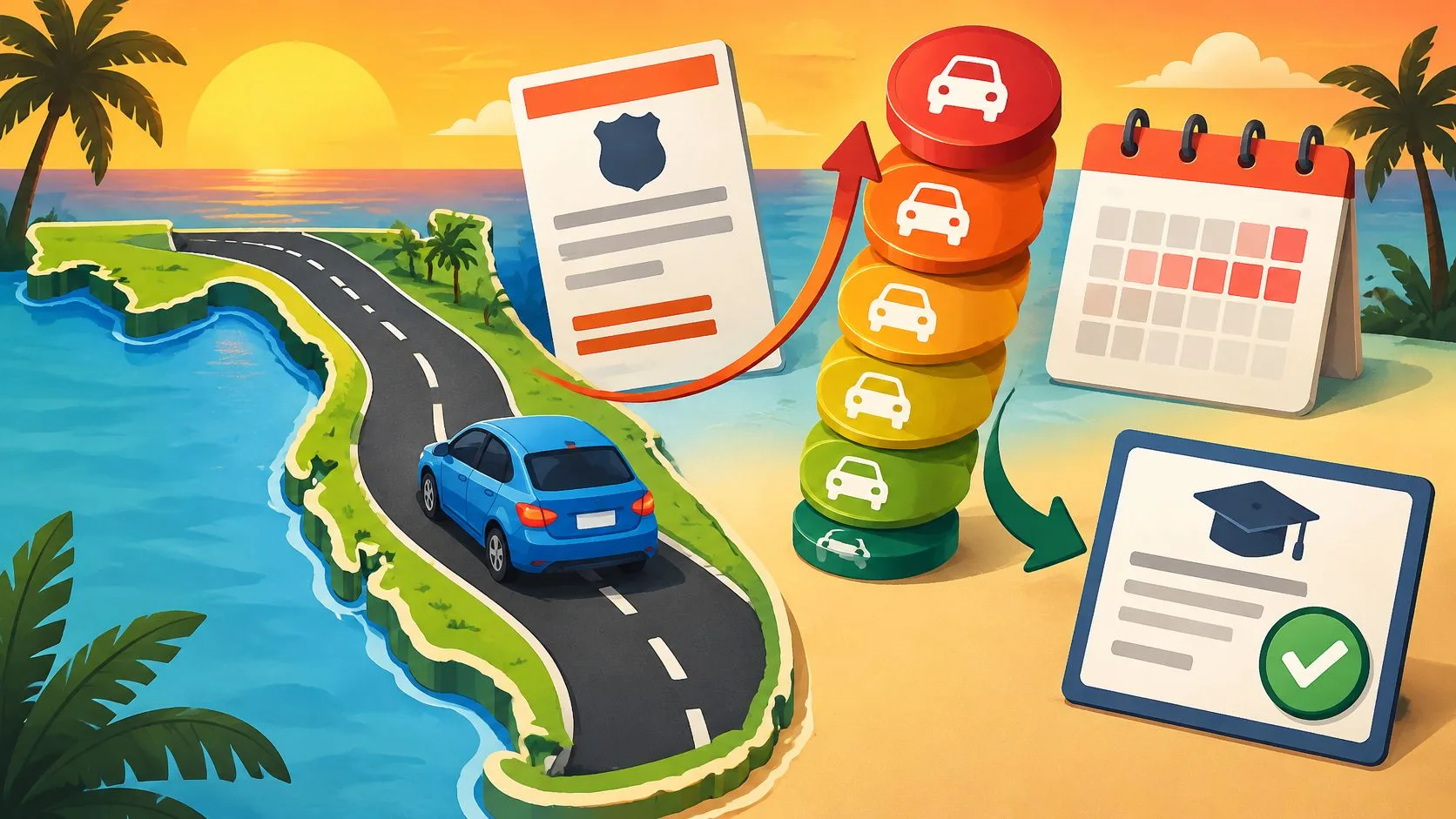
The citation is still on the passenger seat. The court date is printed small, the fine looks manageable, and the violation line never says whether this ticket is a nuisance or the one that parks your car. Florida’s traffic ticket points system does not keep a lifetime total. It looks backward through rolling windows, so the date of each conviction decides whether you keep driving.
One ordinary speeding conviction is usually 3 points. Stack enough of those inside twelve months and the state can suspend you. A teen hits a restriction at half that load. If this ticket is eligible, electing an approved course can withhold adjudication and keep the points off your record. If you already used that election, or the speed is 30 mph or more over the limit, a course will not save this one.
Read the violation, match the points, and test the window before you pay.
Point Values for Common Florida Violations
In Florida, points follow the severity of the violation, not the number of tickets in your glove box. The Florida Department of Highway Safety and Motor Vehicles assigns 3 points for careless driving and ordinary speeding, 4 points for reckless driving, and 6 points for leaving a crash without providing required information. Those entries stay on your record for at least five years from the conviction or disposition date, so a ticket from this year still counts when you renew a license or an insurer pulls your record.
The same agency uses time windows, not a lifetime pile: 12 points within 12 months brings a 30-day suspension, 18 points within 18 months brings a three-month suspension, and 24 points within 36 months brings a one-year suspension. One ticket rarely does that. The type and the timing do.
| Violation | Points Assigned | What to Check |
|---|---|---|
| Careless driving | 3 | Usually the default for minor unsafe driving |
| Ordinary speeding | 3 | Confirm the speed is under 30 mph over the limit |
| Reckless driving | 4 | Higher severity, so confirm course eligibility first |
| Leaving a crash without required information | 6 | Serious violation that stays on the record for at least five years |
| Speeding 30 mph or more over the limit | Not published as its own point total | Excluded from the Basic Driver Improvement election |
Why the gap between 3 and 4 matters
One reckless conviction weighs more than one careless conviction. That extra point changes which window you are about to cross, and the label on the citation changes whether a course can even be elected. Speeding 30 mph or more over the posted limit is excluded from the Basic Driver Improvement election. The exact speed printed on the ticket can decide whether a course protects the record or whether the points land.
A reader who only counts tickets will misread this system. Two careless tickets are 6 points. One leaving-the-scene conviction is also 6 points, and it is a far harder record to explain. If you are unsure whether your speed line even counts as a moving violation, start with whether a speeding ticket is a moving violation before you assume a course is available.
How to read the citation
- Find the violation description printed on the citation, not the fine amount.
- Match that description to the table above.
- Write down the conviction or disposition date once the case closes. That date, not the day you were stopped, starts the five-year clock and feeds the windows.
- If the speed is 30 mph or more over the limit, stop treating a course as your backup. That exclusion is real.
Keep a copy of every citation and the date the case was disposed. A window is only as accurate as the dates you can prove.
Suspension Thresholds and Teen Limits
Florida thresholds depend on time windows, not a lifetime total. Twelve points within 12 months brings a 30-day suspension. Eighteen points within 18 months brings a three-month suspension. Twenty-four points within 36 months brings a one-year suspension. One ticket almost never hits those lines. Repeated convictions inside the same window do.
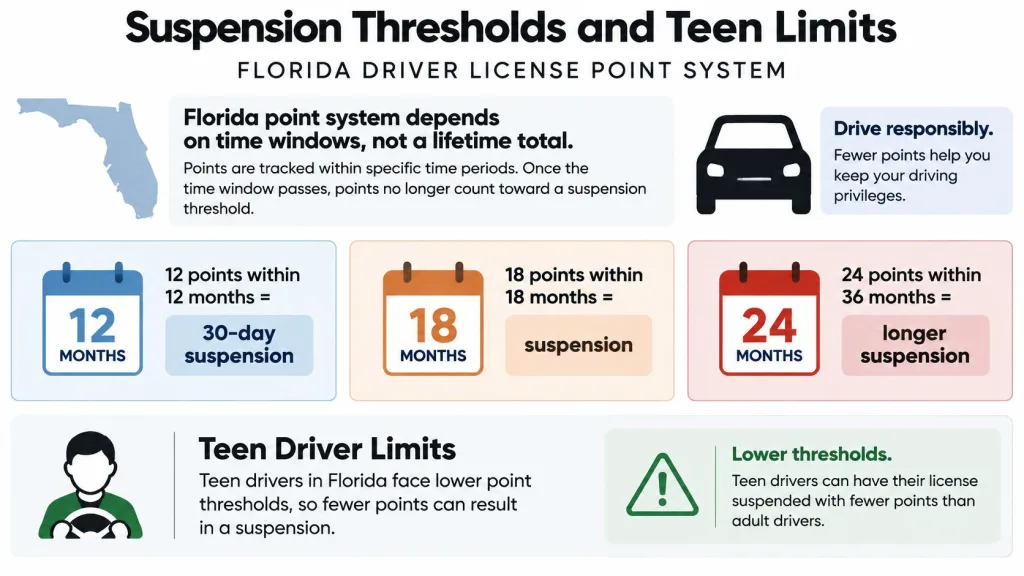
Teens do not get the adult line. The Florida Highway Safety teen-driver guidance says a teen who receives six or more points within 12 months is automatically restricted to Business Purposes Only for 12 months or until age 18, whichever comes first. Each additional point during that restriction extends it by 90 days. Six is half of the adult 12-point trigger. Two ordinary 3-point tickets inside a year are enough to restrict a teen license.
| Driver Group | Points | Time Window | Consequence |
|---|---|---|---|
| Standard adult driver | 12 | Within 12 months | 30-day suspension |
| Standard adult driver | 18 | Within 18 months | Three-month suspension |
| Standard adult driver | 24 | Within 36 months | One-year suspension |
| Teen driver | 6 or more | Within 12 months | Business Purposes Only for 12 months or until age 18, whichever comes first |
| Teen driver already restricted | Each additional point | During restriction | Restriction extended by 90 days |
Test each window separately
Add points by conviction date, then test the 12-month, 18-month, and 36-month windows on their own. The same conviction can sit inside a short window and a long window at once. A 4-point reckless conviction from eleven months ago still counts toward the 12-point line, and it will still be inside the 36-month line two years from now.
The window is the trigger
Parents often total “points on the license” and relax when the number looks small. That total is the wrong number. A teen at 6 points inside twelve months is already restricted, even if an adult with the same record would still be driving. An adult at 11 points is one careless conviction away from a 30-day suspension, even if older tickets from four years ago no longer sit in that window.
Practical rule: Sort convictions newest to oldest, total only the ones inside each window, and stop when any window hits its line.
How Points Build Up, Stay and Escalate
Every conviction enters your record with a date attached. It keeps counting toward each suspension window it still falls inside, and it stops counting only when that window closes behind it. A quiet six months between tickets does nothing. The clock on each conviction runs on its own.
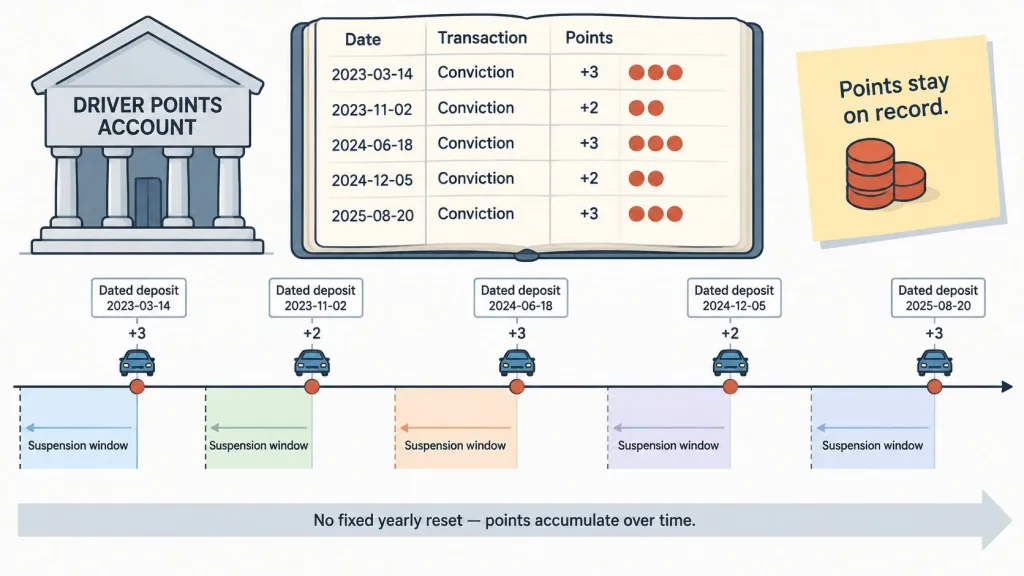
Point values rise with the danger of the behavior. Impaired driving and other high-risk violations weigh more than a minor following-distance mistake. Consequences climb with repetition: warning notices and education first, then hearings, then suspension or revocation. Waiting for an entry to age off is not a plan. The habit that produced the ticket is still in the car.
What actually changes the next conviction
A CDC-hosted review of licensing sanctions treats demerit points as a behavioral-risk intervention rather than a bookkeeping score. Licensing-agency consequences were associated with fewer later violations and crashes. Court-mandated consequences alone were not. The deterrent works hardest when penalties apply automatically and consistently. Discretionary or delayed sanctions weaken the link between the violation and what happens next.
That same review of licensing sanctions reports that assigned points can reduce later offenses, but the deterrent effect may last only about two years before it fades. Fading influence is not expiration. The conviction stays on your record and keeps counting inside any window still open. What weakens is its power to change how you drive. A driver who only waits out the clock changes nothing, so pair any point-avoidance step with a fix for the actual error: speed, distraction, impairment, or following distance.
While a recent conviction is still fresh, an eligible course election can keep its points out of every window at once. Once a ticket’s points land, no election removes them.
Crash entries run on a separate clock from ticket points. If you are sorting how long a collision stays visible to insurers and courts, the car accident record timelines from Olson & Sons are a useful companion to the conviction dates on your own citations. For the points clock itself, read how long points stay on your license before you assume a quiet year erased anything.
Name the habit behind your last ticket this week, and correct it before the next conviction date lands inside an open window.
How One Driver Crossed the 12-Point Line
Marcus is a hypothetical adult driver with a clean recent record. Watch the conviction dates, not the days he was pulled over.
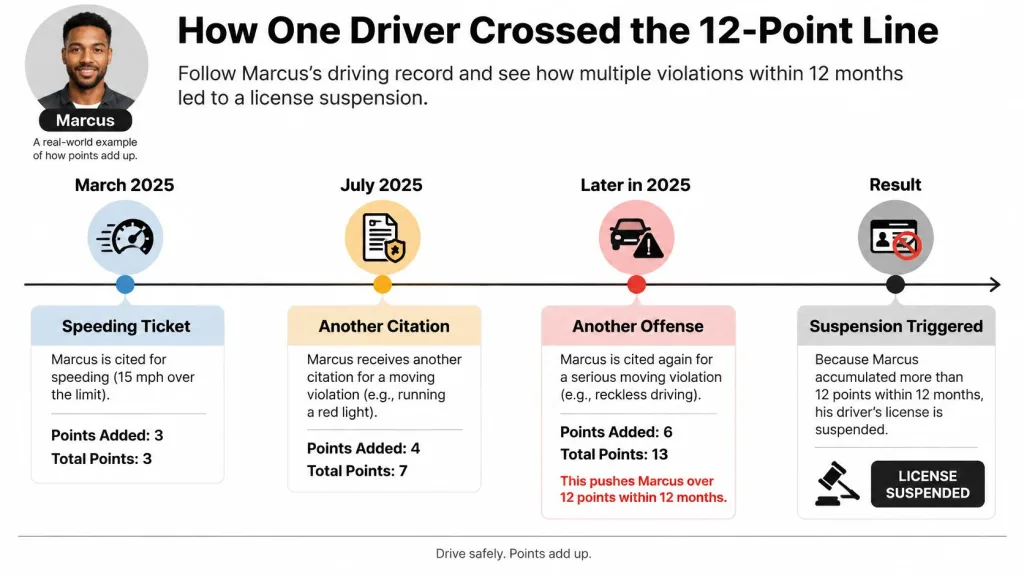
- March 2025: An ordinary speeding conviction adds 3 points. Running total: 3.
- July 2025: A reckless driving conviction adds 4 points. Running total: 7.
- October 2025: A careless driving conviction adds 3 points. Running total: 10.
- January 2026: A second careless driving conviction adds 3 points. Running total: 13.
All four conviction dates sit inside one 12-month window, from March 2025 through January 2026. Thirteen points inside twelve months crosses the 12-points-in-12-months line, so the result is a 30-day suspension. The ticket dates might have been weeks earlier. Those earlier dates do not drive the count. The conviction dates do.
Where a course would have changed the math
The decision point was before the January conviction, and before October. If an earlier ticket had been an eligible noncommercial moving violation, a timely course election could have kept that ticket’s points off the record. Drop the October 3 points and January never reaches 13. Drop the March 3 points and the same stack stays at 10. Marcus did not check eligibility while the window was still open. He paid, took the points, and let the next conviction do the rest.
What to ask the carrier at renewal
Each conviction can raise premiums, but the points system itself does not set the surcharge. The insurer does. At renewal, ask three questions.
- Does each conviction trigger a surcharge on its own?
- How long does that surcharge stay on the policy?
- If a completed course election avoids the conviction, does that mean no surcharge is triggered for that ticket?
Get the answers in writing from the carrier. A 30-day suspension is the licensing hit. The premium hit can outlast it.
Traffic School Versus Accepting the Points
Three paths. Only one of them is built to keep an eligible ticket off your point total.
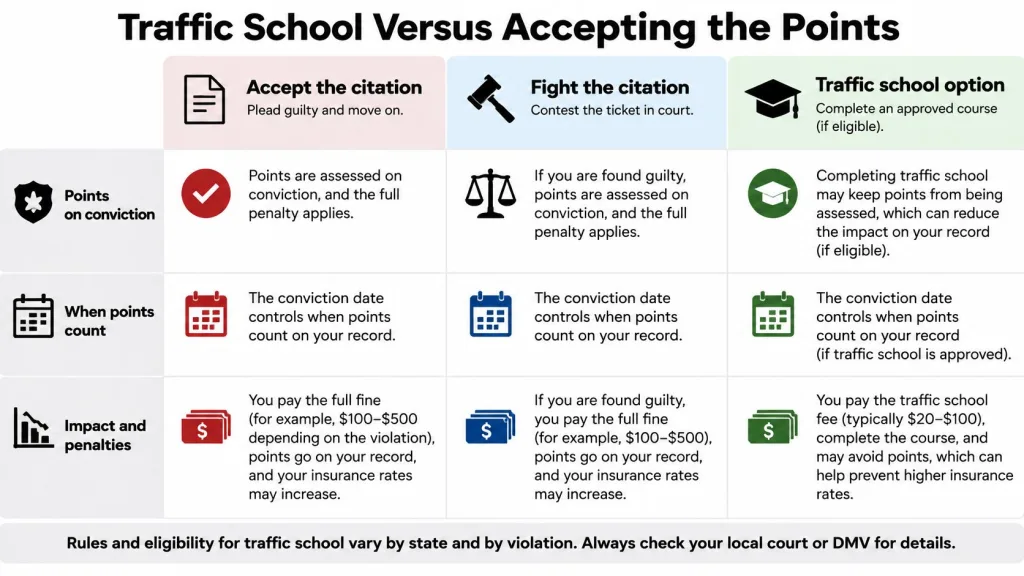
| Option | Points Added | Court Record | Civil Penalty |
|---|---|---|---|
| Accept the citation and pay | Assessed on conviction | Conviction on record | Full penalty |
| Elect a Basic Driver Improvement course | None when the election is allowed | Adjudication withheld | Reduced by 18 percent |
| Contest the citation in court | Assessed only if convicted | Set by the verdict or plea | Full penalty if convicted |
Accepting and paying is the fast path and the costly one. Points are assessed on conviction, the full civil penalty applies, and the conviction sits on the court record. That is the entry insurers review at renewal.
Electing a course is different when the law allows it. Florida statute lets a driver elect an approved Basic Driver Improvement course, instead of appearing in court, for many eligible noncommercial moving violations. When the election is permitted, adjudication is withheld, no points may be assessed, and the civil penalty is reduced by 18 percent. The option excludes serious or specific violations, including speeding 30 mph or more over the posted limit, and it is unavailable if you made another election during the preceding 12 months.
Contesting only makes sense when the facts or the citation give you a real defense. Points are assessed only if you are convicted. A weak denial still ends as a conviction, a full penalty, and a dated entry in the window.
Which path I tell eligible drivers to take
Weigh the course fee against that 18 percent penalty cut and against the insurance review a conviction can trigger. For an eligible driver, the course is the strongest option. You trade a short online session for a record that never receives those points. BDI School is a Florida HSMV-approved Basic Driver Improvement school, and the course is aimed at drivers who recently received a moving violation. Completing it means no insurance rate increase due to that moving violation, and it helps you keep an Excellent Driver or Safe Driver status and discount. How often you can use the election is limited, so read how often you can take traffic school before you spend the option on the wrong ticket.
If you are also comparing classroom and online formats for a separate alcohol-related order, compare in-person and online DUI classes from Lendrum’s Driving School. That is a different case from an ordinary moving violation, and it should not be mixed into this election.
The whole choice hinges on eligibility. Check that before you pay anyone.
Checking Eligibility and Avoiding Costly Mistakes
A driver elects traffic school on a ticket that never qualified, pays the fee, finishes the course, and still takes the conviction. That is the expensive version of guessing. Run this checklist against your citation before you spend the election.
- Qualifying violation: The citation is a noncommercial moving violation that the election covers.
- Not excluded: It stays off the exclusion list. Speeding 30 mph or more over the posted limit is the common miss.
- 12-month gap: You made no other election in the preceding 12 months.
- Lifetime cap: You have not reached Florida’s lifetime limit on the Basic Driver Improvement election. Florida law caps it at a fixed number of uses, so confirm your count before enrolling.
- Recent ticket: The course is built for drivers who recently received a moving violation. A case already disposed with points assessed falls outside it.
Elections live inside dated windows, the same way points do. The 12-month rule runs from the date of your last election, so one completed course does not create open-ended protection. Check both your prior elections and this violation against what is already posted, and pull your record with how to check points on your license if you are unsure what is on it.
Mistakes that void the benefit
Skipping the 12-month check burns the fee. If you elected a course for another ticket inside that window, this election is unavailable and the new conviction still lands.
Using a school that is not state-approved leaves the record exposed. The course has to be state-approved and meet Florida DMV requirements. A generic “defensive driving” video from another state will not withhold adjudication here.
Ignoring a chargeback is worse than a declined card. When a certificate is voided over unpaid chargeback fees, the court or the Florida Department of Motor Vehicles is notified, and a copy of the chargeback document goes to both. The points protection you paid for is gone, and the court has the paperwork.
Asking for a refund after the report fails every time. No refunds are issued once completion has been reported to FLHSMV, and none are issued if the school determines you cheated. Confirm eligibility before the fee leaves your card, then finish the course yourself.
If any item on the checklist fails, do not enroll for this ticket. Pay or contest on the merits, and save the election for a citation that can actually use it.
Enroll in the Right Course Before Your Deadline
Match the course to the situation. Do not grab the shortest one because the fine is due Friday.
Basic Driver Improvement, also called Florida Four-Hour Traffic School, is the 4-hour course for a driver who received a moving violation and wants to avoid points and an insurance increase. This is the election course for an eligible citation.
Intermediate Driver Improvement is an 8-hour program for a court-ordered driver, or for someone who wants a deeper pass at safe-driving habits than a four-hour election covers.
Aggressive Driver is an 8-hour course for a habitual offender involved in road rage, aimed at responsibility and a change in behavior, not at a routine 3-point speeding ticket.
Mature Driver is a 6-hour refresher for drivers aged 55 and older who want to keep insurance discounts and sharpen awareness. It is not a substitute for the Basic Driver Improvement election.
Start before the conviction date
- Run the eligibility checklist on this citation.
- Open the course list at BDI School courses and choose the match. You can also review options at Driver Educators courses.
- Complete the registration form with your name, driver license number, and email. That information generates the completion certificate.
- Study online at your own pace in English, Spanish, or Portuguese.
- Finish and receive the electronic certificate, reported directly to FLHSMV.
The cheapest moment to protect a record is before the conviction. After the points are assessed, the window already has them.
BDI School’s Florida HSMV-approved traffic courses are built for the citation you are holding, from the 4-hour Basic Driver Improvement election to longer courses when the court or your driving history calls for them. Completing the right course can keep an eligible moving violation from adding points and from raising your insurance rate. Visit BDISchool, confirm this ticket qualifies, and start before the conviction date closes the window.