Yes, a speeding ticket is a moving violation in Florida. Florida assigns 3 points for speeding 15 mph or less over the limit, 4 points for more than 15 mph over, and 6 points when the speeding conviction results in a crash.
You may be reading this after seeing flashing lights in your mirror on a Florida highway, or while deciding whether paying the ticket is the simplest option. The fine may feel like the whole problem, but a speeding citation can also affect your driving record, insurance review, and license status. The right response depends on the violation, your record, and whether you’re eligible for traffic school.
Introduction Is a Speeding Ticket a Moving Violation
You are driving to work when traffic opens up, your speed rises above the posted limit, and flashing lights appear in the mirror. The citation may show a fine, but the bigger question is what happens after payment.
Yes, Florida treats speeding as a moving violation. The reason is simple: the alleged offense concerns how you operated a vehicle while it was moving through traffic, rather than where a stationary vehicle was parked.
Florida handles three related consequences through separate systems: the civil fine, license points, and insurance consequences. They can affect one another, but they are not the same decision. Paying a ticket may resolve the fine while still leaving license-record and insurance questions to address.
Practical rule: Treat a speeding citation as a record issue, not just a payment issue.
Florida’s point schedule assigns 3, 4, or 6 points based on the circumstances of the speeding violation, as listed in Florida Statute section 322.27. Those points belong to the DMV side of the problem. Insurance companies use their own underwriting rules and may review a conviction separately, so a ticket’s point result and its insurance effect do not always match.
That split helps explain why one speeding citation can feel manageable at the courthouse yet still matter during an insurance review. The fine is the amount on the citation. Points affect the driving record, while insurance pricing depends on the insurer’s evaluation of the violation and the driver’s history.
An eligible Basic Driver Improvement course may provide a way to address the points side of a qualifying citation. It does not erase every consequence automatically, and eligibility must be checked before choosing that option.
The rest of this guide explains the moving-violation label, Florida’s speeding penalties, the difference between DMV points and insurance surcharges, and how the BDI traffic school option fits into that decision.
What a Moving Violation Means in Plain English
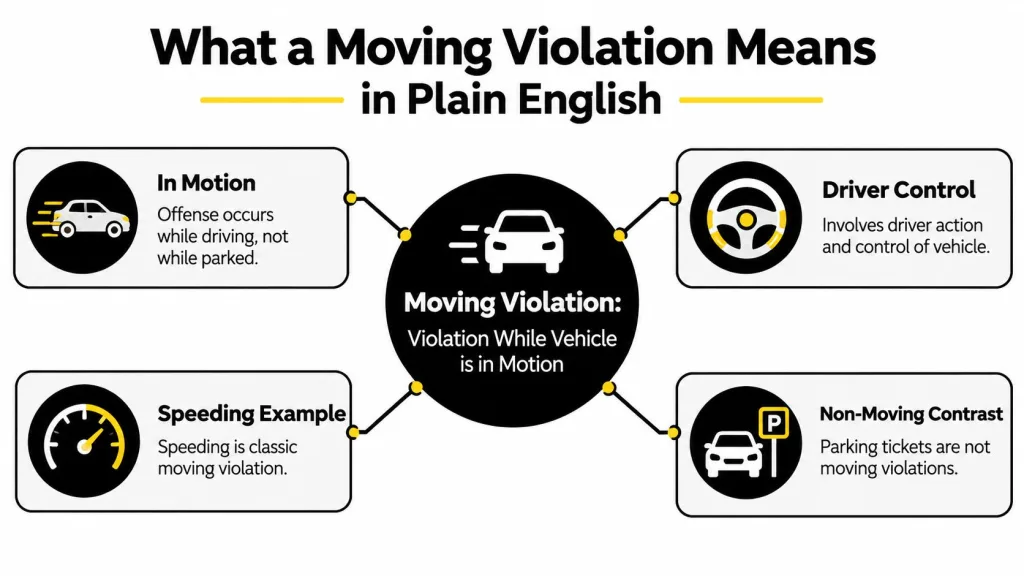
A moving violation is a traffic offense committed while the vehicle is in motion. The key question is simple: what was the vehicle doing when the alleged violation occurred? This plain-English explanation of moving violations in Florida provides the same starting point.
A moving violation occurs when a driver violates a traffic law while operating a vehicle in motion.
Speeding, an unlawful lane change, and failure to obey a traffic control rule all involve how the driver operates a moving vehicle. A parking citation addresses a stationary vehicle and where it is left. Paperwork or equipment problems may fall outside the moving-violation category, depending on the specific law.
The motion test
Consider two scenarios at a shopping center. One driver parks in a restricted space and receives a parking citation. Another drives through the lot too quickly and receives a speeding citation. The first citation concerns the vehicle’s location while stationary. The second concerns the driver’s control of a moving vehicle.
That difference matters because moving violations address driving behavior and roadway risk. Speeding reflects how the driver controlled the vehicle while traveling through traffic, rather than a problem with paperwork or equipment. It therefore belongs in the same broad category as other offenses involving vehicle operation.
Florida lists unlawful speed in its license point schedule. Washington’s administrative code also defines a moving violation as a vehicle-law violation committed while the vehicle is moving, including driving too fast for conditions and exceeding the maximum speed limit, as explained in this background on moving-violation definitions.
Why the label matters
The classification helps determine what may follow a conviction or other resolution. A moving violation can affect the driving record, lead to points, prompt an insurance review, or make a driver-improvement course relevant.
A non-moving citation generally concerns a different type of conduct. It can still require attention, but its administrative path and consequences may differ. Florida traffic-citation guidance lists speeding among moving violations that may assess points against a driver’s record (Miami-Dade Clerk traffic citation guidance).
For a Florida driver, the practical answer is direct: speeding is a classic moving violation because the alleged offense occurred while you were controlling a moving vehicle. That label explains why the ticket belongs on the DMV side of the analysis. Insurance companies may evaluate the same event separately, so the moving-violation classification does not by itself determine every financial consequence.
How Florida Treats Speeding as a Moving Violation
A driver cited for going slightly over the limit and a driver involved in a crash can both have speeding convictions, but Florida does not assign them the same point value. The speed above the lawful or posted limit and the crash result determine where the conviction falls in the license point schedule.
Florida’s speeding point schedule
Florida assigns:
- 3 points: Speeding 15 mph or less over the lawful or posted speed.
- 4 points: Speeding more than 15 mph over the lawful or posted speed.
- 6 points: Speeding when the conviction results in a crash.
These categories connect the speeding conviction to the driver’s license record. The applicable point schedule appears in Florida Statute section 322.27.
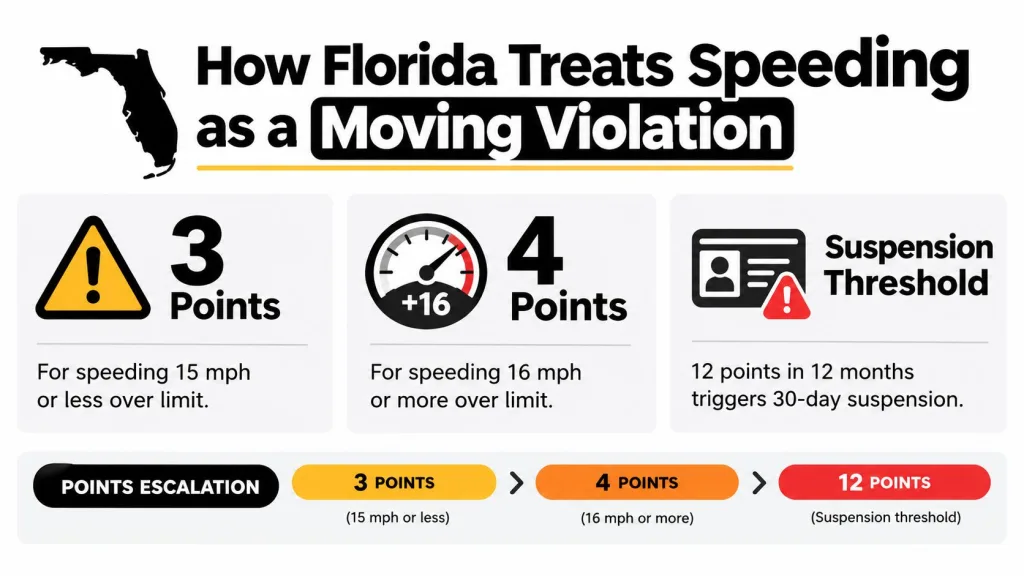
A useful analogy is a license ledger. The ticket creates an entry, and the entry’s value depends on the circumstances. A modest speeding conviction may add 3 points, while a higher speed may add 4 points. A crash-related conviction falls into the 6-point category.
How points can accumulate
Florida also measures point totals across specific time periods:
| Point accumulation | Potential suspension |
|---|---|
| 12 points in 12 months | Up to 30 days |
| 18 points in 18 months | Up to 3 months |
| 24 points in 36 months | Up to 1 year |
These thresholds explain why a ticket deserves attention even when the point total seems small. One conviction may add 3, 4, or 6 points, and later moving violations can bring the driver closer to a suspension threshold.
The point system and insurance system are separate tracks. The DMV uses the conviction and its assigned points for licensing consequences. An insurer may review the same moving violation when evaluating driving risk, so avoiding or reducing points does not automatically answer the insurance question.
The following video provides another explanation of Florida traffic violations and driver improvement options:
Fines Insurance and Hidden Costs of a Speeding Ticket
A Florida speeding ticket can create two different financial concerns. The first is the civil fine connected to the citation. The second is the possibility that an insurer treats the moving violation as evidence of higher driving risk.
Florida’s unlawful-speed fine schedule rises with the amount over the limit. The statutory schedule lists the following amounts (Florida Statute section 318.18):
| Speed Over Limit | Fine Amount |
|---|---|
| 1 to 5 mph | Warning |
| 6 to 9 mph | $25 |
| 10 to 14 mph | $100 |
| 15 to 19 mph | $150 |
| 20 to 29 mph | $175 |
| 30 mph or more | $250 |
The fine doesn’t tell you whether points will be assessed. The points depend on the moving-violation schedule and the circumstances of the conviction, while the fine depends on the speed range listed in the statute.
DMV points and insurance pricing aren’t the same
Many drivers get confused. DMV points are a licensing consequence. Insurance pricing is a separate risk decision.
An insurer may review the driving record and consider a moving violation even when the driver isn’t focused on the point total. Major insurers explain that a ticket can affect premiums because companies evaluate the record, not merely whether a point was added. Speeding tickets may remain relevant for insurance pricing for roughly 3 to 5 years, depending on the insurer and the driver’s situation (Progressive explanation of ticket and insurance effects).
That distinction matters in practical terms. A driver might say, “I avoided points, so insurance can’t be affected.” That conclusion isn’t always safe. The insurer may use its own underwriting rules and review the event as part of the driver’s history.
A citation can therefore create several separate questions:
- What fine applies?
- Will points be assessed?
- Can the violation move me toward suspension?
- How will my insurer evaluate the record?
- Am I eligible to elect traffic school?
Paying the fine answers only the first question. Before choosing that route, review your ticket and contact the clerk listed on it. If the citation is eligible for driver improvement, traffic school may address the point component more effectively than paying and moving on. You can also review the connection between a Florida speeding citation and license points in this Florida speeding-ticket points guide.
How Traffic School Can Keep Points Off Your Record
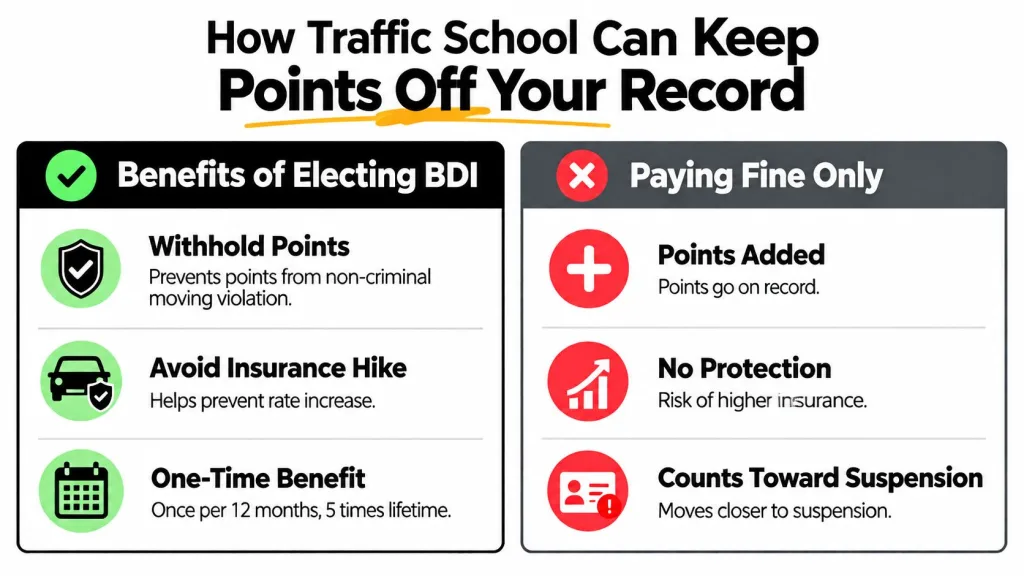
For a qualifying non-criminal moving violation, Florida law allows a driver to elect a Basic Driver Improvement course, commonly called BDI. The election isn’t automatic, and eligibility depends on the citation and the driver’s circumstances, so the first step is checking with the appropriate clerk of court.
A qualifying driver who elects BDI and completes the approved course may avoid points being added to the license record. Florida’s course information also explains that adjudication of guilt may be withheld when the election is allowed, and the process is specifically designed for eligible moving violations (Florida Basic Driver Improvement course information).
Paying the fine versus electing BDI
Paying the fine may close the immediate payment obligation, but it doesn’t automatically solve the point or insurance questions. Electing an eligible BDI course creates a different path, one that focuses on completing driver education and handling the moving violation under Florida’s traffic-school rules.
Independent Florida traffic-school guidance notes that eligible course completion can keep points off the driving record, may reduce or avoid insurance premium increases, and may sometimes reduce the civil fine depending on the county (Florida traffic-ticket school overview). Those outcomes aren’t guaranteed for every driver or every citation, so confirm the terms before enrolling.
A busy professional might complete the approved course online after work, during a lunch break, or over a weekend. The value isn’t just convenience. A structured course gives the driver a chance to review following distance, speed control, defensive driving, crash avoidance, and the decision-making habits that led to the citation.
The goal isn’t merely to finish a requirement. It’s to prevent one rushed decision from becoming a pattern.
BDISchool offers a Florida-approved online BDI option for eligible drivers, with self-paced access and electronic certificate reporting. DriverEducators also provides Florida traffic-school course options for drivers who need a state-compliant educational path.
Before enrolling, confirm these details:
- Eligibility: Ask the clerk whether your citation qualifies.
- Election: Complete the election through the required court or clerk process.
- Course: Enroll in the approved BDI program and finish all requirements.
- Reporting: Confirm that completion is reported to the FLHSMV as required.
- Record review: Keep your certificate and verify that the disposition matches your election.
Insurance questions can remain separate from DMV points. Drivers who want broader context about policy treatment can review how minor violation forgiveness works from Professional Insurance Advisors, LLC.
If you believe the citation contains an error or you want to contest the charge rather than elect traffic school, review the available process in this guide to fight a speeding ticket in Florida. Traffic school and fighting a ticket are different choices, and the better route depends on the facts and your eligibility.
Choosing the Right Florida Course for Your Situation
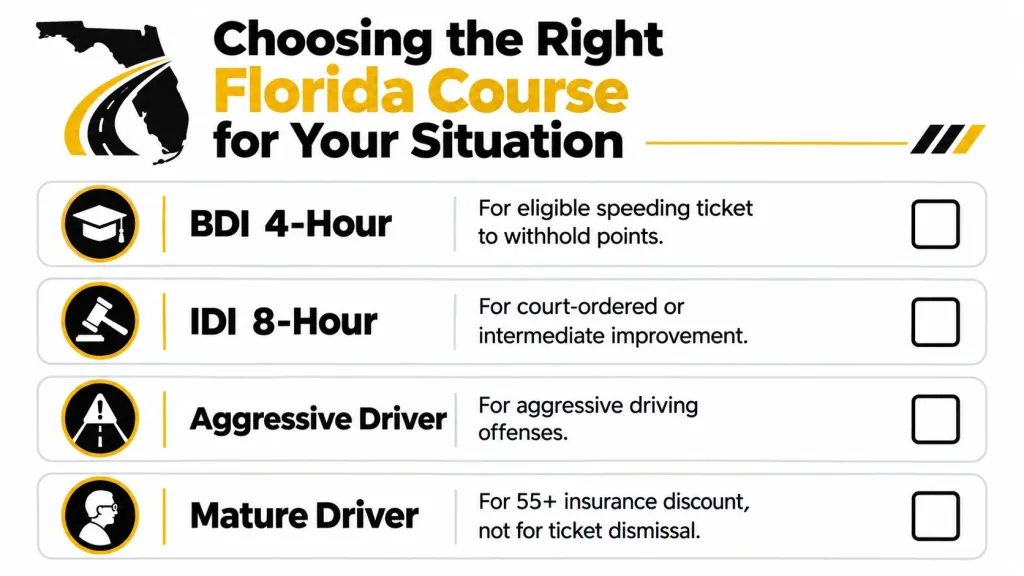
The right course depends on why you’re enrolling. A driver handling an eligible speeding citation may need BDI, while a court order, aggressive-driving history, or insurance-discount goal can point to a different program.
Match the course to the situation
BDI, Basic Driver Improvement: This is the usual starting point for a qualifying, non-criminal moving violation. The course is commonly described as a 4-hour program, and it may help an eligible driver avoid points when the required election and completion steps are followed (Florida Basic Driver Improvement course information).
IDI, Intermediate Driver Improvement: An IDI course is an 8-hour program for court-ordered drivers or drivers directed to complete intermediate improvement. Don’t substitute BDI if your court paperwork specifically requires IDI.
Aggressive Driver Course: This is an 8-hour course focused on aggressive driving, road rage, responsibility, and behavior change. It isn’t the same as electing BDI for an ordinary eligible speeding citation.
Mature Driver Course: This is a 6-hour refresher for drivers aged 55+ who are seeking an insurance discount. It isn’t a ticket-dismissal or point-withholding course.
Check the administrative details first
Read the citation carefully and identify the clerk of court handling it. Ask whether the speeding ticket is eligible for BDI, whether you must make the election before enrolling, and what deadline applies.
The course experience should fit your schedule and learning needs. BDISchool and DriverEducators offer self-paced online access from a device, with course materials available in English, Spanish, and Portuguese. Certificates are issued electronically and reported directly to the FLHSMV according to the provider’s stated process.
A simple decision checklist can keep you from choosing the wrong program:
- First-time eligible speeding ticket: Check BDI eligibility with the clerk.
- Court order: Follow the exact course named by the court, which may be IDI.
- Aggressive-driving requirement: Use the aggressive driver program if ordered.
- Insurance discount for a mature driver: Review the mature driver course requirements with your insurer.
- Unclear status: Contact the clerk before paying, electing, or enrolling.
The online format can help a parent, shift worker, student, or professional complete the material without arranging repeated classroom visits. Still, convenience doesn’t replace compliance. Save the electronic certificate, watch for confirmation, and make sure the court receives the completion information.
Drivers who want to compare course features and formats can review this guide to the best online traffic school in Florida. The important choice is not the most attractive course title. It’s selecting the program that matches the citation, court instruction, and intended outcome.
Protect Your Record and Drive Forward With Confidence
A speeding ticket is a moving violation in Florida because it concerns how you operated a vehicle while it was in motion. The point schedule assigns 3 points for 15 mph or less over, 4 points for more than 15 mph over, and 6 points when the speeding conviction results in a crash (Florida Statute section 322.27).
The practical lesson is to separate the systems. The fine is one issue. DMV points and suspension thresholds are another. Insurance companies can also evaluate the moving violation independently, so avoiding or withholding points doesn’t necessarily answer every insurance question.
For an eligible non-criminal moving violation, Florida’s 4-hour BDI course can offer a path to keep points from being added when the driver properly elects and completes the program. Check eligibility with the clerk, follow the election deadline, and confirm the completion report.
Commercial drivers should be especially careful before treating a speeding citation as routine. A separate resource on the impacts of speeding for CDL drivers can help explain why professional drivers need to review consequences beyond the standard passenger-license process.
Don’t let a short highway stop become a long-term record problem. Review the citation, verify your options, and use the experience to strengthen your speed awareness and defensive-driving habits.
BDISchool offers Florida-approved online traffic courses, including BDI for eligible moving violations, with flexible self-paced access and electronic completion reporting. Visit BDISchool to check the course that matches your speeding ticket and start taking action before the clerk’s deadline.