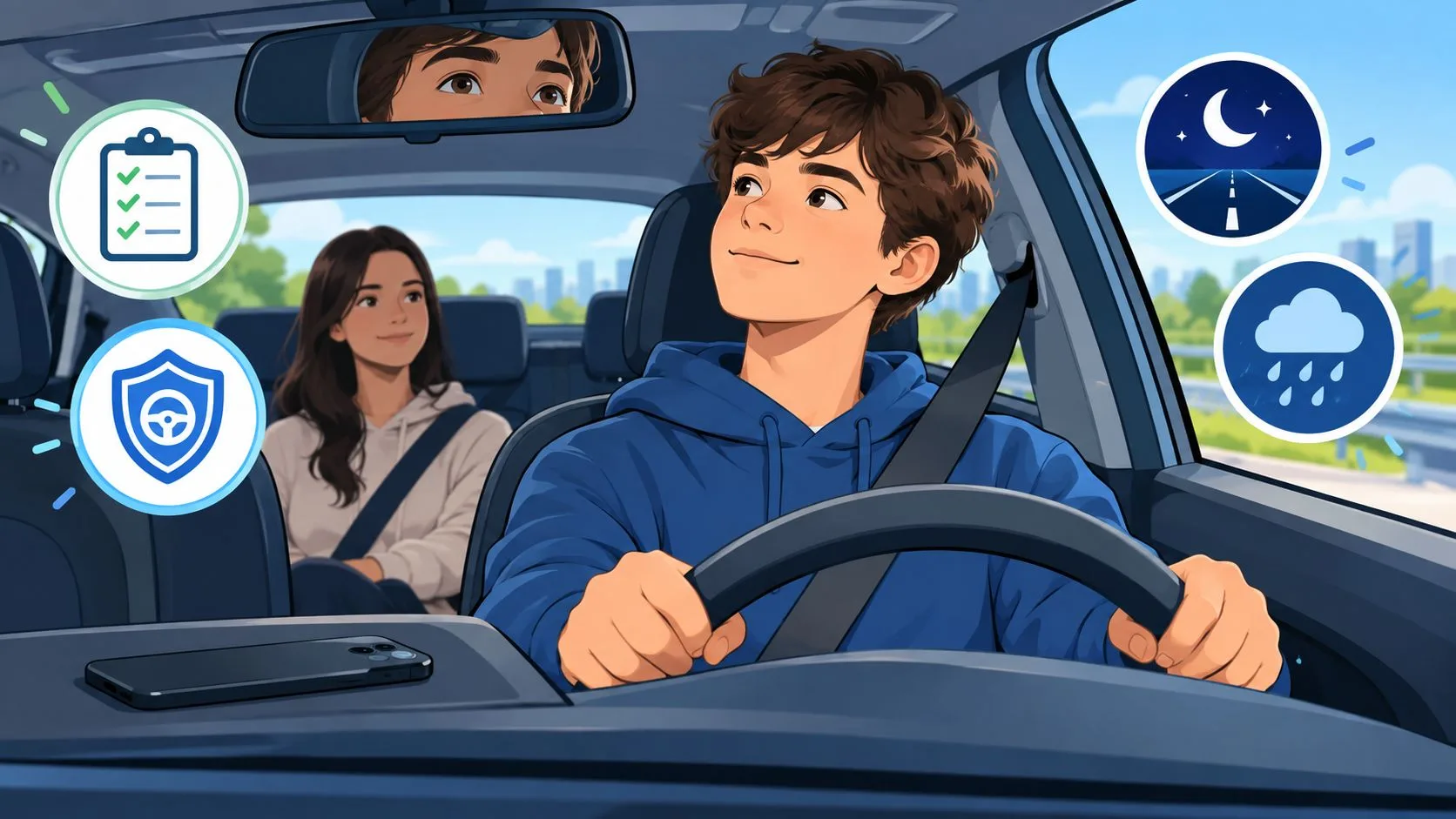
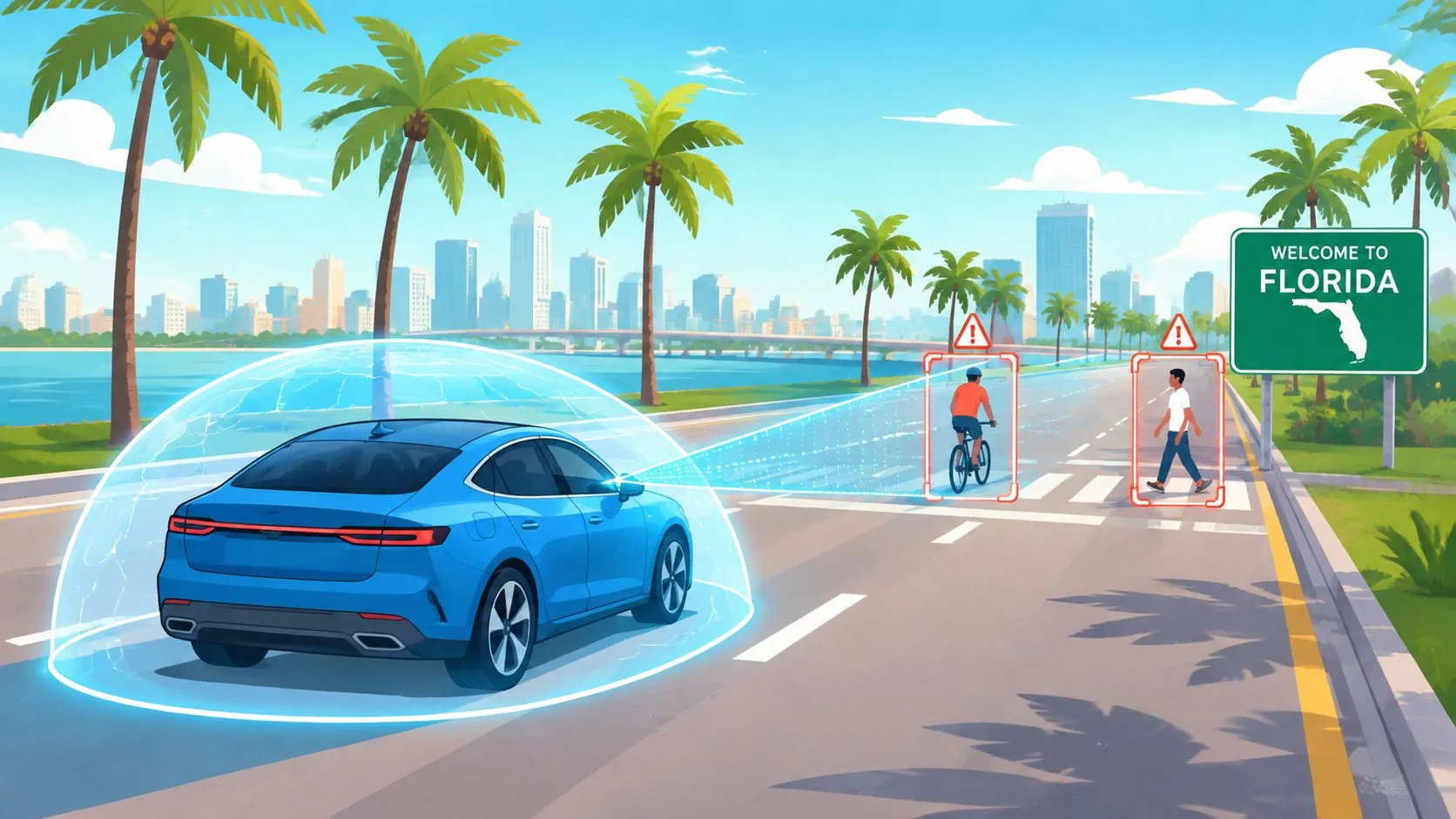
Your 16-year-old pulls out of the driveway at dusk with three friends in the car. The phone is sitting on the passenger seat, and you're watching from the porch, trying to remember which Florida restrictions apply right now. You want to protect your child, but another lecture about “being careful” won't tell either of you what to do before the next drive.
Teen driving safety works better as a staged family program. Florida's graduated driver licensing rules provide the framework, but parents must turn those rules into supervised practice, repeatable habits, a signed agreement, and consistent monitoring. The risk is not solved when a teen passes a test. It changes as the teen gains experience, encounters new road conditions, and begins driving without an adult.
This guide gives you a practical seven-step path built around Florida milestones. It won't use fear as a substitute for instruction or bury you in generic warnings. It will identify the rules that deserve enforcement, explain how to build driving skill in stages, and show where structured courses can close gaps that home practice often leaves behind.
Why a Family Plan Beats Another Talk
A one-time conversation usually fails because it asks a novice driver to remember broad advice under pressure. “Pay attention” doesn't explain what to scan, “slow down” doesn't define a safe speed choice, and “don't use your phone” leaves room for the familiar exception, such as checking a message at a red light.
The danger is concentrated during the transition from supervised practice to independent driving. IIHS research on teenagers reports that teen drivers have crash rates over four times those of drivers aged 20 and older per mile driven, while fatal crash rates for drivers ages 16 to 19 are about three times higher than those of older drivers. Those figures support a training plan based on risk, not a family ritual of repeating the same warning.
Practical rule: If a safety expectation can't be observed, practiced, and reviewed, it isn't a family rule. It's a wish.
A strong Florida plan has several layers:
- Milestones: Track the learner-license period, supervised hours, night hours, and license dates.
- Habits: Make the phone, seat belt, mirrors, tires, lights, and weather checks part of every departure.
- Practice: Move from an empty lot to residential streets, city roads, and highways only after a skill check.
- Contract: Write down phone, speed, passenger, curfew, maintenance, and consequence rules.
- Monitoring: Review driving behavior without turning every trip into an argument.
- Training: Use a structured course when the teen needs clear instruction beyond informal family coaching.
- Review: Revisit privileges as the teen demonstrates judgment, not because time has passed.
Parents often waste energy debating small issues while ignoring the big three: phone use, speed, and passengers. Those are the behaviors that need a clear rule and a predictable consequence. The safe-driving apps discussed by BDISchool can support monitoring, but no app replaces a parent who sets limits before handing over the keys.
Florida's GDL system gives families a useful sequence. Own each milestone, practice deliberately, and make independent driving an earned privilege rather than an automatic reward for passing the road test.
Florida GDL Rules Every Parent Should Own
Florida's learner-license period is not a brief waiting room before independence. A teen must hold a learner's license for at least 12 months or until age 18, complete 50 hours of supervised driving, and include 10 hours at night in that log. These requirements are summarized in Florida's graduated driver licensing guidance.
The parent's job is to turn each requirement into something verifiable. Don't accept “I've driven enough.” Review the log, witness night practice, and mark the expected license-upgrade date on the family calendar.
The milestones that matter
| Stage | Minimum Age | Supervised Hours | Night Hours | Curfew | Passenger Limit |
|---|---|---|---|---|---|
| Learner's license | 15 | 50 | 10 | Licensed driver aged 21 or older in the front seat | Adult supervision required |
| First three months after licensure | 16 | Completed before licensure | Completed before licensure | Daylight only | Florida restrictions apply |
| After the first three months, during the restricted period | 16 | Completed before licensure | Completed before licensure | Until 10 p.m. | Florida restrictions apply |
| First six months of unsupervised driving | 16 | Completed before licensure | Completed before licensure | Follow the applicable Florida restriction | No unrelated minors under 18 |
| Later restricted licensure | 16 to 17 | Completed before licensure | Completed before licensure | Follow the applicable Florida restriction | Follow the applicable Florida restriction |
The table is a planning tool, not a substitute for checking the current license conditions attached to your teen's credential. Florida's published teen-driver guidance requires the learner to drive with a licensed driver aged 21 or older in the front passenger seat at all times. A learner's license doesn't authorize unsupervised public-road driving.
The same guidance requires daylight-only driving during the first three months after licensure, followed by a restriction to driving until 10 p.m. after that period. It also requires no unrelated minors under 18 during the first six months of unsupervised driving. Parents should treat those limits as minimum legal boundaries, not as the family's entire safety plan.
The rules parents should make non-negotiable
Cell phone use is prohibited for any driver under 18 in any zone, so don't create a loophole for red lights, navigation searches, or "just one quick glance." Store the phone out of reach, silence it before the engine starts, and require the teen to pull over safely if a call or message needs attention.
Night practice needs careful planning. Parents who want a plain-language explanation of the permit rules and night driving restrictions can review whether you can drive at night with a permit, then apply the rule to the teen's actual license status.
Put these clauses in the family contract:
- No phone in hand or within reach while driving.
- No driving outside the applicable curfew.
- No passengers beyond the legal and family limit.
- No solo driving until the parent signs off on readiness.
- Every supervised hour gets logged accurately.
- Every night hour is identified and reviewed.
- The vehicle check happens before the key turns.
The 60-second departure routine
The teen should own a short inspection before every trip. For the first month, require the routine verbally. After that, let the teen perform it independently and treat consistency as evidence of responsibility.
- Tires: Take a visual tread and pressure glance. A soft tire or damaged tread can change braking and steering before the teen notices a problem.
- Lights: Confirm headlights, brake lights, and turn signals with a walk-around. A failed signal can turn a normal lane change into a dangerous surprise for another driver.
- Mirrors and seat: Adjust the seat and mirrors before starting the engine. Fixing the driver's position after moving means attention is already divided.
- Interior scan: Remove loose objects, store and silence the phone, and click every seat belt. A loose bottle can roll under a pedal, while an unbuckled passenger can suffer serious harm in a crash.
- Weather equipment: Check windshield wipers and washer fluid before Florida's summer storms. Confirm that the air conditioning and defrost work well enough to maintain visibility in heat and humidity.
- Fuel: Read the gauge and avoid highway trips below a quarter tank. Running low leaves less margin when traffic, weather, or a detour slows the trip.
The routine takes about a minute, but it creates a repeatable decision point. The teen either confirms readiness or fixes the problem before moving.
A Staged Practice Curriculum From Parking Lot to Highway
Mileage alone doesn't prove readiness. A teen can drive the same easy route repeatedly and still lack the judgment needed for a wet merge, a blocked sightline, or a sudden stop. Practice should add one meaningful challenge at a time, with the supervising adult holding veto power at every gate.

Stage 1, closed-lot fundamentals
Start in an empty lot. Work on seating position, mirror setup, smooth throttle and brake modulation, low-speed turns, backing, and controlled emergency stops from 15 mph.
The skill check is simple. The teen must stop smoothly, maintain control through repeated turns, reverse without drifting toward hazards, and explain what the mirrors show. If the movements are jerky or the teen can't describe the scan, stay in the lot.
Stage 2, quiet residential streets
Move to daylight residential streets after the teen controls the vehicle at low speed. Practice complete stops, neighborhood intersections, pedestrian scanning, speed control, and a three-second following distance.
The gate is consistent observation. The teen must identify driveways, parked vehicles, sidewalks, and possible crossing points before reaching them. One successful trip isn't enough. The parent should see the same standard across several supervised drives.
Stage 3, two-lane roads and city traffic
Add two-lane roads, school zones, busier intersections, and a first limited-access on-ramp in dry, low-traffic conditions. The teen must hold a learner's license, and the supervising adult must be comfortable with the route and the traffic level.
Before moving forward, require clean lane positioning, correct yielding, controlled speed changes, and calm decisions when another driver behaves unpredictably. Parents should use emergency maneuver training to supplement, not replace, ordinary road practice.
Stage 4, highway and complex conditions
Highway merging, multiple-lane changes, rain practice, and dusk drives come last. Add them only when the teen has demonstrated reliable scanning, space management, and speed control, and when Florida's night-driving limits allow the trip.
The final gate is judgment under changing conditions. A teen who can merge in dry traffic may still need more practice before driving in heavy rain or at dusk. Align each stage with the supervised-hour log, but don't turn the 50-hour requirement into busywork. Count mastery, not just time.
Defensive-Driving Rules That Actually Save Lives
Parents often create long lists because long lists feel thorough. They're usually impossible to enforce. Three rules deserve the family's strongest attention: phone down, speed managed, passengers limited.
Rule one, the phone stays away
The phone goes out of sight and out of reach when the engine starts. No mount, no red-light exception, and no “quick glance” to check a notification.
NTSB cites NHTSA research showing that dialing a phone while driving increases a teen's crash risk sixfold, while texting increases it 23-fold. Those figures appear in NTSB's teen-driver safety discussion. The exact mechanism doesn't matter during a family argument. A phone creates a competing task, and a new driver has limited spare attention.
Rule two, speed gets managed before the trip
Agree on a speed buffer below every posted limit, adjusted for traffic, rain, visibility, and road design. Treat 10 mph over the limit as an automatic contract violation.
Speed was a factor in 30% of fatal crashes involving passenger-vehicle teen drivers in 2022, according to the NTSB summary of NHTSA data. A lower self-imposed speed ceiling gives a novice more time to recognize a hazard and more distance to stop.
Rule three, passengers are a privilege
Florida's legal passenger restrictions provide the floor. During the first six months of unsupervised driving, set a stricter family ceiling if possible. AAA Foundation research found that for 16- or 17-year-old drivers, death risk per mile rises 44% with one passenger under 21, doubles with two, and quadruples with three or more, as reported in the foundation's passenger-risk research.
For better mirror awareness, some families also consider stick-on blind spot mirrors as a visual aid. They can help expose areas the regular mirrors miss, but they don't replace shoulder checks or proper lane-change timing.

Watch this demonstration together, then practice the behaviors during ordinary drives.
Parents who need structured instruction can use defensive driving techniques as a lesson framework. Enforce fewer rules consistently instead of reciting many rules inconsistently.
Your Parent and Teen Driving Contract
A contract turns family expectations into operating conditions. Write it together, sign it the same evening, and review it after 90 days.
Use plain clauses:
- License commitment: The teen follows every learner-license and graduated-license restriction.
- Phone commitment: The phone stays out of sight and out of reach from engine start until the vehicle is parked.
- Speed commitment: The teen maintains the family's agreed buffer below posted limits and accepts a contract violation for 10 mph over.
- Passenger commitment: The teen follows Florida's passenger restriction and the stricter family cap during unsupervised driving.
- Curfew commitment: The teen follows the applicable Florida night-driving restriction, including daylight-only driving during the initial restricted period.
- Insurance commitment: The teen is listed on the family policy as required by the insurer, and reports any at-fault fender bender within 24 hours.
- Maintenance commitment: The teen performs the pre-drive inspection and reports warning lights, tire problems, damaged lights, or visibility issues.
- Privilege commitment: Expanded solo access follows earned supervised hours and demonstrated skill, not a calendar date alone.
Consequences should be predictable rather than emotional. A first phone violation means loss of keys for one week. A second means loss of keys for one month. A third triggers a request to suspend driving privileges and review whether the teen should continue toward independent driving.
| Clause | What It Covers | Tier 1 Consequence | Tier 2 Consequence |
|---|---|---|---|
| Phone | No handling or checking while driving | Keys withheld for one week | Keys withheld for one month |
| Speed | Family buffer and automatic violation threshold | Restricted routes and review | Loss of solo privileges |
| Passengers | Legal limit and stricter family cap | Passenger privilege removed | Solo access suspended |
| Curfew | Florida restriction and family schedule | Evening driving removed | Driving privileges reviewed |
| Reporting | Crashes, tickets, and vehicle damage | Immediate privilege review | Driving paused pending retraining |
Leave signature lines for the parent and teen, then write the review date at the bottom. The contract should protect the relationship by removing negotiation from the moment when emotions are highest.
Monitoring Tools, Insurance Discounts, and Course Options
Monitoring tools serve different purposes, and parents should choose based on the behavior they need to see. Insurer telematics and active coaching apps aren't interchangeable.
| Option | What It Does | Typical Florida Savings or Cost | Best For |
|---|---|---|---|
| Progressive Snapshot | Insurer-based telematics that records driving behavior | May affect premiums, depending on program results | Families comfortable sharing trip behavior with an insurer |
| GEICO DriveEasy | Insurer-based driving feedback | May affect premiums, depending on program results | Policyholders seeking carrier-linked feedback |
| Allstate Drivewise | Telematics-based driving monitoring | May affect premiums, depending on program results | Families already using Allstate |
| Life360 | Active family location and driving alerts | App-dependent cost and features | Parents wanting trip visibility |
| AT&T DriveMode | Driving-focused phone controls | Plan and feature availability vary | Families emphasizing phone interruption control |
| Verizon Hum | Connected vehicle and coaching features | Device and subscription terms vary | Families wanting vehicle-connected monitoring |
| BDISchool courses | Online Florida-approved traffic-safety education | Course fee varies by selected program | Teens and drivers needing structured education or an eligible certificate |
Telematics can affect premiums and may surface hard braking or other driving events to the carrier. That transparency can help a careful driver, but parents should read the insurer's terms before enrolling. Coaching apps can send parents alerts without necessarily changing the insurance rate, though features and costs depend on the product.
Potential Florida discount categories include good-student, driver-education, multi-policy, and low-mileage discounts. Availability, eligibility, and stacking rules are controlled by the insurer, so ask the carrier for written confirmation instead of assuming every discount applies.
Families comparing coverage should also build a broader financial foundation with insurance before adding a newly licensed teen. A lower premium matters, but the policy must still match the household's actual drivers and vehicles.
The certification layer has a separate purpose. A Florida-approved basic driver-improvement course may satisfy a court order or help with point-related consequences, while a voluntary course may be considered by an insurer for a discount. The carrier decides whether a completed course qualifies for a premium reduction.
BDISchool offers Florida-approved online courses, including a four-hour Basic Driver Improvement course, an eight-hour Intermediate Driver Improvement course, and an eight-hour Aggressive Driver Course. The courses are self-paced, available in English, Spanish, and Portuguese, and certificates are issued electronically and reported to the FLHSMV according to the publisher's stated process. Confirm the exact course, court, and insurer requirements before registering.
Florida Teen Driving Safety FAQ
Why are the first months of independent driving so risky?
The first six months after full licensure are the highest-risk period for novice teens, according to the CDC's graduated driver licensing guidance. The main problem is limited experience with hazard perception, speed judgment, traffic, passengers, distraction, and night conditions.
Keep the first months deliberately narrow. Limit passengers, delay unnecessary night trips, monitor phone compliance, and expand routes only after the teen demonstrates reliable judgment.
How much does one teen passenger change the risk?
Passenger presence can sharply increase risk because peers create distraction and encourage social decision-making. AAA Foundation research found that one passenger under 21 raises death risk per mile by 44% for a 16- or 17-year-old driver, while two passengers double it and three or more quadruple it.
Florida's legal passenger restriction is the minimum. A family contract should use a stricter cap while the teen is still developing judgment.
What are Florida's night-driving restrictions?
A Florida teen with a learner's license must drive with a licensed driver aged 21 or older in the front seat. After licensure, Florida requires daylight-only driving during the first three months, followed by driving only until 10 p.m. after that period, subject to the applicable license conditions.
Check the teen's credential and current FLHSMV guidance before approving a trip. Don't rely on a friend's interpretation of the rule.
Is a court-ordered course the same as a voluntary course?
No. A court may order a specific driver-improvement course after a violation, while a driver may voluntarily take a Florida-approved course for education, possible point-related benefits, or an insurance discount. The court, FLHSMV, and insurer determine which course counts and who pays.
Ask for the requirement in writing before enrolling. Course completion certificates and validity requirements can depend on the purpose and the receiving organization.
Does a parent's policy automatically cover a newly licensed teen?
Don't assume it. Contact the insurer before the teen begins regular solo driving and ask when the child must be added as a rated driver, which vehicle use is covered, and whether discounts apply.
The insurer's underwriting rules control the answer. Keep the teen's license status and household vehicle use current with the carrier.
What does a Florida learner's license allow?
It allows supervised practice on public roads under the applicable Florida conditions. The supervising driver must be licensed and at least 21 years old in the front seat, and the family should log supervised hours, including the required night practice.
Use the permit period to build skill across controlled conditions. A learner's license is permission to practice, not proof that the teen is ready for every road, passenger, weather pattern, or time of day.
BDISchool provides Florida-approved online driver education and traffic-safety courses that can support teens, parents, and drivers handling court or insurance requirements. Visit BDISchool to choose the course that fits your situation, complete the training on your schedule, and turn your family's teen driving safety plan into structured instruction.