You’ve just received a Florida traffic citation, or a court order telling you to complete an 8-hour driver improvement course. You’re looking at the paperwork and wondering whether any online class will satisfy the requirement. That uncertainty matters, because Florida courts may require a specific course, not any class that lasts eight hours.
The Florida 8 Hour Driver Improvement Course is generally an intermediate, court-directed program for drivers who need more than the standard 4-hour response. It can address repeat violations, a judge’s order, or other circumstances identified by the court. Florida’s system treats driver improvement as a regulated compliance option, so the correct course, provider, deadline, and reporting process all matter.
This guide will help you identify the course named in your paperwork, understand the curriculum, compare online and classroom formats, and verify that your county or judge accepts the certificate before you enroll. You can also review what traffic school means in Florida before making a decision.
Introduction to the Florida 8 Hour Driver Improvement Course
The short answer is simple: take the 8-hour course only when your citation, court order, or jurisdiction requires that specific level of instruction. It isn’t automatically interchangeable with a 4-hour Basic Driver Improvement course, an 8-hour Aggressive Driver course, or an 8-hour DWLS/R course.
Florida’s driver-improvement framework gives eligible drivers a defined period to elect Basic or Advanced Driver Improvement courses. The Florida Department of Highway Safety and Motor Vehicles states that the election must be made within 30 days of receiving the traffic citation. For the 8-hour driver-improvement path, FLHSMV also states that a driver with a non-criminal moving violation and no commercial driver license may elect an approved basic driver-improvement school once every 12 months, with a lifetime limit of 8 times.
Those limits show why timing and eligibility deserve attention. The course isn’t merely a set of videos to watch after a ticket. It’s part of Florida’s traffic-enforcement system, and your course choice needs to match your legal situation.
A practical example
Suppose a driver receives a citation and later receives paperwork directing them to complete an intermediate driver-improvement class. Searching for “8-hour traffic school” may produce several choices that look similar. Enrolling in the wrong one could leave the court requirement unresolved, even if the student completes every lesson.
The safest approach is to read the exact wording on the citation or order, identify the required course name, and confirm acceptance with the court that has jurisdiction. Online learning can make completion easier, but convenience doesn’t replace jurisdictional approval.
BDISchool and DriverEducators offer online traffic-school course options for students who need a flexible way to begin. Before paying, compare the course name with your paperwork and ask the clerk or court whether the online certificate will be accepted for your case.
Who Needs the 8 Hour Course and When It Is Required
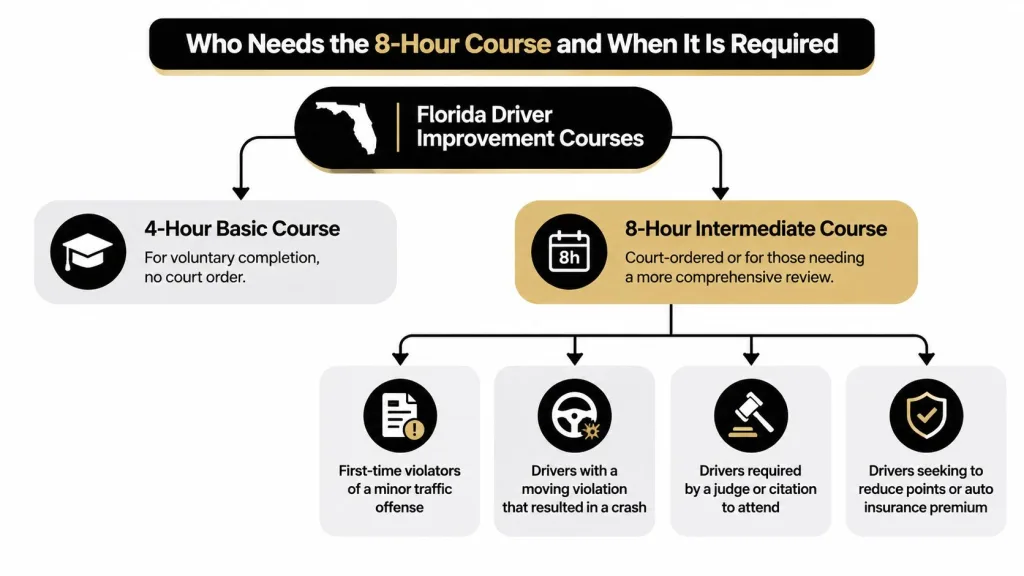
The 8-hour Intermediate Driver Improvement course is usually connected with court involvement or a need for more extensive remediation. Independent Florida traffic-school guidance describes it as an option commonly used after multiple recent non-criminal moving violations or when a judge orders attendance, while FLHSMV distinguishes Florida’s driver-improvement system by course length and category. See the state’s driver-improvement school information for the official framework.
The 4-hour Basic Driver Improvement course is different. It often serves as a first-response election for an eligible moving violation, subject to the state’s timing, license, and prior-use rules. The 8-hour course functions as a deeper intervention, much like first aid compared with a more extensive rehabilitation plan.
Use this yes-or-no filter
Ask these questions before you register:
- Does the paperwork name an 8-hour course? If the citation or order specifies Intermediate Driver Improvement, follow that wording rather than choosing a different class.
- Did a judge or hearing officer order attendance? Court-directed attendance usually controls the course type and completion deadline.
- Is the issue connected with repeat violations or a more serious compliance concern? Independent provider guidance associates the 8-hour Intermediate route with these situations, but your court paperwork remains the controlling document.
- Are you assuming the 4-hour option is enough? Don’t make that assumption if the order clearly requires eight hours or names a particular category.
- Do you hold a commercial driver license? FLHSMV’s eligibility statement for the basic driver-improvement election excludes drivers with a commercial driver license, so confirm your specific status and course requirement before enrolling.
The state’s limits also matter for drivers considering a voluntary basic course. FLHSMV identifies a once-every-12-month limit and an 8-times-lifetime cap for the applicable basic election, alongside the 30-day election window. Those rules don’t turn every 8-hour court order into a basic-course election.
A separate license problem may require different guidance. If your matter involves suspension or reinstatement, this resource on how to reinstate a Florida license can help you understand why a driver-improvement class may not resolve every licensing issue.
For court-directed enrollment, review the guidance on court-ordered driving school and verify the exact requirement with the clerk before starting.
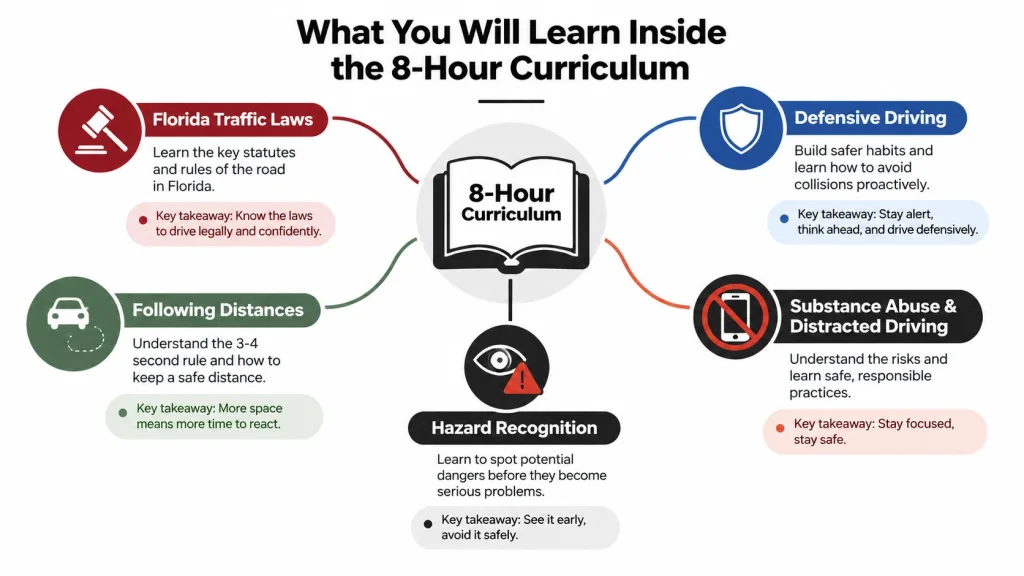
What You Will Learn Inside the 8 Hour Curriculum
An 8-hour intermediate curriculum is designed to do more than review isolated rules. It connects Florida traffic law with the decisions that lead to violations, near misses, and crashes. The strongest lessons help you recognize a risky situation early enough to change your response.
A typical learning path begins with Florida traffic laws and rules of the road. You may revisit right-of-way, traffic-control devices, lane use, speed management, and the responsibilities that apply when road conditions change. The purpose isn’t to memorize legal language for its own sake. It’s to make the correct decision more automatic when traffic becomes complicated.
From rules to usable driving habits
Defensive driving focuses on what you can do before another driver’s mistake becomes your emergency. That includes scanning ahead, keeping escape options open, adjusting for weather and visibility, and avoiding assumptions about what another road user will do. The defensive driving techniques course information offers a useful companion to these principles.
Following distance receives practical attention because a driver needs time to perceive, decide, and brake. A vehicle that feels safely spaced on a clear road may be too close when traffic slows, visibility drops, or a driver ahead stops unexpectedly.
Risk recognition and behavior
The curriculum also addresses aggressive driving, distracted driving, and impaired driving prevention. A driver who checks a phone at a light may still be distracted when traffic begins moving. A driver who feels angry after being cut off may need a deliberate strategy, such as increasing space and allowing the other vehicle to move away.
Crash avoidance lessons bring these topics together. You learn to identify hazards, choose a safer speed, communicate clearly, and reduce the chance that one poor decision creates a chain reaction.
The course also examines attitude behind the wheel. Patience, judgment, and responsibility affect how drivers interpret risk. That behavioral focus is important for repeat-violation situations because compliance is stronger when the student understands why a habit must change, not just which answer appears on a test.
Course materials may include explanations, visuals, and real-life scenarios. Florida-approved programs are also expected to reflect applicable traffic-law changes, roadway technology, and safety concerns, so students aren’t relying only on outdated driving advice.
Online vs Classroom Options and State Approval Explained
Online learning is often the practical choice for a busy Florida driver, but online availability doesn’t answer the approval question by itself. You need to confirm that the specific course and certificate format will satisfy the court handling your case.
Online self-paced courses let students study around work, family, and travel. BDISchool and DriverEducators describe online course access in English, Spanish, and Portuguese, with learning available from a range of devices. A classroom course may suit students who prefer a scheduled environment, direct instructor interaction, and a fixed location.
| Feature | Online Self Paced | Classroom In Person |
|---|---|---|
| Schedule | Study when your schedule allows | Attend according to the provider’s class schedule |
| Location | Complete lessons remotely where the provider permits | Travel to the classroom location |
| Learning style | Self-directed lessons with digital materials | Instructor-led discussion and group setting |
| Language access | May be available in English, Spanish, and Portuguese, depending on the provider | Confirm the class language before registration |
| Court acceptance | Verify the online certificate with the court that has jurisdiction | Confirm that the specific classroom course meets the order |
| Completion record | Follow the provider’s certificate and reporting process | Follow the provider’s certificate and reporting process |
State approval is not the same as court acceptance
Florida’s 8-hour category has a technical nuance that many enrollment pages overlook. Some 8-hour Intermediate Driver Improvement programs are not regulated in exactly the same way as FLHSMV-approved basic courses, and the court may be the controlling authority. Independent provider guidance recommends confirming acceptance with the court before beginning.
Practical rule: Read the course name on the order, then ask the clerk whether an online certificate from your chosen provider will satisfy that order.
Ask specifically whether your county accepts the online format, whether the provider must appear on a particular list, how the certificate should be delivered, and whether the court expects electronic reporting or a separate submission. Keep the clerk’s instructions with your enrollment records.
This check protects you from paying for a course that teaches useful material but doesn’t close your case. It also prevents confusion between a state-approved basic election and a court-controlled intermediate requirement.
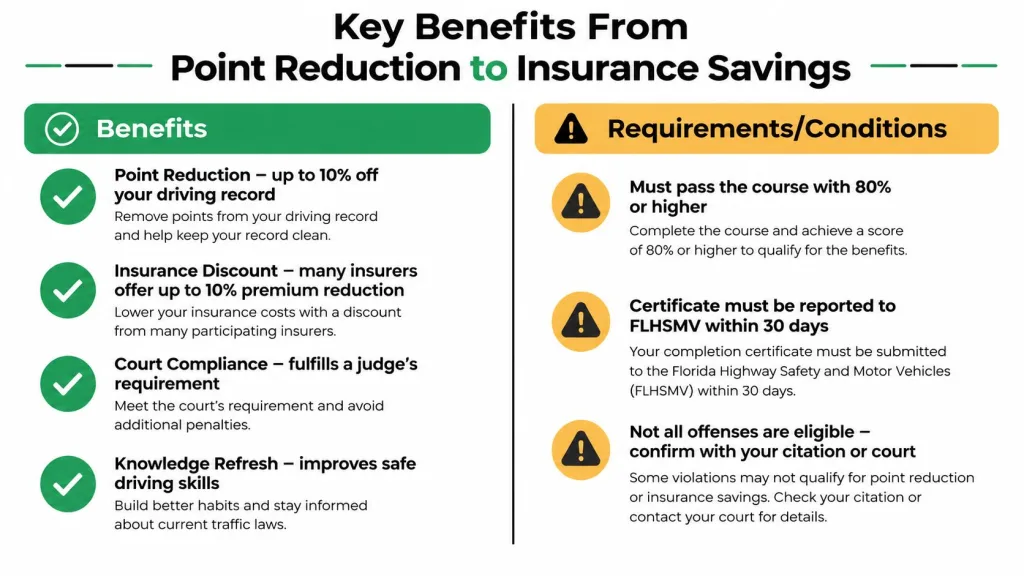
Key Benefits From Point Reduction to Insurance Savings
The most reliable benefit of an 8-hour course is compliance with the order that applies to your case. Completing the required class can demonstrate that you followed the judge’s instruction and addressed the driving concern identified by the court.
Other outcomes depend on the violation, the course category, the court, and your insurer. Don’t assume that every 8-hour course automatically removes points or produces an insurance discount. The legal effect of a basic election may differ from the effect of a court-directed intermediate class.
What the course can help you accomplish
- Court compliance: A properly completed course may satisfy the educational component ordered by a judge or hearing officer, provided the court accepts that course and certificate.
- Record management: A course can help you address the matter through the option available to you, but point treatment must be confirmed from the citation, court, or FLHSMV.
- Insurance conversations: Some insurers may offer savings for qualifying driver-improvement or defensive-driving education, but eligibility and discount decisions vary. Ask your insurer before enrolling if the discount is a major reason for taking the course.
- Safer decisions: The lasting value comes from applying the lessons to following distance, distraction control, hazard recognition, and emotional self-management.
Consider two drivers with similar paperwork. One enrolls immediately in the first course labeled “8-hour,” without checking the category. The other confirms the exact wording, verifies online acceptance, completes the assigned curriculum, and follows the certificate instructions. The second driver has created a much clearer compliance trail.
A defensive-driving mindset begins before the emergency. Space, attention, and patience give you more choices when traffic changes quickly.
BDISchool’s course options include an 8-hour Intermediate Driver Improvement program, along with other Florida driver-improvement categories. Treat the provider as one possible enrollment route, and match the product to your court paperwork rather than choosing based only on course length.
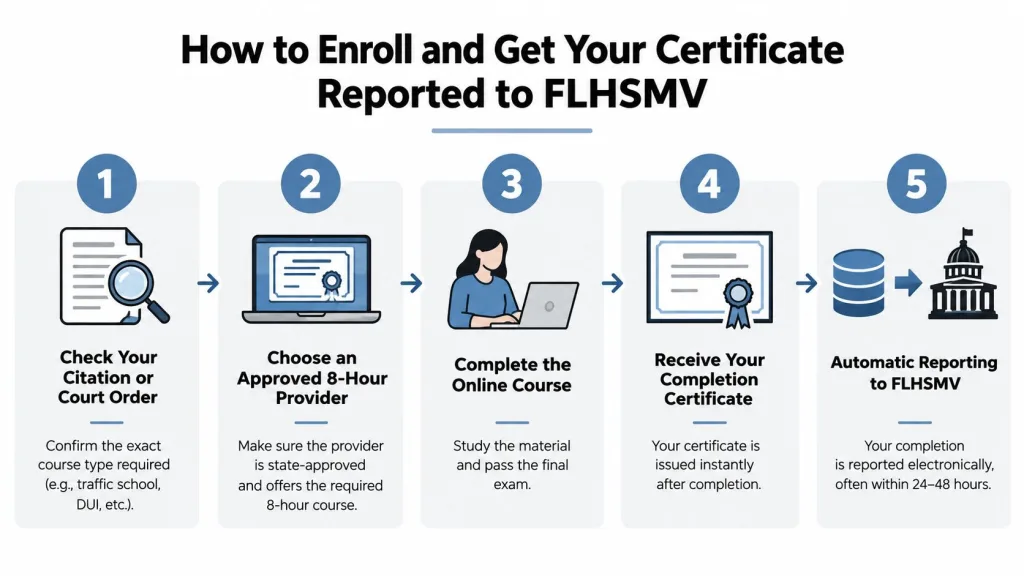
How to Enroll and Get Your Certificate Reported to FLHSMV
Start with the document, not the checkout page. The citation or court order should identify the required course, and that wording should guide every later decision.
Follow the enrollment checklist
- Read the citation or order. Look for the exact category, completion deadline, court name, and certificate instructions. If the document is unclear, contact the clerk before paying.
- Separate the three 8-hour choices. Florida providers may list Intermediate Driver Improvement, Aggressive Driver, and DWLS/R courses separately. They aren’t automatically interchangeable, so ask the court which one applies.
- Verify online acceptance. Confirm that your county or judge accepts the online format and the chosen provider’s certificate. This is especially important because some 8-hour programs are controlled by court requirements rather than a uniform state-approval process.
- Choose a provider and language. Online programs may offer English, Spanish, and Portuguese access, subject to the provider’s available materials. Review the total price and completion terms before registering.
- Complete every lesson and assessment. Work through the modules carefully, especially the sections tied to your violation. Keep your login and completion details until the court confirms compliance.
- Follow the reporting instructions. Some providers report completion electronically to FLHSMV, while the court may still require a certificate or separate confirmation. Ask the clerk exactly what your case requires.
Keep proof until the case is closed
Electronic reporting can simplify the administrative process, but don’t treat submission as the same thing as confirmed compliance. Save the completion certificate, receipt, course name, and any communication from the court or provider.
You can review the online driving certificate process to understand how electronic completion records work. If your order gives a separate court deadline, that deadline remains important even when a provider reports completion to FLHSMV.
Start Your Approved Course Today and Drive With Confidence
The right Florida 8 Hour Driver Improvement Course gives you a structured way to respond when a citation or judge’s order demands more than a basic traffic-school election. It combines legal-rule review with practical instruction on attention, space, hazard recognition, and responsible decision-making.
Your first task is not to find the fastest checkout button. It’s to confirm the exact course category, check whether the court accepts online completion, and record the deadline. That small amount of preparation can prevent the most frustrating mistake, finishing a course that doesn’t match the order.
Online study can make the process easier for professionals, parents, travelers, and students who need language flexibility. A self-paced format also lets you revisit explanations instead of rushing through a classroom schedule, while an in-person course may be preferable if you learn better through direct discussion.
The course is also an opportunity to change the pattern behind the citation. Better scanning, safer following distance, calmer responses, and stronger distraction control can help you manage ordinary Florida traffic long after the certificate has been processed.
If your paperwork names Intermediate Driver Improvement, compare that wording with the available course options at BDISchool’s course page or DriverEducators’ course page. Then contact the court with jurisdiction, confirm online acceptance, enroll in the matching program, and complete it within the required window.
BDISchool offers Florida online driver-improvement options, including an 8-hour Intermediate Driver Improvement course for court-directed situations. Visit BDISchool to review the available course, verify that it matches your citation or court order, and start your enrollment after confirming acceptance with the court.