You opened the envelope, saw the fine, and figured paying it ends the problem. It doesn’t. Florida traffic citation points run on a clock, not a one-time fee. The dates already on your record decide whether this ticket is a nuisance or the one that suspends your license. The one move that stops those points before they start is electing an approved course inside the short window on your notice.
Florida Point Values for Common Citations
Read the charge first. The points follow the statute printed on the citation, using the FLHSMV point schedule. Confirm that statute number against the schedule before you pay anything.
| Citation | Points | How to read it |
|---|---|---|
| Speeding 1-15 mph over limit | 3 | Lowest speeding tier |
| Speeding 16 mph or more over limit | 4 | Higher speeding tier |
| Careless driving | 3 | Check the statute number on the ticket |
| Failure to yield right-of-way | 3 | Common at intersections and merges |
| Running a red light or stop sign | 3 | Counts toward the same windows as other moving violations |
| Reckless driving | 4 | Serious charge with a higher point value |
| Failing to stop for a school bus | 6 | Among the highest common values |
| Distracted driving (texting or related conduct) | Points follow the statute cited | Find the points on the citation’s statute and the FLHSMV schedule |
Speeding 1 to 15 mph over is the ticket most drivers get, and it is a 3-point moving violation. Speeding 16 mph or more over steps up to 4 points. That extra point is why a “just a little fast” defense is a bad bet if the officer wrote the higher tier. If you are sorting a recent speeding citation, start with the Florida speeding ticket guide and match the speed on the ticket to the tier.
Careless driving is 3 points, but only if that is the statute the officer wrote. Failure to yield right-of-way is also 3 points, and it shows up constantly at merges and left turns. Running a red light or a stop sign is another 3-point moving violation, and it counts in the same time windows as every other moving conviction. None of these is “minor” once you already have convictions sitting inside the current year.
Reckless driving is a 4-point charge, and it is a serious one. Failing to stop for a school bus is 6 points, among the highest values on an ordinary citation. Two school-bus convictions, or one school-bus conviction plus a cluster of ordinary tickets, can put a clean record near a suspension line fast.
There is no single texting number
Distracted-driving tickets do not share one point value. The points follow whatever statute the officer cited, which might be texting, careless driving, or another moving offense. Find the statute number on the face of the citation, then read that row on the FLHSMV schedule. Do not assume a phone ticket is automatically the lowest tier.
One ticket almost never suspends a license by itself. Points accumulate over time, and the dates determine the sanction. The schedule is the starting point. The windows are what threaten the license, and every conviction leaves a long trail on the record after the fine is gone.
Suspension Thresholds and Rolling Time Windows
A driver with 13 points in the past 18 months is already over the 12-point threshold for a suspension of up to 30 days. If another 4-point conviction falls within that same 18-month window, the total becomes 17. One more ordinary conviction can bring it to 18, which can mean a suspension of up to three months.
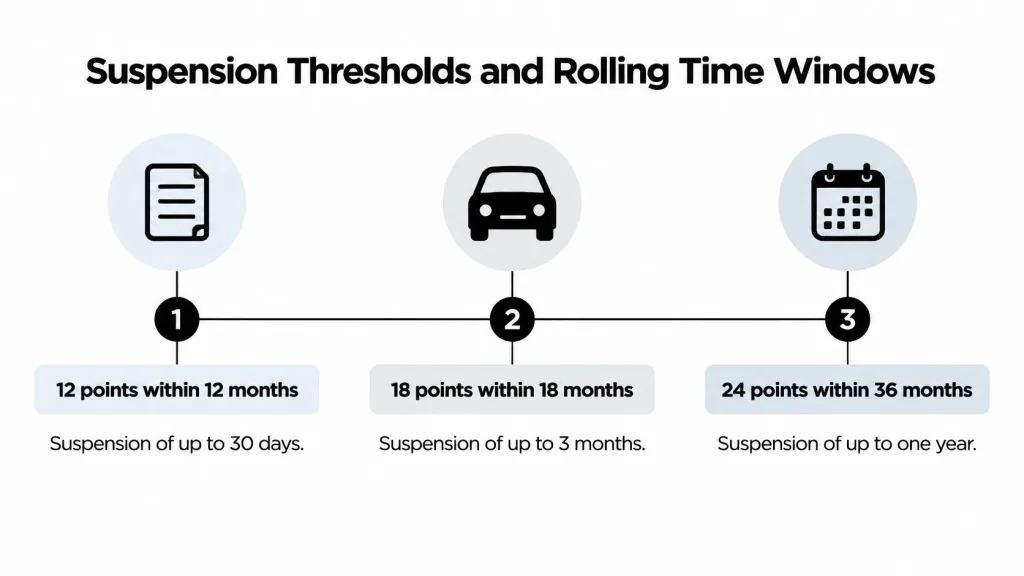
Florida counts points within rolling time windows, not as a lifetime total. The FLHSMV point-suspension page lists these thresholds:
| Points reached | Time window | Maximum suspension |
|---|---|---|
| 12 points | 12 months | Up to 30 days |
| 18 points | 18 months | Up to 3 months |
| 24 points | 36 months | Up to 1 year |
An earlier suspension does not reset the count. Points remain relevant to later thresholds while they fall within the applicable window. FLHSMV says points remain on a driver record for at least five years from the conviction or disposition date.
A point stops counting toward a threshold only after its window closes.
The math is simple: four 3-point convictions within 12 months reach 12 points. Three 4-point convictions do too. Dates decide which convictions are still inside each window.
A year that looks safe until it isn’t
A driver gets a 4-point speeding conviction in month 2, a 3-point careless-driving conviction in month 9, and a 3-point red-light conviction in month 11. That is 10 points within 12 months. Another 3-point conviction in month 11 brings the total to 13, putting the driver in range of a suspension of up to 30 days.
The same dates matter in the longer windows. If the driver has 13 points within 18 months, a later 4-point conviction raises the total to 17, not 18. One more ordinary conviction can reach the 18-point threshold and a suspension of up to three months. Across 36 months, keep checking against the 24-point line, which can bring a suspension of up to one year. The FLHSMV basic driver improvement provider guidance explains how separate violations can lead to longer sanctions when they cluster within these windows. Review the record by date and total each period separately.
Do this before the next conviction
- List the dates: Use each conviction or disposition date shown on your record.
- Sort oldest to newest: This makes it clear when a conviction falls outside a window.
- Total each window: Add points for the past 12, 18, and 36 months separately.
- Act before points are assessed: If you qualify, elect a course within the 30-day window for the citation. That is the step that can prevent points from being added for that eligible violation.
Distracted Driving Citations and Their Points
Two drivers can use a phone in similar ways and receive citations with different point values. The statute listed on your citation, not the behavior alone, determines which points apply.
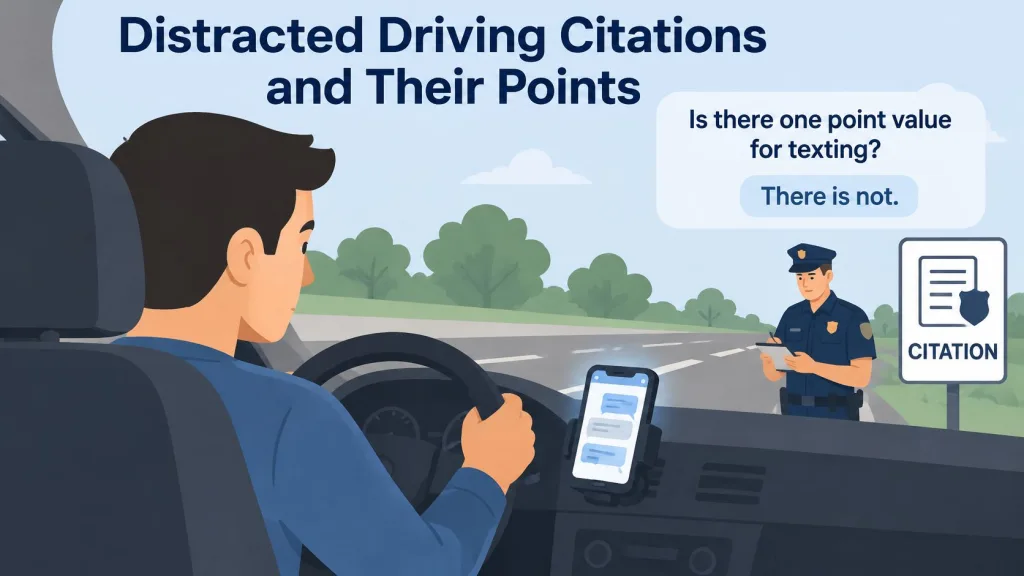
Texting while driving is a primary offense, according to FLHSMV’s distracted-driving notice. An officer may cite related conduct under another statute, such as careless driving or failure to maintain a single lane. Those charges can carry different point values and consequences.
Check the statute, not just the behavior
Find the statute number on the citation, then match it to Florida’s points schedule. A driver cited for careless driving after looking at a phone receives the points for careless driving, not a separate “texting” point value. This guide to Florida texting-and-driving tickets explains why the charge on the citation controls.
The same distinction matters when checking whether you can elect a course. Florida’s Basic Driver Improvement Course is for eligible moving violations. Criminal charges and violations excluded by law may follow a different process, so read the charge before deciding your next step.
Electing a Course Within 30 Days
You generally must elect Basic Driver Improvement within 30 days of receiving the citation. FLHSMV’s citation guidance is plain about the rest. In that period you pay the fine and fees and notify the court or clerk that you selected the course. Miss the 30 days and you forfeit the option, and points can be assessed.
| Path | Points | Record effect |
|---|---|---|
| Pay the citation without a course | Points assessed | Conviction on the record |
| Elect BDI within 30 days and complete it | No points assessed | Withheld adjudication and civil penalty reduced by 18 percent |
| Miss the 30-day election | Points assessed and option forfeited | Conviction on the record |
| Contest the citation in court | Points assessed only if convicted | The court decides the outcome |
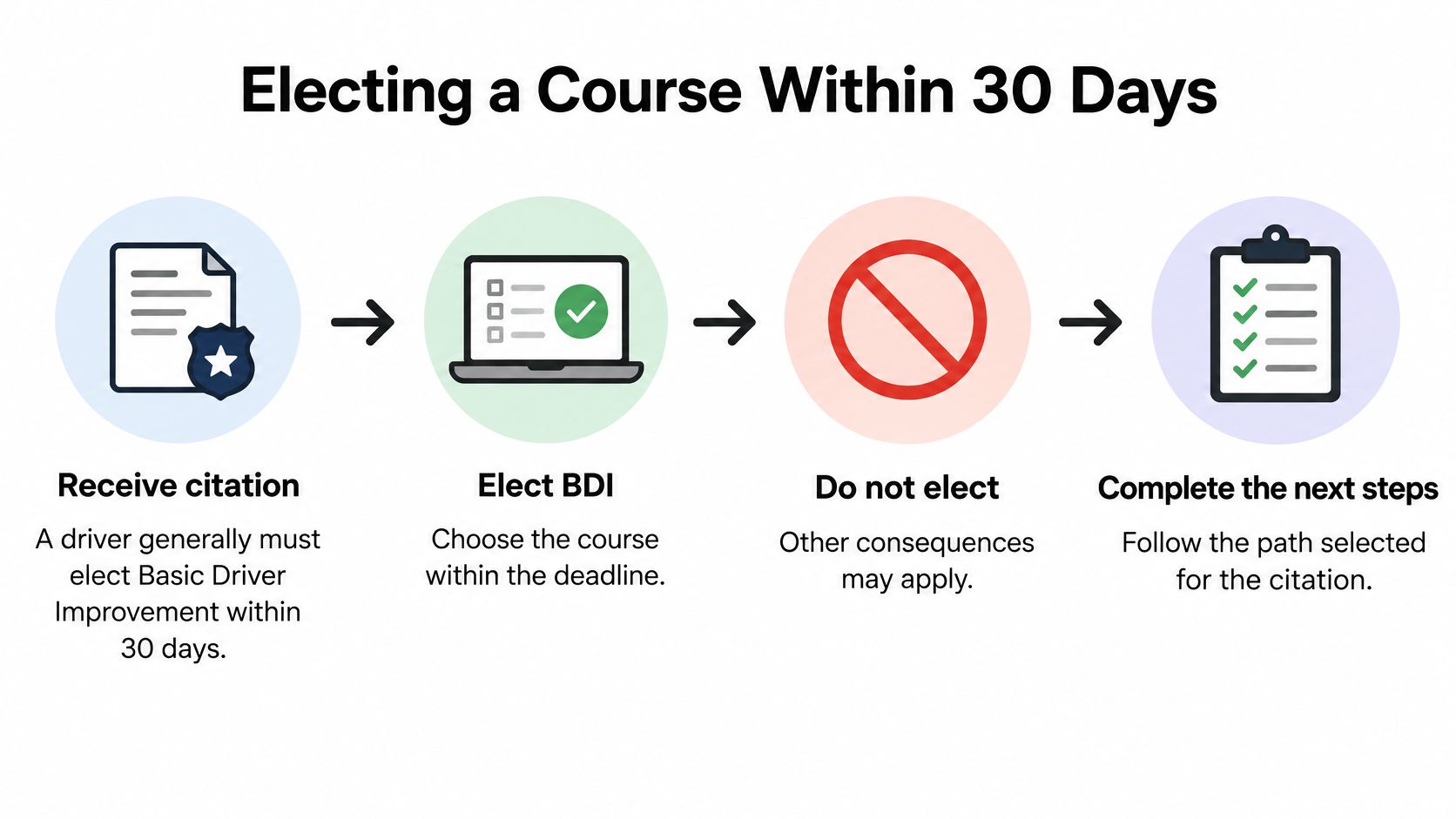
Paying without a course is the default, and it is the path that puts a conviction on the record. Electing and finishing the course is the path that keeps points off and withholds adjudication. Missing the deadline throws you back onto the conviction path. Contesting is a real option when the charge is wrong, but a loss still assesses points.
Make the election in this order
- Pay the fine and fees. The election is not a request to skip the civil penalty. Payment is part of making the choice valid.
- Notify the court or clerk that you are electing the course. Payment without notice, or notice without payment, is how people think they elected and didn’t. Do both inside the same 30 days.
- Complete an approved course and keep the certificate. Completion is what closes the case on the course path. A registration alone does not.
- Confirm the completion was reported to FLHSMV. You want the agency record to match the certificate, not a clerk file that never got the update.
Where people lose the option
A citation can sit in a stack of mail for a week. That week counts. Once day 30 passes, the option is forfeited and points can be assessed. You cannot elect after the points are already on the record and expect the same result.
Count the 30 days from the day you received the citation, then read the notice for the clerk’s exact instructions. If the notice gives a shorter local deadline, use that date. Act in the first few days, not the last afternoon.
How Points Affect Your Insurance and Record
Insurers read a motor vehicle record as a risk signal. Many of them pull that record at renewal, so a conviction can raise your premium even when nobody suspended your license. You do not need a suspension for this ticket to cost you for years.
A conviction and a withheld adjudication are not the same status. A conviction is the violation on your record. Withheld adjudication is the status an approved course produces when you qualify and you finish.
Florida Statutes section 318 is the authority here. For eligible noncommercial moving violations, completing an approved Basic Driver Improvement course results in withheld adjudication and prevents points from being assessed. Florida also reduces the applicable civil penalty by 18 percent when you properly elect the course. That is a record benefit and a smaller fine in the same election.
The cheapest point is the one that never gets assessed.
Points that do get assessed stay on the record for years, so the protection of never assessing them lasts for that whole history. Our course is state-approved and meets the requirements set by the Florida DMV. BDI School is a Florida HSMV Approved Basic Driver Improvement School, and the course is approved by the State of Florida for all courts and counties.
The limit is real. The election applies only to eligible violations. If your citation is outside that set, the statute does not give you withheld adjudication no matter who you pay. For drivers comparing what a conviction does to renewal pricing, the insurance increase after a ticket page is the practical companion to the statute. Completing the eligible course is aimed at no insurance rate increase from that moving violation, and it helps drivers keep an excellent-driver or safe-driver discount.
Confirm Eligibility and Enroll This Week
Confirm you qualify, then register before the election window closes. Waiting for a convenient weekend is how eligible drivers become convicted drivers.
Basic Driver Improvement is aimed at drivers who recently received a moving violation. It is a 4-hour course, also called Florida Four-Hour Traffic School, and it is the election that keeps points off an eligible citation. The 8-hour Intermediate Driver Improvement course fits court-ordered drivers who need a longer program. The 6-hour Mature Driver Course fits drivers 55 and older who want a safety refresher and to keep insurance discounts. The Aggressive Driver Course, also 8 hours, is for habitual offenders involved in road rage, with the emphasis on responsibility rather than a simple point election.
Register in one sitting
- Pull the citation number and the election deadline off the notice. If you can’t find both, you are not ready to click register.
- Register on our site with your name, driver license number, and email. That registration form is required before you use the course, and that information generates the completion certificate. You can register for Florida’s Basic Driver Improvement Course and start it on the website.
- Study the online, self-paced course in English, Spanish, or Portuguese, on any device. Busy schedules are the reason the course is not a classroom night.
- Take the certificate that is reported electronically to FLHSMV. Keep your copy, and make sure the report went through.

Compare the course pages at BDISchool courses and Driver Educators courses if you are choosing between BDI, the intermediate course, the mature driver course, and the aggressive driver course. If you have used traffic school before, read how often you can take traffic school before you assume this citation still qualifies.
Short answers before you pay the fine
Does paying the ticket avoid points? No. Paying without the course assesses the points.
Does every phone ticket have the same points? No. The statute on the citation sets the points.
When does the 30 days start? From when you received the citation.
Register this week, while that window is still open. A course you start after the deadline cannot undo an election you already forfeited.
BDISchool offers Florida’s Basic Driver Improvement Course for drivers who just received an eligible moving violation and need points withheld before the election window closes. The 4-hour course is online, state-approved, and reported to FLHSMV when you finish. If your citation still qualifies, visit BDISchool and register before day 30.