A single speeding ticket in Florida can raise your car insurance by an average of $859 per year, taking a driver from $2,694 to $3,553 annually. If you do nothing, that one stop on the side of the road can follow you into future renewals and cost far more than the ticket itself.
That’s the part most drivers don’t see when they first get cited. They’re focused on the fine, the court date, and the frustration of knowing one mistake might now get expensive.
A significant concern is the insurance rate increase after ticket fallout. In Florida, the smartest move is usually the one that protects your record before the insurer prices the violation into your policy. For many drivers, that means acting fast and using a state-approved Basic Driver Improvement course as a financial defense, not as a punishment.
The Shocking Cost of One Florida Traffic Ticket
You get pulled over. The officer hands you the citation. You glance at the fine and think that’s the damage.
It usually isn’t.
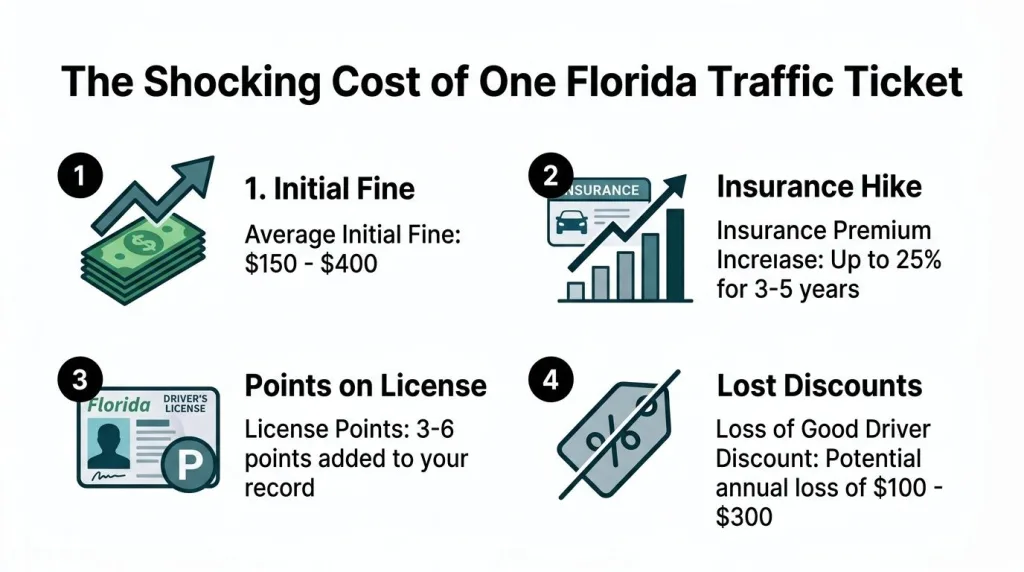
For Florida drivers, the bigger hit is often insurance. A single speeding ticket increases car insurance rates by an average of $859 per year, raising the annual premium from $2,694 for drivers with no infractions to $3,553 for drivers with a speeding violation, according to Insurance.com’s Florida speeding ticket calculator.
That number changes the conversation. You’re no longer deciding how to handle a traffic ticket. You’re deciding whether to accept a much higher cost of driving for the next several renewals.
Why the fine is only the beginning
Many drivers fixate on the citation amount because it’s immediate. The insurance impact is quieter, but it’s often the more painful part.
If you want a clearer look at the immediate court-side cost, this guide on how much a speeding ticket costs in Florida helps put the initial penalty in context. But the long-term issue is what happens after the conviction reaches the systems your insurer checks.
Practical rule: Treat every moving violation like a three-part bill. The court fine is part one. Insurance is part two. Lost flexibility with future insurers is part three.
Why Florida drivers should act fast
Florida isn’t a state where you can casually shrug off a moving violation and assume the damage is minor. A ticket can turn into a recurring expense.
That’s why passive advice like “wait and see what your insurer does” is weak advice. Waiting helps no one except the company recalculating your premium.
When the average annual increase is $859 for one speeding ticket in Florida, speed matters. The right response is to protect your record before that increase becomes your new normal.
How Florida Tracks Violations and Why It Hurts Your Wallet
A ticket doesn’t stop being a problem when you pay it. It becomes part of your Motor Vehicle Record, and that record is what insurers use to judge risk.
That’s the mechanism behind the insurance rate increase after ticket situations. Insurers usually aren’t reacting to your memory of the stop. They’re reacting to what appears on your record when they review it.
Your MVR matters more than the moment
Insurers typically review the Motor Vehicle Record for the past three years when recalculating premiums. That means the financial impact of a ticket is not a one-time event but a sustained cost over multiple policy renewals, potentially adding up to over $1,850 in extra insurance costs, as explained by Ticket Shield’s breakdown of insurance increases after a speeding ticket.
That’s why “I already paid the ticket” doesn’t solve the underlying issue. Payment closes the citation. It doesn’t erase the underwriting consequences.
Florida’s point system isn’t just a DMV issue
Points matter because they create a cleaner path for insurers to classify you as a riskier driver. If you need a plain-English overview, this guide to the Florida traffic ticket point system is worth reading before you choose how to respond.
Florida’s process isn’t unique in principle, either. If you want a simple comparison showing how point systems influence driving records in another state, David G. Moore on Michigan points gives useful context on how states track violations and why drivers shouldn’t treat points casually.
The ticket is an event. The record is the problem.
What this means at renewal time
Here’s the practical effect:
- Your insurer reviews history: They usually don’t price your policy based only on what happened this month.
- Your violation stays relevant: The review window commonly reaches back three years.
- Your cost can repeat: One ticket can affect more than one renewal cycle.
- Your first mistake matters most when ignored: Doing nothing gives the record time to work against you.
A lot of drivers make the same mistake here. They assume a small traffic matter stays small.
It doesn’t. Once a moving violation lands on the record your insurer uses, your wallet gets involved for much longer than the roadside stop lasted.
The Number One Way to Prevent an Insurance Rate Increase
The best move after a Florida ticket is usually simple. Handle the first ticket aggressively, before it turns into an insurance problem.
For many non-criminal moving violations, a state-approved Basic Driver Improvement course is the most direct off-ramp.

Why the first ticket matters so much
Drivers get into real trouble when they treat the first citation like no big deal. That’s exactly how a manageable issue becomes an expensive pattern.
For drivers with two speeding tickets within a three-year period, the average insurance rate increase reaches 43%, nearly double the 22% average increase for a single ticket, according to Law-KC’s analysis of insurance increases after tickets.
That’s why I’m opinionated here. The first ticket is the one you need to manage correctly. Once violations stack, insurers get less forgiving and your options narrow.
Why a BDI course is usually the smartest play
A Florida-approved BDI course is not exciting. That’s fine. It doesn’t need to be exciting. It needs to be effective.
The value is straightforward:
- It gives you a proactive option: You’re not just waiting for underwriting to punish you.
- It can help you avoid points for an eligible non-criminal moving violation: That matters because points are what often trigger the downstream insurance problem.
- It costs far less than years of higher premiums: Even without repeating every number above, the math heavily favors prevention.
- It’s flexible: Online options let busy drivers handle the issue without sitting in a classroom.
If you’re comparing providers, a Florida online BDI course is a popular choice due to its flexibility, allowing individuals to finish the requirement around work, family, or travel.
Bottom line: The goal isn’t to “save money” in some vague sense. The goal is to stop one ticket from becoming a recurring insurance expense.
A lot of online advice treats traffic school like an afterthought. That’s backwards. In Florida, it’s often the main financial move.
Don’t frame traffic school as punishment
That mindset costs drivers money.
Traffic school is a control mechanism. It gives you a way to respond before the ticket does full damage. If you’re eligible, using that option is the rational move.
You don’t need to love the course. You need to love what it can prevent.
Your Action Plan After a Traffic Ticket
Panic makes drivers do bad things. They either pay too fast without thinking, or they procrastinate until the deadline pressure gets worse.
Use a clean plan instead.
Step one is the most important
Elect traffic school quickly if you’re eligible. In Florida, timing matters. Waiting too long can eliminate options that were available right after the citation.
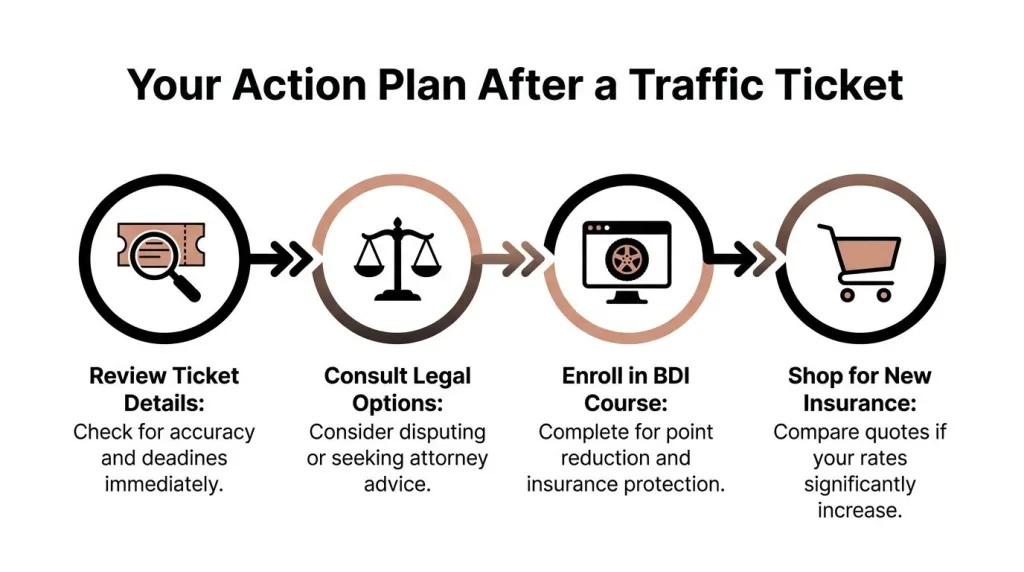
Review the ticket right away. Check the county, deadline, violation type, and whether the citation appears to qualify for traffic school treatment. If anything on the ticket looks off, that’s the moment to address it, not after the due date passes.
The four moves that keep you in control
Read the ticket carefully
Don’t guess. Look for deadlines, instructions, county details, and whether a court appearance is required.Choose your path early
You usually have a few options, such as paying, contesting, or electing traffic school if eligible. The best choice depends on the violation and your record, but delay makes every option worse.Complete the required course promptly
If traffic school is the right move, finish it early enough that paperwork isn’t a scramble.Confirm reporting and keep proof
Keep your completion confirmation and verify that the correct agency receives what it needs.
When to consider legal help
Some tickets are straightforward. Others aren’t.
If the citation involves unusual facts, multiple violations, commercial driving issues, or anything that could threaten your license status, legal advice makes sense. If your situation is already in high-risk territory because of a more serious record issue, even reading about affordable auto insurance after DUI can help you understand how insurers think once driving history becomes a major rating factor.
Handle the ticket in the order of risk. First protect your record. Then worry about shopping for better rates.
What not to do
A short list of bad moves saves a lot of money:
- Don’t assume the insurer won’t notice: That’s wishful thinking.
- Don’t miss election deadlines: Lost options are hard to recover.
- Don’t treat online traffic school like a last resort: For many Florida drivers, it’s the best first move.
- Don’t throw away your documents: Keep proof of completion and any court-related confirmation.
A calm approach works better than a defensive one
You don’t need to turn a traffic ticket into a life crisis. You do need to treat it like a financial event.
Drivers who move early usually preserve more options. Drivers who react late usually end up stuck choosing among worse ones.
Other Strategies to Lower Your Car Insurance
A BDI course is the strongest first move when it’s available, but it’s not the only lever you can pull. The problem is that most alternatives are reactive. They help after the damage starts, not before.
That’s why they belong in second place.
Which options are worth trying
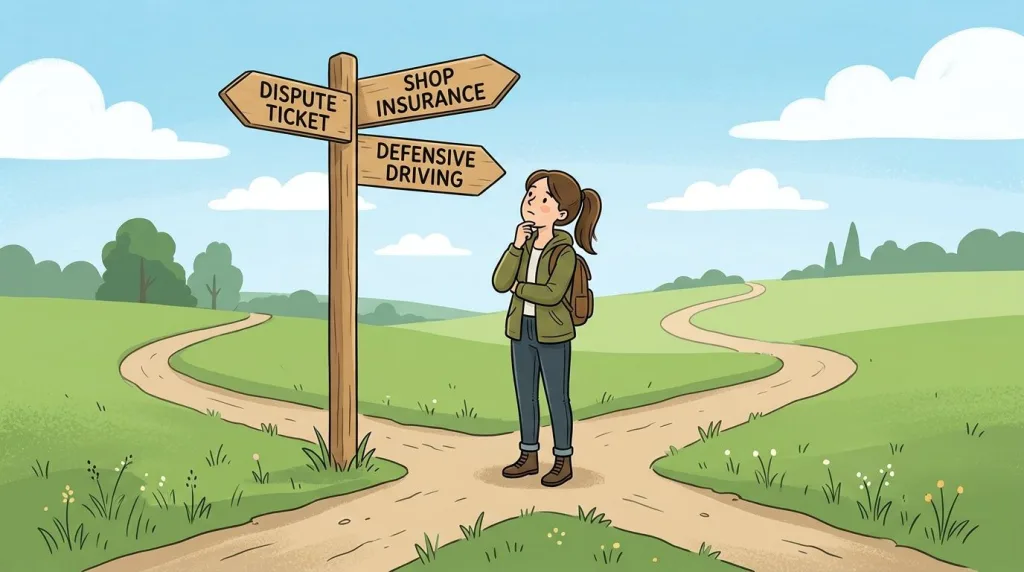
Here’s the honest comparison:
| Strategy | Good for | Main drawback |
|---|---|---|
| Contest the ticket | Cases with errors, weak evidence, or strong defenses | Takes time and may not succeed |
| Ask about forgiveness | First-time incidents with a carrier that offers it | Not every insurer offers it |
| Shop for new quotes | Drivers facing a sharp renewal increase | You’re reacting after the rate change |
| Take a BDI course if eligible | Preventing the problem earlier | Requires action before deadlines pass |
Ticket forgiveness can be valuable
This is one of the most overlooked questions drivers should ask their insurer. A 2024 NerdWallet study found premiums rise 25% on average after a ticket, yet many insurers offer specific ticket forgiveness programs where the first ticket causes no rate increase, according to Mercury Insurance’s explanation of ticket forgiveness options.
That doesn’t mean you should rely on forgiveness as your only plan. It means you should ask about it immediately.
Shopping still matters, but it’s not the first fix
If your rate rises anyway, comparison shopping can help. This guide on ways to lower car insurance is useful because it focuses on practical levers drivers can pull instead of vague “drive safer” advice.
Use shopping strategically:
- Check renewal offers carefully: Don’t auto-renew out of habit.
- Ask carriers how they treat first violations: Underwriting differences matter.
- Compare total policy value, not just premium: A lower number with weaker coverage isn’t always a win.
One caution: Shopping for insurance after a ticket is damage control. Preventing the ticket from affecting your record in the first place is usually stronger.
Disputing the ticket is sometimes right
If the facts are on your side, challenge it. But be realistic.
Contesting a citation takes time, preparation, and sometimes legal help. It’s not the universal answer the internet makes it sound like. For a lot of busy Florida drivers, the more practical route is the one that resolves the ticket cleanly and protects the record without turning the matter into a part-time job.
Florida Traffic Ticket and Insurance FAQs
Will one Florida ticket always raise my insurance?
No. A first ticket doesn’t always trigger an increase for every driver. Experian reporting cited in the verified data notes that a single ticket over three years may result in no increase for drivers with clean records, especially older drivers with no recent violations. But counting on that outcome is risky. Hope isn’t a strategy.
Can multiple tickets make the increase much worse?
Yes. Repeated violations make insurers much less generous. The broader data in the verified research shows that drivers with multiple violations pay meaningfully more, which is why handling the first ticket correctly matters so much.
Do insurers only care about speeding?
No. They price risk across many violation types. Some violations hit much harder than speeding. The highest average impact listed in the verified data is leaving the scene of an accident, followed by DUI and racing, which tells you insurers care about severity, not just frequency.
If I take traffic school, do I still need to pay attention to deadlines?
Absolutely. Traffic school only helps when you use it correctly and on time. Miss the election window or completion deadline and you can lose the benefit.
Can I take an online course, or do I need a classroom?
Most drivers prefer online because it’s easier to finish around work and family obligations. Florida-approved online options are usually the practical choice for people who want to resolve the issue without rearranging their week.
What if my insurance already went up?
Then act on two tracks. First, make sure the ticket was handled in the best available way. Second, compare insurers and ask directly about forgiveness, underwriting treatment of first violations, and policy options tied to your driving history.
Should I tell my insurer about the ticket myself?
Usually, drivers don’t gain anything by volunteering extra information before they understand how the ticket will be resolved. The smarter move is to handle the citation properly, keep records, and let the actual reporting process determine what reaches underwriting.
If you want the most practical way to protect your driving record and limit the chance of an insurance rate increase after ticket trouble, start with a Florida-approved online course from BDISchool. Their programs are built for Florida drivers who need a flexible, state-approved way to handle a citation, avoid points when eligible, and move on without turning one mistake into years of higher costs.