You’re sitting at a Florida intersection, glance down at a quick message, and notice blue lights in the mirror. You pull into a parking lot, hand over your license and registration, and leave with a texting and driving ticket that looks inexpensive at first glance.
Don’t treat that ticket as a minor piece of paper. Florida made texting while driving a primary offense, and enforcement has expanded into broader hands-free rules. Your next decision can affect fines, license points, insurance, and whether a court requires driver improvement training.
What Happens When You Get Pulled Over for Texting
The traffic stop usually begins with a simple question. The officer approaches your window, asks what you were doing with the phone, and requests your license, registration, and proof of insurance. Answer calmly and provide the requested documents, but don’t volunteer a long explanation or argue from the window.
You don’t need to confess, debate the officer, or try to prove that the message was harmless. A quick text still involves visual, manual, and mental distraction. The National Highway Traffic Safety Administration’s distracted-driving guidance explains why phone interaction receives serious attention from traffic officers.
The officer may explain the alleged violation, confirm your information, and hand you the citation. Read it before you leave the scene. Look for the statute number, court or traffic division, response instructions, payment information, and any written warning or notice printed on the ticket.
Read the paperwork before choosing a response
A label such as noncriminal traffic infraction generally means the citation isn’t a criminal charge. It still creates a legal obligation to respond, however. The label doesn’t mean you can ignore the ticket or assume the outcome won’t affect your driving record.
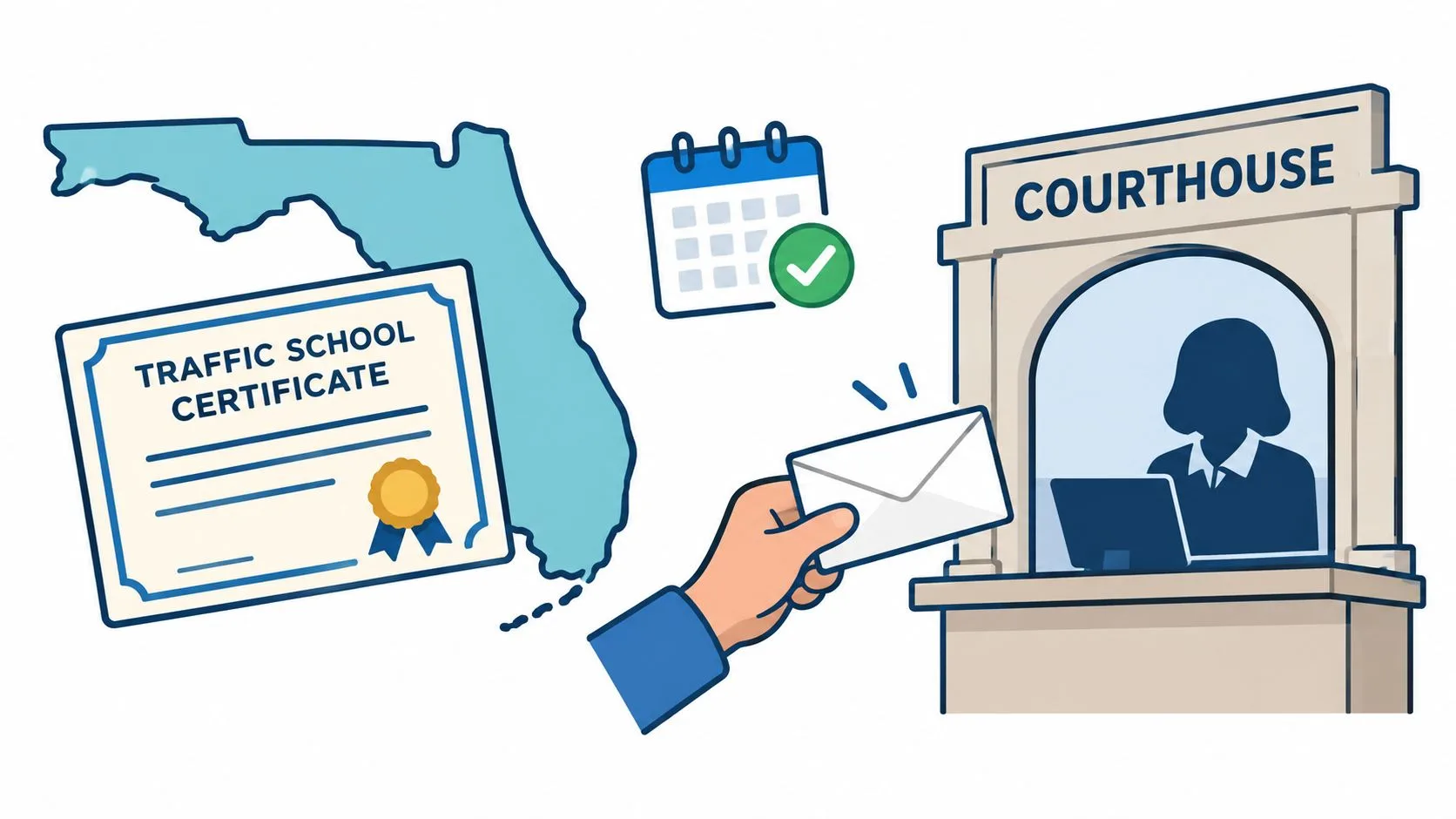
Florida law gives you 30 days to respond to a traffic citation, as stated in Florida Statute 316.305. Your county’s clerk or court may provide specific instructions, so use the information printed on your citation rather than relying on a general internet answer.
Practical rule: The moment you receive the ticket, stop thinking only about the fine. Start thinking about the response that protects your record.
If you want a useful overview of the traffic-stop process, review this traffic stop guide from Brian Hansford Law. It can help you understand the interaction, but it doesn’t replace the instructions on your Florida citation or advice from a qualified traffic attorney.
How Florida’s Texting Law Actually Works
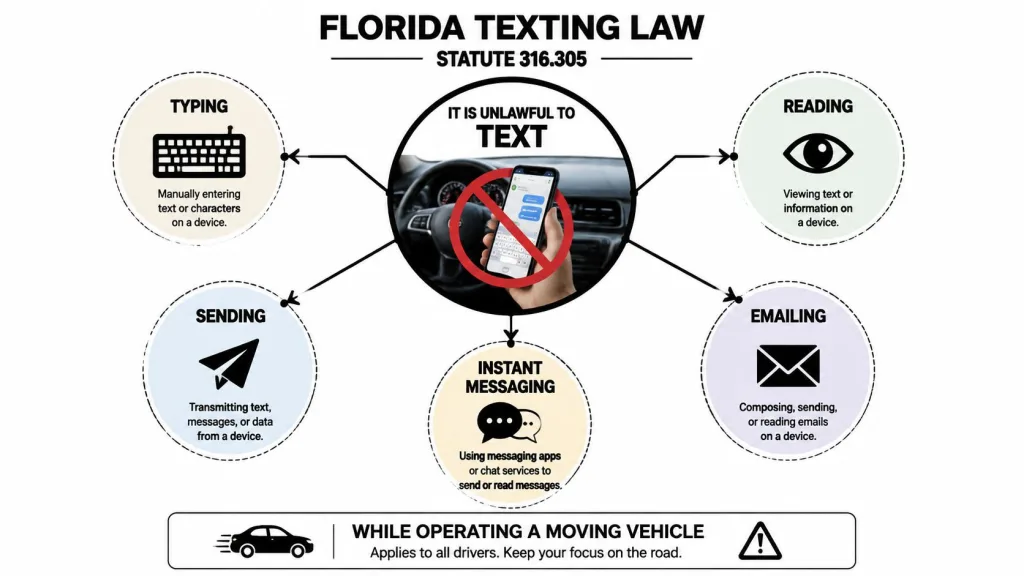
Florida Statute 316.305 prohibits texting while operating a moving motor vehicle. In plain English, that includes manually typing, reading, or sending text-based communications, as well as emailing and instant messaging while the vehicle is moving.
The danger isn’t theoretical. NHTSA says reading or sending a text takes your eyes off the road for about five seconds. At 55 miles per hour, the vehicle travels roughly the length of a football field during that time, without your eyes on traffic. See the agency’s explanation of why texting combines multiple forms of distraction.
What conduct creates trouble
The following actions can support a citation when you’re operating a moving vehicle:
- Typing: Manually entering letters or numbers into a message.
- Reading: Looking at text-based communication on the screen.
- Sending: Transmitting a text, email, or instant message.
- Browsing: Scrolling through content or selecting contacts through manual phone interaction.
Florida’s newer hands-free framework also focuses on holding a handheld wireless device, not only on the act of texting. The Florida Legislature’s current text of section 316.305 should control when older online explanations conflict with current law.
What generally remains permitted
Hands-free voice commands, passive receipt of information, and GPS navigation can be treated differently from manually typing or reading messages. A mounted device may support navigation, while a single swipe or tap used to activate a function can fall within the statute’s permitted conduct.
Don’t assume a red light automatically makes phone handling legal. A vehicle stopped in an active traffic lane may still be considered operating in traffic, so the safest practice is simple: put the phone away before moving and use hands-free controls before entering the road. For a plain-language overview, read this guide to Florida cell-phone laws while driving.
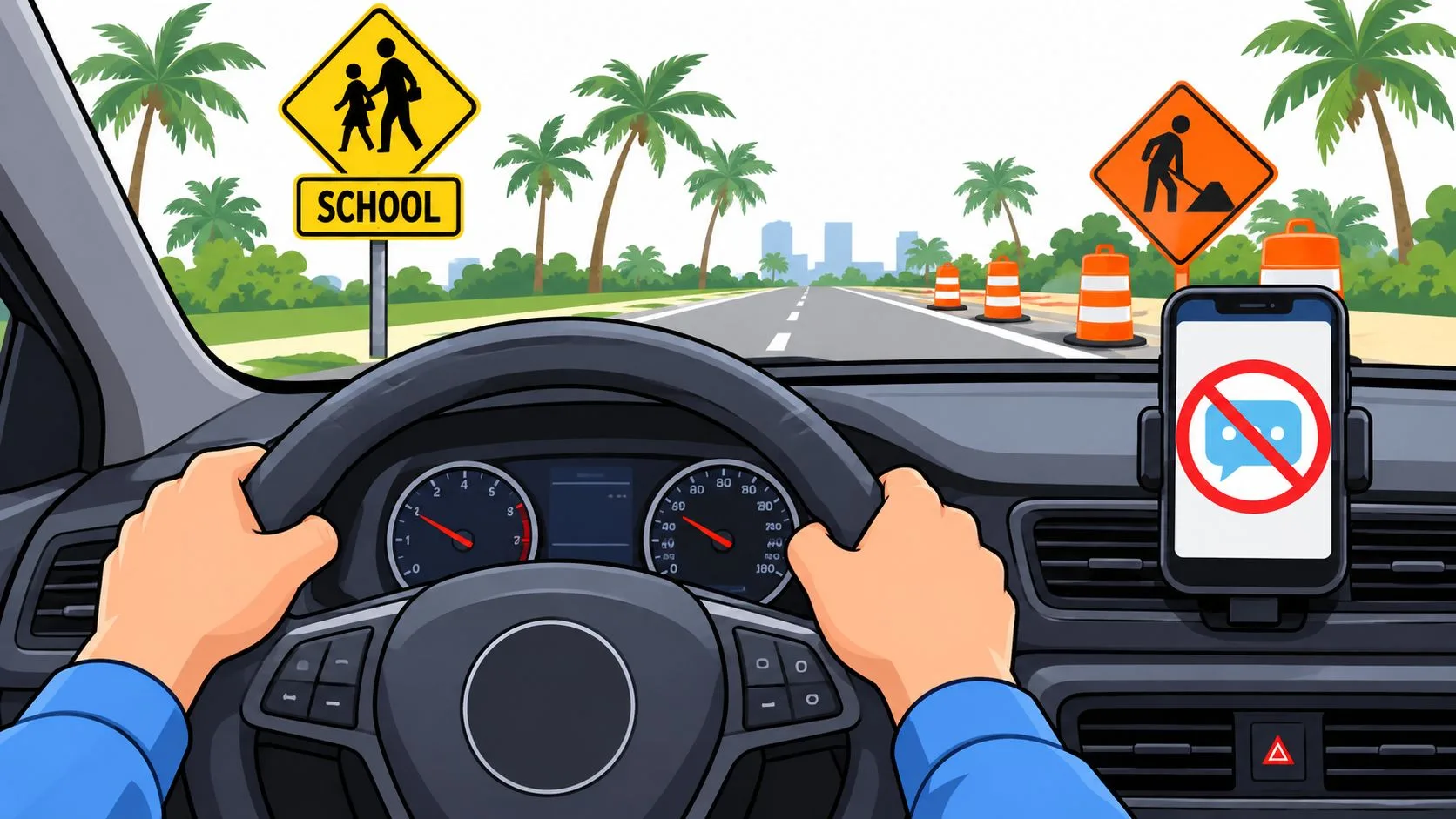
School zones and work zones carry enhanced consequences under the newer framework. That makes phone handling especially risky in areas where children, workers, emergency responders, and changing traffic patterns already demand your full attention.
Fines, Points, and Penalties Explained
The ticket’s real cost depends on the offense level and what happens after payment. A first texting violation is a nonmoving violation with a $30 base fine and no points, although court costs can raise the amount due. The Florida Highway Safety and Motor Vehicles distracted-driving information confirms this first-offense structure.
A second offense within five years becomes a moving violation, with a $60 base fine and three license points. Your county and court may add different costs, so confirm the final balance before choosing how to resolve the citation.
Florida texting and driving penalty tiers at a glance
| Offense Type | Base Fine | Typical Total Paid | Points on License | Notes |
|---|---|---|---|---|
| First texting violation | $30 | Base fine plus court costs | 0 | Nonmoving violation |
| Second offense within five years | $60 | Base fine plus local court costs | 3 | Moving violation |
| Crash involving death or serious bodily injury | Not specified in the verified data | Varies by case and court | 6 additional points may apply | Crash-related enhancement |
| Handheld-device conviction under the newer framework | $500 | Varies by court costs | 3 | Separate handheld wireless-device penalty |
A texting-related crash that causes death or serious bodily injury can add six points, according to the Florida Senate bill analysis for the 2025 hands-free changes. School zones, work zones, and designated emergency zones can also bring enhanced penalties.
Plan for more than the base fine. Court costs increase the payment, while a conviction may affect insurance after the clerk closes the case. Paying promptly may resolve the court file, but it does not automatically erase a moving conviction, points, or an insurance review. If the citation creates an insurance problem, compare that risk with the cost and eligibility requirements of an approved course before paying.
A low base fine does not make every resolution inexpensive. The record consequence may matter more than the amount printed beside the violation.
The broader safety record explains the enforcement focus. NHTSA recorded 3,208 deaths and an estimated 315,167 injuries in distracted-driver crashes in 2024, including 437 deaths in crashes involving at least one driver engaged in cellphone-related activity. Those figures appear in NHTSA’s 2024 distracted-driving crash report.
License Points and Suspension Risk
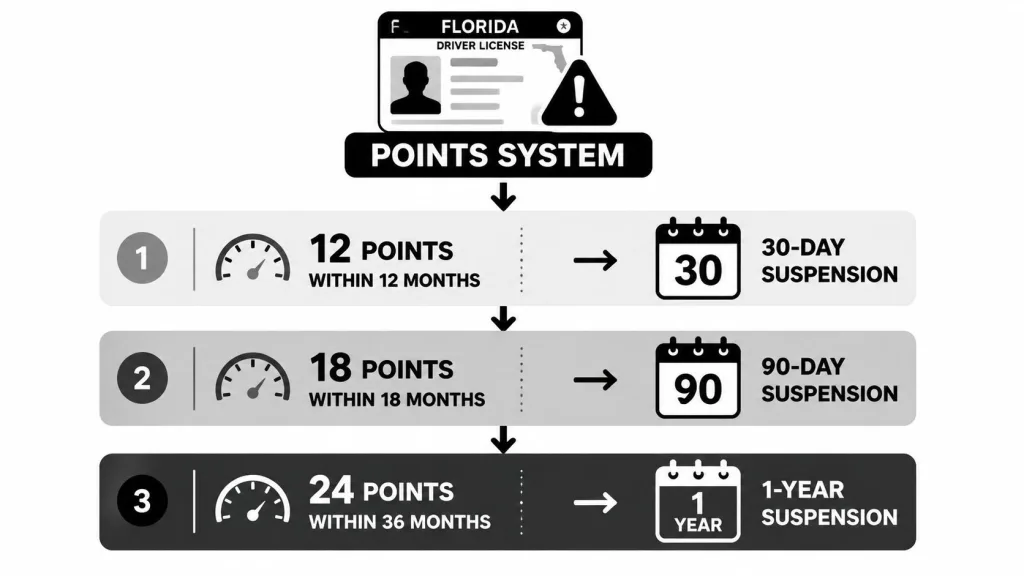
Florida’s point system becomes dangerous when several violations accumulate close together. Twelve points within 12 months can produce a 30-day suspension, 18 points within 18 months can produce a three-month suspension, and 24 points within 36 months can produce a one-year suspension, according to Florida traffic-law guidance on license-point consequences.
A first texting violation doesn’t add points under the standard structure. A later moving violation can add three points, while a qualifying crash can create a six-point consequence. The 2025 hands-free expansion makes later phone-related conduct more important because holding the device can lead to enforcement even when the conduct isn’t limited to composing a text.
What suspension can disrupt
A suspension can affect your commute, school schedule, childcare, and employment. Commercial drivers face an even narrower margin for error because a driving-record problem can threaten access to work, routes, or employer-required insurance.
Insurance companies may also review the conviction and decide whether to increase your premium. An SR-22 filing, reinstatement fees, and the inability to drive legally can become more burdensome than the original citation.
The Florida point thresholds are not a reason to wait until your record is close to suspension. Read the eligibility rules for a Florida license suspension based on accumulated points and verify your own status with the state or clerk.
A BDI election may keep eligible points off the record, but it isn’t automatic and it isn’t available for every driver or every situation. Confirm eligibility with the court before enrolling, then complete the correct course within the required deadline.
Your Four Options After the Ticket
After receiving a citation, you generally face four practical paths: pay the fine, contest the ticket, negotiate a plea, or elect traffic school. The right choice depends on eligibility, evidence, prior violations, court instructions, and how seriously you need to protect your record.
| Option | Cost Range | Points Outcome | Insurance Impact | Time Required |
|---|---|---|---|---|
| Pay the fine | Base fine plus court costs | May place a conviction and applicable points on the record | Possible premium increase | Fastest |
| Contest in court | Court costs and any legal representation costs | Possible dismissal or different outcome | Depends on final disposition | Court preparation and appearance |
| Negotiate a plea | Varies by court and agreement | May reduce the record impact if accepted | Depends on the agreed disposition | Communication and possible hearing |
| Elect traffic school | Course cost plus court-related amounts | Eligible points can be kept off the record | May help avoid a moving-conviction surcharge, subject to insurer rules | Course deadline and proof submission |
The Florida traffic-ticket options guide can help you identify which response deserves closer review. Don’t choose payment because it’s the quickest button on the clerk’s website. Payment can be the wrong move if your priority is avoiding points or protecting insurance treatment.
Use the decision matrix honestly
Paying makes sense when the citation’s consequences are acceptable and you need the fastest administrative resolution. It isn’t the preferred choice when the violation could add points or create an insurance problem.
Contesting makes sense when you have a defensible factual or legal position. Useful material may include dashcam footage, photographs, witness information, or records that challenge what the officer observed. A weak defense still costs time and may not change the result.
Negotiating a plea can be appropriate when the facts are unfavorable but a different disposition may reduce the record impact. The court, prosecutor, or attorney controls what options are available.
Traffic school is the practical route for an eligible noncommercial driver who wants to address a moving violation without points posting. Florida limits this option to once every 12 months, requires completion within 90 days of election, and requires a noncommercial license. Verify those requirements before treating the course as your answer.
Florida-Approved Courses That Fix the Problem
Choose the course based on the problem you need to solve. A point-dismissal course, a court-ordered program, a reinstatement course, and an insurance-reduction course aren’t interchangeable.
Match the course to the outcome
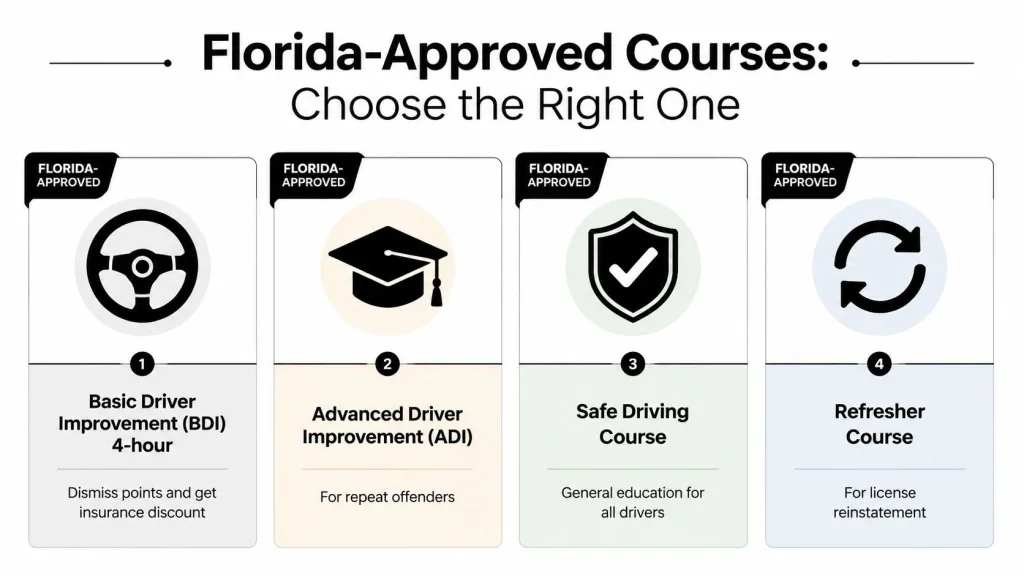
Basic Driver Improvement, or BDI, is a four-hour course for eligible moving violations. It can help an eligible driver avoid points and may support insurance-discount eligibility, but the court must allow the election and the driver must meet the state’s conditions.
Intermediate Driver Improvement, or IDI, is an eight-hour program for court-ordered drivers or people who need deeper instruction after a crash or repeat violation. A court order controls whether this is the correct course, so read the citation and any judge’s instruction carefully.
Advanced Driver Improvement, or ADI, is a 12-hour course used in situations involving license reinstatement after suspension. It isn’t a substitute for BDI when the court gives you a BDI election.
The Traffic Collision Avoidance Course is approved for insurance-reduction purposes. It addresses collision avoidance and safer driving habits, and insurance treatment depends on the insurer’s rules. Use it for an insurance goal rather than assuming it will dismiss ticket points.
BDISchool offers these course categories through an online, self-paced format. The publisher states that its courses follow Florida approval requirements, provide electronic certificates, and report completion directly to FLHSMV. Course availability, language options, and the exact program required by a court should be confirmed on the Florida-approved online traffic school page.
Don’t enroll in the wrong program
If the court requires IDI, a BDI certificate won’t satisfy that order. If your license is suspended, a general safe-driving course won’t automatically reinstate your privileges.
The safest process is to identify the desired legal outcome first, confirm eligibility with the court or clerk, and then register for the matching course. BDISchool and DriverEducators course listings are available through the course selection page, where you can compare available programs before starting.
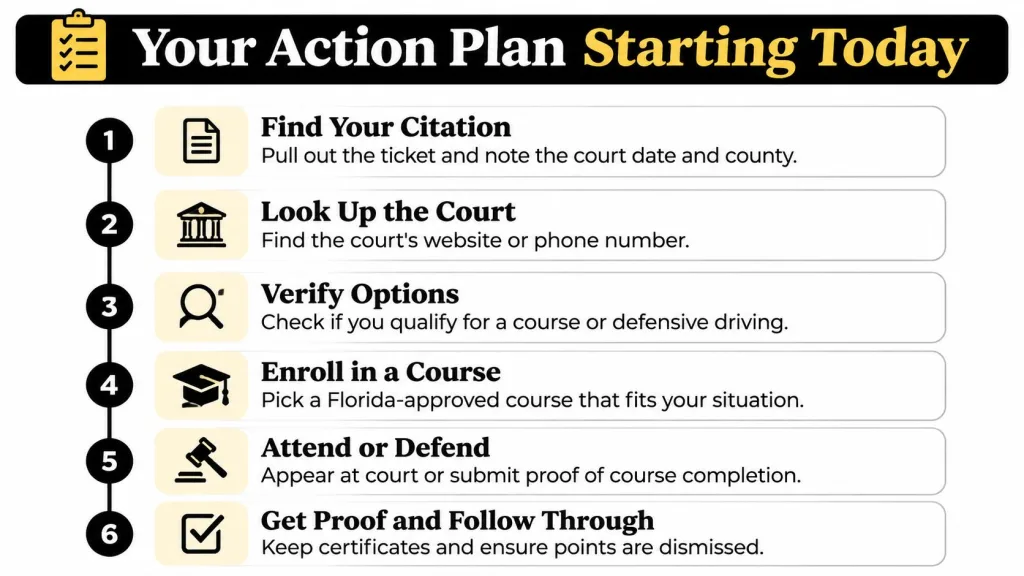
Step-by-Step Action Plan Starting Today
Delay creates avoidable risk. Pull out the citation today and work through the following list in order.
- Find the deadline: Note the court date, response date, county, statute number, and whether the ticket identifies a course option.
- Check the court: Use the clerk’s website or telephone number to confirm payment, contest, plea, and traffic-school procedures.
- Review eligibility: Ask whether you qualify for BDI, whether your license is noncommercial, and whether you’ve used traffic school during the relevant period.
- Protect your evidence: Save dashcam footage, photographs, phone records, and witness details if you may contest the citation.
- Contact your insurer: Ask how the possible disposition could affect your policy. Don’t assume the base fine tells you the full financial story.
- Enroll or defend: Register for the correct Florida-approved course if you choose traffic school, or prepare your court response if you plan to contest or negotiate.
Don’t miss the deadline: A course certificate matters only when you elect the option properly and submit proof as required.
Make the central decision promptly, ideally within 48 hours, so you have time to verify the county’s process and complete any required steps. Every extra day without a plan brings you closer to points posting, a possible insurance review, or another citation that can carry a higher fine and points.
FAQ on Texting and Driving Tickets in Florida
Is checking a phone at a red light legal in Florida?
Don’t assume it is. Florida’s current hands-free rules focus on operating a vehicle in traffic and holding a handheld device, while the statute also addresses whether the vehicle is moving. Because the facts and location matter, keep the phone out of your hand unless you’re lawfully parked and have confirmed the applicable exception.
How much does a first texting ticket cost?
The first violation has a $30 base fine, plus court costs and other local charges. The final amount depends on the county and court, so check the citation or clerk rather than relying only on the base amount. If you’re eligible for BDI, confirm that option before paying.
Do out-of-state points transfer to a Florida license?
Florida record treatment can depend on the other state, the offense, your license status, and reporting agreements. Ask the Florida licensing authority or a qualified traffic professional to review your specific record. A Florida-approved course may help only when the relevant authority allows it.
Does BDI erase the ticket?
BDI can keep eligible points from being assessed, but it doesn’t mean the citation never existed. You must elect the option correctly, meet the eligibility rules, finish the course on time, and submit proof as directed by the court.
How long will an insurance surcharge last?
There’s no single duration that applies to every insurer or policy. Ask your insurance company how it treats the final disposition, then choose a course or legal response based on the record outcome, not only the fine.
The safest next step is to match the citation to the correct course or court option before the response deadline.
BDISchool provides Florida-approved online driver improvement and defensive-driving courses for eligible point dismissal, court requirements, license reinstatement, and insurance-related education. Review the available options and register through BDISchool before a texting and driving ticket becomes a larger record and insurance problem.