You’re at the kitchen table with a Florida traffic citation in front of you, a court deadline approaching, and a search tab open for “traffic school online cheap.” The first low-priced course looks tempting. You click through, enter your information, and assume the problem is solved.
That shortcut can cost more than it saves. A course may be inexpensive but unusable if it isn’t approved by the Florida Department of Highway Safety and Motor Vehicles, fails to report completion properly, or doesn’t match your citation. The smart purchase is the course with the lowest total risk and total out-of-pocket cost, not necessarily the lowest number on the checkout page.
The Real Cost of a Cheap Online Traffic School in Florida
A cheap online traffic school should protect your record, satisfy the court, and make completion straightforward. The advertised tuition is only one part of that decision.
Florida recorded more than 3 million traffic citations, 381,210 codable crashes, and 3,184 traffic fatalities in 2024, according to the Florida traffic safety summary from FLHSMV. The same report recorded 82,447 teen crashes, 102 teen-driver fatalities, and 701 pedestrian fatalities. Those figures explain why a properly designed course should teach more than how to click through a quiz.
Your real cost usually has four parts:
- Course tuition: The provider’s advertised enrollment price.
- County election fee: The payment required when you elect Basic Driver Improvement.
- Civil penalty: The citation payment, which can be reduced by 18% when an eligible driver properly completes BDI, as explained by Florida’s official driver-improvement guidance.
- Certificate handling: Electronic reporting, delivery, processing, or other provider charges.
A low tuition price doesn’t help if the provider isn’t on the approved list or if the clerk never receives acceptable proof. Before checkout, confirm approval, reporting, language access, and curriculum depth. The course should address speed management, following distance, right-of-way, impairment, distraction, and defensive driving.
Practical rule: Compare the complete checkout total and the provider’s reporting process, not just the headline tuition.
For broader evaluation criteria, a traffic school cost guide can help you separate course fees from court-controlled payments. You can also use this comparison of traffic school review sites to see why price, approval, customer support, and completion handling belong in the same decision.
Verify FLHSMV Approval Before You Look at the Price
Approval comes first. Florida drivers should verify the provider through the official FLHSMV approved-provider listing before comparing tuition or entering payment details. A polished website isn’t proof that a course will satisfy the clerk of court.
Start with the FLHSMV approved BDI provider listing. Search for the provider’s exact business name and confirm that the listing covers the course type you need.
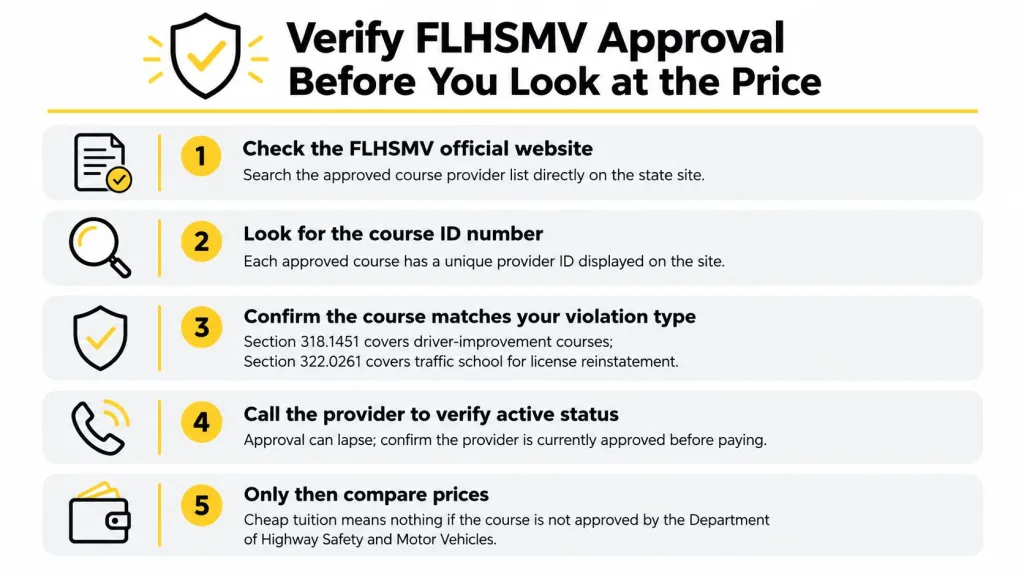
Use this approval check
- Find the provider on the state list. Search the official FLHSMV page directly rather than relying on a badge or marketing statement.
- Match the course category. Confirm whether you need BDI, IDI, an aggressive-driver course, or a mature-driver course.
- Record the provider details. Save the listing, provider identification information, and the course name before enrolling.
- Call when anything is unclear. Ask whether the approval is active and whether the provider reports completion electronically.
- Walk away if the provider can’t be found. An unverified course isn’t a bargain. It’s a potential court problem.
Watch for warning signs such as a broken approval lookup, no clear Florida business information, vague certificate instructions, or pressure from countdown timers. A legitimate provider should explain what happens after you pass, who reports the completion, and whether you must send anything to the clerk yourself.
The approved online traffic school course information is useful as a second checkpoint, but the official state listing remains the controlling verification source. Don’t pay until the course and provider match your actual requirement.
Calculating the Real Price of a Cheap Online Traffic School
Once approval is confirmed, compare the total transaction, not the sticker price. Florida’s cost structure includes a provider-controlled course fee, court-controlled payments, and possible administrative extras.
Florida guidance says a properly completed BDI election can reduce the citation fine by 18%, while points are withheld and adjudication is withheld when the requirements are met. You still have to pay the course, the election fee, the reduced civil penalty, and any required certificate-handling costs.
| Cost Layer | What It Is | Typical Range | Who Controls It |
|---|---|---|---|
| Course tuition | The provider’s charge for instruction and testing | Varies by provider | Traffic school |
| County election fee | The fee for choosing the BDI option | Set by the court or county | Clerk or court |
| Civil penalty | The citation payment after the applicable BDI reduction | Depends on the citation | Court and statutory rules |
| Certificate handling | Electronic reporting, delivery, or administrative service | Varies by provider | Traffic school or court process |
The required comparison is simple:
Total out-of-pocket cost = course fee + election fee + reduced civil penalty + confirmed provider charges.
Use a worked example carefully. Suppose a citation has a $125 civil penalty and one provider advertises a course for $8 less than another. If the cheaper provider adds a $25 administrative fee, the apparent saving disappears before you account for reporting convenience or certificate delivery. The point isn’t that every provider uses those charges. The point is that checkout fees can reverse the ranking.
Ask each provider these questions before paying:
- Is the listed course price the complete provider charge?
- Is electronic certificate issuance included?
- Does the provider report completion to FLHSMV?
- Must you send proof to the clerk yourself?
- Are any processing or delivery services optional?
Insurance savings should remain a separate possibility, not part of your guaranteed checkout calculation. Florida law allows an insurer to provide a premium reduction after successful completion of an approved course, but eligibility and policy conditions vary. For additional context on comparing defensive-driving expenses, review these Georgia driver education cost details, then apply Florida’s court and FLHSMV rules to your own citation.
Matching the Course to Your Citation Without Overpaying
The shortest course is the right choice only when it matches the order or citation. Choosing a longer course without a legal reason wastes time and money. Choosing a shorter course when the court requires another category can leave the ticket unresolved.
| Course | Length | Typical Trigger | Best For |
|---|---|---|---|
| Basic Driver Improvement | 4 hours | Eligible moving violation | Drivers seeking BDI treatment for a qualifying citation |
| Intermediate Driver Improvement | 8 hours | Court-ordered completion or more serious driving matter | Drivers whose paperwork specifically requires IDI |
| Aggressive Driver Course | 8 hours | Aggressive driving or habitual-offender concerns | Drivers directed to complete an aggressive-driver program |
| Mature Driver Course | 6 hours | Insurance or mature-driver education need | Drivers aged 55 and up seeking approved refresher education |
BDI is the normal starting point for an eligible moving violation. It’s designed for drivers who want to complete traffic school instead of receiving the ordinary points consequences, subject to eligibility and court requirements.
IDI and aggressive-driver courses aren’t interchangeable with BDI. Read the court order, citation paperwork, or clerk instructions. If the document names a specific course, enroll in that course rather than choosing based on length alone.
The mature-driver option serves a different purpose. It may support an insurance discount request, but the insurer decides whether the driver and policy qualify. If you’re comparing options, the Florida driving course overview can help you identify the course category before registration.
Meeting the 30-Day Election and 60 to 90-Day Completion Deadline
The deadline sequence matters more than a small tuition difference. For an eligible BDI election, notify the county clerk and pay the required fine and election fee within 30 days of the citation, then complete the approved course within the period assigned by the court.
Use this order:
- Read the citation. Identify the issuing county, citation date, violation, and payment instructions.
- Contact the clerk. Say: “I’m calling to elect Basic Driver Improvement for citation number [number]. Please confirm my eligibility, total payment, completion deadline, and certificate-submission procedure.”
- Pay and document the election. Keep the receipt, confirmation number, and any written instructions.
- Enroll with an approved provider. Choose the course category named by the clerk or court.
- Finish early. A self-paced course lets you study around work, family, or travel, but waiting until the deadline creates avoidable risk.
- Confirm reporting. Keep your completion certificate even when the provider reports electronically.
The standard completion period can fall between 60 and 90 days, but the exact date depends on the citation and court instructions, as explained in the FLHSMV traffic-school FAQ. Certain required-course convictions, including reckless driving, racing, school-bus violations, and specified red-light or traffic-control offenses, can carry a 90-day completion window.
Florida also limits how often eligible noncommercial drivers may elect BDI. State guidance describes use once every 12 months and imposes a lifetime limit, but the official pages should be checked for the current applicable count because published state language has not always been consistent.
What Separates an Acceptable Course From a Frustrating One
FLHSMV approval is essential, but approval alone doesn’t guarantee a smooth student experience. A usable course makes reporting clear, offers help when something goes wrong, and teaches defensive decisions instead of rushing students toward a completion screen.
Look for four practical signals:
- Reliable reporting: The provider explains when electronic completion information is issued and whether the clerk receives anything directly.
- Language access: English, Spanish, and Portuguese options help students understand safety concepts rather than guess at legal vocabulary.
- Responsive support: A working phone line or chat during Florida business hours matters when a deadline or certificate question appears.
- Substantive lessons: The curriculum should cover speed, impairment, distraction, right-of-way, following distance, and crash avoidance.
Speed deserves special attention. The NHTSA 2023 speeding data records 11,775 speeding-related U.S. traffic deaths, representing 29% of all traffic fatalities. Speeding was also involved in 28% of fatal crashes, 13% of injury crashes, and 9% of property-damage-only crashes in that year, with an estimated 332,598 people injured in speeding-related crashes.
The same NHTSA data shows speeding in fatal crashes alongside alcohol impairment more often among speeding drivers, and it identifies higher speeding involvement among young male drivers. That makes course quality a safety issue. A provider that explains how speed affects stopping distance, severity, and decision-making offers more value than one that treats the class as a box to check.
A certificate solves the administrative problem. Clear instruction helps prevent the next citation and the next crash.
Start the Right Course Today and Protect Your Record
Use four filters before you enroll:
- Verify FLHSMV approval.
- Calculate the complete cost.
- Choose the course that matches the citation.
- Protect the election and completion deadlines.
BDISchool and DriverEducators offer Florida-approved online courses covering BDI, IDI, aggressive-driver, and mature-driver categories. Their course information describes self-paced access, English, Spanish, and Portuguese availability, electronic certificates, and direct FLHSMV reporting. Review the available BDISchool and DriverEducators courses or DriverEducators course options and select the category that matches your paperwork.
A successful approved course may also support an insurance discount request. Under Florida Statute 627.06501, an insurer may provide a premium reduction of up to 10% for three years after successful completion, although the insurer can impose eligibility and maintenance conditions. The statutory insurance provision doesn’t apply when the course is taken in lieu of a court appearance, so confirm your situation with the insurer.
If you’re ready to enroll, follow the online traffic-school registration steps, choose BDI for an eligible standard citation, and start before the deadline becomes urgent. Don’t buy the cheapest course blindly. Buy the approved course that reports correctly, matches your requirement, and lets you finish on time.
BDISchool offers Florida-approved online BDI, IDI, aggressive-driver, and mature-driver courses with self-paced access and language options for drivers comparing traffic school online cheap. Visit BDISchool today, choose the course that matches your citation, and start your enrollment before the court deadline gets closer.