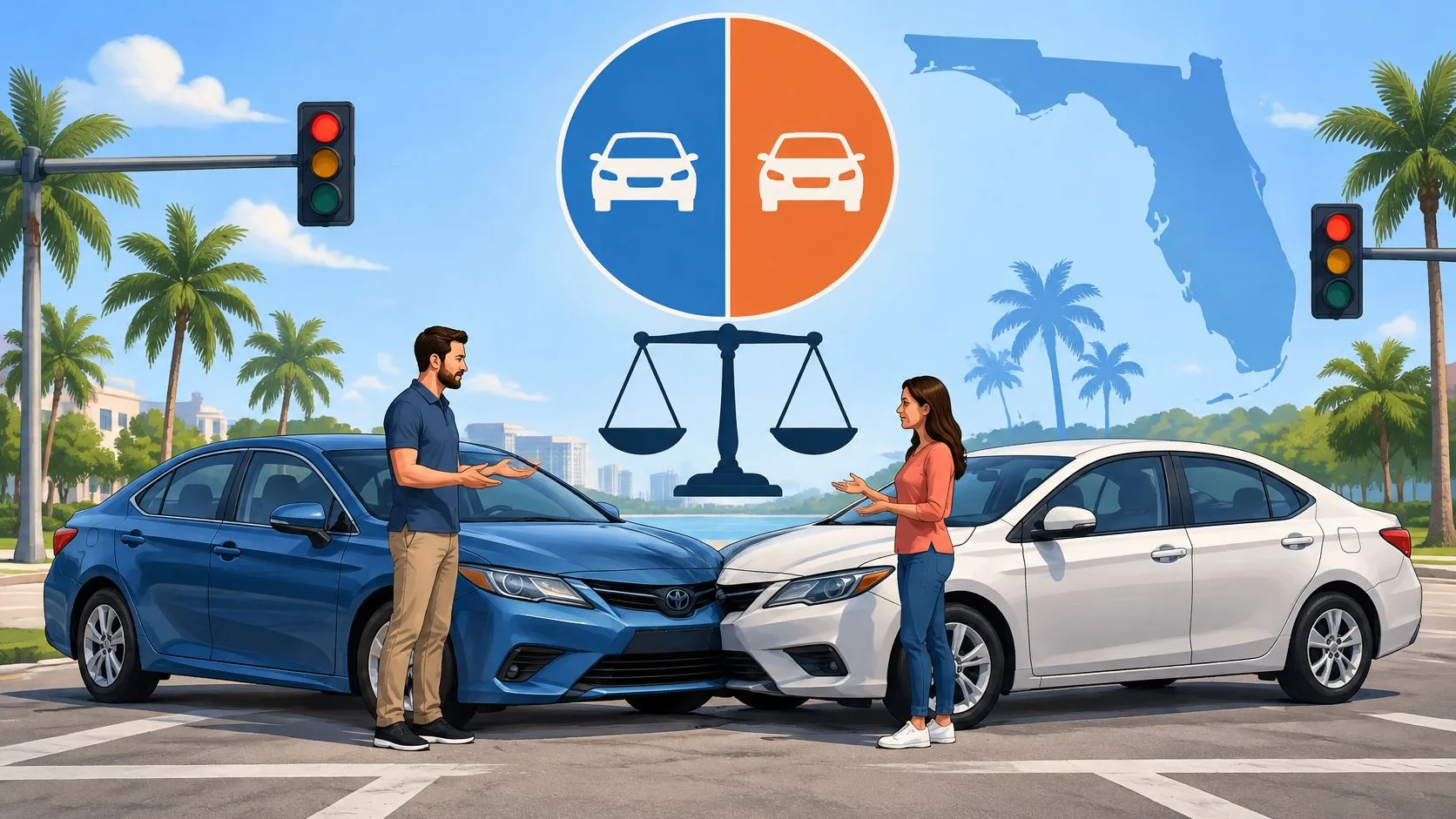
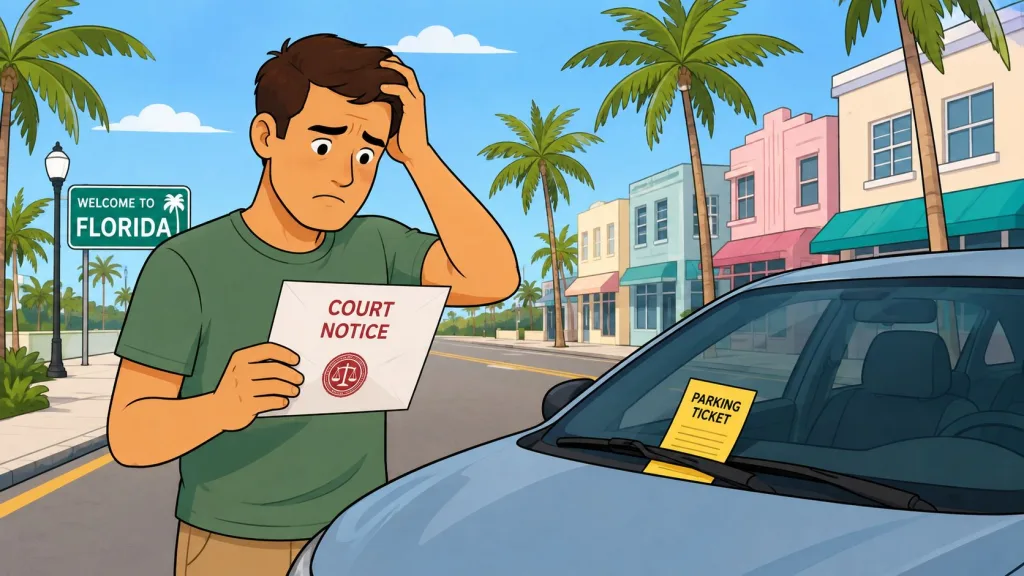
You’ve just found a citation on your windshield, received a court notice, or opened an insurance renewal that costs more than expected. Searching for a driving course in Florida can seem simple until you discover that Florida doesn’t have one universal class for every situation.
Your reason for enrolling determines the right path. A moving violation may point to a Basic Driver Improvement, or BDI, course. A court order may require a more advanced program. An insurance discount follows a different route, and a first-time teen driver now faces a staged education process. This guide helps you identify the correct course before you spend time or money on the wrong one.
Why Florida Drivers Need the Right Course Right Now
A commuter named Daniel gets a non-criminal moving violation on the way to work. He searches for “Florida traffic school,” finds several course names, and nearly enrolls in a teen education program. The mistake would have cost him more than time. His citation requires him to follow the traffic-school process, meet the court’s deadline, and complete an approved course that fits his eligibility.
That confusion is common because Florida driving courses are purpose-specific. The course that helps with an eligible citation isn’t automatically the course for a court-directed intervention, an insurance discount, or a first license. Starting with the course name instead of the reason for enrolling is like choosing a tool before checking the repair.
The four main decision paths are:
- A ticket: An eligible driver may elect a FLHSMV-approved BDI course for a non-criminal moving violation.
- A court order: The court may direct an intermediate, advanced, or specialized course.
- Insurance savings: A mature-driver course may support a discount, but the insurer decides the amount and conditions.
- Age and licensing stage: Teen applicants follow Florida’s newer DETS pathway, while adult applicants follow a different process.
A separate concern often appears after a ticket. Drivers want to know whether their insurer can raise their rate, and the answer depends on how the violation is handled. The practical details are explained in this guide to insurance rate increases after a ticket.
The fastest safe approach
First, read the citation, court notice, or insurer’s instructions. Then confirm the course type, eligibility, deadline, and reporting requirement. A flexible online class can make enrollment easier for a busy driver, but convenience doesn’t replace checking whether the program is approved and accepted for your specific purpose.
Florida-approved online courses are designed for self-paced study, and language availability can make the material easier to understand. The right choice should leave you knowing what to complete, where your certificate goes, and what action remains after the final lesson.
How Florida Driving Courses Work Under FLHSMV Rules
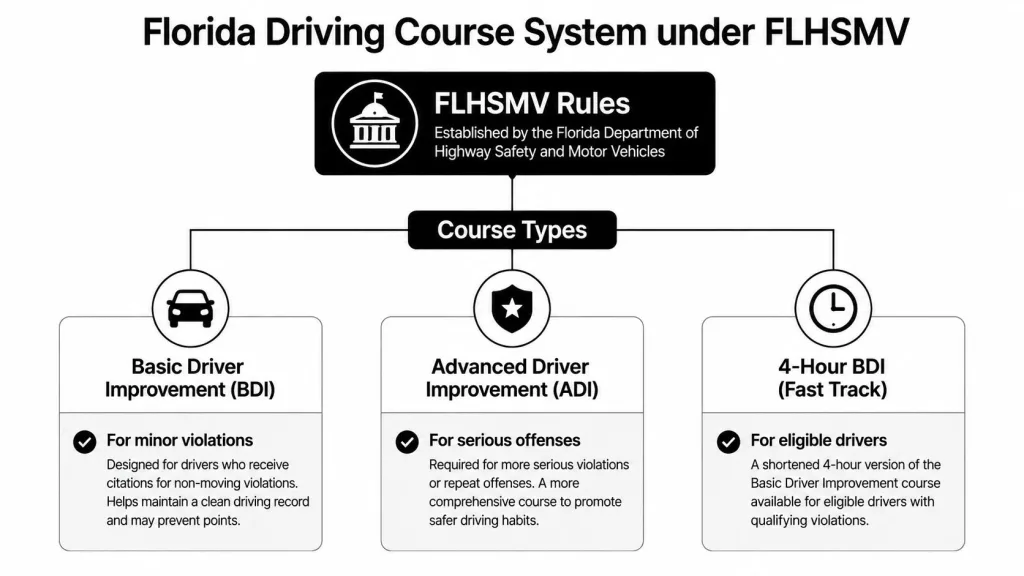
Think of Florida’s course system as a toolkit. Each course has a specific job, and using the wrong tool may not satisfy the court, insurance company, or licensing requirement.
The Florida Department of Highway Safety and Motor Vehicles, or FLHSMV, establishes approval and course requirements. You can review the agency’s role through this overview of Florida Highway Safety and Motor Vehicles.
Level one, a citation-related course
The Basic Driver Improvement course is the usual starting point for an eligible non-criminal moving violation. Florida treats BDI as a 4-hour program, and the course can support citation handling without functioning as a complete retraining program. Its value comes from the legal consequences attached to completion, not from the number of lessons.
A driver must still follow the court or clerk process. Completing a class by itself doesn’t automatically resolve every administrative requirement.
Level two, court-directed improvement
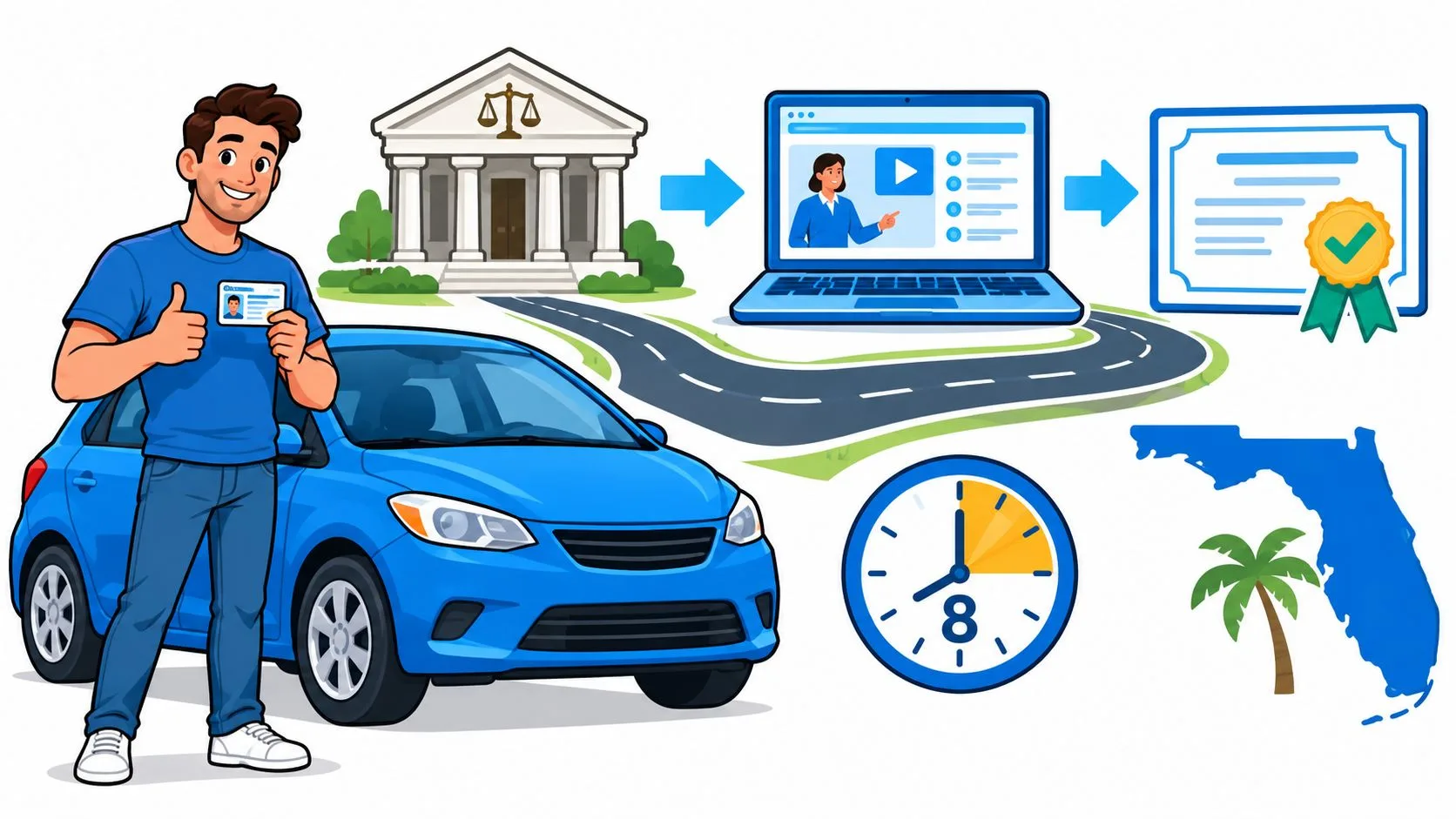
An Intermediate Driver Improvement course is an 8-hour program intended for court-ordered drivers or people directed toward deeper driver-improvement education. An Aggressive Driver course is also an 8-hour program, but its emphasis is behavior, responsibility, and decision-making connected with aggressive driving.
These courses shouldn’t be selected just because they sound more thorough. The order or official instruction should guide the decision.
Level three, age-specific education
Florida’s teen pathway changed sharply in 2025. As of August 1, 2025, a person under 18 who has never held a driver license from another state, country, or jurisdiction must complete a 6-hour Driver Education Traffic Safety course before applying for a Florida license, according to FLHSMV’s DETS requirements.
FLHSMV also states that all new drivers must complete the Traffic Law and Substance Education course before applying for a license. That means a teen applicant may be moving through several requirements rather than signing up for one generic “driving class.”
Online delivery changes the location, not the responsibility. You study from a device, complete the required material, and receive documentation or reporting according to the provider’s process. Before enrolling, match the course to the legal purpose.
Choosing Your Florida Driving Course Type With Confidence
The quickest way to choose is to ask one question: Why are you enrolling? The table below gives you the practical match.
| Course Type | Duration and Best For |
|---|---|
| Basic Driver Improvement, BDI | 4 hours. Best for eligible drivers handling a non-criminal moving violation, point avoidance, and related citation requirements. |
| Intermediate Driver Improvement, IDI | 8 hours. Best for a court-ordered driver or someone directed to complete a deeper improvement program. |
| Aggressive Driver Course | 8 hours. Best for a driver ordered to address aggressive driving, road-rage behavior, or related decision-making concerns. |
| Mature Driver Course | 6 hours. Best for Florida drivers 55 years of age or older seeking an insurance discount course. |
If you received a ticket
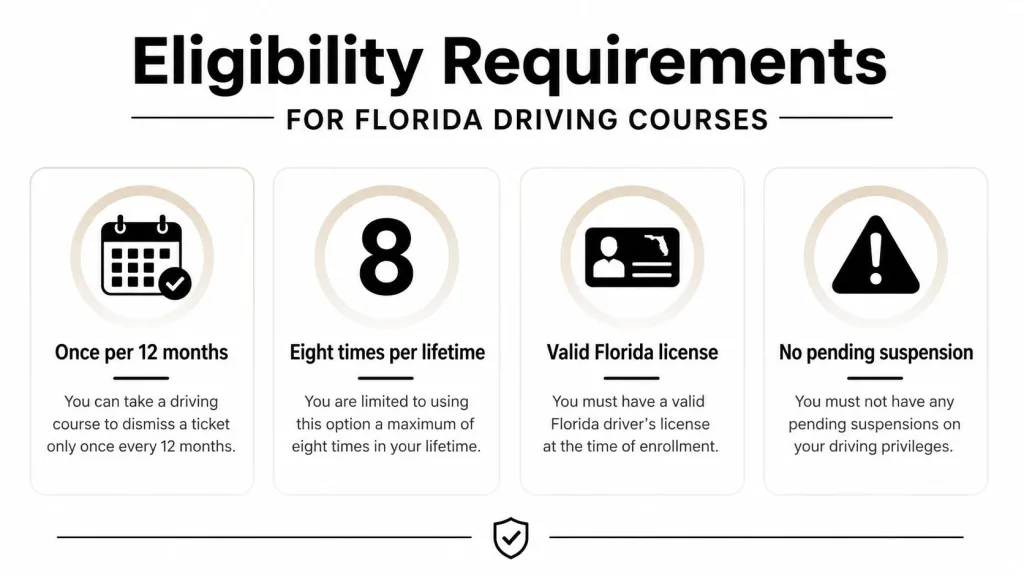
Start with the citation and the clerk’s instructions. Florida permits a driver with an eligible non-criminal moving violation to elect an approved BDI course once every 12 months and no more than 8 times in a lifetime, as described in Florida’s driver-improvement guidance.
The BDI course is a compliance choice, not a general refresher. If you’re a commuter trying to protect your record after a minor moving violation, this is usually the course category to investigate first.
If a judge or agency directed you
Court language matters. An order requiring an intermediate or aggressive-driver program shouldn’t be substituted with a shorter BDI class because both involve driver improvement. Read the exact wording and choose the matching program.
Florida is also moving toward more context-specific instruction. A 2026 Florida statute requires some court-directed driver-improvement courses to address vulnerable road users and behind-the-wheel assessment, showing why a court order can demand more than a basic online point-avoidance option. The relevant background is discussed in new Florida teen driver education requirements.
If you’re seeking an insurance discount
The mature-driver course is a separate choice from ticket school. Florida Statute 627.0652 authorizes the course for drivers 55 and older, and the certificate can be provided to the insurer. The insurer, not the state, sets the discount amount, and the benefit typically lasts three years if the driver has no qualifying crash or moving-violation conviction during that period, according to Florida mature-driver course guidance.
A Florida-approved course catalog can help you compare these options before you register. Review the available Florida driver education courses and select the program that matches your purpose, not the shortest duration.
Eligibility Timing and Limits You Must Not Miss
Enrollment may take only a few minutes, but eligibility rules can determine whether the certificate helps you. Check the limits before paying, especially if you’ve used traffic school before or received a notice with a short deadline.
Florida’s official FAQ confirms two important BDI limits:
- Once per 12 months: A driver can attend a driver-improvement course only once during any 12-month period.
- Eight times in a lifetime: A driver can use the option no more than eight times over a lifetime.
Those limits apply to the driver’s history, not just to the current ticket. A driver who remembers taking a course “a while ago” should verify the dates instead of guessing.
The filing deadline matters
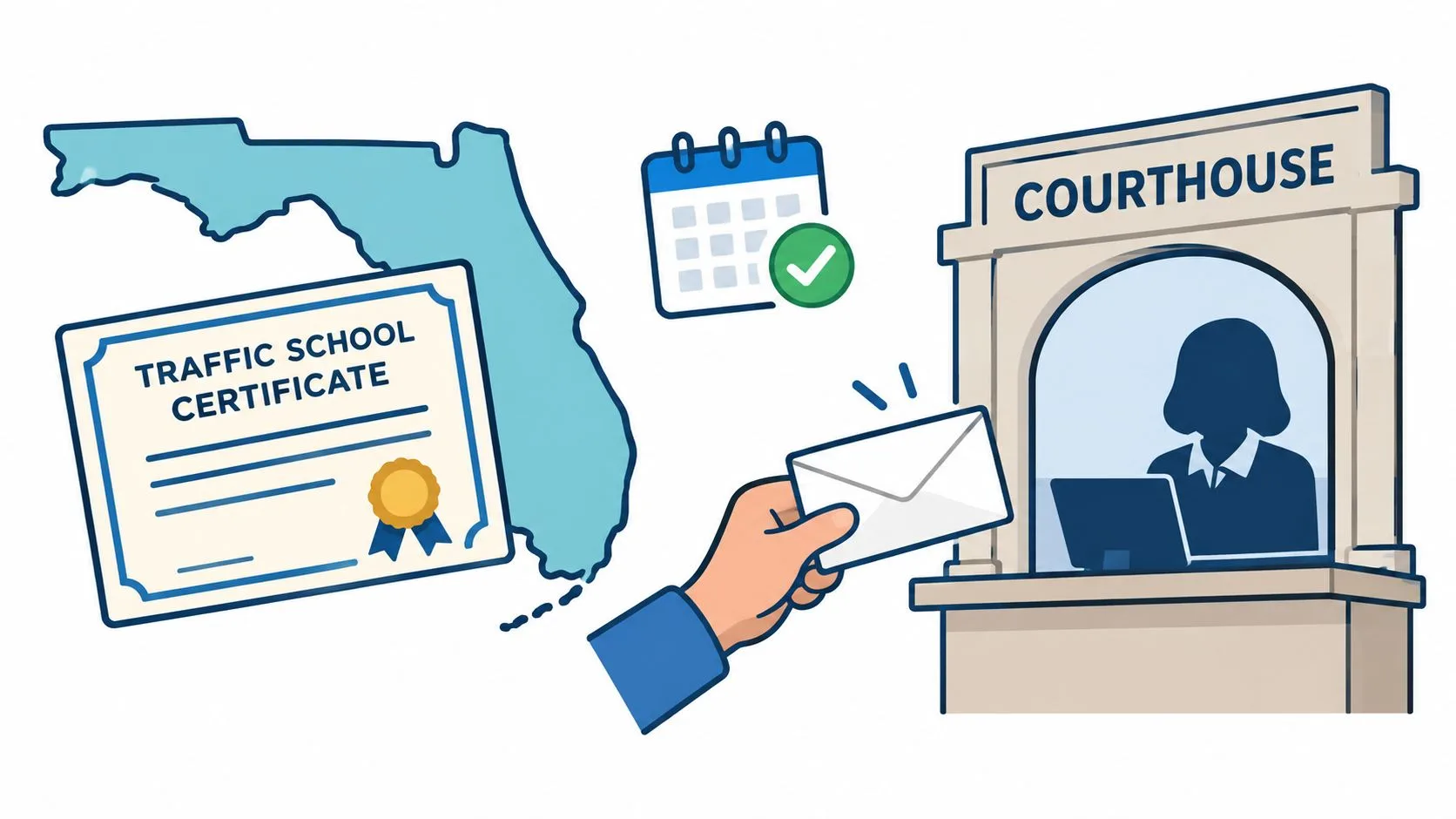
Miami-Dade’s clerk information adds a practical requirement. The certificate must be received within 120 days, and the 4-hour option isn’t available to CDL holders, according to the state FAQ and clerk guidance summarized in Florida certificate validity information.
The exact process can vary by court, so read the citation and contact the listed clerk. Completing an online course doesn’t eliminate the need to submit or report the certificate where required.
Teen drivers follow a different clock
A 16-year-old with a Florida driver license may drive only between 6 a.m. and 11 p.m. A 17-year-old may drive between 5 a.m. and 1 a.m., unless traveling to or from work or accompanied by a licensed driver who is 21 or older, according to FLHSMV’s DETS information.
First-time teen drivers must hold a learner’s license for at least 12 months or until age 18 before qualifying for a full driver license. These restrictions show why “driving course in Florida” is too broad a search phrase for a teen. Age, licensing stage, prior licensing history, and the reason for enrollment all affect the correct path.
Practical rule: Confirm your course eligibility and deadline before you begin. A completed class can’t repair a missed court requirement or an ineligible enrollment.
What to Expect From Enrollment to FLHSMV Reporting
A modern online course should feel like a clear sequence rather than a maze. At BDISchool and DriverEducators, the process begins with choosing the course that matches your ticket, order, insurance goal, or licensing stage.
Step one, select the course
Start at the course catalog and read the purpose of each option. Look for the duration, eligibility description, language availability, and certificate process before creating an account.
Choose English, Spanish, or Portuguese if that helps you understand Florida rules more comfortably. Clear comprehension matters when lessons cover right-of-way rules, following distance, impaired driving prevention, distracted driving, and crash avoidance.
Step two, enroll and study
After registration, you’ll work through the course online at your own pace. The curriculum uses explanations, visuals, and real-life driving scenarios so the rules connect to situations you may recognize, such as a rushed lane change or a failure to yield.
You can study from a compatible device rather than arranging a classroom schedule. That flexibility helps a parent, shift worker, or professional fit lessons around existing responsibilities.
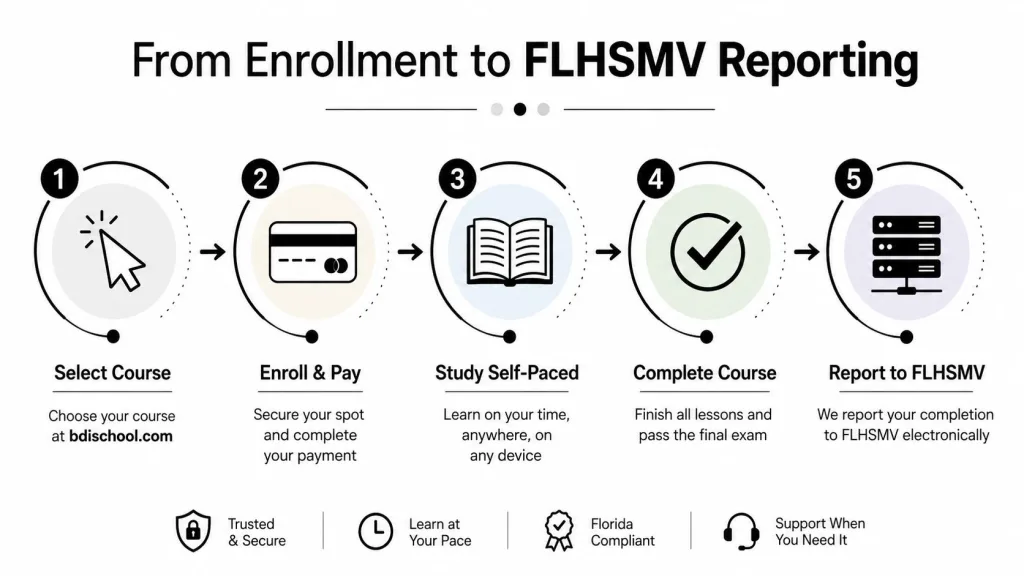
Step three, complete the checks
Course modules generally include knowledge checks and a final assessment. Read each explanation carefully, especially when a question involves a traffic control device, safe following distance, driver attitude, or the effects of impairment.
If you’re taking the class for a citation, keep your court deadline visible while you study. Finishing the educational portion is only one part of completing the legal process.
Step four, receive and verify the certificate
After completion, the provider issues an electronic certificate and reports completion directly to FLHSMV according to its process. Save your confirmation and check whether your court or insurer also requires a separate submission.
Drivers dealing with an out-of-state license or identity documents may need professional help understanding translation requirements. A useful resource is Translators USA driver’s license translation from Translators USA, LLC.
Step five, finish the outside requirement
For a ticket, contact the clerk if the citation tells you to elect traffic school or submit proof. For insurance, give the mature-driver certificate to your insurer and ask how its discount rules apply to your policy.
Before you close the browser: Save your completion confirmation, note your court or insurance deadline, and confirm that the required recipient has received the certificate.
Benefits That Make Your Course Pay for Itself
The strongest reason to choose the correct Florida course is that completion can protect more than your calendar. For an eligible citation, Florida law provides that adjudication is withheld, no points are assessed for that violation, and an insurer can’t raise a premium or refuse renewal solely because of that non-criminal traffic infraction when the driver completes the qualifying course. The official driver-improvement rules explain these consequences.
Florida also reduces the civil penalty for an eligible citation by 18% when the driver elects traffic school, as reflected in Florida Statutes section 318.18. That doesn’t mean every cost disappears, so follow the clerk’s instructions about payment and filing.
Insurance savings follow a different route
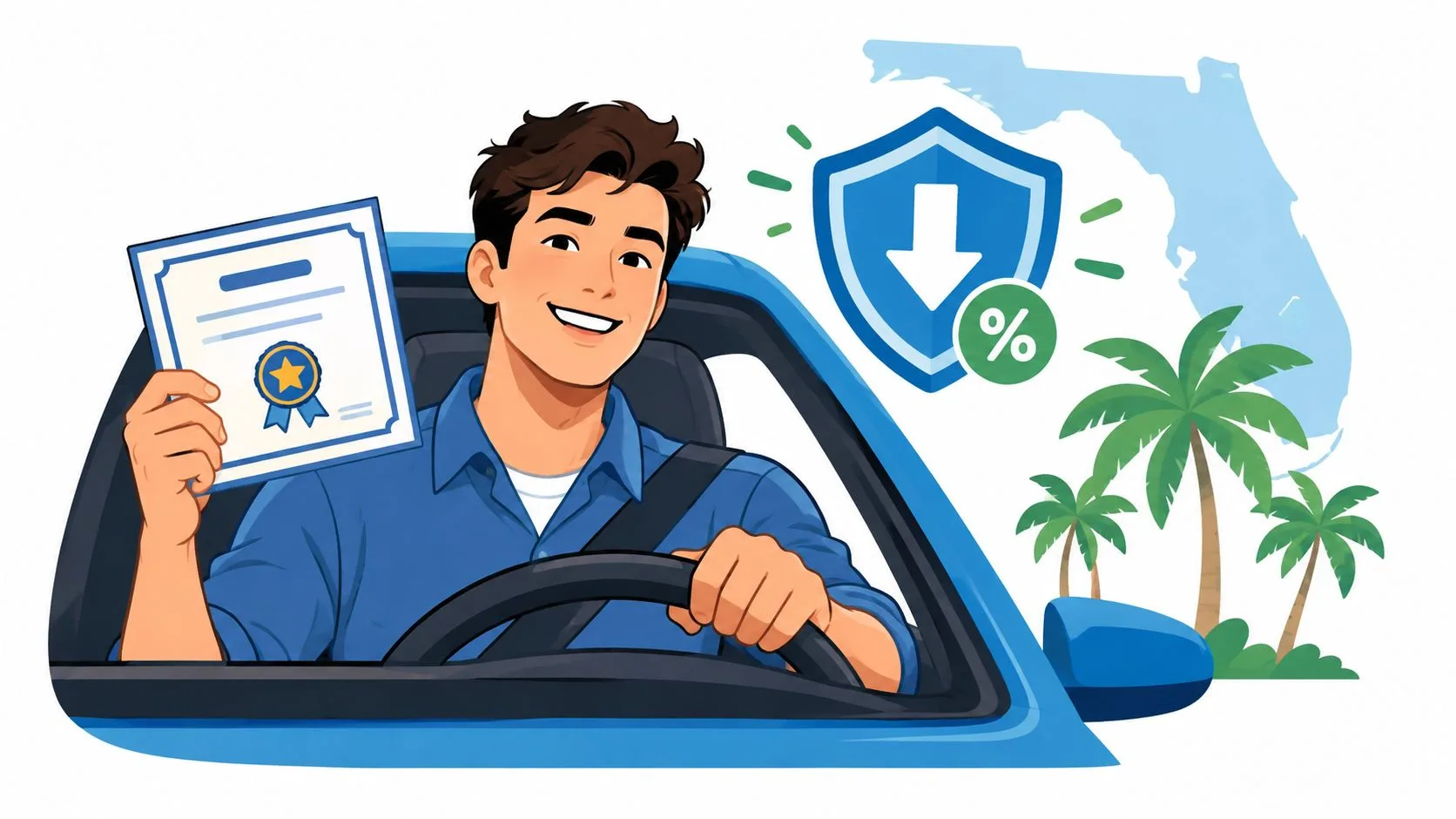
A BDI course and an insurance-discount course aren’t interchangeable. Florida law allows insurers to offer a premium reduction of up to 10% for three years when the principal operator completes an approved course, but the discount is discretionary and depends on approved-course and loss-data criteria, according to Florida Statute 627.06501.
For drivers 55 or older, the mature-driver course may support an insurance discount. Each insurer sets the amount, and the benefit typically lasts three years when the driver has no qualifying crash or moving-violation conviction during that period.
A course can resolve today’s requirement, but defensive habits protect tomorrow’s driving record.
The educational payoff matters too. Lessons on driver attitude, distraction, safe spacing, vulnerable road users, and crash avoidance can help you recognize risk before it becomes another citation. A course updated for current Florida statutes gives you a more useful refresher than relying on memory from years ago.
Start Your Florida Driving Course Today With Confidence
Choose by purpose, then verify the rules. A recent eligible moving violation usually points toward the 4-hour BDI course. A court order may require the 8-hour IDI or 8-hour Aggressive Driver course. A Florida driver 55 or older seeking an insurance discount should review the 6-hour Mature Driver course, while a first-time teen applicant under 18 must consider the newer 6-hour DETS requirement and the rest of Florida’s staged licensing process.
Online enrollment makes the next step straightforward. You can select a state-approved course, study at your own pace, use English, Spanish, or Portuguese materials where available, complete the required assessment, and receive electronic completion reporting according to the provider’s process.
Don’t wait until the court deadline is close or the insurance renewal is already active. Check your eligibility, choose the course that matches your situation, and begin while the details are fresh.
BDISchool offers Florida online courses for ticket-related improvement, court-directed education, mature-driver insurance discounts, and other driver education needs. Visit BDISchool to compare the available options, choose the course that fits your reason for enrolling, and start studying with clear guidance today.